 Cola1973
Nice strawman.
WHAT?!
That works great if the jammer can keep up with the rapidly changing freq. You seem to be under the impression that all of this is occurring in real time, and the jammer not only has had time to process the signal, react to it, and send the altered signal back, all the while ignoring the fact that if the altered signal is on the old freq, that the radar’s signal processor won’t notice. I’m not saying that LPI is NPI, or that AESA performance can’t be degraded. I am saying that you’re greatly oversimplifying the challenges in doing so.
Wrightwing, DECM’s signal arrives AFTER original signal and has always been doing so.
And you want to discuss DECM jammers?? LOL
You’re struggling with radio basics…
What LPI has to do with DECM jamming, apart from requiring different power level?
The big differences between the 2 systems is that the APG-77 could’ve done a complete sweep many times, in the time it’d take for the -63 to conduct 1 sweep. The -77’s ability to detect a target in one sweep is considerably better than the -63. The likelihood of an enemy RWR detecting the -77 is considerably lower. The brains of the backends are in no way comparable, in term of capability.
All this is true, but has nothing to do with your claim that APG77 can do periodical sweep, as something authentic, when it’s not.
Second, APG63 was as much LPI for contemporary RWS’, as APG77 is for today’s and many fanboys here (not only you) permanently compare APG77 to Sirena3, or similar systems.
Cola1973Right throughout the war by radar, in the UK. Germany also had operational radars at the start of the war.
Yes, but I was referring to aircraft installations and it was not until the end of the war that interceptors could operate during night.
Cola1973The radar return would give the Raptor accurate info, as its ping would return prior to an altered return from a jammer.
LOL, Wrightwing, this is why I told you to learn how does the radar work and yet you didn’t.
Of course, the original pulse returns before, the jammed one. So what?
How could it return faster, when both travel the speed of light? 😀
However, DECM (also called, RGPO – range gate pull off) jammers exploit exactly that, to spoil radar’s range finding and target usually appears farther then actually is.
How’s that possible, eh? 😀
What do you suppose the POI is for the APG-63 vs. APG-77, or how intelligent the backends of the 2 systems are, especially considering the fusion between the ALR-94 and the APG-77, and other third party info?
What’s POI?
Anyway, the points you’re trying to push don’t matter, since both systems use same principals.
You have tried to portray APG77’s periodical sweeps as something authentic, while it isn’t and APG63 did that 40 years ago (periodical sweeps), so that’s another false claim.
Cola1973What matters is how far/near you can detect an incoming platform.
What’s your point?
During WW2, detection was performed by eyes and by the end of the war by radar.
This was technically and conceptually much larger leap than today’s switch from mono-static to networked warfare (multi-static/multi-sensor), which enables tracking (for detecting itself, a monostatic LF system is enough) and engaging of such targets.
Whether the B-2 only appears smaller to the radars that are looking for it, is kind of an important detail.
What?
Cola1973So for practical matters(i.e. what the search radar sees), the B-2 appears much smaller, which supports my point. Shape is more important than size.
It doesn’t matter if it’s for practical, or other matters.
You make false claims.
B2 only appears smaller than Cessna but really isn’t, which is precisely the place where will the anti-stealth combat begin and it already did with widespread of networked combat systems.
Cola1973APG-77 has a typical operating
range of 193 km and is specified to achieve an 86 per cent probability of intercept against
a 1 m² target at its maximum detection range using a single radar paint (Jane’s Radar and
Electronic Warfare Systems 2004c, ).
Rafale with weapons under wings would have higher RCS than 1m2.
At what offboresight angle?
What’s a “single paint”? Never heard of that…is it a technical term?
How do you know Rafale has 1m^2 of RCS and how do you know how will Rafale be turned when APG77 starts to illuminate it (temporary RCS), while Rafale’s RWR doesn’t care for that.
Cola1973So a B-2 should have a much larger RCS than a Cessna right?
Larger surfaces reflect better than small ones. That’s out of the question and size iz directly related to RCS, so your assertion is wrong.
Where did you get the idea that an ordinary F22 and F22 that is 5 times bigger, but otherwise identical in shape, will have the same RCS from the same angle, against same wavelength?
Yes, B2’s RCS is much larger than Cessna’s but differently distributed, so it only appears to be smaller.
Cola1973That’s not the point he was making though. The ping will make it back before the signal is analyzed, identified, and the jammer sends a signal of its own.
So?
What’s your point?
If the Rafale were 200km away, it wouldn’t be considered a threat yet, first of all, as the APG-77 prioritizes targets by range, and the amount of time that they are illuminated and subsequently tracked. Secondly, it would take more than 1 ping to correctly identify what the ping was, much less respond to it.
And Apg77 will measure azimuth, elevation and range out of 1 pulse, at 200km against Rafale?
Maybe, it’ll cook a coffee, too.
This shows a fundemental misunderstanding of how the APG-77 works.
I’m longing to hear how does ANY radar work, from you.
It doesn’t send out constant broadcasts to the maximum range that it can achieve. It might do a brief periodic sweep to see if anything’s out there, but until the target gets within a certain distance, its track is only periodically updated. It doesn’t get a constant track until it’s within range to engage.
APG63 worked the same way, 40 years ago.
How’s APG77 special?
Cola1973answer Russia and US have taken tailplanes in the most advanced stealth designs of 2010
Yes well, that’s something else, but you should be aware that F22 was conceived 25 years ago, so it’s not exactly the most modern concept, around.
T50 is somewhat younger, but still heavily dependent on Sukhoi’s years of research, which won’t be abandoned easily, neither.
Anything further leads to speculation and demagogy and it’s best to leave it for other forums.
Cola1973RCS isn’t directly related to the size of the object.
Oh, crap…and I thought it was. 😀 …oh well, I guess you know better…

Cola1973The canards on the Gripen, Lavi and J-10 do have camber, however even a symmetrical airfoil will have downwash, it won`t change that, because As may be expected, symmetric airfoils will have zero lift at zero angle of attack. Thus, a0 is zero for symmetric airfoils. increasing the local AoA of the canard will create a downwash, no matter how symmetrical it is.
Yes well, that’s what I said, not you, so what’s your point?
You came with the idea of level flight and canard downwash killing the lift, in the first place.
Canards may have cambering and may have not one.
It’s pretty obvious that J10 canard’s profile doesn’t follow fuselage “footprint”, so no you can’t deduct cambering from that.
Anyway this is beside the point and the real point you’ve been missing is, apart from permanently and incorrectly quoting documents without understanding, that you assume canard designers are idiots who put enough cambering on canards, so that those blow under the wing??!!
These are the grounds for your entire idiotic anti-canard case and guys from Dassault and SAAB that produced coupled canard-wing system, actually designed their canards to blow under the wings??!!
C’mon Kiwi, man…:D
To that, I can only respond with, what if the guy that designed F16, put it’s LERX stream over the wing root, while twisting the wing towards the tip, to create washout?
BTW, wing has much larger downwash than canard and when a tailed RSS plane’s wing starts to blow into the elevator’s high pressure area (when “contributing” to lift :D), how much such elevator actually lifts and how much is a dead drag and why does an elevator need to be large and strong?
Cola1973Yeah Cola i think the boot is in another foot, the evidence shows they have camber however there is low camber and there is high camber
What evidence? Like the one where F22 has elevators, so they must be better??
Where did you see there mean camber line deviating from chord line in those photos?
With what eyes? 😀
I mean, canards may be cambered, but you most definitely can’t see that.
Get real, Kiwi…more daydreaming, eh?
BTW, here’s a condensed read about symmetric airfoil of an appropriate level.
Cola1973i do see cambering it is easily spotable
Kiwi, that’s not cambering.
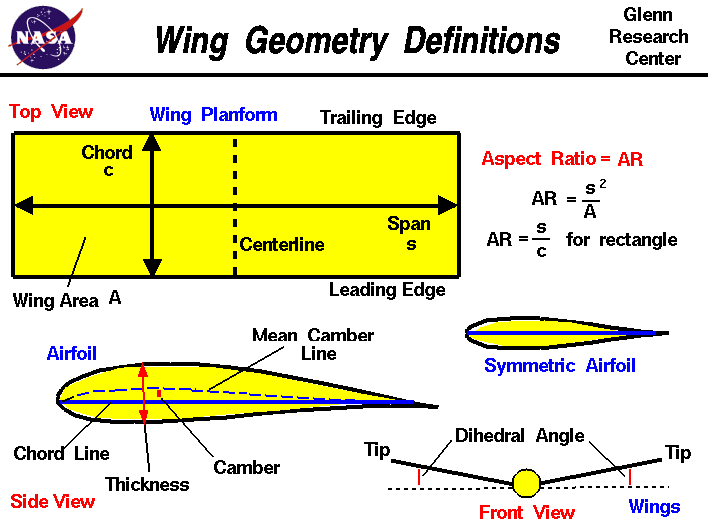
Quick google search and here’s an example.
Symmetric airfoil in the picture is an non-cambered profile.
There were/are planes flying on symmetrical airfoil.
How it doesn’t generate lift, then and moreover you can see the actual camber line from those J10 and Gripen photos??
As I said, you must have 100/100 vision, or be completely ignorant.
Look Kiwi, we can’t argue about basics and if you really don’t get it, how can you discuss canard’s downwash and it’s influence on the wing, then?
It is not basics Cola, it is simply you are wrong, a canard without lift is plain drag, the canard of course was not a Me-109 wing profile but it has camber.
LOL, Kiwi…if I were you, I’d stop right now, but obviously you’re not even aware of what you’re saying.
That’s called a “self-assurance derived from ignorance”, but ok…I mean it’s ok to have opinion, but when it’s so wrong and utterly superficial, better keep it to yourself, because you’re “teaching” others, wrong.
Cola1973Not accurate at all.
If the canard is uncambered them you lose all the stability advantages of a canard you are losing the extra lift ahead of the center of gravity, now you are not even sure if they are cambered or not showing you are just making up an explanation that does not go well with you basic concepts,
Now having a canard that does not produce lift is just adding drag without any benefit just plain downwash and turbulance
Kiwi, what does the cambering have to do with the ability to generate lift?
Cambering only allows a profile to generate a lift at alpha 0°.
Supersionic aeroprofiles like missile’s wings and fast fighter planes have very little (supercritical) to NONE cambering.
You don’t loose the ability to generate lift without cambering, but you loose the ability to generate lift at canard’s alpha 0°.
Those two are very different things!
C’mon man…these are basics.
see this picture the J-10 has a very easily to spot cambered canard
Gripen is the same
LOL, you must have an 100/100 vision to be able to see that from those pictures.
Do you know what cambering is?
So my friend i do not believe your explanation
Too bad and frankly I don’t overly care…however, I don’t want other posters to create a false image of these concepts, so I’m trying to sort this mess of yours, out.
Cola1973The documents are right, the only way it will increase lift is at an AoA beyond 5 degree, when canard upwash vortices re-energize the wing upward vortices but at level flight there is an important reduction of wing lift by canard downwash.
No, Kiwi.
First of all, learn what downwash and upwash are.
Second, when you learn how does the wing work, you’ll understand that it doesn’t matter if the wing is at 0° or 15° alpha, since it produces lift in the same way and that’s the pressure difference.
Once the pressure difference becomes sufficiently small the wing stalls.
So, lower pressure above the wing means air passes over longer route chordwise, meaning it must move faster to “catch up” with high pressure air from below the wing, producing low pressure.
Now, if you have a canard (or some other body) blowing over the wing, what you essentially do is increase the amount of air passing through the lower pressure zone reducing the pressure even further, thus increasing pressure difference against high pressure zone and therefore INCREASE the lift.
high canard achive the best lift but at a higher drag, why? well higher the lift, higher the downwash, this also applies to canard deflections, which increase the lift coefficient of the wing but at the same time downwash.
You don’t get it…Look, first of all, control canards like Rafale’s, Gripen’s etc, are most probably not cambered at all, meaning they have no lift per se, at alpha 0° and therefore no downwash.
This is why I emphasized difference between Viggen’s lifting and Eurocanard’s control canards.
So, such non-cambered canards produce lift only during alpha increase and their wake behaves differently than normal cambered profile’s.

Now, check where the tip vortex from even as low canarded plane as the EF is, blows.
It blows way over the stagnation point.
Low set canards will shed their upwash at the bottom of the wing at high AoA therefore reducing lift.
EF doesn’t even have a problem with this, so where should those canards be put to kill the lift?
Below the wing level?
Never saw that, except in F16AFTI, but those were way below the wings.

Some sweptback and forward swept wings use wing twist do reduce downwash effects.
Ok, slow down…
Wing twist is something completely else and is used to manage stalling characteristics and is present in all wings beginning in 1930s.


 Sign In







