ppp
pppJudging from facts alone, Neuron is not french. Its European.
Dassault main contractor 50% because french gov, pays well to the program (Master builder, Overall architectures & design, Flight control system, Final assembly and Global testing (static & flight) )
Saab 25% (overall design, Equipped fuselage ,Avionics, Fuel system, Flight testing)
Alenia Aeronautica 22% (Weapon firing system, Smart Integrated Weapon Bay, Air data system, Electrical system, Flight testing)
EADS CASA, EAB, RUAG, Thales and EADS gets smaller shares.
As I said, the French will make sure Dassault get the critical design work.
pppThe author of that article seems under the impression that everything Iran procures must be for sinking super carriers else must be a joke and worthless. The idea that Iran might do 😮 recon 😮 or want to patrol its shores doesn’t seem to be considered, not the idea that Iran might think about threats other than a full scale US invasion 😮
The Iranians using a weird aircraft comes as no surprise though 😎
pppThis is an argument in which I’m strongly interested. This is what I think:
– I don’t think that any major european aerospatial industry is actually in danger. This because every country with a military spending big enough to mantain an indipendent industrial base will strongly prefere to buy an home-made aircraft rather than a foreign one. Those firms will remain profitable as long as the defense spending in UK, France, Italy, Germany and Sweden will remain big enough to pay for home made product or for some cooperative development.
– We are not in an US-style world, where we have some 4-5 private owned firms that compete for a single project. Here in EU each major country has just one firm, strongly connected with the goverment and always (BAE apart) state-owned.
– this situation is inefficient compared with the US one (that is, with the same input EU will have a lower output than US), but is the best one we can achieve given the fact that EU has not, unluckly, an unified air force. In fact if you allow free competition, you will just end up in killing the european industries and buy american.
IMHO the solution (ideally of course, I’m perfectly aware we will not see this for decades) is FIRST to make a single EU airforce and THEN allow EU firms to compete in this market.
To answer at your question:
1) We miss an opportunity by buying the F-35 (italian navy apart, but some 20 F-35B could just be bought off the shelf). The next train is a six generation manned fighter-bomber and/or an UCAV. Both will be stealthy and both, I strongly believe, will be made by some sort of european consortium because…. errare (in being fooled by F-35) humanum est, diabolicum perseverare :diablo:
2) Aircrafts sales are only minimal driven by pure economical aspects. As long as european countries could afford to develop home made aircrafrs and as long as they have the political power to have other countries buying their products, I don’t see any problem
3) With time. Also the US developed stealthy aircrafts from scratch and knowledge in EU is actually not zero (Neuron, Talarion…)
4) In 15-20 year…. if we will not be fooled by another F-35 of course :p
5) I’m not sure I’ve understood correctly your question, however… there’s no need to start the development of a new aircraft now and, about EF-2000, it will have Meteor, it will have AESA, it will have TVC.. this are all things that actually flew on EF-2000. And then, in the medium term, it will have a major MLU. With 700+ aicrafts that will be produced without counting India and Japan, do you really think development will be stopped?
Cheers from Italy
A European Air Force could be a good idea for the Europeans, but I don’t think we will ever see the UK as part of one, nor do I think it would be a good idea for the UK to join with the European’s air force. In any case, there is little fairness or unity in the EU, they all have their own agendas. Industrially, expect the French to try and work it so that all the other European countries get subcontracts from Dassault (as per the future European fighter programme!). Sooner we are out of there the better IMO 😎
The European Air Force have never been technology leading, apart from the French. The French are well set with Rafale, the other will do with Grippen and Typhoon (or even up-dated F-16s) till 2040. Then they will either buy American or Russian planes. The European industry, French apart, has failed to deliver state-of-the-art aircraft in the past and with no budgets to use and an already huge technology gap to Russia, China and the US they surely won´t be able to built a 5+ generation fighter in 2030. The current fighter will be the last manned combat aircraft built in Europe.
Some non-French technological leaderships in EU/UK:
-> Longest ranged fighter radar? That’ll be Typhoons CAPTOR
-> Longest time in the air for a UAV? That’ll be Qinetiq Zephyr
-> First stealth UCAV demonstrator produced? That’ll be Taranis
-> Most capable naval radar? That’ll be Sampson
-> Most powerful fighter engine? That’ll be the XG40/EJ200
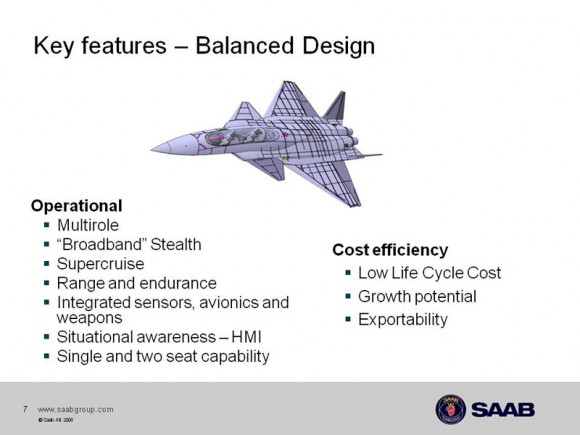
Why you want to rule yourself out when you have the 2nd canard + stealthy design?
I wouldn’t really call that a design. Its more of a conceptual sketch of what SAAB would like to design. The closes thing to a design is Neuron, but the French, judging from their previous actions and demands in these programmes, will have ensured 95% to 100% of the design work was done in France, not Sweden or Greece!
pppSounds like a good idea if it is truly green (and not just “green” on paper by damaging the environment in a different way!). I’m not too sure about the extensive use of a nuclear powered ships though, if one of them gets hit with a decent size munition its going to make one hell of a mess.
I said: SIMILARLY EQUIPPED units.
I think you are missing the point. I’m interested in comparing the fuel economy of e.g. Leopard 2 versus M1A2, Marder versus Bradley etc. much like the fuel economy of US cars versus European cars and the per household energy use in the US versus in Europe. In Europe, for example, energy prices are higher than in the US (due to fuel tax among other things) and so there is a bigger incentive to be fuel efficient, which results in a more awareness of the need for energy efficiency and more fuel efficient cars and better insulated housing (less heat loss).
Besides, you are overlooking the fact that US troops overseas are also (to a substantial extent) resupplied from US bases in Europe where equipment and ammunition have traditionally been stored with a view to Soviet/Russian threat > Germany (close to 55k-60k US personnel there) + UK (close to 10k US personnel there) > equidistant.
http://en.wikipedia.org/wiki/File:US_military_bases_in_Germany.svg
http://en.wikipedia.org/wiki/List_of_United_States_Army_installations_in_Germany
http://en.wikipedia.org/wiki/US_military_bases
http://oilprice.com/Geo-Politics/International/The-Afghan-Problem-Logistics-Re-supply-Growing-Violence.html
http://www.nato.int/docu/logistics/html_en/logistics07.html
http://www.nato.int/docu/logistics/html_en/logistics03.html
http://www.nato.int/docu/logistics/logistics-e.pdf
Just tax I think. Still, its going to go up with the rise in VAT to 20% in Jan! There are no army forces in the UK, just airforce. Any army in the UK will be either small numbers of specialists/higher officers or those there for exercises.
In any case, in terms of fuel they could just buy it from the nearest willing supplier in the nearest willing country. No need to use American fuel, its all the same stuff!
In ~1992, there was a report comparing USMC and US Army airlift needs. It compared similarly-equipped & manned combined infantry/armor units, and found that the US Army’s list of “required equipment” would use ~30% more airlift than the USMC’s list.
The main difference was not in the combat equipment, it was in the other stuff…
the USMC would bring basic tents with folding cots while the Army wanted ones with floors, heating & air-conditioning units, and metal bunks with matresses;
the USMC would bring a minimal field kitchen while the Army wanted a “portable mess-hall” (specialized tents to eat in, full-up stoves & dishwashing equipment, etc);
the USMC would bring the absolute minimum of administrative personnel & equipment while the Army wanted to bring the full admin sections with field offices;
the USMC planned for minimal R&R gear while the Army wanted a field gym, etc;
the USMC had basic shower-tents & field latrines while the Army wanted trailers with showers & water heaters, other trailers with proper lavatories, etc.The difference was summed up as:
I think it would be fairer to say the USMC goes to fight a short war, the US Army goes to fight a long war, but they both certainly go to fight a war.
I guess all that does make a difference… I would not be suprised about those types of things in the UK or Germany or Japan but was suprised that those porta-cabin barracks had pizzahuts and mcdonalds in afghanistan.
No wonder people are still trying to develop autonomous cargo airships powered by solar panels.
I believe he is referring to the bases in the UK, which have a crispy creme and cheap fuel amongst other things IIRC.
pppWell considering that the Super Hornet already carries the JSOW, JASSM, JDAM, SDB, Paveway, SLAM-ER, Maverick, AIM-9X, AIM-120C/D, Harpoon, HARM/AARGM, etc…, money could be saved on duplication of weapons.
How does this save on duplicating weapons?
pppOh, that is a catch.
When is Rafale production expected to close ?
(assuming no more orders)
2023 if the French order the full 286 aircraft, but its quite possible that the French will not order the full amount. Even based on the 2023 figure, the line won’t be around when MLU F35 production takes place so the UK order is going to need to be in one, around the time we would make our main F35 order. Of course if the Rafale were an amazing export success then its line would stay open for longer, but its failed to sell so far, and so the chances of a long term Rafale line are slim. The fact that the French can’t shift it, even with the extremely generous deals they are offering buyers, also suggests its a bit of a paper wonder and a procurement we’d be better off steering clear of. F35C offers the ideal solution for the RN IMO, and Typhoon for the RAF, though obviously F35C will be a part of both. SH is also none too good an idea, considering it will leave service before the F35.
pppUSN Super Carriers won’t be able to stay close to the Amphibious Forces only for a very brief period. So, they would be extremely vulnerable to enemy fire and defense less without air support. In short the USMC cannot live without the F-35B.
The whole point is the loss of the F-35A would not impact the USAF or any other Landbased Operator. As they can use F-35C’s or even F-35B’s from Airfields. The Reverse can’t be said for the F-35A. Which, is why it’s the only type that could be cut. Without impacting any other service!
The F35Cs can fly in fropm further out. There is no real need for organic fast air from LHAs, its a complete waste of money. Much better would be to have battlefield support from attack helicopters. The aviation focus needs to be moving the assault forces ashore, which means transport helicopters. Fast air just soaks up logisticals for no real benefit.
pppWhich version to cut? The F35B, no question. The USMC fast jets are “nice to have”, but a bigger carrier/airwing fleet would be better, and it would force the two to depend on each other. The F35C is the most important version in that most of the US power comes from the CVNs, and the aircraft from them are equally capable of being land based. In fact, an all F35C fleet for the USN and USAF would be great, but its not really economical, so keeping the F35A and F35C makes sense. As the Superhornets leave service, it might be a good idea to standardise on single USN type (F35C), easing logistics on carriers (sea force being where logistics is going to be the hardest) and driving down the cost of the SH replacement.
pppHow many F-35C was it UK plan to embark on the new CV again ?
Nicolas idea is worth looking into, but around 20 Rafale is more appropriate.
The F35 will most likely be bought in batches, this can’t be done with Rafale as the production lines will close, so our Rafale order will have to include any potential second F35 batch quantity, plus reserves, making for a much larger up front cost when we can least afford it. With the F35 the opportunities for cost saving are much larger, we can save on a OCU and we can push procurement into a second batch of F35C-V2, 10 or 15 years down the line.
pppAnother guy with an agenda. We’d be better off leasing extra Typhoons, at least we would have workshare and help our own domestic industry. With regards to price, when we send billions off to the USA, that does not come back to the treasury, and this need to be considered when talking about the real cost of large government contracts.
In some aspects, yes. The APG-79 flies or should i say scans rings around the pulse dopler CAPTOR and the pylon configuration plus the radar makes it bit more suitable for some missions than the Tornado GR.
Reforming 800 and 801 with leased supers (probably block Is though) at Oceana or Cherry Point and putting them into CVWs wouldn’t be a bad idea. You’d have a veteran corps of aviators and crews by the time the F-35C and the QEs come into service.
Typhoon has an AESA coming so that doesn’t really come into it. We aren’t in any urgent need of AESA equipped aircraft.
As for leasing American aircraft, then paying for the pilots and giving it all to the USA for their use for a decade doesn’t really have much benefit for the British taxpayer. Would be a great idea from the view of an American taxpayer though, we buy an airwing from your industry, then give it to you, saving your taxpayers money and giving your people jobs. The current situation where we send the pilots to get training and experience, and the Americans pay for the aircraft, is a much better idea 🙂
pppTornado is next.
pppNo thoughts on a name. Hopefully there are no major issues that crop up and cost even more, probably will be though. On a side note, I can’t believe we awarding contracts to the US whilst they continue their assault on our largest defence contractor (BAE), and one of our largest companies (BP).
Also, will it still have the QQ Tigershark?
pppGripen without a doubt.
pppThe best form of defence is offence, so a good defence would be to give the Argentinians something to really fear. The best, and easiest idea, is a blockade until they give the islands back. That doesn’t mean blocking all traffic, just declare all shipping to/from Argentina within a certain distance of Argentina as a target, and start sinking a couple, the insurance costs alone will do 90% of the job for us. Maybe mix in special forces raids on some of their most important infrastructure. Another idea could be to start taking out their power stations, once their population starts to suffer they’ll soon see the error of occupying our territory. Hydroelectric ones are an ideal target, and they have 12 for us to destroy. When the Argentine civilians start seeing consequences of their government actions against us, they will soon decide that the Islands aren’t worth it.
They could be used for attacking the Falklands, reality is though, they’ll end up using them for peacekeeping and in natural disasters, both of which are really in our interests.
I was about to ask about rapiers and it would not be a disaster- in less then 18 hours the RAF could have another gaggle of 4-6 typhoons there and maybe a squadron of SAS-so no real strategic problem
Or a transport plane full of marines, paras or the like with heavy weapons and another with food and ammo. As is, the current base set up means the Argentines will pay a very big price in military lives in launching an attack on the Islands.
pppI thought the CVF’s will be going the CTOL route now that the UK has decided to purchase the F-35C rather than the B? If the F-35B and C(?) did get cancelled, so I suppose they could buy Rafales or Sea Gripens. But I do not think the F-35C will be cancelled… The F-35B on the other hand may…
Its not about the UK carrier, it just happens to be a topic started by a British poster. As you say, the British are going for the C version. Just a side note, the C version is CATOBAR (Catapult Assisted Take Off But Arrested Recovery), B is STOVL (Short Take Off Vertical Landing) and the A version is CTOL (Conventional Takeoff and Landing)


 Sign In