 Grendel
I mean the Me-109 is the obvious choice, but i would have thought that the narrow track undercarriage would have made it very unpopular.
Take notice that the Spitfire’s gear was even narrower than 109s, and yet it was put into a carrier role. With the enlarged wings and strenghtened gear the 109T would have been a much safer plane for carrier operations.
In their tests the Germans did several hundreds of catapult launches and carrier landings to carrier sized fields with catapult trappings, with little problems. One interesting design detail is the hook positioning, which was better in the 109T than in Seafire. Seafire’s hook caused many nosings and broken props in CV landings, while 109T did not suffer of similar problem.
In real operations the range of 109T would have been quite insufficient, though, and I don’t know whether they had fuel drop tanks in the T model, or if the catapult lauches were done with tanks.
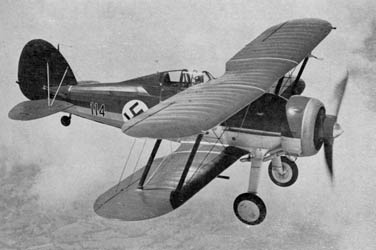
GrendelIt’s not a swastika at all (I’ve forgotten its name, however).
Also, don’t the arms point in different directions?
It is a swastika, just like the Indian and Asian swastikas are swastikas. And the Finnish word for it is also same. But not a Nazi swastika, just like the Latvian swastika was not one. The differences are the rotation and color (usually, generally blue on Air Force, black on ground vehicles), and of course the history – taken into use in 1918 and still in use today, though not as a national insignia in the vehicles themselves for the well known reasons.
As example, Latvian AF insignia 1918-1940, Red swastika on white background, at 45 degrees. Used until the Soviet invasion of Latvia 1940:
GrendelA Hurricane with Swastikas…a chilling vision of what might have been…
This is no “what might have been” but “what was”.
This plane flew in WW2/Continuation War against Soviets in this form, after having bought from Britain in 1940, and is credited with 2 and half aerial victories. Other British aircraft that flew in Finnish color, wearing Finnish swastika (or Von Rosen Cross as we tend to call it unofficially), are Blenheims, Lysanders and Gladiators.
See:
http://www.sci.fi/~ambush/faf/fighters.html#Buldoggi
http://www.sci.fi/~ambush/faf/fighters.html#Gladiaattori
http://www.sci.fi/~ambush/faf/fighters.html#Hurrikaani
http://www.sci.fi/~ambush/faf/bombers.html#blennu
http://www.sci.fi/~ambush/faf/recon.html#Lysander
GrendelMore photos of the Hurricane etc, from the “Defence & Security Fair 2005” that had very sizable Finnish defence forces presentation. As well as the Hurricane the Finnish Air Force section had a WW2 fighter pilot as visitor each day giving a n interview to the audience:
http://www.byterapers.com/~grendel/photos/mp_messut_2005/index.html
Example:

Pictured: the 32 victory Curtiss Hawk / Messerschmitt 109 pilot Kyösti Karhila.
GrendelAnd some older photos of mine of the same plane:
http://www.virtualpilots.fi/feature/photoreports/helsinginpuolustus2004/
GrendelMost in Finland are ok with the Brewster at Pensacola, even the veterans who flew the Brewsters, as they’re taking good care of it and retain its history.
It belongs to them, that’s it.
It would have been nice to have it here, but it is better to have the BW at Pensacola than having it rusting to pieces in some shady storage.
GrendelWow! All the veteran pilots I know have flown with a Viima in their training. It is great to see one still in the air.
Could I ask a service? Could I have full resolution versions of these photos? I’d print them to photo paper and deliver the photos to the Finnish war pilots’ association chairman, the photos would be passed from hand to hand in the war pilots’ next meeting. I’m sure the photos would bring them many happy memories.
My address is jkauppin at jmp dot fi
Cheers,
Jukka
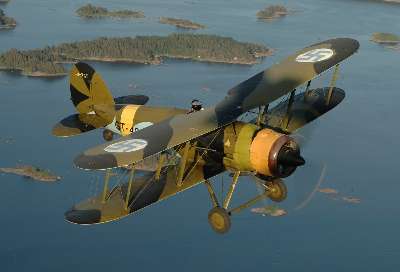
GrendelUpdated with some more photos:
http://www.virtualpilots.fi/feature/photoreports/gauntletflies/
GrendelI got permission to publish the photos on Virtualpilots’ site, so they are now available here:
http://www.virtualpilots.fi/feature/photoreports/gauntletflies/
Example:
GrendelTwo new sets of photos added. Check them at:
http://www.byterapers.com/~grendel/photos/adex2005/
Some thumbnails:


GrendelGarryB
Of course they never overflew the USSR, instead they operated just outside the border. Nevertheless, MiG-25’s attempted to intercept the aircraft on numerous occassions and failed every time.
Incorrect. There are successful SR-71 interceptions by Russian MiG-25/MiG-31 pilots. It’s hard but not impossible. The nicest descriptions of one such encounter was by a Russian pilot of the Northern fleet, in Murmansk area, how he had positioned his MiG below the SR-71 and could see the spyplane above him. He flew some way below the SR-71 for a moment to “finish” the intercept, then returned home.
GrendelAs for JägerMarty’s claim for Finns having had a well trained air force compared to Russia, well, maybe, but in the beginning of the war at least the Germans did not have any part of its training. I remember the late head of CAA Finland K.J. Temmes, ex MS.406 pilot himself, once saying that in the war between Russia and Finland there were two bad Air Forces against each other.
At work, not going into lenghts here, later maybe 🙂
The training varied a lot, to what I’ve understood. LLv24’s pre war cadre was definitely very well trained and motivated group. They had had the luxury of time, good trainign and even “sparring” in peacetime with Soviets just before the war broke out (source: Mauno Fräntilä’s interview). They did also train younger pilots well.
Training was different in different squadrons. LLv32 was, to all my sources and interviewed vets, a good place for young pilots because their CO did all he could to train the young pilots. Training was very systematic. LLv24 was quite similar. But then there were also squadrons,where young pilots got little to none training from the older pilots.
GrendelCool stuff. Thanks for sharing.
Anything about Finn experience with the Hurricane?
Here:
http://www.virtualpilots.fi/hist/WW2History-Ilmasotakoulu03English.html
Careful, though, he didn’t really like it, mr. Siro preferred his Fiat G.50.
I got plenty more from Siro, but that material isn’t even on paper yet.
The other Finnish Hurricane pilots aren’t available for interviews anymore, unfortunately. Two of the chaps, who brought Hurricanes from Britain in 1940 and were in RAF’s training are still alive, but in too poor condition for interview. But here is a great story about their trip to Britain:
http://www.virtualpilots.fi/hist/WW2History-HC-English.html
A: Pinkham was a skilled trick pilot, right? He came to me one day and asked if we’d have the contest that afternoon, and if I want to fly in front or behind. All the same to me, I said. We agreed on the matter, and I went out to tell the guys that Pinkham had challenged me to a contest. Paavo Aikala went nuts, goddamn you’re not going there, it was agreed with him and Pinkham has confused our names, Aikala and Alitalo. So Paavo was the one who flew.
M: Pity they didn’t have the drag lines for Aikala to pull, inverted with the tailfin.
A: It was fun time, when we flew. There were no flying of flag, giving signs or shouts of any kind. When we left from the hangars, we started from two sides of the field, gathered downwind and took off in order. Same thing with landings, so it went fine. There were British students too. Once Jussi was on the field with Pinkham, when a HC came with the propellor set on steep angle, gear and flaps up, and landed on the field. The plane ended up near the hangar wall. “Let’s go and see first,” said Jussi. It was a Canadian who emerged from the plane.
Jussi patted Pinkham on the shoulder and said, “your boy!”
GrendelHere’s some my interviews with Curtiss pilots:
http://www.virtualpilots.fi/hist/WW2History-JarlArnkilEnglish.html
http://www.virtualpilots.fi/hist/WW2History-MaunoFrantila2English.html
http://www.virtualpilots.fi/hist/WW2History-KyostiKarhilaEnglish.html
http://www.virtualpilots.fi/feature/photoreports/overdose2002/
Mr. Jarl Arnkil on Curtiss:
– How did Curtiss do against different Russian planes?
Well, in the Karelian isthmus we flew against I-16s and I-153s and we did quite well. There were no IL-2s or Pe-2s at that time. But like in there, it was tough to shoot down an IL-2, because the pilot and gunner sat like in a bath tub with a damn thick armor. Pe-2 was a bit too slick. Pe-2 flew many times over the western bank of Aunus isthmus. I don’t know where they flew those reconnaissance flights. They kind of came down over the west bank, following the shoreline of lake Ladoga. We caught some of them there when we happened to be around at the right time. But if you started to chase them, you couldn’t catch them.
– It was that much faster?
Yes.
– Then against these newer fighters?
Well, they were… I didn’t fly anymore because I was an intelligence officer. But when we encountered Airacobras, La-5s and so on, we were in trouble. Like in that story, Colonel Rekola had agreed with 6 AK that we should avoid dogfights so that we could help the ground forces with reconnaissance flights. So that we would not waste the last Curtisses we had.
– Not necessarily related to Curtiss, do you remember which was considered most dangerous opponent, Airacobra or Lagg?
My opinion is that Airacobra was more dangerous.
– On what basis?
It had a bigger cannon, I think it had a 37 mm cannon and it was pretty fast.
– How should you dogfight with a Curtiss? What kind of maneuvers did you use?
For example in Suursaari, where we had a lot of Russians going around in a Spanish circle, we could get them by diving after a plane and then pulling up again. Then attacked from above again. We chased the last plane, a Tsaika, with Manu Fräntilä. That guy either had a really flexible neck or he was sitting backwards in the cockpit. He was like an owl. Whenever we got him in our sights he kicked the plane to the side. We should have attacked from below, but he was hugging the treetops, so we couldn’t get him from there. We got him in the end anyway.
– It was normal pendulum (zoom&boom) tactics then?
Normal pendulum, yes.
– So, Curtiss pilots didn’t develop any own tactics adapted specifically to that plane type?
Guys had to fight quite fierce dogfights with it too. Sometimes the Russians had really superior numbers. Now I remember one time when I was somewhere there – more and more Russian fighters came in from near Lotinanpelto. I think we had five or six planes in the air and they started to call for help, because the density of Russian planes started to become too high. But we bagged that situation too. They were in a furball. And once someone even had a dogfight against some Lagg above our airfield.
– You mentioned that it could turn well. How fast was the roll?
Yes, it was…
– So you could change directions quickly?
It was quite agile. Very pleasant to fly.
– How about the armor in Curtiss? Did it have a back plate?
It only had a back plate.
– Was it standard equipment from the beginning or were they installed later?
I think it was standard equipment. FR (Fokker D.XXI) didn’t have a back plate. It was installed in Tampere (State Aircraft Factory) and then the fixed head plate was added. The armor consisted of two pieces and we lost one pilot during training in Siikakangas. He was doing aerobatics and lost control while doing a loop – or immelmann – at high altitude and crashed into a lakelet. We wondered what the hell happened, because he was pretty high when he lost control. When the war began, we installed the machine guns and started to adjust them. The tail wheel was lifted on a barrel and the weapons were adjusted. I don’t remember who it was, it might have been the squadron commander himself, who tried to raise the seat but it wouldn’t move. The back plate should have risen in front of the head plate, but it didn’t. It jammed against it. We inspected the problem and noticed that the seat brackets had almost broken off. That’s when we realized what had happened to the unfortunate pilot. His seat fell on the control cables when he was pulling an immelmann. It was an uncontrollable situation. The control cables ran beneath the seat. The airplane factory had not noticed that when you add armor to the seat, you also add quite a lot of weight and the brackets should have been strengthened too. I think we had many similar accidents.
– How rugged was Hawk considered by the pilots, in respect of structure stress or damage endurance?
I felt it was a sturdy plane. The worst spot was the gas tank behind your back. You didn’t want any bullets to hit that.
– It wasn’t protected? It wasn’t self sealing?
No, it wasn’t. Pretty big tank right behind your back.
– Were self sealing tanks then later installed by the Finns?
No. That kind of advanced contraptions were not installed in these planes. They remained as they were received from Germany. We only got the bigger guns, 12,7 mm.
– There is a rubbered Curtiss gas tank in Hallinportti aviation museum.
It’s possible.
– How about the engine? How good was the engine durability and how well was it liked?
We had two kinds of engines, Mercurys and Wasps. Mercury had a little more power than Wasp. I considered Mercury better, but there were sow few planes equipped with Mercury that they wore out quickly. In the end all the engines were Wasps.
– Kössi Karhila said, that with Mercury engine Curtiss was as good as Brewster
True. It was a completely different machine, but we ran out of engines. The fifteen planes which we retrieved in the summer of -43 all had Wasps. They were in crates. The Americans had sent them to France and they were found from some harbor in their packing crates when Germany occupied rest of France. The first planes we got came from Norway. America had sent them to Norwegians as military aid. When the Germans invaded Norway, they gave the planes to us.
Mr. Karhila, quite likely the highest scoring Curtiss Hawk 75 ace in the world alive today:
Your opinion is that the Curtiss was in principle a high class plane and pleasant to fly?
It was indeed, flying and mechanical quality. I used to admire the cockpit plexiglass quality. Sunlight did not affect it unlike that of the Messerschmitt. There was not even the blue tint. Comparing that with a Messerschmitt canopy, through that you could see but… .
The Curtiss windscreen did not include any bullet proof glass, it was just one piece.
What kind of gunsight was the Curtiss equipped with?
It was a reflector sight, a little offset from the center line, the pilot is sighting with one eye. The German planes also had off-set gunsights, but just a little. The supports for the Curtiss gunsight were placed inside the cockpit.
The first WW pilots had a fear of burning and some carried a pistol to get a more “pleasant” death in case. The planes of the Second WW must have been better “fireproofed” and fire was not such a fear factor, was it? A Messerschmitt pilot was sitting on the fuel tank, in fact ?
That is true but the fuel tank was covered with rubber that after penetration by a projectile sealed the hole. Only if the fuel exploded was the end at hand.
Did the Curtiss have self-sealing tanks?
She did.
There have been arguments about the Curtisses equipped for the French service. The ones in the Finnish Air Force had been used by the French.
And by Norwegians. Quite a lot of them were delivered from Norway (by Germans, tr.rem.) They were still in crates, brand new ones.
There are very exiting things about the Curtisses. For example the Curtiss Aircraft Company promised that a Curtiss (A-75)would do 511kmh with a Pratt-Whitney (P-W) engine which is quoted in all books. What is your view on the matter?
No, no. It was four hundred and fifty. A Cyclone powered Curtiss did 485kmh.
Do you have any idea how is it possible that the Curtisses in Finland were found to be so much slower than the manufacturer claimed? Was it a case of plain lying?
Look, a plane custom made for representation could be polished as well as possible, all the cracks were filled up and so on. A lot of advantage could be gained that way. The planes used in the front were not similarly treated, it cut the speed. And when testing there was no limits in using the engine. An engine could be worn out just to get good performance readings.
I have read the brochures sent to the Finnish Air Force by Curtiss and it is a real shame that these planes were not purchased before the Winter War. The offered planes were equipped with the Cyclone, by the way. The brochures mention that the top speed has been gained with the “max 5min” power setting, the climbing rates likewise: the first 5 minutes with emergency power setting. This could explain the matter partly.
In those days she climbed pretty high in five minutes. It could have been five minutes fifteen to 5000m. I could do it below four.
GrendelI am afraid I don’t know that much about the Continuation War. What were the success ratios of the other Finnish fighters?
Morane-Saulnier 406
LLv 28, 25.6.1941-4.9.1944, claimed 104 Russian aircraft, losing 36 planes, of which 16 in aerial combat.
LLv 14, (recon squadron), 28.7.1942-4.9.1944, claimed 17 Russian aircraft, losing 6 planes, 2 in aerial combat.
Highest scoring Morane pilots were V. Karu (2 kills) and M. Linkola (2 kills)
Curtiss Hawk 75
LLv 32, 14.7.1941-4.9.1944, claimed 190 1/3 victories, losing 24 planes, 8 in aerial combat
Highest scoring Curtiss aces were K.Tervo (15 3/4 victories), K. Karhila (13 1/4 victories, alive today) and E. Koskinen (11 1/3)
Fokker D. XXI
LLv 32 25.6.1941-7.10.1941, claimed 5 victories, losing 3 planes, none in aerial combat.
LLv 12 15.7.1941-8.8.1944, claimed 10 victories, losing 7 planes, five in combat (AA fire etc, not aerial)
LLv 30 25.6.1941-27.3.1943 claimed 40 victories, losing 11 planes, 6 in aerial combat
LLv 10 21.9.1941-1.11.1941, claimed 5 victories, losing 2 planes, 1 in aerial combat
Fiat G.50
LLv 26, 25.6.1941-27.6.1944, claimed 88 victories, losing 12 planes, 2 in aerial combat, 1 to AA.
Highest scoring Fiat aces O. Tuominen (23 victories), O. Puhakka (11 victories) and N. Trontti (6 victories).
(52 of Fiat victories were claimed during 1941, against the loss of two planes., and most of the rest in 1942. 1943+1944 included very little activity for the Fiat squadron, who had only limited number of planes serceable, were totally outclassed to new Soviet planes and were positioned in a quiet sector)


 Sign In







