alleged Russian design in order to obtain expert assistance sent to Russia for at AIDC, have been specially prepared fifty thousand U.S. dollars in cash to buy advanced whiskey and vodka as a gift, but Russian experts, โvery enthusiasticโ , a considerable investment guidance and help, and no intention to charge an additional precious gift.
:rolleyes:
It should be Chepkin’s mentioned type-30 engine or a modification of the current engines with “type-30” engine components untill its development ends! According the picture at least engine development going on its way :rolleyes:
At least something is going on. Funny, coz it looks as if the engine was charred. ๐
You can do LPI any time of the year, no big deal with mixed signal designs ๐
Question is, Will Fujitsu sell these things to Russia? Or is Russia already developing some of their own? The next round of radars should be interesting to see. AD, Fairchild, etc also have GaN tech from what I read.
IIRC, 2nd generation AESA radar would use either Gallium Nitride or Silicon Carbide technology. The former because it can handle high voltage (to generate more power), and the latter operate at higher temperature. Either method can be use to generate stronger radar beams.
GaN is quite proven among the promising semiconductor materials.
http://www.fujitsu.com/global/news/pr/archives/month/2010/20101004-01.html
Check out the data from Fujitsu, they did a lot of initial work on HEMT.
The dies are not like typical microprocessor dies. These are clunky dies with low transistor density. Check out the ganging of two transistors for driving up power output :diablo:. That is over simplistic but much better ganging designs are known. Power to the radiating element is only limited by cooling.
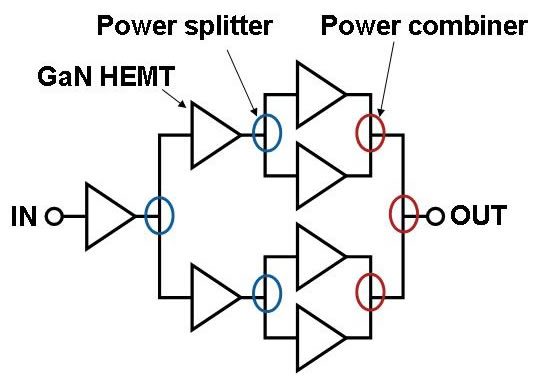
ยฉ Fujitsu.
The new amplifier will offer transmission output equivalent to approximately 16 times that of existing amplifiers that use gallium-arsenide (GaAs), thereby enabling W-band transmission ranges to be extended by approximately six times.
Although the 16x gain will be limited by attenuation and the inverse square law, the gain in range is impressive. 4x compared to current material GaAs.
http://www.fujitsu.com/global/news/pr/archives/month/2011/20110606-02.html
For X band the situation won’t be different, power output of 20 W is easy with good cooling.

give me a ring when Typhoon finally gets DSI air intakes ๐
Would be interesting to see DSI intakes on a typhoon in vertical climb, a pair of half concealed bumps … ๐
JF 17 might start shooting his (pay)load too soon.
China is a socialist country. Things don’t cost anything in China. ๐
a la 1984 :p
what does a Rolls Royce have to do with planes? :confused
Ooops ๐
Typhoon’s technology is at best a match for that of Thunder Block 2 ๐
Don’t forget it is free as well vs the โฌ100m Typhoon.
RIVET-JOINTski, most likely – to date there were only one or two pictures of its forward fuselage while under construction, but this is the first time it has been seen either in the air or in its entirety, so you’re in good company ๐
Which airframe is this, Tu 204?
Yet still are “free”.
I’ll stick with the much better Typhoon thank you very much.
Noo.. Please take. We will also give you money to train your pilots and buy you fuel. Please accept our kind gesture.
Even Ajay’s beloved F-35 won’t have a “World beating 360 degree AESA “:eek:
…but let me point HAL (and Tikhomirov-NIIP) in the right direction (c/o DARPA):http://phys.org/news/2012-04-silicon-wafer-scale-ghz-phased-array.html
http://phys.org/news165768262.html
The only exceptional thing there is noise and interference elimination of having all components on chip and the reduced dimension, probably for space constrained applications. HFET/HEMT are known to scale well uptil 600 GHz in power and current gain, so there is so much headroom available and no need to get all BiCMOS with it complicated fabrication process.
Since MMICs in general are mostly LSI, for maximum power output you are better off designing a big ugly die with maximum area for heat dissipation, robust signal paths and with maximum power that you can extract from your transistor design. The modulating signal can be synthesized elsewhere. High power HEMT transistor designs are commercially available for WiMAX base devices. So if you know what you want you can even order samples from Hitachi or Fairchild, AD etc… although in this case you will need a soldering iron. In case you need it for your radar :diablo:, you might have to tailor the frequency response of your design… HFETs can be ganged just like BJTs can be Darlington Paired to drive up the power output.
I still have 2 DACs from AD which provided me with some samples years ago, I never used them cause they are gold plated!!
By the time this thread finishes JSLLL4 would have had 10 accounts. ๐
— hides —
Meh, what new aircraft is the US procuring till 2020 in the THOUSANDS?
The F-35 will be lucky to hit that by 2040 given tepid rate at which the US economy is moving along.
We were talking about numbers in the inventory, so I think yeah 1000s, even USN has 1000+ ๐ฎ
So then what is the VVS inventory like as … snip
Soyuz/ISS Exp 31/32 countdown, four hours to launch.







