 LordAssap
toan;1346682]The test pilot of F-35 has said that the ultimate speed target for F-35 to achieve in the near future flight test is: [COLOR=”Red”]1.6 Mach with two 2,000 Ib bombs and two AAMs in its internal weapon bays.
AGAIN BOY: DESIGNED MACH LIMIT IS 1.6.
Even F-22A may not be able to achieve such speed in the same combat configuration, since it has to carry 2,000 Ib class weapons outsides.
:rolleyes:
By comparison, Typhoon with the similar combat configuration (four 1,000 Ib LGBs, three 1,000 L tanks, and two AAMs) can only reach the speed of no more than 0.9 Mach for the safety reason
Little to do with “Safety” you meant structural and aereodynamic limits, as for F-35 do you have ANY idea of the fuel it will need to accelerate from its cruising speed of M 0.9 to M 1.6???.
We don’t care if the F-35 CAN fly at this speed with A2G weapons, FACT is in A2A he have a great speed disadvantage and at anything more than M 0.9 it will have to fly in FULL A-B.
(LGB is not designed for supersonic flight).
:rolleyes:
They go supersonic on their own and AASM goes and STAYS supersonic if launched UPWARD at M 0.83 untill it hits the target…
SpudmanWP While I do not have the time to do a detailed debunking of Kopp’s radar studies now… I will point you to another man’s debunking of his Flanker study. What does this show?
It shows how badly Kopp does his research and the lengths he goes to to deceive his readers.
But, on a quick note, here are several discrepancies with Kopp’s radar study.
1. He used photos to do a RCS study!! He does not have a real 3D model of the F-35.
2. He only used a few sectional cross-section measurements to make his point.
3. He completely discounts ECM, RAM, and structural materials in his study.
I am sure there are others, but I just wanted to show the biggest problems I have with the report after reading it.
YOU my friend have absolutly NO clue what analyst need to do a proper job and your post shows this big time, who else than F-35 programme partners had the chance to come anywhere close to an accurate 3D model of it?
To summerise; those who are so vocaly critical of his job in forums doesn’t even have the necessary knowledge to beggin to comprehend how analysts can do it and yet they do in a regular basis, ask Jane’s they know tons about it…
LordAssapwrightwing the Rafale and Typhoon aren’t gonna be travelling at M2 with a full load of AAMs, and since we’re discussing IR signatures, they’d have to use A/B to hit their dash speeds in any event.
No they wont in mosty cases but they CAN since it is not an aerodynamic limitation coming from the drag but inlet/engine…
It means all things being equal, the plane with the lowest RCS gets spotted last.
Within the amount of time provided to do so and CRUISING speed is part of the equation as well as IR signature…
The F-35 can climb/accelerate if it needs additional kinetic energy.
From SUBSONIC speed weither the others can count of a 0.4 Mach advantage from stock even with 1 X 1.250 l external tank and do the exact SAME thing.
They already do it to increase the AAM energy/range, it is called LOFTING, it works much better from above of course.
Of course since it can get closer to its target without being seen, that offsets the kinetic advantages/necessity.
Not necessarly even less with lower Operational ceilings in the balance…
You’re right, it’s not undetectable. It’s just low probability of detection.
NOT detection, INTERCEPT.
The word DETECTION is not in the phrase LPI.
It will be detected but intercept means getting much more accurate position datas than simple detection.
We shall see. Of course if the EF/Rafale emits, they’re definitely gonna be detected, as they’re not currently LPI, so it comes down to whether they can spot the F-35 with their IRST, before the F-35 spots them.
RBE2 IS LPI even in its PESA form although not as much as the AESA which is already being ordered by DGA..
Right now the AdA/MN doctrine is evoluting at S-Speed toward the minimum time of radar use…
And there are tactics that take these things into account. What about a passive shot from the F-35, where the datalink updates are coming from other aircraft(i.e. AWACS, F-22s, other F-35s, etc..), and then the launch aircraft changes heading away from the target?
On its own F-35 canot do passive, even less in BVR, since its AAMs are internals it have to lock BEFORE launch and posses NO IR BVR capabilties.
What’s the search rate though, and field of view?
Classified i guess.
The AIM-120D/D+ have very large NEZs
Much smaller when they have to climb about 15.000 ft if not more acording to L-M mission profiles…
I’m not sure why you are using the example of a Rafale/EF engaging an F-35, but…the with the VLO of the F-35, but it’d be a waste to use a Meteor against it, as you’ll be in or just outside of ASRAAM range before you could get a radar lock.
What the Russians are working at right now is anyway quiet close to have the same performaces than these even greater in terms of DASH speed.
More to it it is a question of performances in the first place.
That’s why all this talk about altitude/speed/kinetic energy/etc…. is great when talking about >1m^2 targets. It becomes much less relevant if you can shoot at your foe, and they don’t know you’re there.
That’s the theory and applie much more in the case of F-22 because it is realy stealth; NOT F-35.
This is the point i make time and time again; Supercruise, Operational ceiling about 10.000 ft superior (Source USAF website) and much more developed L.O features including IR are part of what makes F-22 superiority.
Without it it’s nowhere near as close to be superiority you’re talking about, expecialy with what Europe and others are working at in terms of passive detection.
LordAssapI would be more concearned about the F 35s VHF signature. It isn’t invisible there and VHF radars now are solid state active phased array designs in 2008 and F 35 is still optimistically 5 years from service entry. What enhancements will the Chinese and Russians make by then? The F 35 may well be obsolete in its stealth strategy (X band all aspect, moderate L, S Band) before it enters service and likely within 5 years of service entry…
You don’t think the U.S quietly resurrected the B 52 jamming effort (now primarily in high VHF bands) for nothing do you? Or the sudden “need” for the next-gen bomber to have enhanced stealth (Why isn’t B 2 good enough?), nor the “in from the cold” resurrected funding for UCAV-N aka X 47B?
Agreed, everyone is blinded by commercial stuff, F-35 is a cheap strike aircraft with limited EM L.O, not what some would like us to believe…
The actual 360*X360* EM coverage includes all known EM frequencies…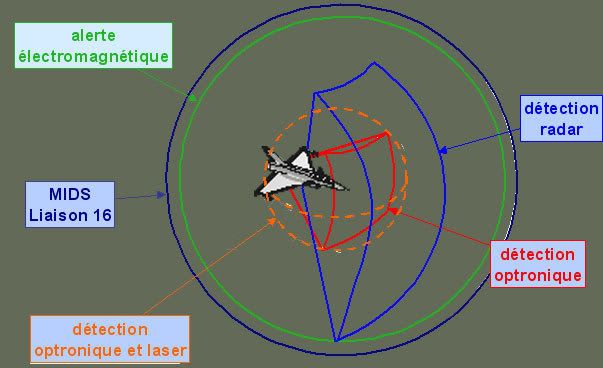
Don’t confuse minimum requirements with maximum capabilies though. The full flight performance envelope has not yet been disclosed in terms of altitude or speed. With regards to dash speeds- the F-35 will be able to reach its dash speed with a combat load- the EF/Rafale/Su-XX, cannot, much like the F-15C dash speed is M 2.5+, but with AAMs, it’d be lucky to break M 2.
Sorry but you still can make up a few basic thing here.
On F-35: “DESIGNED Mach limit” does what it says on the box…
ONE: DASH speed on these European aircraft is reached at the limit of their inlet pressure recovery limits NOT the airframe/AAMs DRAG aerodynamic limits which BTW with a delta wing are way above that of F-15 if it wasn’t for the use of single shock inlets.
SECOND: Typhoon or Rafale have a higher TWC in most cases than F-15 which goes to PROVE again that their Mach 2.0 limit is NOT related to DRAG but engine pressure recovery.
Scorpion82 Operational reality proves you wrong my friend. That nonsense is the hard reality like it or not.
You have NO idea what operational reality is since you can’t even comprehend the basics of what makes aircraft performances in the first place and keep ignoring the operational datas given by those who usess these aircrafts and i’m going to prove it again…
Most service ceilings given in publications are upper limits.
SURE, so Marine Nationale and Dassault are liars or mythomaniacs is that what you are saying?
Sorry you INVENT AGAIN.
Rafale Operational ceiling IS 55.000 ft.
Can the aircraft operate there? Yes it can! Does it operate there on a regulare base? No! And why doesn’t it operate there? Because the performance at such altitude would be insufficient!
Blah-si-Blah. Try to confuse the readers?
Operational ceiling is NOT Maximum ceiling and NO performances are NOT ” insufficient” at these altitude because they were designed to fly at these in the first place, you’re still INVENTING to make a FALSE point (AGAIN).
Care to elaborate why the operational top speed of the Rafale is given with mach 1.8 then, rather than M2.0?
ABSOLUTLY:
Operational speed M 1.8 DASH speed M 2.0 very much the SAME for Typhoon.
Care to elaborate why the MiG-29 which achieves M2.3 clean just achieves some M1.7 or so when loaded with a crappy pair of 2 R-27 and 4 R-73?
Absolutly, it reached Mach 2.3 within the engines pressure recovery limit thanks to multi-shock inlets but is much closer to the critical drag/thrust balance limit, simply because as everyone knows (but YOU) engine thrust lowers as speed increases.
Thus at M 2.0 the opposite happens in the case of the European aircrafts, they reaches their inlet pressure recovery BEFORE the Drag/Thrust ratio get REAL bad; reason WHY they also can reach M 1.3 in DRY power.
More to it Mig 29 engines are not realy on par with M88 and EJ200, beside one other thing you do not know, external loads are all limited on the Mig 29 in a way they aren’t on the celta canards of a much more c=recent design i’d not be surprised it this was a STRUCTURAL limit BTW..
I you would leave your little aviation world which seems to be centered around Dassault, the AdA and MN you might face reality!
BOY: I know much more and much better than YOU about the realities of aviation as i have cared to learn my ABC while you visibly didn’t and served in an Air Force after flying aircraft you weren’t born yet.
Keep your familiarities for newbies like yourself. PLEASE.
Care to show a single source which suggests that Rafales are operating at 55k ft on a regulare base?
LOL! As if AdA or MN was going to disclose these sort of details, you realy have a problem with your X-Mass list, you’ll have to content with datas from manufacturers and historical FACTS.
Cinematics is a widely used term in military aviation and means speed expressed as energy. What was that with ABC and home work?
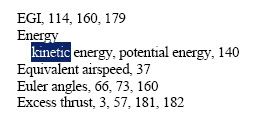
The english word refers to a sequence as for in the Cinema industry, NOT Kinetic which is the ONLY and correct word and is defined in terms of Ft/Pounds.
The word Cinematics isn’t even LISTED in the USAF Flight-Test Centre handbook.
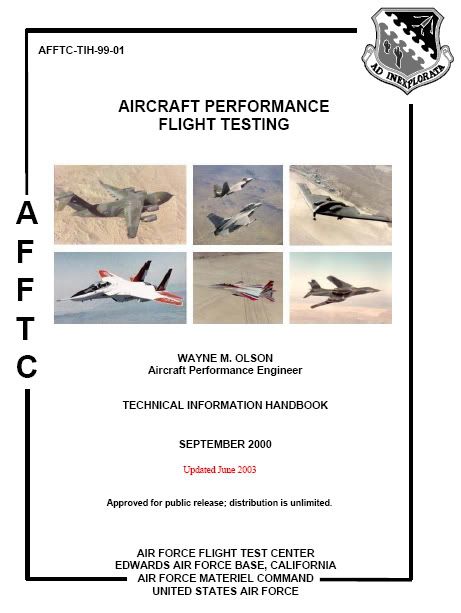
Please buy yourself an Oxford, pronto this doc is WAY above your head…
If you stop wrong turning everything I say just to make your point…
Problem for YOU; you always managed to open up WRONGLY without anyone having to “turn” what you say, AND you can also talk total vents on the topic of Typhoon, proven time and time again too…
My turn for your education as to what Operational ceiling and DASH speed means…
Operational ceiling……………………………………….55,000 ft
http://www.dassault-aviation.com/en/defense/rafale/aircraft-characteristics.html?L=1
Operational ceiling……………………………………….55,000 ft http://www.dassault-aviation.com/en/defense/mirage-2000/aircraft-characteristics.html?L=1
AND this is not the actual physical Operational ceiling for BOTH, (Only the safety limits) that of the 2000 (Second link) was given at 47.500 ft long ago altitude at which it can reach a Max Mach of 2.2 proving you wrong AGAIN. i.e. Mirage 2000C M53-5 (NOT the more powerful P2)…
At this altitude, from Mach 0.9 to Mach 1.85 it beats the ekke of F-16 (flying LOWER) with 120 sec, even better up to 2.17 after 180 seconds.
French aircraft are designed to intercept Mig 25, not Harrier IIs at sea level mate!!!
THIS is what Optimisation AND Operational ceiling MEANS for US.
Vitesse maximale : Mach 2 (1 290 noeuds)
http://www.defense.gouv.fr/marine/decouverte/equipements/aeronefs/rafale_m
LordAssapAlso we saw a jump in the F-22s empty weight by quite a few kilos.
There is no disrespect, just the collective memory.
Please refresh, they lost some too to structural strengthening of the fins and side fuselage panels due to stronger than anticipated aerodynamic bashing…
LordAssapwrightwing-What’s the frontal IR signature of an F-35 that’s not using A/B?
What’s the SIZE and temperature of its exhaust plume?
What’s the kinetic energy of a subsonic aircraft flying at 10.000 ft lower and 0.4 M slower?
What does window of detection means?
Is it not time and speed related (to target velocity?).
What’s the added range of equivalent AAMs launched 10.000 ft higher and 0.4 Mach faster?
Detection range for OSF is about 130 km and SPECTRA is proven to detect LPI radars (NATO MACE-X Exercise), it’s not even a match it’s laughable, limited EM L.O doesn’t compensate for this…
LPI doesnt mean UNDETECTABLE BTW…
-What’s the search volume/detection range of an IRST vs. the APG-81
Use your APG-81 and you will be detected just as well if not earlier than by a Pirate or OSF, what is going to be more difficult it to get a lock on you but this is where IRST, Remote (networking) targeting, BVR IR AAM and sensor fusion are useful.
If the adversary doesn’t know where to look with his IRST, he’s gonna be looking around for a while, without any guarantee of success.
You visibly didn’t study the subject in any form nor detail; there are more than one way to detect L.O in particular trans-horizon radars complements AWACS quiet well in the role, we know, we got them at home.
OSF search patern is the SAME as the radar and its search angle as well…
When the F-35 enters service, it won’t be AIM-120C5s that it’s carrying. It’ll be D/D+s. In any event, they’re a 50g+ missile, not 30g.
50 G is the upper limit within the NEZ and in any case flown and fired slower and lower they still wont make the difference.
Everybody knows that AAMs fired faster at a higher altitude flies with more energy (Larger NEZ), further and FASTER as well, PLUS, we got Meteor this side of the pound, mate so F-22 advantages still apply for the faster, more maneuvrable and higher flying aircraft…
LordAssapIf your adversary isn’t flying a VLO aircraft, it won’t matter in BVR whether it has a kinematic advantage, because it won’t be able to engage the F-35 any earlier than it can detect it. The F-35 will always see the non VLO adversary first, and have the first shot/first kill advantage.
That’s a HELL of an assumption considering its IR signature is superior to some of the supposely non-L.O and that it doesn’t supercruise, BOTH of which are part of the USAF stealth conceipt for F-22.
You have little idea what L.O conceipt realy means in USAF terms do you?
As for F-35 structural limits:
The concept of cousin parts has been maintained – the 7g-stressed F-35B may have thinner, lighter bulkheads than the carrier-capable F-35C or 9g-capable F-35A, but the difference is not visible, says Williams.
DATE:27/06/06
SOURCE:Flight International
JSF special: Future fighter
http://www.flightglobal.com/articles/2006/06/27/207393/jsf-special-future-fighter.html
Quiet clear who’s informed and who isn’t by now…
If you have some hard numbers to the AIM-120’s and AIM-9x’s G ability, please post. Otherwise, from what I have seen in the past, they are in the 30-50g range.
30 G more likely expecialy the croped wing C5 considering MICAs much larger wing areas and TVC allows for a 50 G Maxi…
For the rest mate i stick to my gun, No supercruise, Structuraly G-limited and M 1.6 DESIGNED Mach.
High-g maneuvers are getting less and less relevant.
In your dreams and ho-so conveniently for you as your favourite is visibly G-limited…
@SpudmanWP Infortunatly for you, in ALL the doc you posted there is not a single ONE which makes your points and if you had read them you’d know i already posted pictures of some of the PDF to illustrate F-35 operational ceilling…
As for the details provided it even get worth than the less specificaly informed sources…
• The F-35 has the most powerful engine ever installed in a fighter, with thrust equivalent to both engines today in Eurofighter or F/A-18 aircraft. The conventional version of the F-35 has 9g capability and matches the turn rates of the F-16 and F/A-18. More importantly, in a combat load, with all fuel, targeting sensor pods and weapons carried internally, the F-35’s aerodynamic performance far exceeds all legacy aircraft equipped with a similar capability.
Is this not specific enough for you?
This “legend” about F-35 out-turning a clean F-16 in A2G configuration is total laughable and if you were aware of what it does imply you’d be laughing too.
LM and USAF have always sad that the F-35 has IR suppression tech. These include fuel-based cooling of the body and treatments to the engine nozzle (ref A, D and photo below)
NOMATE BY TODAY STANDARDS THIS IS not ir SUPRESSANT, IT IS MERELY STANDARD…
WHAT WAS I SAYING???
It wont out-turn or outfly a Rafale or a Typhoon any time soon…
LordAssappfcem No, a COMBAT LOADED (i.e ~5000 lbs of ordanace, as in two 2000 lbs JDAM + two AMRAAM, & nearly a full load of fuel – test flight load equivalents have been ~15,000 lbs) F-35 vs CLEAN configuration F-16.
Easier said than proven.
On which basis are you posting such a comment? The Journal of the USAF association?
Just for your info, Wingloads and TWRs in this situation alone makes this totaly impossible, please get real… 😀
Also keep in mind that chase planes are not “stock” block 50/52 F-16s…
They also never were “Clean” but equiped with external tanks…
NOT structuraly limited, NONCOMBAT operations limited. The F-35C, JUST LIKE THE F/A-18 can be flown up to 9g during combat operations, the lower NONCOMBAT operations limit is meant to extent airframe life given the harsh conditions of carrier operations.
WRONG: You got your infos from commercials or non-specialised commentors not NEWS.
To reduce weight, the SWAT team reduced STRUCTURAL LOADS LIMITS.
Right, the F-35 does not “supercruise” at >Mach 1.5 like the F-22…
According to L-M themself it doesnt supercruise point…
BUT using the same definition others use to claim that CLEAN F-15s & F-16s and air-to-air configuration (i.e. 4 MRAAMs + 2 SRAAMs + 1 external tank) Typhoons & Rafales can supercruise, the F-35 VERY VERY VERY likely can.
NOPE. 😀
KPP THRESHOLDS (i.e. MINIMUM acceptable performace) ‘similar’ to CLEAN F-16 & F/A-18…
Up to Mach 1.6.
The F/A-18 is renowned for its high AoA capabilities.
Of couse but the problem for you is that it is also never refered as an example as for F-35 maneuvrability…
LM has pretty much just regurgitated KPP THRESHOLDS, not true performance…
Whatever they’ve done their actual performance level is lower than what you pretend it is accoding to their own sources…
No, KPP THRESHOLD (i.e. MINIMUM acceptable performace) of Mach 1.6…
NO. Maximum DESIGNED Mach of 1.6 still according to them.
The F-22 is as expensive as the JSF will be cheap, and the USAF sees no obligation to take one without the other. In fact, it sees no way to have the JSF without the F-22. At $30 million a copy, the JSF will be an affordable attack aircraft because it does not have to perform the F-22’s stealthy air-superiority mission, the service argues.
http://www.flightglobal.com/articles/1999/08/04/54593/stealth-shackled.html
LordAssapDoesn’t matter even if that was true (which it isn’t – there are lots of RAF/MoD statements to it as a UCAV), BAE Mantis will fly a full two years before your little wooden Neuron. :diablo:
ONLY the truth matter Mr Rob L; as for your stament you still obviously can’t make the distinction between an UCAV demonstrastor (A demonstrator UCAV as opposed to Demonstrator aircraft) and an UCAV technology demonstrator (An UAV-UCAV terchnology demonstrator)…
And NO NONE of MoD or BAe refers to Taranis as being an UCAV demonstrator ot an UCAV…
LordAssapIt is still considered a UCAV technology demonstrator because that is where it would head if the MoD decide to make Taranis the basis for a future production UCAV model (that would be its role). Neuron falls into the same category, except it will have bomb bays and will actually drop bombs as part of the testing.
Yes it IS a UCAV technology demonstrator but NOT an UCAV in itself, it is an UAV…
We agree.
LordAssapbut you are getting confused to a degree or there may be a lot lost in translation.
Well as far as my source is concerned on the “Name” of the effect in question it is SAAB designer, but you’re welcome to bring up correctives because i do not have an University to learn from…
The flow phenomenon, commonly called “dynamic lift”, perhaps more aptly called aerodynamic hysteresis,
http://www.mach-flyg.com/utg80/80jas_uc.html
I’m simply building up from what i had to learn at my flying school and obviously it takes a lot of home work. Cheers.
LordAssapI was and I’am right:p Like it or not facts don’t change because of your fantasy!
You interpret it wrong in the first place or maybe just turn it wrong to look like the smart expert nothing else.
But you have to take into account external stores on the ECDs as well.
Interesting in the “speed department” would be what the considered typical max. speed of the F-35 is in an operational configuration. Will it accelerate out to mach 1.6 to launch a missile with best cinematics? The M2.0 says pretty much nothing as it is the defined max. speed. Operational speeds with AAMs and ETs are much lower (~M1.6 for Rafale and Typhoon, don’t know for Gripen).
The ceiling given for the F-35 (30k-40k ft) is the practical operational altitude. The aircraft can be operated at higher altitudes, but it might not make much sense. The operational ceiling given for most aircraft is exagerated from an operational point of view. The Gripens ceiling is given with ~45k ft, though sources suggest it is more like 55k ft, but that doesn’t mean the aircraft usually flys that high.
Did YOU write all this nonsense when obviously BOTH L-M and AdA/Dassault were showing CLEARLY that you were wrong?
Operational speeds with AAMs and ETs are much lower (~M1.6 for Rafale and Typhoon, don’t know for Gripen)
My reply was clear, with tanks they are EQUAL without they have an advantage of 0.4 Mach and you’re WELCOME to prove they CANT fly at M 2.0 with AAMs or that the DRAG issue is the reason for their Max Mach. Please…
The operational ceiling given for most aircraft is exagerated from an operational point of view.
SAY WHO? YOU? Who should I believe? Marine Nationale AND Dassault or YOU?
Rafale Operational ceiling IS 15.000 ft HIGHER; period.
best cinematics?
TRANSLATE in proper Aerospacial terms PLEASE.
Please stop you’re making this topic another one of your now famous “I didn’t write this” mess!!!
LordAssap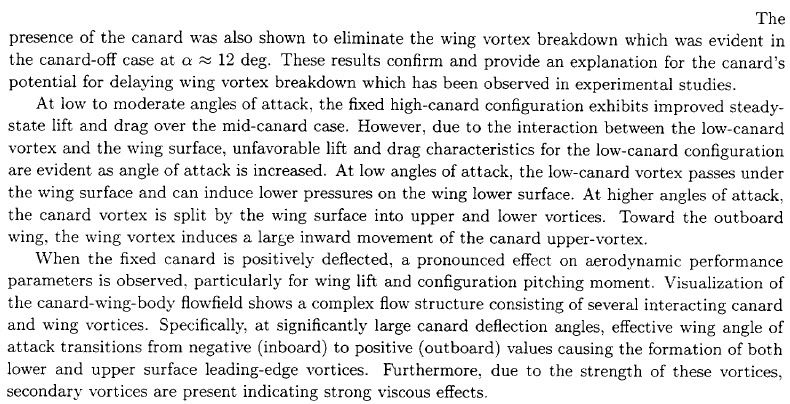
Here from NASA…
LordAssapIf you would actually try to understand what others say, rather than counter every claim and wrong turn it,
When you will be talking according to proper aerospacial standards instead of inventing them i will probabily understand.
Where have I claimed that the performance will be the same or better at 40k ft and above?
The usual nonsense all over AGAIN.
Dont try to make up you were R.I.G.H.T. to pretend F-35 ceilings were the SAME because it is just NOT the case.
Nowhere, it’s surprising how much crap you interpret into some statements and it makes me wonder why,
I do not need to interpret you, you already write it all wrong in the first place.
but I have the feeling it’s just your personal disease with my person that causes such reactions, rather than a rational logic behind.
As opposed to you i do not have any personal issue nor personal nor with yourself but what you wrote is worth flushing, sorry. 😀
LordAssapwrightwing That’s not what the folks that have flown the plane are saying(though I suppose they’re just lying to save their jobs).
I’m not implying they are lying i’m implying they do not use the best turning F-16 as example and actualy never realy mentions high energy turn rates.
Beside i’m sorry to remind you that Gripen, Typhoon and Rafale have much higher performances than the F-16 of any blocks.
You still can’t explain to me how a 7.0 G structuraly limited aiurcraft will out-turn a 9 G one…, expecialy the later block which are puting on lot of weight.
This affects turning abilities significantly.
Look at it another way- what do you suppose the turn radius of an F-4 at 8g is vs. an F-16 at 8g(or an F-18 at 7.5g vs. an F-15 at 9g for that matter?)
At the same speed it will be exactly the SAME.
The G number alone doesn’t tell everything with regards to turning ability.
G results in the forces involved in the turn and are the SAME values for every object in ther planet obbeying the SAME laws of physics.
I’d be more curious as to what the instaneous/sustained turn rates are, than the max G number.
You can forget about it too, it does invole aerodynamic features F-35 simply doens’t have, low wingload (compatratively) and HIGH Lift Coeffiscient.
What system and aircraft have an equivalent system to the DAS/EOTS?
In the EM dpt SPECTRA does just as well, the IR and laser coverages are there the difference rests in the visual presentation in DAS absent from MIDS but the new generation of IR/OPptical sensors developed in France is much more performant expecialy when it comes to Visual Meteo Condition limits.
OFS is also boosting TWO Channels versus EOTS one and is optimised for A2A weither EOTS is not, EOTS is also more MTO limited.
That was the USMC requirement.
Replacement for Harrier II+.
The USAF and USN requirement was to replace F-16s and F-18s.
This is NOT a requierement, requierement means specifications not which aircraft it will replace or supplement.
USAF requierement was for Supersonic speed DASH and INTERNAL weapon baies.
LordAssapCan you elaborate on what your trying to say about hysteresis?
Yes i can. (Roughly by memory)…
The interaction of the root and tip vortexes from the canard surfaces, are actualy increasing the energy of the main wing vortexes, when they merge they are rotating accordingly (Opposite rotation over the main wing than if they were on their own) and exchange energy.
Diverse effects are resulting from this:
Earlier apearence of vortex lift over the wing.
Increase in lift of up to 50% (Stated by BAe about the EAP for example).
Increased YAW stability due the the canard root vortex which are not shielded by the fuselage at high AoA.
The center of lift moved forward by some degree, up to 1/5% on the Mirage III S…
Also this involves an increase in damping as well as dynamic instability which remains at supersonic speed.
This means that the transonic region can be crossed in a much smoother maneer as well as a lower reduction of the aircraft level of instability in supersonic due to the induced dynamic instability.


 Sign In








