 LordAssap
Lol LmRaptor just said what I have said since quite some posts, just the selection of some words was different.
NO mate, as opposed to you, HE doesn’t try to blur the difference between Maximum and Operational ceilings.
He knows what he is talking about, you on the other hand, clearly DONT.
Yet agree with him, but claim that I’m wrong and have to do my homework.
He desagree with YOU clearly by stating that the OPTIMISATION of F-35 reuslts in a lower OPERATIONAL ceilling and LOWER performances at above 40.000 ft which as HE can READ from L-M own documentation IS the designed Operational ceilling of the aircraft as I was saying.
I don’t know if I should be angry about that or if I should just laugh about it. Maybe you should start to put your personal problems with other users aside, would help much for such discussions. Everything else is just flamming.
You should learn two things:
ABC of Aerospacial and intellectual honnesty. 🙂
Considering that the F-35 most likely won’t be detected from greater than 15-20nm.
Say WHO?
LordAssapThe one going into the two weapons bays.
Link.
http://www.flug-revue.rotor.com/frtypen/FRTaran.htmJust because it will simulate this at the beginning doesn’t mean it can’t carry weapons, Taranis is Europes second UCAV, right after the BAE Mantis, being rolled out in a few weeks/months.
NOT according to MoD AND Taranis program goals documentation beside this source is the only one mentioning Weapon baies on this TDV and is by NO MEAN an official source…
What MoD says is cristal CLEAR; it is NOT intended to drop weapons and it is an UNARMED Technology Demonstrator Vehicle NOT and UCAV.
Thanks. 😎
LordAssapLord – please take this on board – I think it will help. Honestly you could be a very good contributor to a forum if you were a bit more organised with your responses. You have bookmarked and compiled some fantastic sources. If you stopped going off on tangents to the topics discussed – and everyone is to blame for that to a degree but you are one of the worst – it would be a lot more digestable for most.
Cheers
Dan
OK mate i reccon this is my main problem, please do not forget that English is only my second language and that i had to RELEARN all my ABC on the subject in English, also i tend to cover too much at once this is true.
BTW you have a personal message and i have to say i am very pleased to have you onboard so you can add some technical aspect to the stories…
LordAssapWith an engine similar to a Hawk, the weapon load probably won’t be dissimilar. Weight saving due to all pilot related gear being removed will no doubt be counteracted by less lift from a stealthier more compact planform
WHAT weapon load? :confused:
LordAssapamen
What, no argument? 😀
I study the subject as part of a masters degree at one of the better institutions for the subject
Credential speaks for some wise revisions of your views Scorpion82….
LordAssapLmRaptor Im not disputing that lol – I don’t need a techie fan to illustrate this to me – I study the subject as part of a masters degree at one of the better institutions for the subject.
Good for you at least you can comprehend what i am talking about and i’m not exactly a “techie fan”, i had some proper training…
All I am saying is the F-35 will be able to fly at 50 kft.
So does the Tornados but it turns into a flying iron at this altitude and you can expect F-35 to follow suite for the very same reasons, i do not need to remind you that one needs air density as well as thrust to sustain a turn rate do I?
It won’t have the performance level the EF or the Rafale will have up there as there is no doubting the EF/Rafale will have superior top end KE + PE performance.
So at their Operational ceilling of 55.000 ft they will be markedly superior in performances to F-35…
And despite what the general public think – there is still a lot of dynamic performance gain over what we saw in the 80s – mabye not so much in terms of absolute performance gains.
Not absolute gain but generaly the flight envlops have growns outward and away from the top right corner of their previous scales, since requierement for speed above M 2.0 tends to desapear.

Here a picture from one famous genius from your favorite forum who was trying to prove to me that F-35 design Mach was M 2.0. You know who i mean, the one guy able to get F-35 sweep angle all wrong (It’s actualy closer to 33*)…
The guy mystakes Mach line for Critical Mach but it is still an interesting comparison, with a 33* sweep angle i can’t see the F-35 design optimised even for mid-supersonic speeds…
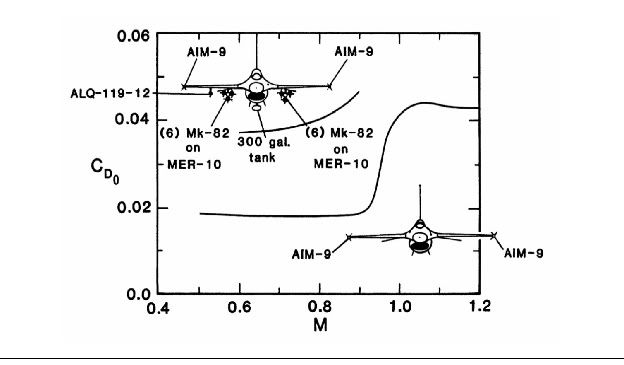
From F-16.com with love…
LordAssapThe point Assap is – almost any aircraft can break their operational ceiling with optimised climb profiles. The F-35 has a The F-22 was officially limited to 50kft during its equivalent SDD – now its flying well above 60kft – you don’t always need official data to utilise your critical faculties. It is apparent from looking at the stats – the F-35 with F135 will have sufficient L/D ratio to support flight up in 50kft region.
Agreed and there is NOTHING new in this point, it also goes BOTH way and is a valid for other aircrafts too, as you mentioned; which altitude was the couple aircraft/emgine optimised…
And in the case of F-35 it is obvious that it is at a much lower ceiling than the European aircrafts…
Supporting flight is onr thing, being effiscient in A2A when your kinetic energy is already lower than your adversaries is something else.
LordAssapIf it is explained, everyone can follow it, at least if he is willed.
This is not a question of “will” this is a question of = talking proper aerospacial language and reporting accuratly, you keep bubling and talking horse vent…
You want to tell me an aircraft with 6 or 8 external AAMs mostly on pylons will have the same drag as the same aircraft clean?
Do you understand what engine pressure recovery limits ARE?
These ARE the M 2.0 LIMITS of the European fighters NOT the DRAG caused by their AAMs because a Mirage 2000 will do M 2.0+ with 6 AAMs due to its multi-shock inlets.
Sorry but that is ridiculous.
What is ridiculous is your insistance into refusing to comprehend what the real limits of these aircraft is and interpreting what i say in a permanent basis.
Sure 2 or 4 missiles won’t hurt much, especially if fitted to wing rails or semi-recessed fuselage stations, but if you have 6 or 8 missiles and 4-6 of them need pylons, you are going to have increased drag and that will have an impact on the performance, like it or not.
Blah-di-blah. (See below)…
Usually the result is, but the cinematic doesn’t mean lofting itself.
cinematic – of or pertaining to or characteristic of the cinema
As i said you seems to have NO CLUE what you’re talking about…
In aerospacial terms, cinematic is defined by the way the landing gear deployes in an order of mechanical sequencies.
The word you’re looking for is Kinetic energy and the F-35 have LESS of it by the bucket.
Being forced into combat earlier than planned, with external fuel not used to the degree as planned in the mission for example.
If this occurs then your mission plannig is wrong, in ANY case all of these are air-refuelable…
Neither AdA/MN nor Dassault are of interest here, we speak about a US design, so anything related to the AdA/MN or Dassault is completely irrelevant!
IT IS PERFECTLY relevant expecialy because YOU keep INVENTING standards and words which only exist in your fantasist imagination.
According a briefing from Maj. Davis from the HQ ACC the typical ceiling will be:
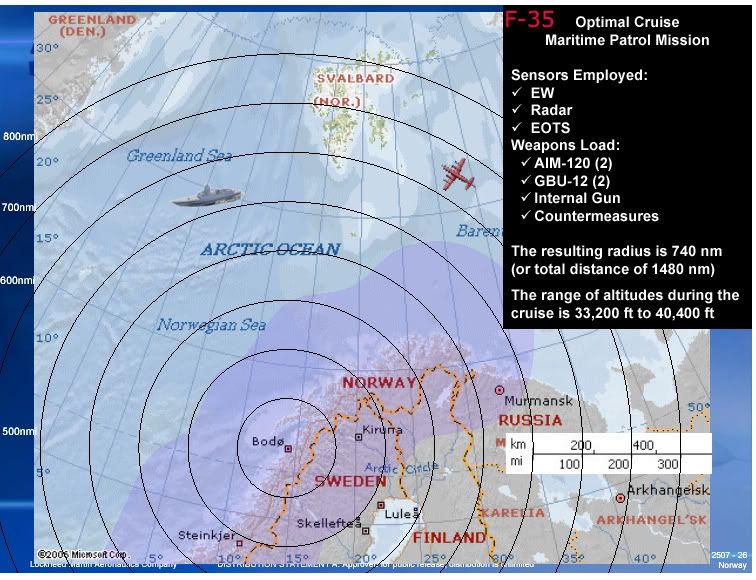
No higher than 40.000 ft according to L-M.
Anyway you don’t get my point. In the end LM or the customer will state a service ceiling of 50k ft or something like that,
In the end you’re still talking MANURE in the face of every official documents posted to you as ervidence, typical of you. :rolleyes:
that the aircraft wasn’t optimised for that altitude is true, but it will be able to operate there.
And be a sitting duck because its lower performances will have degraded further when their opponent will be at the RIGHT ceilling.
Whats are known advantages for F-22, higher cruising speed and ceiling are ALSO valid advantages for more performant aircrafts over F-35.
It just makes not much sense, as the aircraft will have insufficient performance at that ceiling.
It just makes not much sense that you keep igonring REALITY even when L-M own documentation proves you’re wasting forum space arguing wrongly.
That is true for many aircraft including the F-15, F-16, F/A-18, MiG-29 or Su-27 to mention some examples. Neither of these aircraft is operated at altitudes of 50k ft plus on a “regular” base as you claim, though all of them are capable to fly at that altitudes.
FIRST of all you got to loose the habit to bring things at a personal level, then LEARN from those who know meaning the manufacturers datas and operators themself.
Give it a REST, you are proven WRONG and your failure to admit it is only another evidence of bad faith from you…
Operational ceiling……………………………………. …55,000 ft http://www.dassault-aviation.com/en/…stics.html?L=1
Quote:Caractéristiques du F1
Envergure : 10,90 mètres
Surface alaire : 46 m²
Longueur : 15,27 mètres
Hauteur : 5,34 mètres
Masses :
à vide : 10 196 kg
maximale : 24 000 kg
Vitesse maximale : Mach 2 (1 290 noeuds)
Vitesse d’approche : 120 noeuds
Temps de patrouille : supérieure à 3 heures
Plafond : 50 000 pieds
Distance franchissable : 1 000 nautiques
http://www.defense.gouv.fr/marine/de…onefs/rafale_m
Here BOY, go invent yourself some standards now or go tell Marine Nationale and Dassault that they do not comprehend the word Operational according to YOU…
LordAssapIt is optimised for 30,000 ft operations – and it will feel much more at home in that region but to believe its not capable of reaching 50kft or higher shows your critical faculties are failing you.
This is precisely what i am saying, optimisation IS the keyword here although you have absolutly no evidences that it will reah such altitudes since it is designed for lower ones…
Max Altitude is not my concern and certainly not that of the pilots conducting war missions…
But at 50.000 ft it will have much reduced performances compared to other aircraft which Operational ceiling have seen their opimisation (by design) for a higher ceilling and BTW this also mean that its Maxi is WAY lower too.
This is well illustrated by the Tornados series and their RB199.
JSF requierements included an operational ceilling of 35.000 ft just like the Harrier II+.
One L-M document gives its Operatioanl/Cruising ceiling at a maximum of 40.000 ft.
LordAssapSince i have made a promess to my friend signatory, a guy who always have displayed the highest level of “coutoisie” to myself and other of my nationals…
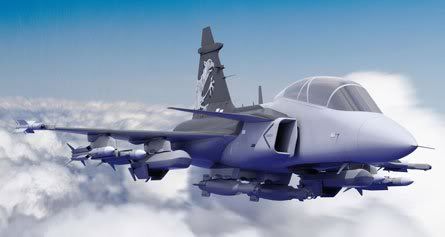
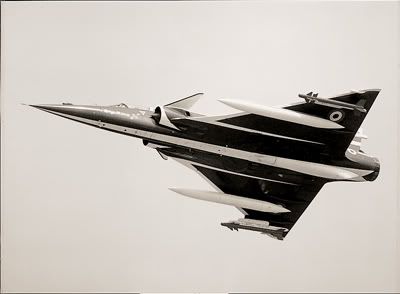
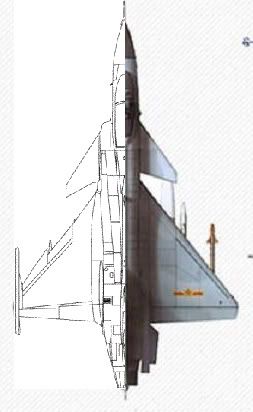
For a starter i would like to point out at the MAIN characteristic of the close-coupled DELTA Canard:
 —————
————— 

 —————
————— 
The type of LIFT generated by the DELTA wings:
Vortex LIFT. —–
—– 
This kind of lit if very particular in that the airflow creating the vortexes actualy comes from the INTRADOS (Lower surface), contourns the leading edge and form into a single (or double) cornet.
This detail is of primary importance because when close coupled to a canard surface it is the interaction of the canard vortexes and that of the wings which created the famous Hysterisis effect.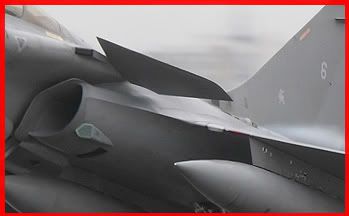
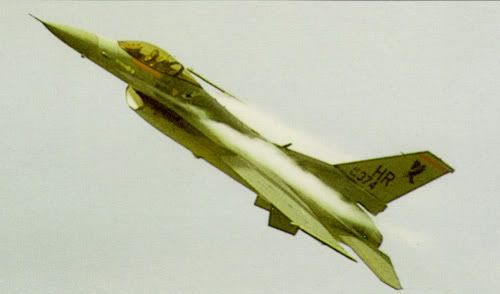
LEX and Canard vortexes at work…
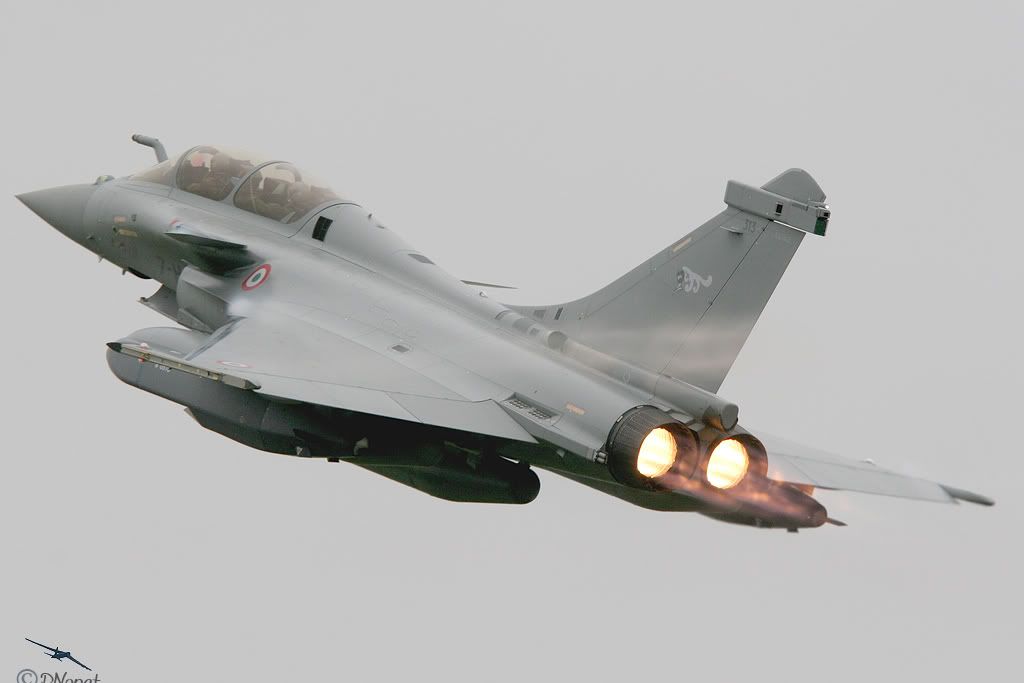
-The close coupled delta canard configuration’s primary feature, its stable vortex flow up to very high angles of attack, meaning high maximum lift coefficient, had lately been realized by the Americans, instead using large strakes as forward wing root extensions together with conventional tail arrangement, as found on the F-16 and F-17/18.-
U. Claréus, project manager, JAS 39 Aerodynamics, Saab Aerospace
http://www.mach-flyg.com/utg80/80jas_uc.html
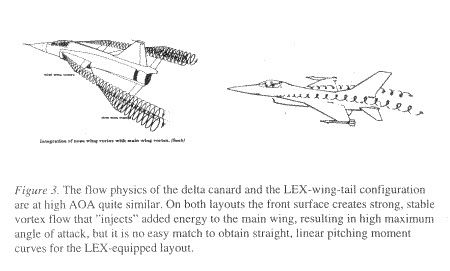 —-
—- 
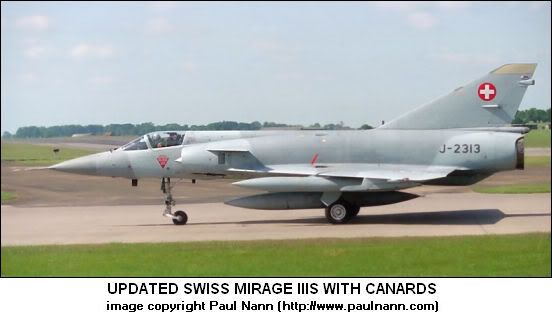
Adding close-coupled Canards to the Mirage III actualy had some very positive effects on low-speed handling:
Low speed and High AoA…
Quote:-The canard produces two additional vortices which combine with the vortices of the delta wing. This gives and extension of controlled airflow up to higher AoA and an unshielded fin and rudder.-
-The vortex lift starts ealier which results in reduced drag at a given lift.-
-At a given AoA. the canard configuration gives more lift and less drag than the canardless delta configuration.-
-The improved YAW stability permits higher AoA, and therefore lift and drag are approximatively doubled with the canards.-
-Overal maneuvrability at low speed is much improved. Minimum speed in 1g flight is down from 150kt to less than 107kt KAS.-
-The canards are about two-third the size of those on the IAI Kfir.-
-Up till now we had a forward and aft c.g limitation on the Mirage III. From test we know that the aft c.g limit was too optimistic and the wind-tunnel proved that the canard would move the neutral point forward by about 1-5 per cent.-
High AoA…
Quote:-Approaching AoA limits in a standard Mirage III, a minor buffeting is felt. Beyhond this limit, the buffeting increases slowly without being a real warning. With the canard fitted, no buffeting at all is felt, and the pilot has no natural warning.-
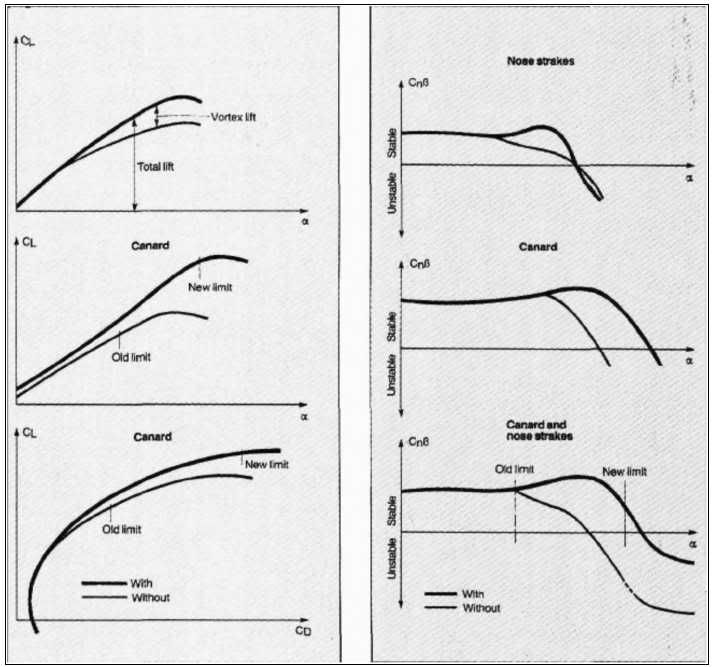
RESULT of the interation between canards and delta wing on the Swiss Mirage IIIS…
NOTE: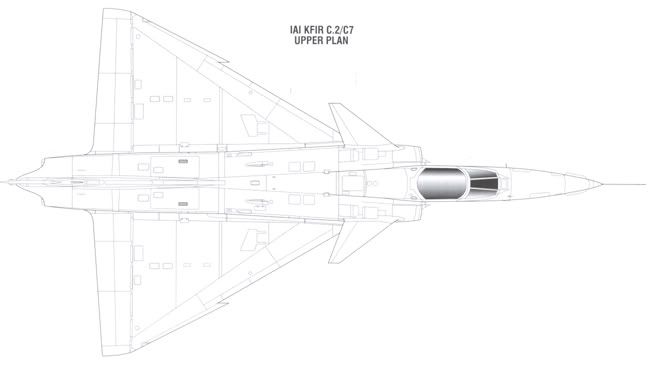
IAI Kfir…
For those wondering what the dogtooth are for on the leading edge of the IAI KFIR, they results on turbulent airflow separation and creates this buffeting, giving the pilot the warning he needs when approaching AoA limits.
On a Rafale the leading edge slats have the same effect while energising the airflow above the wing at higher AoA.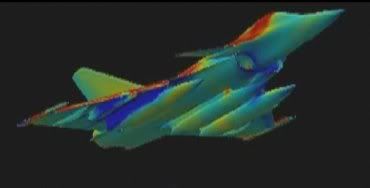
Quote:-The canard configured Mirage III presents a great improvement in low-speed maneuvring and INSTANTANEOUS turn rate.-
DATE:14/12/85
SOURCE:Flight International
Canard Mirage on test (Archive)
By Test Pilot Walter Spychiger
Another serious source:
Quote:-The aerodynamic advantages derived from the close coupled canard configuration, foremost its good vortex flow stability up to high angles of attack (AOA), that can be translated into a very high instantaneous turn rate,-
Delta canard’s inherent good aerodynamics are:
· Stable detached leading edge vortex flow, high maximum lift coefficient.
· Positive trim lift on all lifting surfaces.
· Floating canard offers stable aircraft if EFCS fails.
· Good field performance (take off and landing), enhanced by special aerodynamic breaking mode.· Battle damage tolerance good, “overlapping” control surfaces.
· Potential for future adaptations, like steep approach, fuselage aiming.
· Low buffeting levels made even better with leading edge flaps.Spin recovery known to be acceptable for close coupled delta canard (not necessarily so for a long coupled canard configuration):
· Proven spin recovery capability for complete cg and AOR range.
· Nor risk of being trapped in a superstall, control authority exists.
http://www.mach-flyg.com/utg80/80jas_uc.html
So here you go:
· Positive trim lift on all lifting surfaces.
Think: The hysterisis effect doesn’t vanish at supersonic speed, so positive trim lift remains.
DAMPING defines the ability of an aircraft to naturaly counter parasite moments such as unwanted pitch-up at transonic speed.
Similarly, low speed characteristics are way better, which make them naturaly more suited to carrier operation.
There is NO risk of SUPERSTALL, 3-axis control remains throughout the whole flight envelop…
Quote:-Rebourg said that to date, they have not been able to depart the aircraft into a spin».
DAVID M. NORTH/ISTRES, FRANCE quoting Philippe Rebourg, «deputy chief test pilot for military aircraft at Dassault.-
Quote:SAAB designers agrees on that point, so does NASA Technical Memorandum 11394:
Eugene L TU Aug 1996.
Quote:-For long-coupled canard configurations, the effects on aerodynamic performance is usualy limited to the lift of the canard itself and the total pitching moment. However, the close-coupled canard has significant influence on wing performance as well.-
NASA Technical Memorandum 11394:
Eugene L TU Aug 1996.
-Increasing mid-canard deflection increases overall pitching moment for all computed angles of attack. Significant nonlinearities due to the canard-wing interaction are also noted in the pitching moment curves.-
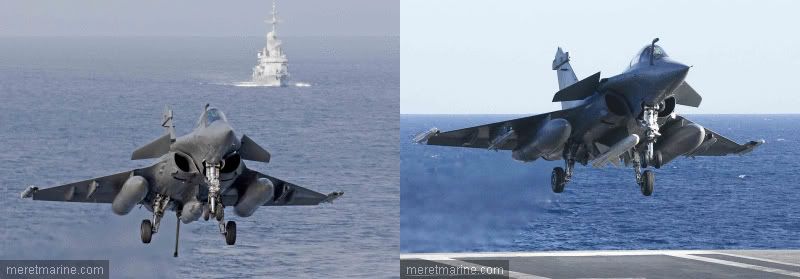
In landing configuration, the Rafale canards are automaticaly pitched-up at 30*…
LordAssapDon’t worry, it will be far, far behind schedule, or even be terminated finally, once UK prepares to formally introduce productional UCAVs instead of just playing with an experimental toy……
TSR-2, FOAS, Future Attack Submarine (FASM), FSC, FRES………So many previous examples…. 😀
I am not worried at all.
What worries me is the press (or a small fraction of it) which keep talking about the Taranis TDP as the European first UCAV when if fact it is only by (MoD) definition and UAV TDP designed to develop (later programmes) UCAV technologies.
Mike Turner cried a long time for MoD to allow proper funding for BAe to keep up technologicaly with the rest of europe but from nEUROn lauch we have seen this “Me too” thing florishing in both forums and some uninformed articles.
The “All-British” UCAV vehicle is not designed just yet…
And i’m still waiting for details of this UAV weapon load which owes me to be called all sort of names when i mention these little “details”.
642.44 / 0.82 = 783.7 km/hr = 217.7 m/sec –> Mach 1 ???
Depending on local MTO conditions and kind of Airspeed given?
Mach is given with a typical 24* at sea level (NOT corrected thus) so be aware it doesn’t always fit the aircraft local airspeed/Mach…
Thank you all and Happy New Year to you. 😀
LordAssap1. Combat radius 1,000 NM+ –> 3,700 km+ in range.
2. Average speed: 450 ~ 550 kts –> 833 ~ 1019 km /hr.
3. Flight time: 3700 / 833 ~ 1019 = 3.6 to 4.5 hrs.
At a typical cruise speed of M0.82/347kt, Chris Yeo/ISTRES FLIGHT TEST CENTRE DATE:23/06/99
SOURCE:Flight International
Combat ready
Flight International puts the Rafale BO1 two-seat prototype to the test in its heavy configuration
http://www.flightglobal.com/articles/1999/06/23/53125/combat-ready.html
Let’s be precise…
LordAssapIs the F-22 for sale? No.
SO?
sferrin Quote:Originally Posted by LordAssap
I personaly define it as a “Stealthy A7” rather than a true multi-role.LOL! So much for your credibility.
So much for YOURS.
When it came into service the A7 was the MOST advanced strike aircraft in the world, and you my dear SIR have so little of it you only can come up with some personal trashing mad-up instead of elaborating on the subject properly.:cool:
In numerous bombing and gunnery competitions it constantly underlined its reputation as one of the most accurate strike aircraft ever built
http://www.military.cz/usa/air/post_war/a7/a7_en.htm
The aircraft was fitted with an AN/APQ-116 radar, later followed by the AN/APQ-126, which was integrated into the ILAAS digital navigation system. The radar also fed a digital weapons computer which made possible accurate delivery of bombs from a greater stand-off distance, greatly improving survivability compared with faster platforms such as the F-4 Phantom II. It was the first U.S. aircraft to have a modern head-up display, now a standard instrument, which displayed information such as dive angle, airspeed, altitude, drift and aiming reticle. The integrated navigation system allowed for another innovation – the projected map display system (PMDS) which accurately showed aircraft position on two different map scales.
The A-7 enjoyed the fastest and most trouble free development period of any American combat aircraft since World War II. The YA-7A made its first flight on 27 September 1965, and began to enter Navy squadron service late in 1966. The first Navy A-7 squadrons reached operation status on 1 February 1967, and began combat operations over Vietnam in December of that year.
http://en.wikipedia.org/wiki/A-7_Corsair_II#Design_and_development
As for the way European companies are developing IR sensors, both in the EUs, in the US on their own or in collaboration with US companies…
French Firms Develop Bispectral Sensors for Air, Land
French industry is developing infrared sensors that see in two bandwidth groups, an effort to fill military requests for gear that can penetrate camouflage, smoke, fog and other difficult conditions.
Posted 05/17/07 17:44
Print this story
Seeing More Infrared
French Firms Develop Bispectral Sensors for Air, LandBy PIERRE TRAN, PARIS
Le 34e prix ingénieur général Chanson, décerné par l’association de l’armement terrestre (AAT), a récompensé le 25 avril 2007 quatre ingénieurs et chercheurs pour Caladiom, un capteur optique unique au monde, pavé de pixels intelligents.
The 34th General Song prices engineer, awarded by the association of land weapons (AAT), was rewarded on 25 April 2007 four engineers and researchers for Caladiom, a world unique optical sensor, smart chunky pixels.
Une première mondiale
Mené pour le compte du ministère de la Défense, le projet Caladiom est une caméra intégrant une rétine artificielle – programmable en technologie CMOS – dont chaque pixel contient un processeur de 45 bits. Une telle densité de calcul miniaturisé et intégré dans chaque pixel – au plus près de la captation des photons – constitue une première mondiale et une avancée technologique majeure.
A world first
Conducted for the Department of Defense, the project is a camera Caladiom incorporating an artificial retina – programmable CMOS – which each pixel contains a 45-bit processor. Such computing density miniaturized and integrated into each pixel – close to the capture of photons – is a world first and a major technological advance.
S’appuyant sur la technologie bolométrique – technologie émergente dans le domaine de l’imagerie infrarouge –, des études sont en cours pour réaliser un Caladiom à infrarouge thermique, pour la vision de nuit.
Based on technology bolométrique – emerging technology in the field of imaging infrared -, studies are underway to achieve a Caladiom thermal infrared for night vision.
So i guess the US aren’t so hot at every level…
LordAssapCould this be that very rare occurance when a UK project is actually ahead of schedule
LOL!
Considering they do use mostly exiting technologies from previous UAVs and does not have to develop a weapon bay nor the associated systems (Emulation of the attack) it would be a shame to be behind schedule…
LordAssapNo one here mentioned sustained here!
NO but you inplied it by making a comment on the F-35 “operational configuration” which isn’t that different to that of the European fighters.
More to it, if you do not use proper technical terms the meaning of your post is lost…
They can fly at a dash speed but the dash speed with AAMs is not equal to the max dash speed clean!
SAY WHO?
Go and find a source saying so, you realy think that AAMs designed to fly at M 4.0 drag that much?
Why is that that when mounted on the wingtips they induce so little drag it doesn’t even come into acount in the computing of aircraft which are said to be “clean” even loaded with them?
The difference comes from a slight aerodynamic intereference between pylons and wing and is still negligible, the REAL Mach limit is far more about pressure recovery of the couple inlet/engines than DRAG because with this sort of power output, with a multi-shock intake they all would fly passed M 2.0 easly.
Simply giving the missile more speed on launch to increase their effective range.
= LOFTING.
In F-35 case it means having to use its A-B from subsonic to M 1.6; meaning through its highest drag peak value and with a lot more time and fuel consumption than the European aircraft which would fly at anything between M 1.2 to M 1.3 even with external tanks.
Basically true, but there might be situations were dropping the tanks at a given status might not be desireable.
I cant SEE why it wouldn’t be possible the only reason they keep them and why they are cleared for supersonic speeds is cost…
“Practical” operational ceiling is a term I use…
NOT in AdA/MN or even Dassault nomenclature…
Operational ceiling……………………………………. …55,000 ft http://www.dassault-aviation.com/en/…stics.html?L=1
Caractéristiques du F1
Envergure : 10,90 mètres
Surface alaire : 46 m²
Longueur : 15,27 mètres
Hauteur : 5,34 mètres
Masses :
à vide : 10 196 kg
maximale : 24 000 kg
Vitesse maximale : Mach 2 (1 290 noeuds)
Vitesse d’approche : 120 noeuds
Temps de patrouille : supérieure à 3 heures
Plafond : 50 000 pieds
Distance franchissable : 1 000 nautiques
http://www.defense.gouv.fr/marine/decouverte/equipements/aeronefs/rafale_m
Plafond = Ceiling in French…
Tornados operational ceiling is given with 50k ft, but you will never see them flying any mission at that altitude,
Not surprising.
You chosed the WORSE example possible because RB199 is a total SLOUCH at high altitude, NOT the case of M88 or EJ200…
they can reach it but flying at it is not practical, same for the F-16, F/A-18 and whatever aircraft you want.
This does NOT reflect reality in MN/AdA service, if they need to they would fly higher, and AGAIN it is NOT a question of “practicality” it is a question of SAFETY.
Apart a few exceptions where operational ceiling is really a practical altitude at which the aircraft can operate.
We’re rewriting ther books here… I’ll pass, i have enough of this…
The F-35s operational ceiling is for sure 50k ft or more, but the typical altitude band for operations is 30k-40k ft, as the performance/economics ratio is best here.
NO it isn’t it is by DESIGN 20.000 ft to 35.000 ft in best case and its mission profiles reflect this perfectly.
If you don’t agree with this go and tell L-M their last doc is inacurate.
F135 as well; as the inlets are NOT designed for a higher Operational ceiling but quiet the opposite, they were BOTH optimised by DESIGN for lower altitude, maximum output at sea level in the case of the engine due to the need for it during Vertical T-O.


 Sign In







