 LordAssap
Of course everything which might not speak pro Rafale is just biased fanboy crap the guys who reported it are of course paid by the manufacturer.

Of course it IS you simply never bother substantiating your earsay for the simple reason that there is NOTHING to substantiate like 90% of what you wrote so far…
 If you don’t mind me laughing.
Dont complain people look at you like a fanboy because you behave like one, in FACT you visibly have NOTHING to oppose to any substanciated technical argument appart for more earsay and “i’ve been told”, total reality denial, paranoiac bits, invention, spin twist and the rest. :p
The guy REALY writes WAY above his head:
EJ200 CURENT pressure limit DRY is M 1.3, at 0.2M higher it would run so hot it would spits its turbine blade after only a few hours at this regime.
Obviously it looks good in catalogs to SAY it CAN (Forgeting the “IF” in passsing) and there you go.
Rafale CAN supercruise at M 1.6 with 3 X 1.250l and 6 MICAs IF the M88 is derated to 10kN (Simulation SNECMA).
With a 90kN ECO it WILL do M 1.5 easly.
The Scorpions and consors flood the forums with Typhoon M 1.5 “supercruise” capability and Saturne V-like climb rates from unproven “I’ve been told” reports, NO sources, NO links and YET dare denying those we posts…
Quiet franckly we ALSO have our “Squadron stories” as i said previously but since they are mostly hardly proven (like most venoumous post we read that is) we at least have the decency to keep them for ourself.
More to the point, it doesn’t make ANY operational sense to send an airplane into combat with only the minimum fuel onboard to grab someone’s attention.
French aircraft figures copes with the real world, NOT forum pupies dreamland and it is just as well because in combat it is reality that matters not how much or how hard some can daydream.
Thus no surprise here if a Rafale M with a weight handicap of 696 kg, 4700 kg internal fuel plus the central tank with another 1000 kg of fuel in it, 4 MICAs, does 40000ft in only 120 seconds because it CAN do it in FULL combat configuration and is READY to stay UP for TWO hours supercruising.
THIS is proven performances NOT the usual forum whatever.
To sumerise; reality is hard to swallow for those who have spent YEARS distorting it and BTW keep at it joyously because this is all they know.
I sourced; NASA/DRYDEN Memorendums, USAF Edward AFB Flight-Test Center, EADS, Eurofighter, Thales, BAe Systems, Dassault-aviation, Flight Internatiuonal documentation and archives.
I end up being replied to with garbages such as distortion, “i’ve been told” stories, reality denial, pure invention, familiarities for schoolboys, spin, twist, etc.
And THIS by a guy who keep complaining about “my behavior” keep calling me names, take the mickey of everyone else and pretend that this is WHY people wants ME banned…
Cool at least i know what to expect from this one.
Another reason for denials.
I forgot to post the picture of the Mirage 2000 mk2 MDPU.
And of course the guy who lectured us on how Rafale was not doing multithreading now pretends “Concurent aircraft” systems architecture to be equivalent to it.
-ACDP, MACS etc. are all no modulare computer designs and structures?
Modularity doesn’t make technology generations.
My post: -There can be as many processors onboard “Concurent aircraft” as its makers will, their level of effisciency depends before all of the BUSES architectures.-
READ: Typhon’s BUSES architectures…
CLEAR WASN’T IT? AND YOU DARE CALLING ME A TROLL?
MISSED:
“Concurent aircraft” sytems modularity is only equal b to that of the Mirage 2000 5F because of the SAME technology generation and BTW, IT CORE system architecture doesn’t depends on terminals BUSES as you thought.
“Concurent aircraft” architecture assigns a number of processors to a terminal through a particular bus, a 5th generation core IT architecture system will use FULL multithreading regardless of the terminal buses and assign power where it is needed from a central unit.
The U from MDPU stands for UNIT
Terminal buses doesn’t matter at all since the system is already configured for the next generation of buses and that multithreading is mainly a software configured application.
-Cockpit improvements would include changes to the microprocessors “in some areas”, including choosing a four-processor configuration in the display symbol generator instead of the original single-processor configuration. This arrangement will be included in all production aircraft.-
DATE:19/08/98
SOURCE:Flight International
Eurofighter studies EF2000 fuel and cockpit changes
Andrzej Jeziorski/MUNICH
For example Typhoon posses ONE separated multi-CPU attack computer, one other for the FCS etc.
MDPU is just connected to the buses while Typhoon terminals are deserved by their own units which makes for a buses architecture of the mosty complicated design.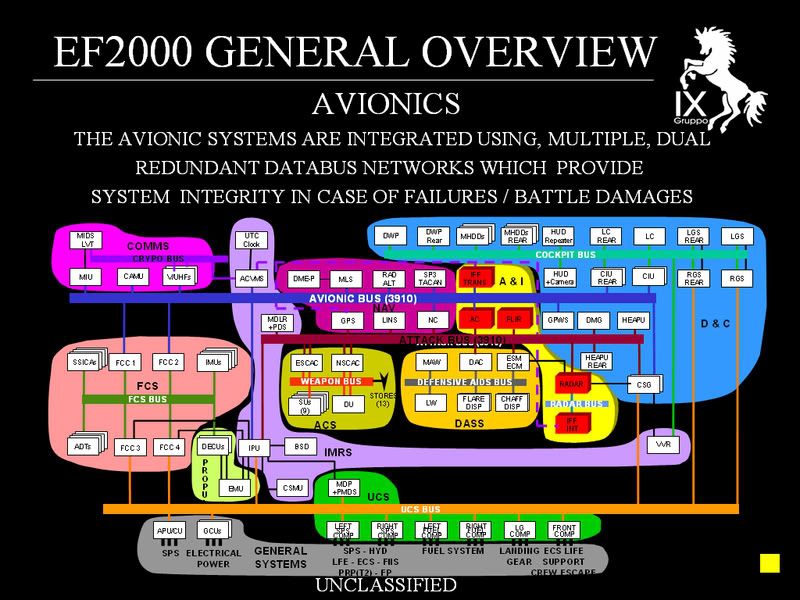
-The MDPU is connected to the 1553 and 3910 databuses.-
Military Missions Missions Combat Aircraft
Thales onboard the Rafale.-MDPU (Modular Data Processing Unit)
The core system is based on a Modular Data Processing Unit (MDPU) comprising:
– mission software
– display software
– mapping software
– network software
– flight-management software
– critical flight software.
-The MDPU is a SINGLE computing unit with FULL multitreading capabilities, all the systems being served in SOFTWARE.
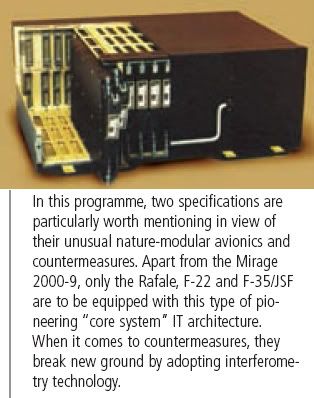
Mirage 2000 mk2 MDPU.
In simple words for you to grab you are trying to pass a Pentium II for a Pentium III because both have floppy disks, uses IDE connectors and DDR DIMM Sockets.
I sure know a few 14 years old IT students who realy would have laugh at this total inventions of yours, you’re TOTALY OUT of your league and it SHOWS.
FACE IT, YOU HAVE NO IDEA WHAT YOU’RE TALKING ABOUT!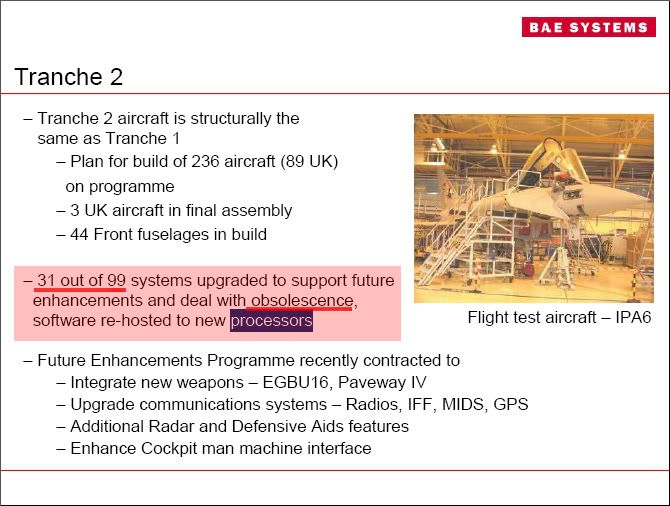
NO NEW CORE ARCHITECTURE HERE…
And only a number LIMITED to 31 out of 99 upgraded systems processors.
MDPU insure an upgrade ratio of 100% for ALL systems.
AGAIN YOU do not comprehend nor wants to undestand or admit what the difference IS, but in the real world in means WIDER bandwidth, higher power available to used prioritary terminals, higher level of redundency (A full module can pack up, processing power CAN and WILL be used for the task), higher level of upgradability.
Looks like the “DoesNotCompute” sticker applies here again, doing ineducated copy/paste doesn’t work at this level, friend but it is true that a little LIE here and then doesn’t hurt does it?
Now boyz please, spare us the vulgarity and deshonnesty we need to see this topic stay at a good informative level if possible at all.
Thank you in advance.
Originally Posted by TMor
The Typhoon special roll isn’t a mere barrel roll, it’s the High Alpha Velocity Vector Roll (HAVVR). I have yet to see Rafale doing the same.
I still have to see a Typhoon going beyhond 70*AoA or landing in 400m without a dragchute.
We all know WHY Typhoon can pass this maneuvre and it is totaly irrelevant to reality when it comes to maneuvrability in combat.
In addition, a few people will hate it because of Lord Assap’s propaganda.
The FACT that you canot comprehend a tenth of what i wrote doesn’t MEAN that it is propaganda Mr Tomor, it only means that you are just a tad ineducated and arrogant enough to take side without knowing.
Give us a break. Alternatively you can READ a learn.
LordAssapMr Scorpion.
This REALY applies to you methink.
Enough reality denial for you!!!
All SPINING-all-TWISTING doesnt change FACTS:
Rafale IS 5th generation core system architecture, “Concurent aircraft” IS 4th generation. = F.A.C.T.
Not to mention GROSS desinformation and mickey taking in a regular basis:
-Climb to 40k ft in 90 sec with 4 x ASRAAM + 4 x AMRAAM + 2 x 1000 l tanks (according RAF Typhoon pilot)-
-Typhoon has been widely acclaimed since its maiden flight offering pilots levels of performance and control that were unavailable in the past. Weighing in at 14 tons, a Typhoon can generate 18 tons of thrust from its afterburners – a power to weight ratio which means it can climb from runway height to 45,000 feet in just 30 seconds.-
North West Workers Celebrate Typhoon ‘Mission Accomplished’26 Oct 2007 | Ref. 342/2007
According to BAe Systems, the WEIGHT of the aircraft for this sort of climb rate is no more than 14t or 896 kg LESS than a Rafale M CLEAN with FULL INTERNAL FUEL…
source: Ministere de la Defense Les Echeances 2006 du programme Rafale pour les Forces Armees_PDF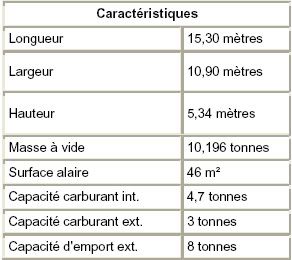
Did you know that the 12F pilots were talking about an aircraft with 4 MICAs, FULL internal fuel and 1 X 1.259 l external tank attached to it?
YES of course you did but it doesn’t STOP YOU coming up with big figures and showing off to the rest of us trying to compare a naval aircraft in full A2A configuration to a 14t “Concurent aircraft” with literaly NO endurence in it.
-The Tranche 2 airframe has been strengthened to carry heavier air to surface weapons that the enhanced system will be able to support.
Feature-
New Typhoon Development Aircraft Makes First Flight06 Nov 2007
What, strengthened airframes and NO change of WEGHT/PERFORMANCES?
“Auch ohne Nachbrenner-Einsatz ist ein Marschflug mit ca. Mach 1,5 möglich (Supercruise).”
This comes directly from the manufacturer. Translated:
“Even with afterburners it is possible to cruise with ~Mach 1.5.”
DREAM ON BOY. Corrected by BAe tech it translates by “IF the Engine Pressure recovery LIMIT was lifted”.
NO “Concurent aircraft” EVER flew at M 1.5 in DRY power nor ever will with this power setting and it says SO in virtualy EVERY Typhoon official wesbite today, BAe. EADS and else.
As always you take your wet dreams for reality and skip more than HALF the full story, is this pure ignorance or PURE intellectual deshonnesty? 😀
LordAssapLooking at all these figures and the “Squadron noises” (without obviously any subtancial source available) the word DESPERATIONcomes to mind.
I’m SURE comparing a NAVAL Typhoon (didn’t know they manage to put ont together) and Rafale M is on par with the usual “I’ve been told” whatever we have been served for years.
BTW 3 kg of AAM is likely to become 0.2 M when it comes to “Concurent aircraft” supercruise speed or even a few thousand feets there and then.
Acuracy and intellectual honnesty are gone down the guter for a few pages now…
Problem is: As usual there isn’t ANYTHING remotly subtantiable to all of these noises, and again WE also have our squadron papotes…
“Concurent aircraft” engine pressure recovery LIMIT in DRY power IS M 1.5 and “Concurent aircraft” NEVER flew at M 1.5 in DRY power, it was just suggested that this would be possible once the engine limits had been lifted.
The difference is honnesty here, and perhaps a tad of respect for the other posters, we dont generaly disclose what we canot substanciate or/and INVENT the rest.
As for the historical and technical argument, i think clearly it is case closed and rested.
Visibly, the “Concurent aircraft” fanboys aren’t bothered with reality checks and when one come their way, the only solution is making as much noise as possible in an atempt to minimise the “damages”, then try to get the guilty part banned, it worked before it might well work again.
WOW! The truth HURTS sometimes doesn’t it?
So what we clearly established is; there is NO substantial evidence whatsoever of “Concurent aircraft” superiority in most field where it was “advertised”.
Expecialy NOT in terms of maneuvrability, Systems etc.
In FACT it is now CLEAR that “Concurent aircraft” suffers from basic design deficiencies that Gripen and Rafale doesn’t know about.
Also as i posted from Dassault’s own Mirage_2000-9_special_issue_PDF, Rafale Core System Architecture is that of a 5th generation aircraft.
ONLY Mirage 2000 mk2/9, Rafale, F-22 and F-35 uses this IT architecture.
MPU.jpg
Mirage 2000 mk2 MDPU.
There can be as many processors onboard “Concurent aircraft” as its makers will, their level of effisciency depends before all of the BUSES architectures.
More to the point; Dassault and Thales says of MDPU that these are 18 MODULES, NOT CPUs and we do not know how many CPUs each modules are countaining.
All we know is that each of them are 50 X more powerful than the Mirage 2000 5F 2084 XRI which in turn were of a newer technology generation than the “Concurent aircraft” processors by a good TEN years…
More to the point, as opposed to what “we’ve been told” by our venoumous friend, we know from Thales that Rafale F2/F3 uses MULTITHREADING to the full, meaning FULL redundency, as well as being fully upgradable in terms of processing power, already possesing a 5th generation core system architecture and buses width to use the power.
Those who want do believe in the “Concurent aircraft” “superior” MMI and systems are more than welcome to keep dreaming.
LordAssapIt is quiet OBVIOUS that Scorpion have LONG ran out of arguments, NEXT desperate measure, get the under poster’s skin … :diablo:
Says a LOT about him doesn’t it?
But he no one is perfect. 😀
LordAssapAnother one who have a go at the unknown…
KKM57P “Possibility for adverse flow disturbances over the wing from the canard.”
Not when you got it RIGHT which is the case and have been validated by the Max AoA of 90* and 100*, superior INSTANTANEOUS turn rate of Rafale, low speed handling and short field performances of both Gripen and Rafale.
KKM57P “High canard CLmax leads to low efficiency e, and high e leads to low CLmax.”
I bet you imagined that LIFT was resulting from HIGH pressures to come up with an aswer like this. LOL.
READ: e value (total energy per unit volume)
Cl LIFT coefficient results from HIGH airflow energy.
Canards main role is to create the hysterisis effect at all AoA, even if deflected pitch down due to the downwash of their own root and tip vortexes.
e value is ACTUALY proven to INCREASES with the presence of Canard vortices which canards BTW doesn’t have a Cl most of the time.
Wing CLmax INCREASES with e and airflow velocity as local coeffiscient of pressure (Cp) values decreases.
Following your resoning, designing a close-coupled “lifting” canard for maneuvring would be first; stupid, second totaly unnecessay.
It is their own vortex interaction which causes these effects not their LIFT and there is more to it: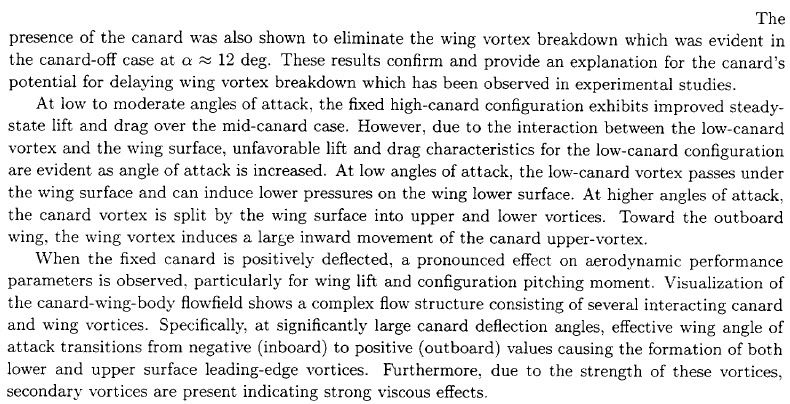
Here you go BOY!
Low and Mid-canard configuration are SIMILAR in effect to that of the Typhoon and does exactly as it says in the box; downwash, reduces LIFT and reduces induced GRAG.
High canard doesn’t display ANY of the so called “Disadvantages” you quoted, quiet the opposite.
AND There is NO “canard CLmax” on Rafale in flight configuration:
They are either used for pitch-down/pitch-up moments most of the time to counter instability both static (Subsonic) and dynamic (Subsonic AND supersonic), then put back to zero-lift or “floating”.
In MOST configurations the FCS will atempt to minimise their drag meaning positioning them floating in the airflow.
This is meant to reduce TRIM Drag, i guess you forgot about this one in your haste to get yourself noticed.
In supersonic, their action needs only to be of a MUCH LOWER amplitude than that of “Concurent aircraft” due to the DYNAMIC instability their interaction with the wing generates.
They energise and creates flow dynamics (and vortices) over the wing at all values of deflection, resulting in higher e values and increased wings-vortices strength and viscousity.
When they are used in pitch-up at high angles of deflection, it is in conjunction with other surfaces for a very particular configuration and effect, it is called variable LIFT.
What the presence of the close-coupled canards does in an instable like a stable design is moving the neutral point forward and INCREASE DYNAMIC instability not the opposite.
Therefore they reduce the need for high amplitude deflection of control surfaces including themself for positive g maneuvres.
Quotes:
• One of the primary mechanisms for the canard-wing interaction is the canard’s influence on the wing leading edge vortex.
• Both the canard downwash and the canard leadind-edge vortex have pronounced effects on the formation and subsequent trajectory of the wing vortex.
• The canard vortex influences the surface pressures on the wing directly, and to a greater extent, indirectly through its influences on the wing vortex.
• Furthermore, the effect of the canard vortex on the wing is highly sensitive to vortex strength and relative location, which are both significantly modified by variations in the canard position and deflection angles.
• Outboard of the canard-tip span-line, the canard leading edge vortex is the primary mechanism for the canard’s influence on the wing flowfield.
NOTE: What i was saying earlier about Typhoon canard tips positioned on the leading edge line of the wing to reduce induced drag using downwash…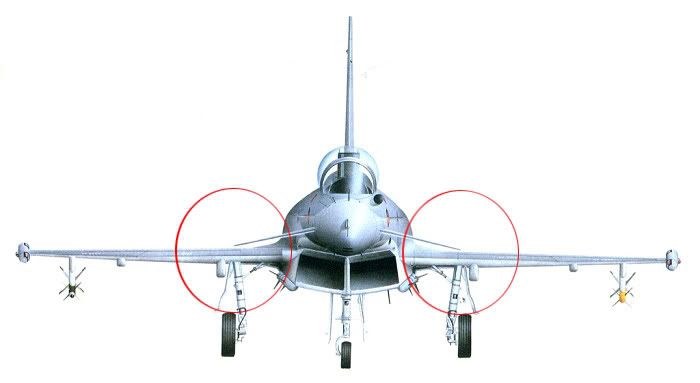
• Crossflow-plane vortex visualisation in the form of normalised total pressure contours and velocity vectors at two constant streamwise stations show the effect of the canard-vortex core and is an indication of the instantaneous vortex strength.
• Although the computed canard vortex is considerably weaker than the conrresponding wing vortex, its influence on the wing flowfield is still significant.
• For the two co-rotating vortices, each with a counter-clockwise rotation and position, the wing vortex induces an upward and outward movement of the wing vortex.
• In the absence of such interaction, the canard and wing vortex trajectories would be expected to follow and upward and outward path which would be dependent on the angle of attack and respective sweep angle.
• In addition to the canard-wing vortex interaction, the flowfield is further complicated by the pressence of a counter-rotating secondary vortex.
• The seconday vortex for the canard-off case is clearly visible in both total pressure contours and velocity vectors.
READ: ENERGISE, LOWER pressure vale (e), HIGHER airflow velocity, CREATES additional vortices (SEE below).
• At Alpha 4.27* (canard deflection), small differences in wing surface pressures are observed.
• For high-canard case, lower pressures on the upper surface near the wing leading edge indicate the possible formation of a leading-edge vortex.
• In the low-canard case, formation of the wing leading-edge vortex is inhibited due to canard downwash and the relative position of the canard and wing.
• The wing leading-edge vortex is clearly visible and contributes substantialy to the lift of the high canard configuration.
• However, even at this higher angle of attack, the low-canard results do not show evidence of a strong vortex on the inboard wing.
• In addition to inhibiting the formation of this vortex, the low-canard case also shows a substantial low pressure region on the wing lower surface.
• Both of these factors (absence of the wing vortex and low pressure on the wing lower surface) contribute to the loss of lift for the low-canard case.
Close-coupled canards are proven MORE not LESS effiscient by airflow peformances over the wing.
KKM57P “Generally have a small moment arm to VT, close coupled canard requiring a larger area as a long coupled canard.”
FALSE, total aerodynamic wet surface is roughly equal in percentage, level of effisciency is NOT.
POINTS
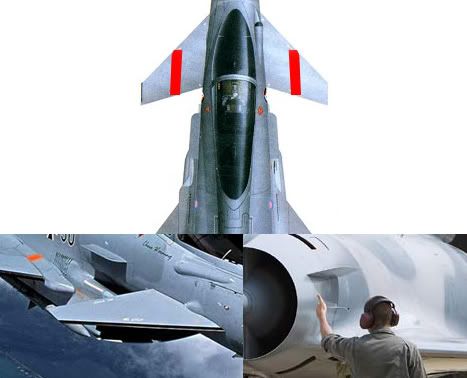
“Concurent aircraft” have to use strakes to obtain the SAME YAW stabilizing effect at high AoA than Rafale larger canards.
These strakes, ADD significantly to the total control wet surface and to the aircraft RCS.
“Concurent aircraft” canard area is 4.8% of its wing surface vs 5% for Rafale A and 6.5% on serie Rafales.
“Concurent aircraft” canards aren’t used for Direct-lift control principles and its landing speed is 20kt higher.
“Concurent aircraft” have to pitch UP in supersonic weither Rafale doesn’t for reasons of induced DYNAMIC instability.
However,at 30,000ft (9,150m) and a speed of M1.8, due to the lack of DYNAMIC instability resulting in the use of the long moment harm, Typhoon requires a 4° upward flaperon deflection to maintain level flight.
DATE:23/05/00
SOURCE:Flight International
EJ200 thrust vectoring backed
http://www.flightglobal.com/articles/2000/05/23/66017/ej200-thrust-vectoring-backed.html
Long-monent-harm IS NOT necessary when your level of pitch-up moment is increased by DYNAMIC instability and as a result Rafale INSTANTANEOUS turn rate is superior to that of “Concurent aircraft”.
• The mutual interaction between these vortices is an important factor in wing performance and is complex in nature.
• A comparison of the relative position of the canard vortex shows that the trajectory of the canard vortex is influenced by the wing upper-surface vortex.
Refers to for comparison and effects;
-The canard produces two additional vortices which combine with the vortices of the delta wing. This gives and extension of controlled airflow up to higher AoA and an unshielded fin and rudder.-
-The vortex lift starts ealier which results in reduced drag at a given lift.-
-At a given AoA. the canard configuration gives more lift and less drag than the canardless delta configuration.-
-The improved YAW stability permits higher AoA, and therefore lift and drag are approximatively doubled with the canards.-
-Overal maneuvrability at low speed is much improved. Minimum speed in 1g flight is down from 150kt to less than 107kt KAS.-
-The canards are about two-third the size of those on the IAI Kfir.-
-Up till now we had a forward and aft c.g limitation on the Mirage III. From test we know that the aft c.g limit was too optimistic and the wind-tunnel proved that the canard would move the neutral point forward by about 1-5 per cent.-
-The canard configured Mirage III presents a great improvement in low-speed maneuvring and INSTANTANEOUS turn rate.-
DATE:14/12/85
SOURCE:Flight International
Canard Mirage on test (Archive)
By Test Pilot Walter Spychiger
Here you GO BOY:
BOTH LIFT, PITCH AUTHORITY AND YAW STABILITY AT HIGH AoA ARE INCREASED BY THE PRESENCE OF CLOSE-COUPLED CANARDS.
READ AGAIN:
-This gives and extension of controlled airflow up to higher AoA and an unshielded fin and rudder.-
-The improved YAW stability permits higher AoA, and therefore lift and drag are approximatively doubled with the canards.- = Test Pilot Walter Spychiger.
KKM57P “The ‘bravest’ way to use canards is the the Typhoon way.”
That’s the opinion of someone who doesn’t bother to READ those of much more advanced aerodynamicists, pilots and technicians and get his answers all wrong first time too.
“Concurent aircraft” can’t achive Mirage IIIs low speed/high aoA performances and needs STRAKES to compensate for the lack of YAW stability at high AoA = Mirahe 2000 technology (again).
EADS:
-ALSR prevents the Eurofighter aircraft from departing from controlled flight at very low speeds and high angles of attack.-
-“After making a cautious approach to a few low-speed recovery corner points, I’ve gained confidence in the system so rapidly that I was able to enter the extreme low-speed recovery set-up with 70 degrees nose-up attitude and power idle without any hesitation”,-
http://www.eads.net/1024/de/pressdb/archiv/2004/de_20041104_low_speed.html
-Dassault:
-During test flights for opening the flight envelope at very low speed the aircraft flew at an incidence of more than 100° and at negative speeds of ’40 knots without loss of control.-
And yes it was brave to go for an unknown solution as a response to problems of interaction between the inlets and the canards.
-As a foreplane located close to the wing produced too much supersonic drag when combined with a chin inlet, designers selected a long-coupled delta/canard configuration.-
DATE:16/06/99
SOURCE:Flight International
Coming together
http://www.flightglobal.com/articles/1999/06/16/52567/coming-together.html
With the early close-coupled configuration of ACA, because an adverse aerodynamic interaction caused by the close proximity of the inlets, repositioning the canard 50% further forward WAS Eurofighter answer to the problem.
DRAG wasn’t the only issue here:
The wing was LOOSING LIFT at 0* AoA by action of the canard deflection only between 25* and 30* Ca.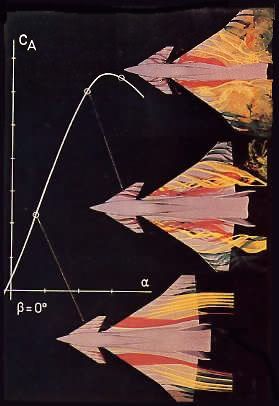
After EFA flight tests, at every redesign stage, the canard were repositioned <> 50% forward of previous.
At 30* Ca the canard would destruct the wing LIFT to such an extend that it was judged inaceptable by the design team.
This is the primary reason WHY the closer-coupled solution of the EAP and EFA wasn’t retained while Eurofighter still reconed at the time that the gain in LIFT was close to 50% like was the case for Rafale A and moprte for the serie aircraft due to optimisation of the design.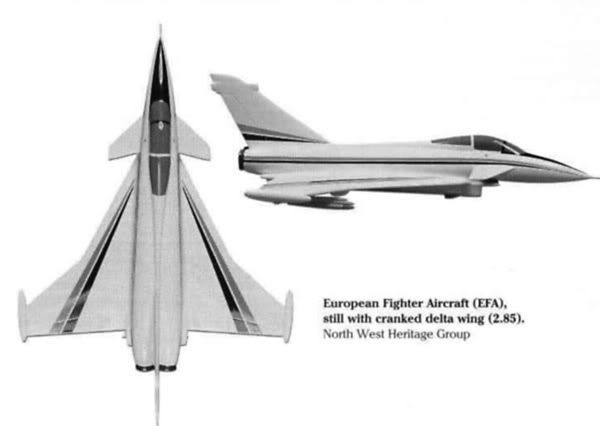
-The original cranked delta planform, seen on the EAP, was replaced by a simpler plain delta when supersonic agility requirements were relaxed. Foreplane size, determined by the degree of pitch instability needed to provide the agility required, was reduced.-
DATE:16/06/99
SOURCE:Flight International
http://www.flightglobal.com/articles/1999/06/16/52567/coming-together.html
POINTS:
ACA/EFA = CLOSE COUPLED CANARD.
DOWNWASH EFFECT WAS USED FROM DAY ONE.
VENTRAL INLET AND CLOSE-COUPLED CANARD DIDN’T WORK.
But this is a story too long for you to remember perhaps…
KKM57P “Much mounted well forward of the wing which greatly increases the moment arm and minimises the effects of downwash on the inner main wing.”
LOL! Typhoon WAS DESIGNED to USE the canards downwash.
There can be NO negative-lift induced downwash on close coupled if they are mounted ABOVE the wing root, too close from the leading edge to affect it with under-wing downwash, it is also the reason for the Su to use them in NEGATIVE pitch only.
On Rafale, the LEX vortex takes root well under the canard surfaces and that of the main wing way before the canard vortices hits the wing surface.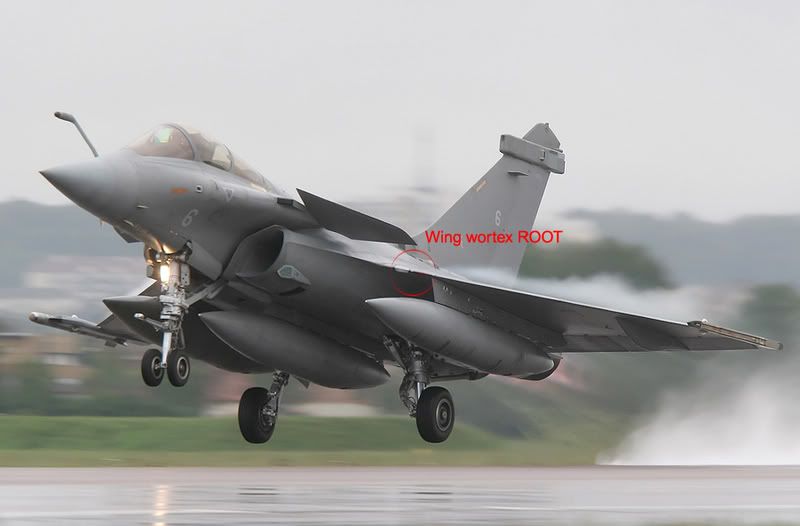
“The Typhoon is the only fighter to use this form as the Rafale, Flanker, J-10, Gripen et al use the safer, less destabilising ‘close coupled’ arrangement.”
AGAIN WRONG ANSWER; although X-31 is NOT a fighter it also uses long moment harm and suffers from EXACTLY the same problems:
= LACK of pitch control authority and YAW stability at high AoA.
As for being destabilising, you certainly dont comprehend DYNAMIC INSTABILITY and certainly havent SEEN a Mirage 2000 display either. LOL.
Which tends to PROVE your little analysis to be what it IS, a poor atempt to counter arguments which are born from hours of test-tunneling and flight-testing.
KKM57P “Computer testing is said to demonstrate that adding TVC to the Typhoon would not enhance agility, despite test engines have been bench run already.”
-Under the same conditions, but in a sustained turn, where the pitch element of the control surface deflection was 6° up, this could be reduced to 2° combined with a 4° nozzle-up component. In this configuration lift coefficient would be increased by 14%, translating into a 9% improvement in turn rate. Take-off distance could be cut by at least 25%.
DATE:23/05/00
SOURCE:Flight International
EJ200 thrust vectoring backed
http://www.flightglobal.com/articles/2000/05/23/66017/ej200-thrust-vectoring-backed.html
Who the hell are you? A Train spoter?
It is OBVIOUS that the long moment harm doesn’t work as advertised and that it IS source of many problems.
Adding TVC to “Concurent aircraft” would solve the problem of supersonic pitch-down and resulting increased pitch-drag because right now it can be as BAD as 4° elevons up.
-In this configuration lift coefficient would be increased by 14%, translating into a 9% improvement in turn rate. Take-off distance could be cut by at least 25%.-
Obviously you didn’t bother reading about it nor did you know the reasons WHY TVC would be beneficial to “Concurent aircraft”.
End of debate.
BTW you’re MORE than welcome to substantiate next time with source with some form of authority on the subject because you might be mystaken for someone who knows what he writes.
Venky
-Thanks for the effort. Canards of Typhoon always looked to me as after thoughts.-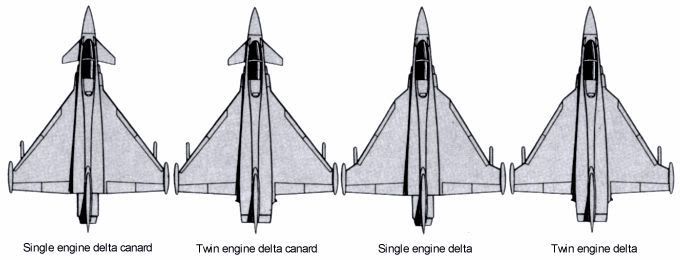
You’re quiet observant, for all i know they could have been positioned anywhere else on the airframe…
-The heavy weight configuration would impose a maximum speed of Mach 1.04 and a minimum speed of 100 kt, depending of engines configurations. Roll rate and maximum angle of attack also would be naturally limited.-
Rafale To Offer Multirole
Mission Capability
DAVID M. NORTH/ISTRES, FRANCE
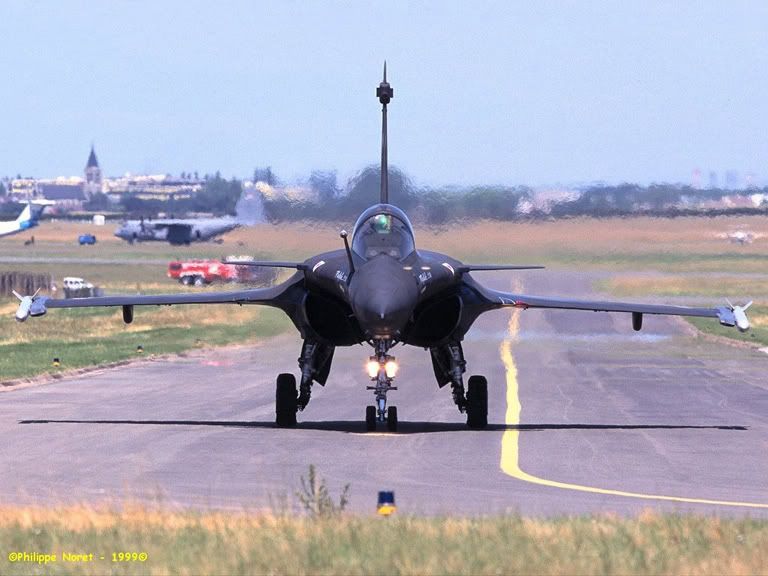
Who’s NEXT?
LordAssapT2 uses PowerPc processors instead of the motorola.
Good luck.
Man you’re the one who GREATLY NEEDS luck…
Power PC? What do YOU think these COTS Motorola processor ARE? :p
Next time try to INFORM yourself before answering.
As for your reply on weapon load same here, just as if you had the knowledge base to comprehend the whole thing.
Have a good look at the way thew weapons are actualy aligned on BOTH Rafale and Gripen and ask yourself; how can Dassault and SAAB BOTHER aligning AAMs close to the Cg when they actualy weight only 112 kg in the case of the MICA(and not 115 according to IXARM or MBDA).
There are those who are serious about this subject and the fan club who are revving about what they either dont know or doesn’t comprehend (Still daring taking the mickey BTW).
I was kind of hoping you wouldn’t fall into this one. :diablo:
For the other posters
I have visited and downloaded the F-16.net Forum, topics (8 pages) “F-16 versus Rafale”…
Those things these guys writes about French aircrafts and weapons!
They still think that the MICA have a range of only 50 km, when it is given for 80km by the MinDef wesite for years now.
Characteristics:
Length: 3.1 mDiameter: 160 mm
Weight: 112 kg
Warhead: 12 kg blast and fragmentation explosive
All-weather missile
Hardened against electronic and IR counter measures
Solid fuel propulsion
High manoeuvrability using 4 jet deflectors in the nozzle.
Guidance modes:
Fully autonomous after launch
Throughout flight, uses inertial guidance with intermediate target update from the Aircraft/Missile link (LAM) to the aircraft’s navigation/attack system.
On final trajectory: active radar or IR imaging seekers
Performance:
Multi target / multiple launchRail or ejector mount launch
Range:< 500 m to > 80 km
Speed: mach 4
Manoeuvring load factor: greater than 50 g
http://www.ixarm.com/Technical-card,11177
As for Rafale, they still can’t grab it to the full, they speak about it like a larger F-16, regardless of its large advantage in wingload and TWR in A2A combat configuration (50% internal fuel).
Still i got some interesting datas from a guy called toan:
-As for the turn rate of Rafale, according to the information I know, the maximal instant turn rate of Rafale is more then 30 degrees per second (Some sources of military information declared that it could reach up to 35 degrees per second), whereas its maximal sustaneous turn rate could reach 24 degrees per second.-
NOTE: From what i can remember of the doc i have read at the time of the Korean contest:
The Korean press WAS reporting these 35*/sec figure, saying that the aircraft was the one with the highest INSTANTANEOUS turn rate ever, that it could “SQUARE” a turn and loose its adversary this way.
As a matter of FACT one only have to look at the figure called “Square Dance” to have an idea…
Obviously i would LOVE to get my hands on this article again, i can’t remember reading the SUSTAIN turn rate figures though but the 24*/sec are the figures demonstrated by Rafale A at the Frarnborough AirShow 1988, SAME for the stabilised AoA of 32*…
In all the figures posted, i can spot MANY of them being those for the Rafale A (AoA, SUSTAINED turn rate) but i am certain of the INSTANTANEOUS turn rate figure for the Korean contest.
Having said that these figures still have to be validated in one way or another…
When it comes to rough figures, if one believes what have been published there and then, a Rafale C would be quasy on par with a “Concurent aircraft” which can accelerate from 200kts to Mach 1.0 in under 30 seconds.
That’s 370.40 km/h compared to the start point given by TMor of 300 km/h.
Q: TMor, Where did you get these figures from?
BTW not ver useful in km/h, only the Russians uses metrics for speed.
In the WEST we use Kts = 1.852m or 6,076.1155 Fts/sec exept for the Mach (M), which is dimentionless, being the ratio of true airspeed to the local speed of sound, and is function of the square root of the ambiant temperature.
The 1976 ICAO data for sea-level M value in standard atmosphere is:
1115.4505 ft/sec.
340.2941 m/sec.
1225.05876 km/h.
661.4788 kts.
So Rafale does; 161.987 kt->M 0.816 in 20s.
0.184 M and just under 10 sec difference.
From 161 kt, 39 kt difference starting point.
A photoshop scale give an idea of the acceleration capabilties of the two aircrafts…
So? Well, as i was saying, i would stick to a Rafale from 0 kt to M 1.5 any time…
If what this 2000 M2k pilot says is true, what goes for the Mirage vs F-16 would OBVIOUSLY go for Rafale vs “Concurent aircraft”:
-This is wrong. A good pilot in an M2K will kill a good pilot in an F-16 9 out of 10 times (1 provided for launch failure).-
-I served in an M2K fighter squadron in HAF. We analyzed tactics and combat scores against HAF F-16 squadrons all the time.-
-The M2Ks higher INSTANTANEOUS turn rate gives it an advantage during the first pass. The F-16 cannot outturn the Mirage. It has to climb in hopes of avoiding the lock. A good M2K pilot will end it right there (the Magic 2 is a better IR weapon than the AIM-9L/M).-
-A rookie in the M2K, however, will probably lose the F-16’s climb. The more powerful viper will escape and will then gain the advantage because of 1) Altitude 2) Higher SUSTAINABLE turn rate-.
-As for turn rates, altitude differences are purely theoretical and in practice make no difference EXCEPT for sea level manuevers where the more powerful Viper starts gaining the advantage.-
So please, give me MORE of “Concurent aircraft” superiority in whatever form you wish…
Rafale C A2A Combat configuration:
6 X MICAs, 50% Internal fuel.
Pylons: <> 320kg
AAMs: 672kg
Fuel (50%): 2350kg
Aircraft: 9500 kg
12842 kg.
TWR: 1.1680.
Wingload: 281kg/m2.
“Concurent aircraft” figures:
Internal fuel 4.800kg (Source EF2000GeneralOverview1BIS).
ASRAAM 2 X 88 kg = 176 kg.
AMRAAM 4 X 157 kg = 628 kg.
Pylpons 2 X 80 kg = 160 kg.
Aircraft 11.000 kg.
Internal fuel (50%). 2400 kg
= 14364 kg.
TWR = 1.253 vs 1.168.
Wingload = 287.28kg/m2. vs 281kg/m2.
Considering Rafale higher Cl (close-coupled canards + LEXs) the Mk2 vs F16 story repeat itself with just a little difference; the Mk 2 TWR is way lower than that of the F16…
Figure Empty for rough comparison.
Mirage 2000 mk2:
7920 kg empty.
M53 P2 = 95 kN.
TWR Empty = 1.199.
F16 Block 60:
10000 kg.
General Electric F110-GE-132. 147 kN
TWR = 1.47.
Rafale C TWR = 1.578
Now compare Rafale and “Concurent aircraft” at EQUAL range and you probaly will got a similar TWR due to the higher fuel consumption of the “Concurent engine”.
You’re all welcome to challenge these figures which are for the aircrafts, AAMs and fuel acurates.
For the pylons i gave an average based on”Equivalent” technology…
LordAssapBITE!
“Concurent Aircraft”:
-modular system based on Motorola 68020 CPU’s with 68882 Maths co-processors.
1) Motorola 16/32 Bit Product Line:
=====================================
-Motorola introduced its first microprocessor in 1974: the 8 bit MC6800 withan extensive line of support peripherals soon available. The MC68000 wasintroduced in 1979 and was soon followed by a host of 16 bit peripheralchips.
-The 6800 and 68000 families soon became very popular due to theirstraightforward architecture and simple and easy to use bus connections.
A) MC680x0
————
The original MC68000 has the following general features:
* CISC – Complex Instruction Set Computer architecture.
* eight 32 bit general purpose data registers (D0-D7).
* eight 32 bit general purpose address registers (A0-A7).
(A7 is the stack pointer – user or supervisor)
* 32 bit Program Counter – linear 4 gigabyte – no paging or segments.
* 16 bit external data bus – needs 16 bit ROM and RAM for system.
Can access 8 or 16 bit memory and peripheral devices.
* 16 Mbyte linear addressing range (23 bit plus Upper* and Lower*
data strobes for an effective 24 bit range), 32 bit with 68020.
* 56 Instruction types – over 1000 useful permutations are possible.
* memory mapped I/O. (peripheral registers addressed as memory).
* 14 addressing modes on a contiguous address space (no segments).
* 5 main data types. (bit, byte, BCD, word and long word).
* Supervisor and User states. Stack Pointer A7 is set to
User (USP) or Supervisor SP (SSP) by a bit in the status register.
* Exception processing and 7 levels of interrupts.
* Tracing function – each instruction ends in a TRAP to user program.
* Asynchronous bus structure. Uses DTACK* from the peripheral chip.
* non-multiplexed address and data buses – interfaces with LS-TTL.
* Bus Arbitration and an internal TRACE facility for debugging.
* 5 volt NMOS dynamic construction. (68HC000 is a CMOS MC68000)
“Concurent Aircraft” Motorola 6800 series = COTS 1980.
Mirage 2000-5F 2084 XRI = COTS 1990.
Mirage 2000B prototype extensively modified as the first Mirage 2000-5 prototype, first flight on 24 October 1990 with Patrick Experton at the controls.
Rafale F2 MDPU EMTI FASTOS was developed by Thales from 2000.
A technology CYCLE is about 5 to 6 YEARS.
This assumption could have been working against me but as it turned out i was WAY off the mark in favour of the “Concurent Aircraft”…
Now my friend Scorpion, i know “Concurent Aircraft”: -modular system based on Motorola 68020 CPU’s with 68882 Maths co-processors have been upgraded with T2, if you want to figure out what its processing power realy is you have the basis for it.
Good luck.
Some precision on your question About the centraly mounted AAMs.
Dassault WAS proposing two stations for MICAs in ventral position in the very early days (I’ve got the brochure from their technico-commercials of the time BEWFORE GIE) but they didn’t pursue or develop them as they did for the external underwing pylons.
Many reaons for this:
First there was NO requierements for them.
Second as SAAB did they tried to concentrate the weapons around the CG as much as they could, the two ventral ejectors being some sort of exception.
Third they wanted to free the central area for either tanks or MN configuration weapons (AM-39 etc).
Other weapons quoted as possible in these two stations were:
AMRAAM
APACHE
ALARM
HARM.
As you can see only the Apache did find its way there with the Rafale Ms.
As far as we know no serie Rafale have been flown with AAMs attached in these stations.
LordAssap@arthuro: My appologies for my lack of courtesy.
LOL! Looks like some haven’t been digesting the reality checks i posted looking at the reactions!
BTW the 68020 processors used by the “concurent aircraft” are of the SAME technology generation than the 2084 XRI used in the Mirage 2000 5F. :diablo:
GlobalPress
-uhmm the typhoon academy rebelion , can’t argumet anything so trys to drags ppl down and beat you by experience.-
Precisely, and the worse thing is that there are still the occasional ones who fall for it.
NOTE how many times the word BAN have been used by the same guys who doesn’t know their front from their back on the subject but realy doesn’t like to be counterdicted even by the strongest of evidence?
I know the truth is VERY disturbing to READ pitty some have the guts to read it and some other doesn’t, it doesn’t make for good, interesting or informative exchanges.
You see i dont need laughing gas when i READ thrown at me like a “proof of superiority” that an aircraft have a G onset of 15 g when its Maximum structural load factor IS precisely 15 g.
 This is a HARCORE dose of whatever they have for breakfast, visibly there is an information and comprehension gap here…
The bit on Rafale computing architecture was some PIECE of work too, and would have had a few IT schoolgirl weting themself laughing…
Q1: What am I supposed to understand from THIS all?
So basicaly we got YEARS of “Superiority” claims about one aircraft vs the other DOWN in flames, this means back to basis, wait and SEE the next Rafale encounter with some concurent aircrafts.
The one guilty of this offense is to be hanged tomorow at down. 
-Were the centre line stations ever considered for AAM carriage beyond the Rafale A?-
You SHOULD read the doc from:
http://www.mach-flyg.com/utg80/80jas_uc.html
The answer is simple NO.
All weapons stations are situated as close as possible to the CG for quiet OBVIOUS reasons while pods can be left in the frwrd position for the SAME obvious reasons.
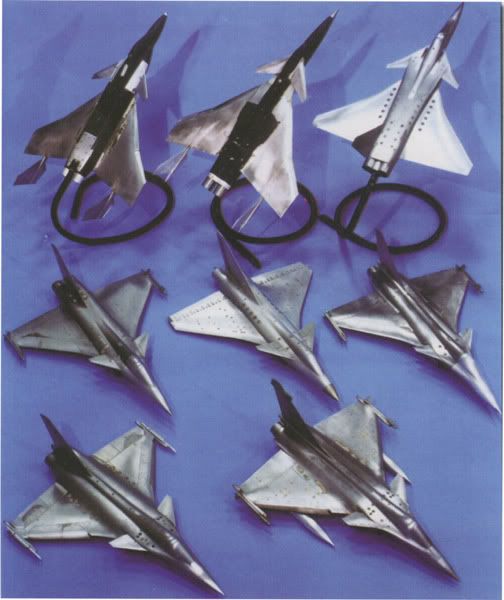

Comparison between some of Dassault’s solutions and HiMAT.
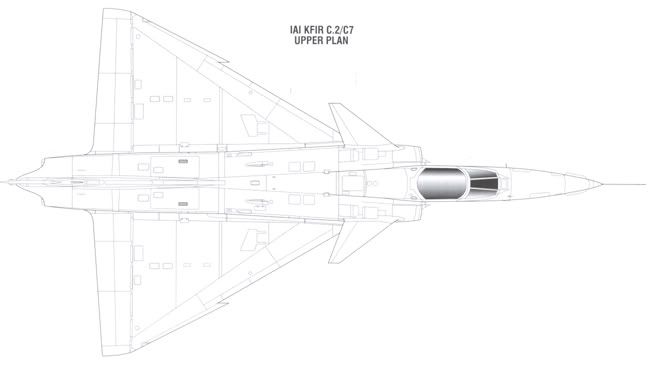
IAI KFIR upperview. Note the dogtooth on the leading edge…
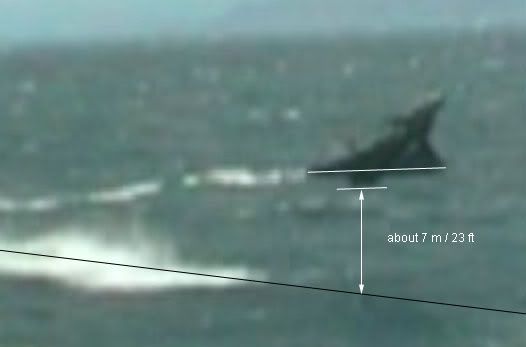
MORE than 45* AoA, WAY passed the soft limit with a 1.250 l tank attached to it, this would guaranty a “Concurent aircraft” spectacular splash.
REALITY:
1) YOU NEED speed-energy to pull Gs.
2) As the maneuvrability matrix SHOWS, the Load Factor Rate phase is ONLY the TRANSCIENT phase, it STILL have to be STARTED and TERMINATED acuratly.
3) To achieve this one will NEED the highest level of pitch control possible, NOT “Concurent aircraft” forte.
4) “Concurent aircraft” MAXIMUM STRUCTURAL LOAD is 15G.
5) “Concurent aircraft” is FCS limited in a way a Rafale or Gripen isn’t, expecialy in the AoA area.
6) This means NO way a “Concurent aircraft” will EVER be pulling 15g in one second or fly above its Max AoA in post-stall maneuvres a Rafale is capable of.
7) Quoting a “Concurent aircraft” display pilot; “The stick does feature an override or detent, but this only produces an effect when the aircraft is in a g-limiting condition (higher speeds) where a percentage of extra g is then allowed”.
“In actual fact the window where 9g would kill you and 9+x%g would save you is very small indeed, but that’s irrelevant to this story because it is highly likely that the aircraft was a speeds where it would be alpha limited not g limited.”
8) “Concurent aircraft” LOWER alpha limits means it FCS limiter will kick-in much earlier than for a Rafale which CAN pull 11 g in case of emergency.
This Rafale M pilot can testify of this when he pulled of a low-level dive with an AoA <> 45* to avoid splashing his pants in from of the Admiralty watching on the deck of CdG. 😮
Say THANK YOU to the Rafale design team whoever was flying this M…
LordAssapYeah of course strange that everyone understood it right except for you. But I understand I’m no french man so I can’t reply to a question about a french aircraft
Troll
Sorry? Say again? Who is incapable of following a civilised discusion here?
POINT: YOUR reply was about total Misslies load, NOT Meteors. :p
-INSTANTANEOUS turn rate:
RULES:
.Instantaneous performance describes the capability of an airplane at a particular flight condition, at an instant in time.
.There is no consideration of the airplane’s ability to SUSTAIN the performance for any length of time, nor is there any consideration of the energy rate at these conditions.
.Energy loss rate may be high, and is manifested usualy by rapid deceleration or altitude loss.
.The engine is capable of changing the energy loss rate at these conditions.
.First, consider the maneuvring potential of the airframe alone.
.Instantaneous turn performance is a FUNCTION OF THE LIFT CAPABILITY AND THE STRUCTURAL STRENGTH OF THE AIRFRAME.
.Neglecting the thrust effect, the LOAD factor is function of LIFT COEFFICIENT, DYNAMIC PRESSURE, AND WING LOADING.
.For a given set of test conditions (Altitude and Mach Number), the maximum load factor is attained when Cl is maximum and W/S is a minimum.
.Instantaneous turn performance demands high Clmax and LOW wing loading for attaining high load factors.
.The maximum LIFT coefficient is limited by aerodynamic STALL, maximum control deflection, or any of a number of adverse flying qualities.
POINTS:
3-AXIS control at HIGH AoA, LOW speed flying qualities, STALL characteristics (Departure), LIFT CAPABILITY and STRUCTURAL STRENGTH OF THE AIRFRAME, LOWER wingloading.
All of which are BETTER in Rafale’s case.
Aerodynamics have little to DO with sensor accuracy but with fluids dynamic and physics.
Close-coupled canard DOESN’T depart at lower speed and displays:
.Spin recovery known to be acceptable for close coupled delta canard (not necessarily so for a long coupled canard configuration).
· Proven spin recovery capability for complete cg and AOR range.
· Nor risk of being trapped in a superstall, control authority exists.
http://www.mach-flyg.com/utg80/80jas_uc.html
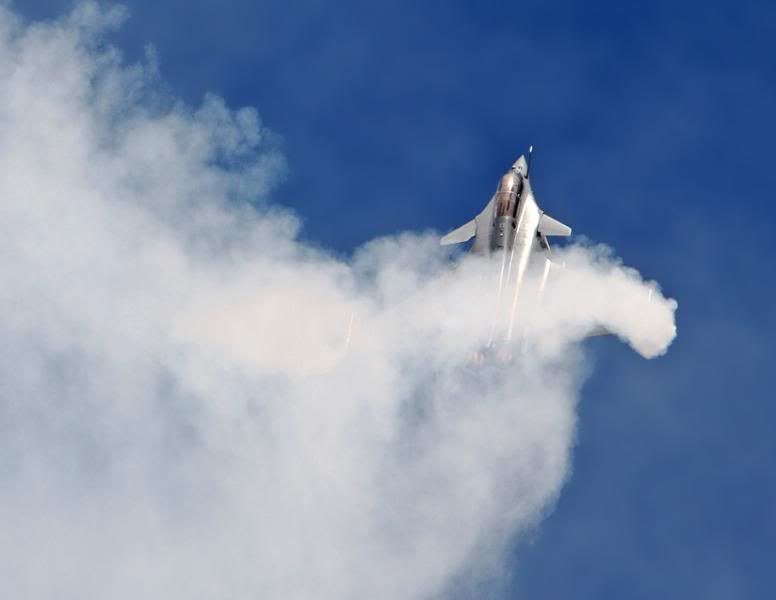
The usual low level posting…
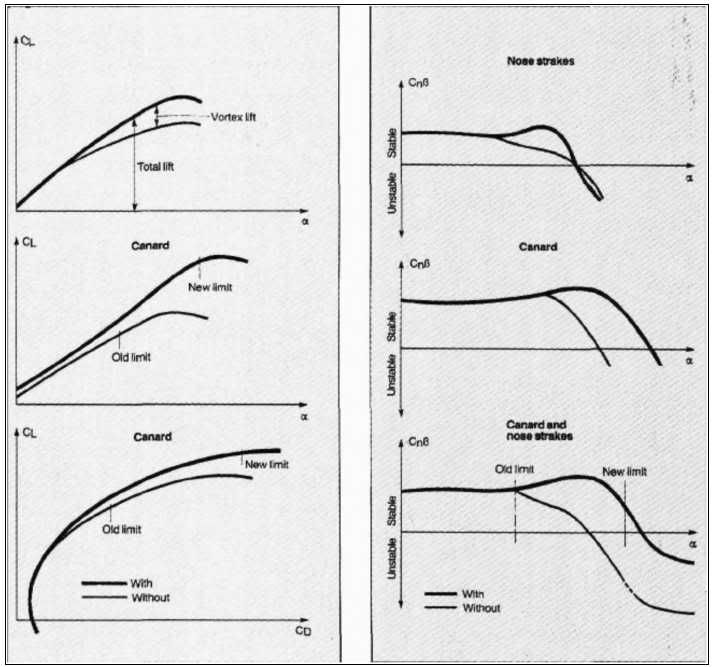
Differences made by the presence of close-coupled canards on the MirageIIIS flight envelop.
From Flight International 19th February 1983:
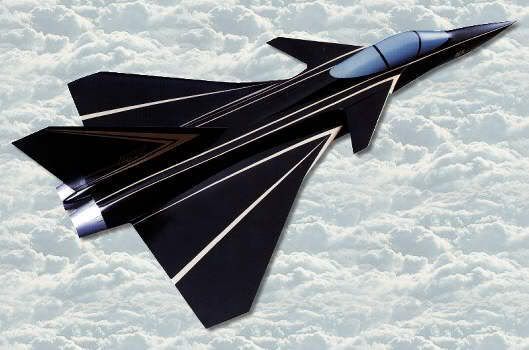
France prepare to “Go it alone”on ACX.
Preliminary design is already under way at Dassault, and several ACX characteristics have been defined:
.Design emphasis on maneuvrability, stability at high angle of attack, and low speed handling for short take-off and landing.
.Crancked-delta wing plan-form, with large area canard control surfaces and a single fin.
.Twin engine (preferably) with intakes optimised for high angle of attack.
.Active control, with guts alleviation, and generalised automatic control to reduce pilot workload. Fibre optic digital transmission, multifunction cockpit display and voice control.(*)
.Extensive use of new materials and manufacturing processes including boron, carbon, kevlar, and hybrid composites and superplastic forming and diffusion bonding of titanium.
Dassault is applying new computer-aided design methods to ACX, enabling engineers to work directly with the computer for conceptual and detail design and machine-tool preparation.
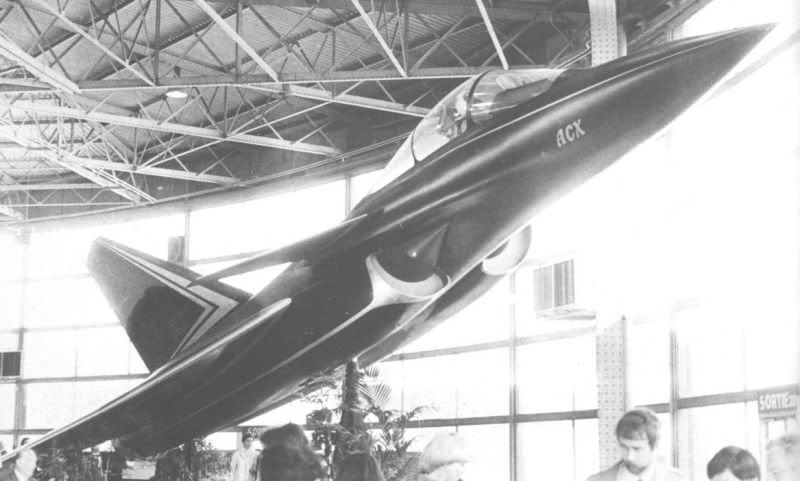
(*) Rafale A began trials in April 1989 with digital flight control and OPTICAL firbre transmission.
(source Jane’s All Worlds Aircrafts 1998-1999).
“Rafale A Good around the boat”.
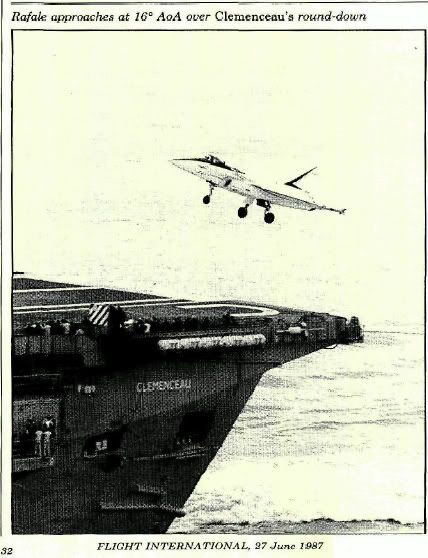
3 different pilots, day/night traps, 98% GO by deck officer.
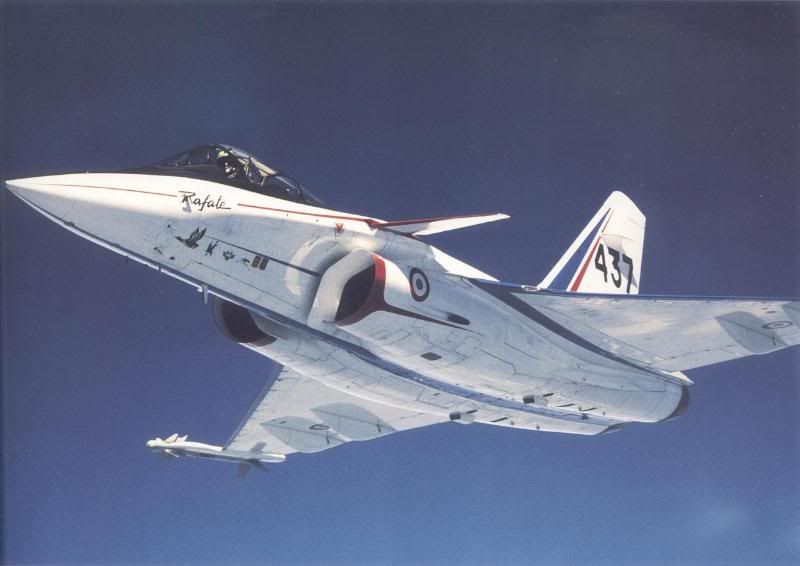
“The higlight of the Rafale display was a very impressive clean pass with the angle of attack slowly increasing to some 40*-45*, before engaging reheat to beggin a serie of loops and rolls”. Flight Internatinal 6th Sept 1986.
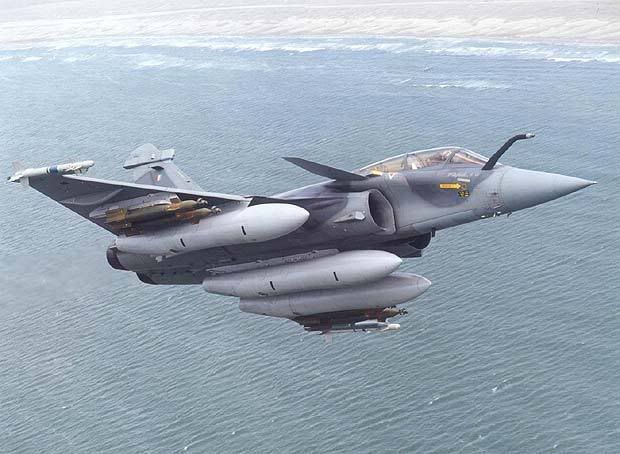
“The active canards allow the introduction of direct-lift control principles. For example,it will be possible to increase or decrease lift at will, by using the canards and elevons together, without changing aircraft attitude or angle of attack”.
Flight International4th January 1986
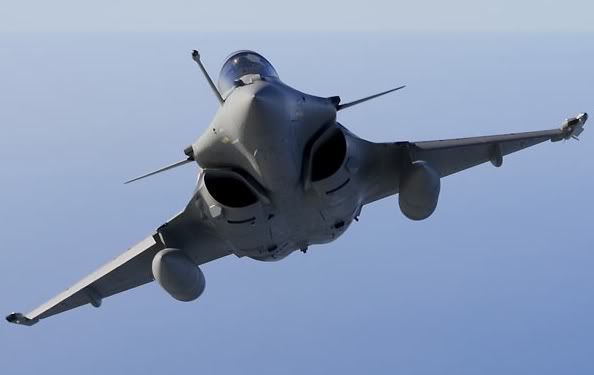
Direct-lift control principles
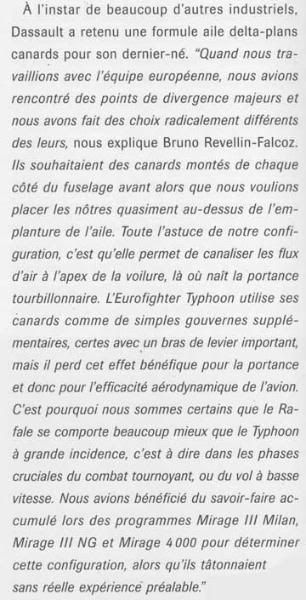
Courtesy of Kovy (?).
😎 Enjoy and please SPARE us the usual mediocre we had it for YEARS…
@TMor please check your targets before firing, boy, i WAS replying to a REMARK made by one of the crybabies quoting eurofighter Typhoon.
Generaly in a democracy, only the offenders are to be blamed, so loose this habbit of yours to shoot blind, thanks in advance.
LordAssapPIRATE can at least cinematically range targets,
I know someone who was literally crucified for claiming the same rough ranging for OSF, MUST be a French thing…
A MICA IR doesn’t requiers LASER ranging, this was added to OSF as a capability more for the AdA traditional gun ranging (Jaguar/F1) and eventually passive firing of EM MICA.
IR MICA seeker detection range is likely to be WAY superior in optimum condition than the laser itself anyway and it wouldn’t see its range decaying the way a laser does in adverse MTO conditions.
MICA IR it doesn’t NEED ranging at all only seeker detection and lock, forget about the laser range finder.
BTW, Pirate was developed with the same manufacturer using the SAME technologies as used by OSF and is only an IRST, OSF posses TWO Channels.
LordAssapDon’t blame me for your incapability.
?????????????
Enough spin please, EVERYONE can READ total of 4 missiles, and skip the paranoiac bit and finger pointing every time you shoot yourself in the feet.
I corrected a GROSS inaccuracy about Maximum MISSILE load and there was NO questions in you reply ABOUT THE MAXIMUM BEING METEORS. :diablo:
We all understood the question but the reply is NOT about that was asked but “TOTAL OF 4 MISSILES“.
AGAIN: For everyone to SEE THIS was YOUR reply.
Scorpion82
-Rear fuselage stations and centre wing stations, mwaning a total of 4 missiles.-
I didn’t write this, YOU DID, i corrected it because the MAXIMUM missile load proposed by GIE is NOT 4 but 8.
Salut OPIT…
LordAssapmwaning a total of 4 missiles.-
Perhaps you have a problem with formulating your answers then, because this was it = TOTAL OF 4 MISSILES.
NOT TOTAL OF 4 METEORS.
LordAssapSome interesting archive pictures…
Some of the diverse configuration fully wind-tunneled byt the Dassault team.
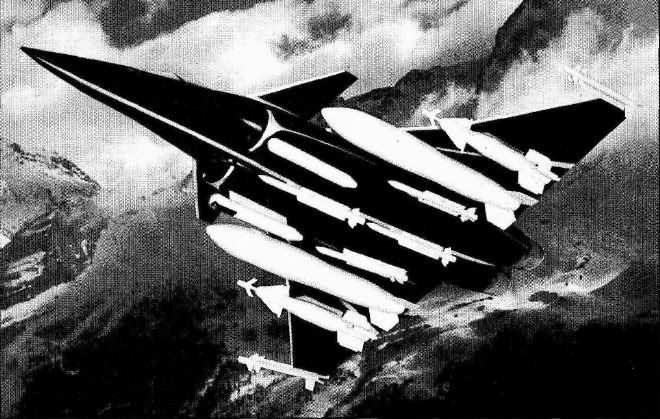
This is the “John Player Special” of the 1983 Paris Airshow, shown in heavy configuration with 2 X BGL, Laser designation pod, Electronic Attack pod, 4 X MICAs, 2 X Magic IIs.
The “Souris” were deleted as there was NO requierement for M 2.0+ and the intakes were reconfigured for 1.5 shock with diverters.
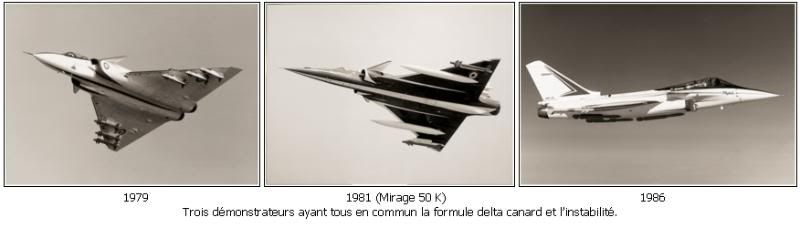
The 3 aircraft which were used for the developement of serie Rafale.
Mirage 4000, Mirage IIING (in fact a 50K modified with crancked delta, canard and Mirage 2000 FCS), Rafale A.
All three were instable but only Rafale A had fully controlable canard surfaces.
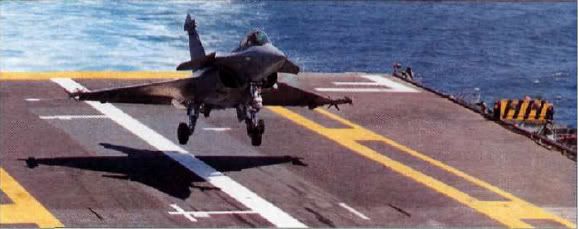
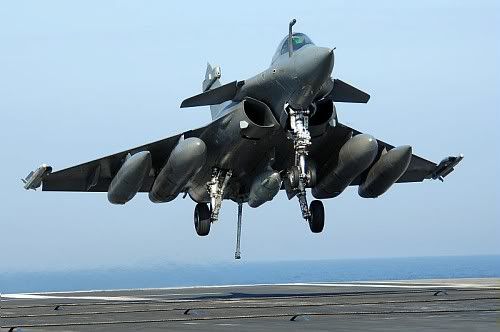
Probaly Rafale M01 during Carrier trial onboard Foch and M1 in Nounou configuration.
Note the canard deflection normaly at 30*, the 16* AoA, the fully deflected trailing edge acting for variable camber, leading edge position is automaticaly adjusted depending on glide slope correction (Sink rate)…
The canards can assist the trailing edge surfaces in case of strong wind gust so they can appear in some pisture out of their 30* setting in landing configuration while in reality their action would be very short.
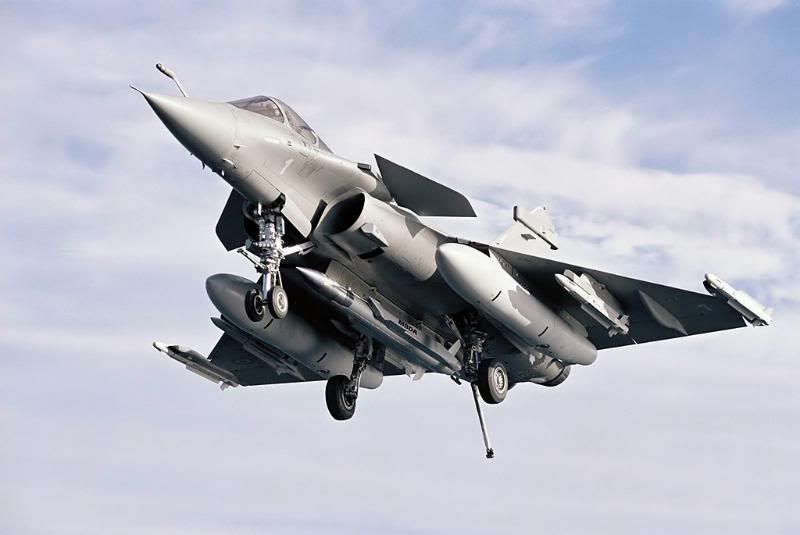
Approach speed should be 120/128kt depending on trap weight.
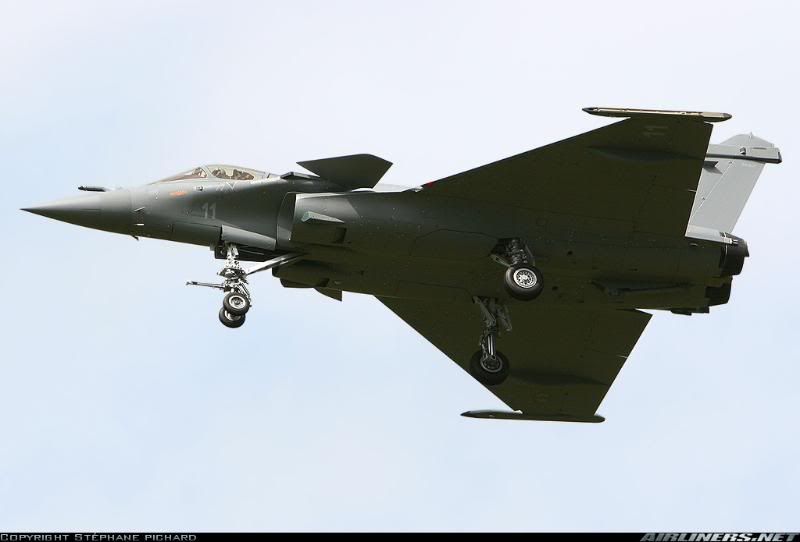
Courtesy of Kovy (i think) M11 shows the trap configuration quiet well, note the rather flat attitude of the aircraft, and the leading edge slats fully “off”…
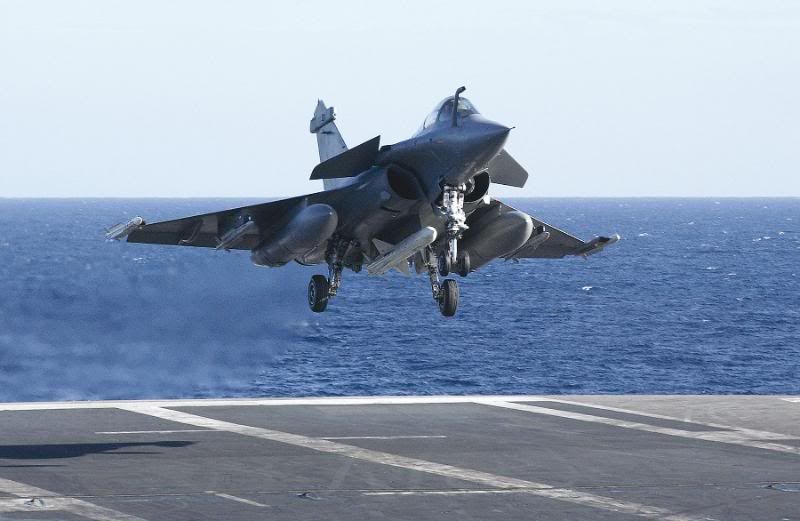
I salute Signatory and other friendlies!!! 😉
LordAssapGood info, keep it up it is interesting!
LordAssapForget about the reality deniers…
Here is a little more for the educated posters…
Rogerout
So according to U. Claréus, project manager, JAS 39 Aerodynamics, Saab Aerospace it is not a contest about the most unstable plane, but what suits your design best.
Exactly, extreme or moderate it will all depend on design which themself depends on requierements.
It is obvious that Rafale designers were looking at a natural lead-on from their researches on canard design which demonstrated clearly the advantages of the close-coupled formula.
Dont forget that they were the first in Europe to flight-test a long moment harm canard M 2.0 fighter.
Following development of KFIR and Mirage IIIS they designed Mirage 4000 and IIINGs to validate the closed coupled canard and Electric FBW but selected it for ACX as early as 1982.
Between 1978 and 1983, they studied 265 possible configurations some of which were looking like HIMAT and actualy tested in St-Cyr windtunnel, before HIMAT was flown, Rafale A flew on 4th July 1986.
They OPTIMISED the design from the Rafale A to the serie aircraft, repositioning the wing so they could ADD LEXs, and the canards so they could increase their level of interaction with the wing.
Serie Rafale low speed characteristics and overal maneuvrability at all speed are WAY better than the A.
The canards actualy are deflected upward at 30* in landing configuration and blow the airflow from their intrados directly over the extrados of the wing.
In this configuration, the aircraft pitch attitude is controled by the trailing edge surfaces and the sink rate by the leading edge slats (LIFT).
Rafale can use FULLY variable camber to control its level of LIFT and autothrottle does the airspeed.
Rafale wing went from a crancked delta (A) to a straight delta at 48*, the optimum Mach was chosen at design stage with the combination of leading edge sweep and Aspect ratio which went from 2 for the Mirage 2000 to 2.2.
The reason was REQUIEREMENTS, for combat between M 0.9 to M1.6/1.8 MAX rather than 2.2 MAX for the 2000 (58* leading edge sweep).
The LEX have for effect to create a SECOND CORNET Vortex at the wing root, increasing the effect of the interaction between the canard and the wing.
Using LEX also solve the problem of the crancked delta non-proportionate shift of Cl in supersonic.
So looking at the Typhoon design, i can tell that the retained solutions are for minimum supersonic drag at M 2.0 (53* Sweep leading edge), even the canard tips are positioned as to use a DOWNWASH effect on the main wing at 0* AoA.
This will reduce induced supersonic drag but doesn’t do any good to LIFT and also their forward position guarantees the problems related to it.
In particular, the loss of DYNAMIC instability means a pitch-down moment in supersonic and the need to have the elevons compensating for it, increasing supersonic pitch drag.
To pin it i will just remember that the Rockwell X-31 which is a similar design to Typhoon suffers EXACTLY the same problems of lack of pich authority at high AoA despite the TVC.
They both reached 70* AoA MAXIMUM.
With an integrated canard, DYNAMIC instability remains in supersonic so it helps maintaining positive trim, just as well the EJ200 are pushing so much.
Typhoon advantage IS a marginaly narrower transonic region as determined by its leading edge sweep angle, and a lower supersonic drag (this is also the case for the Mirage 2000).
But considering that their corner speed is identical (The following curve shape toward the flight evelope edges depends on optimisation), only above M 1.6 would a Typhoon enjoy a real advantage.
Then again it will probably depends on air temperature (what people think is altitude in terms of resulting turning performances) and engine pressure recovery characteristics.
I dont think a Rafale pilot would engage a Typyhoon at M 1.6 and 40.000 ft and if he/she did, he/she would end up with the tigher turn rate anyway considering it loss of energy probably a tad superior at 40.000ft.
This is in the theorical event that as many would think, the EJ200 would offer marginaly better perfs at this speed/altitude than the M88E2.
Between 0 kt and M 1.5 i still would stick to a Rafale for a WVR fight, and while some people think they have been made aware of the Rafale turning rates at M 1.6 and 40.000ft, they dont know enough to realise they were given the equivalent to that of a F-16 and Mirage 2000.
Those who are jumping up and down trying to rewrite the book can keep at it all they want, the more it goes, the more facts are recorded so watch it for the next Rafale/Typhoon encounters.
The page FUNNY quotes:
greg
-AFAIK, the EF has never been tested beyond 30o AoA.-
Well actualy it DID reach a maximum of 70* AoA during development of the ALSR, some of us are actualy less “imaginative” and knows what they are talking about.
Scorpion82
-Rear fuselage stations and centre wing stations, mwaning a total of 4 missiles.-
Total AAMs configuration proposed by GIE to AdA/MN is 8 not 4.
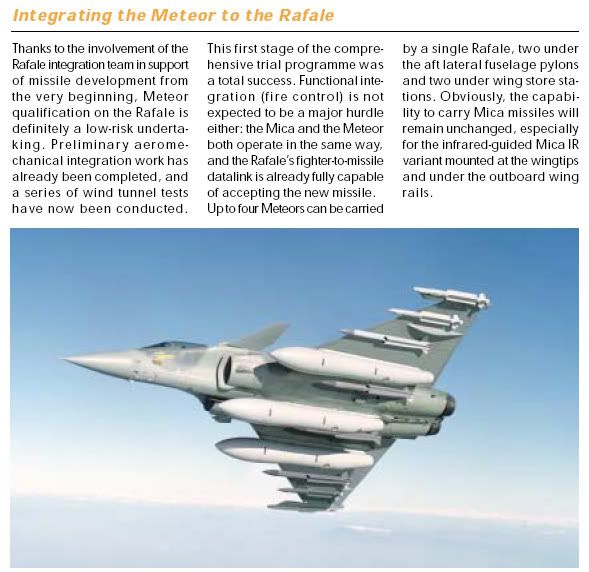
The two external underwing pylons are WIRED and only need to be cleared for MICAs, it is a customer choice not a technical issue.


 Sign In







