 low’n’slow
The maker’s badge on the propeller is for Lang Airscrew, otherwise known as The Airscrew Company, which at the time was based at Brooklands.
Dashwood Lang then moved the company to Peterborough in the mid-1930s, then when the anticipated business from Aeronca failed to materialise, reformed it in Chesham as Hordern Richmond.
The stampings on the propeller boss are identical to those used later by Hordern Richmond on props for Tiger Moths and the like.
The Morris Motors bit is a brilliant red herring. It looks as if – lord alone knows why – the propeller has at some point been mounted on a vintage Morris front wheel hub!
low’n’slowI love the description of it on ‘the forum which should not be named’ as
“a Primary glider that went rummaging in the dressing up box and managed to find Prince Harry’s costume” 😀
low’n’slowThey are actually my photographs, I also have some of the Pawnee, closed cockpit Turbulent, Gunbus etc.
Mike
Apologies Mike. Arthur has sent me a lot of photos of his aeroplane but didn’t tell me whose they were. In hindsight, the filename of the photos should have given me a clue. :rolleyes:
Hope you don’t mind them being shown. And yes, I for one would love to see some others!
Also if you run a search on http://www.britishpathe.com there are some movie images of the Dunstable air shows too.
low’n’slowWhat is RAF Henlow actually used for? The hangar shot is amazing.
RAF Henlow is still an active RAF base, containing the School of Medicine and various other ground-based operations.
The all-grass airfield and one side of one of the double-bay Belfast-truss hangars is used by the Grob Tutors of the RAF Volunteer Gliding School. The other side of the hangar contains a number of aircraft operated by private owners, many RAF personnel. The forgiving grass airfield means that there is a higher-than-average proportion of vintage types, particularly DH Moths!
low’n’slowRAF Henlow? Recently refurbished too!
(Pic courtesy of Geoff Collins.)
I also seem to remember that two survive on the original pre-Squires Gate aerodrome site at Blackpool. Now used as feed stores and animal hospital for Blackpool Zoo.
low’n’slowNone of the race, but here, from Arthur Mason’s archive, are a couple of G-AFIR ‘limbering up’ in 1967:D
low’n’slowLooks like this thread is turning into a re-run of this one :diablo:
low’n’slowThis has been an interesting thread. Blue Max, who has rebuilt a Moth from the ground up, as well as leading the Biggles Biplane restoration, hasn’t got round to commenting (He’s a bit busy fitting the tailplane at the moment :diablo:), so I hope you won’t mind a few observations from my, rather less experienced, point of view.
With something over 16,000 Gipsy Major engines of various marks built over the years, the overall supply stream for the engine isn’t going to run out too quickly.
Some bits are getting harder to find, but most service items including valves, heads, pistons etc., can be re-engineered. However in many areas it is the paperwork that is the problem.
Many Gipsy and Gipsy Major engines are fitted in aircraft carrying Certificates of Airthworthiness, when this is the case, every component has to be individually certified. Often the cost of certification costs more than the value of the components.
A specialist engine restorer such as Vintec can provide ‘as new’ Gipsy Majors, with all certifcation in place. But I hesitate to guess the price!
As you say Scion, if you can build a replica under an experimental classification, then this becomes less of an issue.
Making up metal fittings and even a wooden parts kit to original specification, wouldn’t be impossible, at a price. Specialist DH60 restorers such as Ron Souch in the UK have almost certainly got the expertise, drawings and access to materials.
Based on my time with the Walter Mikron II in the Tipsy Trainer, I really don’t think it would be powerful enough for the job in a DH60. It is a little jewel of an engine, but while it is nominally rated at 62hp, at 2650rpm, it is almost unfeasibly high revving. It is also a small capacity engine, so doesn’t have the torque needed to swing the bigger propeller you would need for a Moth.
The Gipsy Major, with anything from 100 to 145 hp is a more viable proposition and as in the ‘Biggles-Biplane’ replica, a later unit can be successfully converted to run in an upright configuration.
low’n’slowDon’t you believe it – just wait till film SE-5 expert ‘The Blue Max’ gets back online this evening! :diablo:
It is also worth checking out these pics on the Air-Britain website:
http://www.abpic.co.uk/photo/1038262/
low’n’slowDarn – thought I might get someone with this on April Fools morning! :diablo:
You’re correct. Another one from the fertile pen (and imagination) of Lyn Williams!
low’n’slowI haven’t got any information on the source of the picture. It was sent to me last December by a friend in the USA as an e-Christmas card!
We just posted it on the BB site as part of a collection of seasonal images.
I’ll be fascinated to read your biography of the pilot when it becomes available. The pilots of two-seater aircraft such as the FK8 never seemed to get the recognition they deserve. Hopefully we can help redress that balance too when we get the BE-2 replica in the air.
Best
Steve
low’n’slowThanks for the photoshopping Propstrike – although I think Grommit looks better in the aeroplane.
By the way, the Porridge Cannon interrupter gear mod was not a success. Messy!
low’n’slowVery droll, old chap…..
A “Black” project indeed, Low’n’Slow.
It was good to meet you at last, and to put a face to the name, btw.
Likewise Tangmere. And what a privilege to be shown around the facility. Hopefully now working on an HAA Members visit. Worth joining the Association for that alone! 😎
low’n’slowThanks Tangmere, you beat me to it.
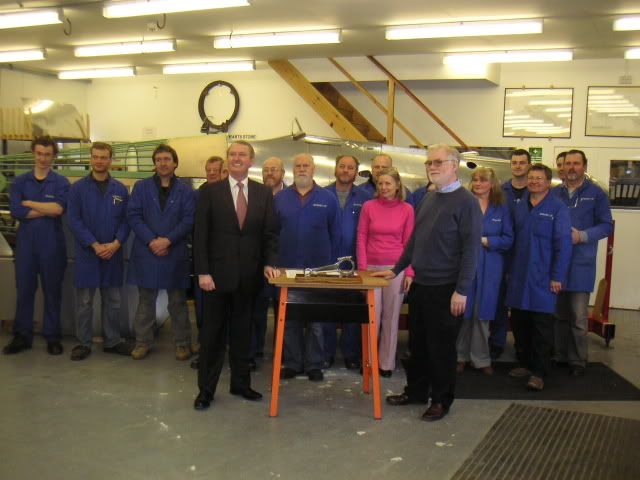
Well deserved congratulations to Guy and the whole Retrotec team.
The quality of the engineering is literally world class. Not just by restoration standards, what we saw yesterday would shame many aircraft manufacturers.
As far as the aeroplanes, can’t show pictures of the FB5 as it is a ‘black’ project – but the Fury in the background of these shots is very definitely taking shape – and yes, there were an awful lot of other Hawker biplane constituents elsewhere!
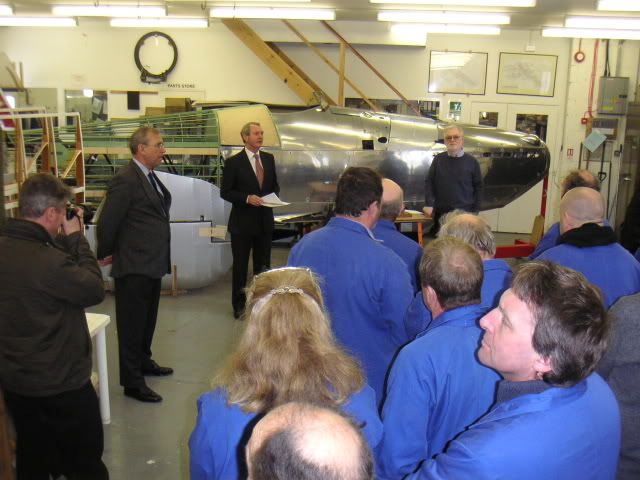
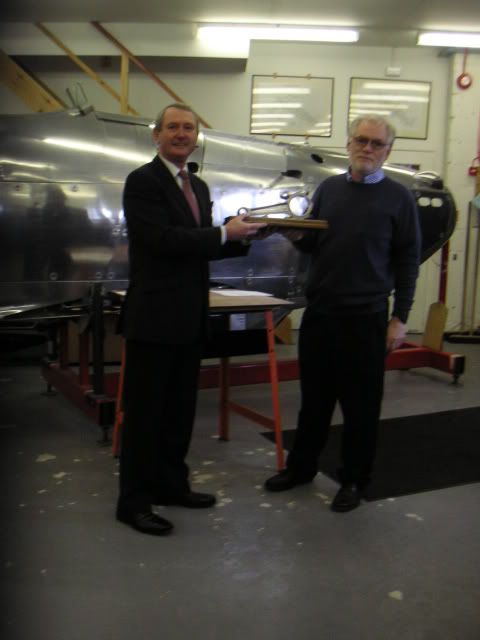
Trophy awarded by HAA Chairman, Air Marshall Cliff Spink.
low’n’slowA brief extract from a new book on the Tiger Moth which will appear shortly……….;)
“….G-AIVW had won the Kings Cup Air Race in 1958. After service with the Newcastle Aero Club, it was acquired by Tiger Club ‘Patron’ Norman Jones and fitted with floats which had originally been installed on an Aeronca Sedan.
The ‘Sea Tiger’ was named ‘Oswald Short’ in honour of the pioneering seaplane builder and made its first flight in 1963. For almost two decades the aeroplane introduced pilots to the joys and challenges of floatplane flying, both from the sea off the South Coast of England, and later to limit the corrosive effects of salt-water operations, from a lake near Lydd in Kent.”
Sadly the Sea Tiger is no more. The aeroplane was lost in an accident in 1983, thankfully survived by its occupants. Since then no other Sea Tigers have been operated in the UK, although in Finland, the USA and Canada, owners have successfully flown examples with modern lightweight GRP floats which detract less from the aeroplane’s performance and handling.
“The Sea Tiger was never the best-handling float plane” says Keith Sissons, who instructed pilots on the aeroplane’s idiosyncrasies. “The large floats meant that she wasn’t dynamically stable and you had to work continuously to maintain balance in the turns and avoid side-slipping.
“So saying, she trained literally dozens of floatplane pilots during her time. We had great fun. Perhaps one day, it might inspire another Sea Tiger to take to the water – and the air – again in the UK. There’s nothing to beat messing about on floats!”
(All pics from the deHMC archive)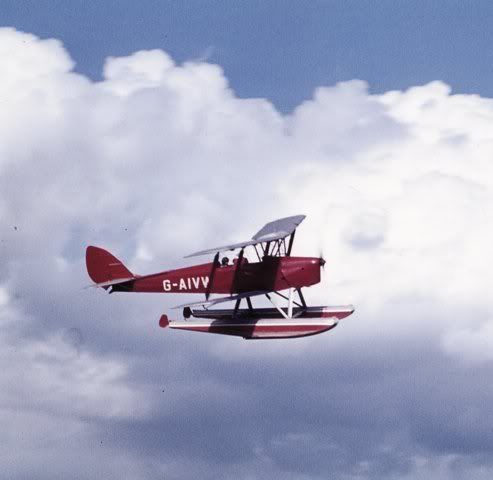
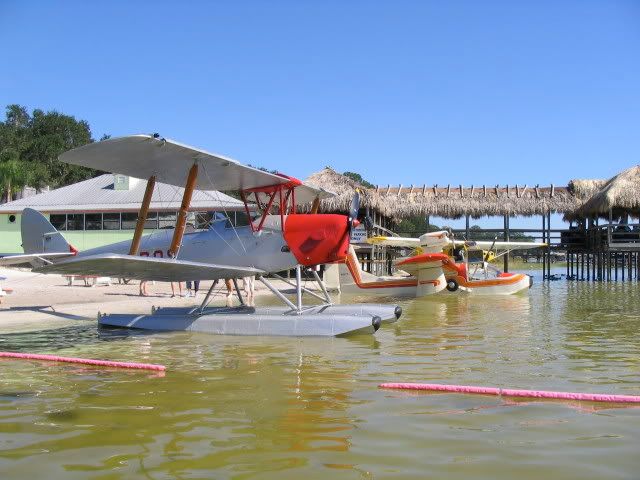
G-ERDS, has operated on floats for the past year or so in Florida. It has now been reconverted back to a landplane and the floats are currently for sale…. anyone wanting to make an offer?
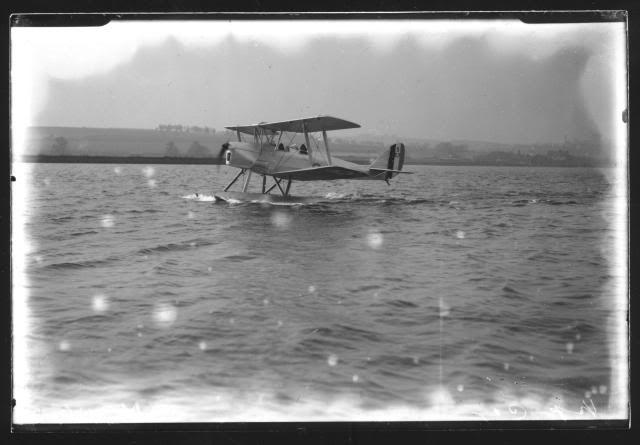
This is a very early Tiger Moth, circa 1932, on sea trials as a possible RAF floatplane trainer.It was never taken up……


 Sign In







