BlauerMax
True, Rafale is a long shot. Most Japanese aircraft mags rate Typhoon as being just behind the F-22 in desirability with Rafale a distant 3rd.
Now that the F-22’s out it’ll be interesting to see what the mags say vis-a-vis the F-35 and Typhoon.
How about the Super Hornet block II. How do the Japanese rate this aircraft compared to the Typhoon and the Mitsubishi F-2.
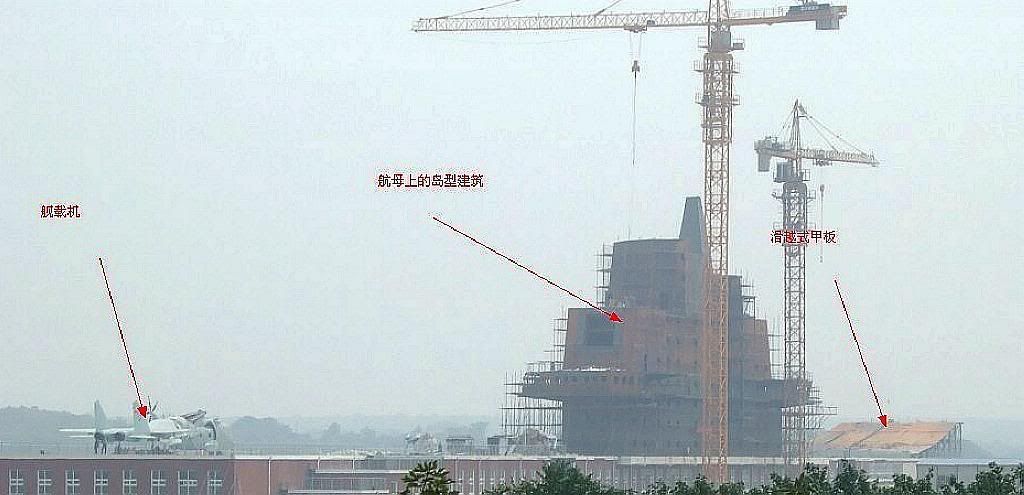
BlauerMaxWhat the……….. (posted by =GT @ CDF)
It looks like they’ve built an entire building to simulate the carrier including its height above ground. The deck is at around tree top height. If they outfit it properly they should be able to practice with a deck crew so they’ll be ready when the real carrier sails.
BlauerMaxNo, it wants low cost & low risk – thus the primary reason that the tanker has to be based on a current production commercial airframe.
If it wanted the best technology it would be asking for a “clean sheet” design.
Oh, & it wanted its 1st new tankers 3 years ago…
Something ‘state of the art’ would be rejected on cost AND risk grounds.
The US has plenty of ‘state of the art’ systems, tankers don’t need to be.
Thanks. Personally I would like to see a clean sheet design like the Boeing X-48 blended wing body as a future tanker or the KC-787. Boeing has the technology, they just need to take the risk like what they did with the KC-135. Unfortunately, I guess its unlikely to happen due to cost and risk reasons.
BlauerMaxI’m interested to know why Boeing doesn’t offer a tanker variant of the 787-8. The RFP requires the tankers to be in service for the next 40 years.
The KC-767 is hardly state of the art unlike the KC-135 when it entered service. They should offer the Pratt PW1000G or GEnx at the very least. Doesn’t the US want the best technology for the job. All this talk about propping up Boeing is like a bail-out mentallity. How are you guys going to keep up the leading super-power and tech-power status with that kinda attitude. Boeing should step up to the plate and offer something state of the art.
BlauerMaxWell so far nobody outside knows the exact answer to that….. But it is believed to be EW pods…
Initially some of us thought whether it might be a strengthened pylon to carry heavier air-to-surface/anti-ship missiles….
It looks like the J-10B is turning out to be quite an advanced aircraft. They’ve introduced alot of home-grown technology in such a short time. FBW, integrated EW and IRST, AESA, Wide-angle HUD, Divertless intakes, high % of composite materials in airframe and locally engineered turbofan.
No wonder Japan keeps requesting the F-22.
BlauerMaxInboard pylons
Posted by =GT & xinhui @ CDF:
Deino is no longer the sole J-10 fetish guy….:p:D
I’m in love with the J-10B
What’s on the inboard pylons? Are they EW pods?
BlauerMaxhttp download
This will be good for estimation…..:D
Thanks for the video. The flight display is very sprightly and the J-10’s performance is reminiscent of the Eurofighter Typhoon.
BlauerMax:D:D:D:D:D:D:D:eek:
Dutch men are among the tallest in the world which causes a leg room problem in the JSF-cockpit
There is an easy solution for this, all future pilots for the JSF will be Dutch women. The men can fly the transports instead.
:D:D:D:D
BlauerMaxF35B Video
First flight video of BF-1. Have a look here. https://www.teamjsf.com/jsf/data.nsf/public/9B7724D832534A3C85257466003F874A?OpenDocument
BlauerMaxSong class sub undetected by Carrier Battle Group
A Song class sub got within torpedo range of the USS Kitty Hawk undetected during a US military exercise in the Pacific.
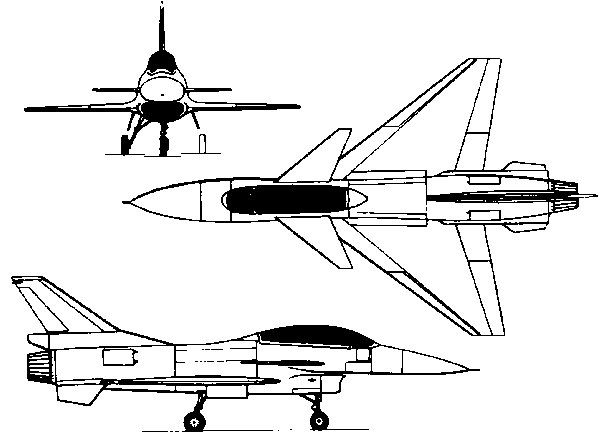
BlauerMaxThe problem here shouldn’t be about “cloning” or not since it’s obviously not for the eventual J-10. The issue is whether considerable influence from Lavi’s design was used for the J-10. I would say the Lavi influenced the J-10 project before the almost total aerodynamic redesign (except for the canard-delta arrangement). Early hand-held models of the J-10s did look very similar to the Lavi’s design…especially the swept back trailing edge and the less pronounced leading edge sweep. However…that design was totally changed compared to today’s finalized J-10. The problem i believe is two-folds. First, China is still not as good as manufacturing/design dense/blended airframes as the Russian and Western counterparts. They can machine the parts, but integration is the problem. Look at all the indigenous fighter designs and that can be seen clearly. Things are still put together as segments rather than designed as a whole. Even the J-10’s wing/body section used fillets instead of blends. This may be internal and cultural inertia at work…simply if it looks good enough to them where’s the problem? (Similar to the familiar lines of Russian aircraft with multiple buldges and surface roughness….what seems to the be the problem? No problem except aethetics? Maybe). Second, the overly optimistic expectation of the indigenous engine and the final adoption of the Russian engines means the stability of the aircraft becomes a problem against the original J-10’s much more compact design. The aerodynamic center must be shifted back (taking away that swept back trailing edge) and the forward section elongated. This can also reflect the required engine duct length due to the Russian engine (as compared to the assumed Chinese engine that still is not available for the J-10). On a side note, notice the intake for the J-10 is not that much different from simply rotating the intakes that the Chinese got used to (J-8II’s).
Thanks for interesting comments, I guess there are many possible reasons why the J-10 does not have a blended wing body airframe, maybe they include maintenance, service life(airframe life) and cost (lower cost to manufacture) reasons.
BlauerMaxfor those who say the Kfir is a complete clone of the Mirage III
hi,
Just wanted to comment on the pictures you provided. There was always the suspicion that the J-10 is a clone of the Lavi, but looking at the pictures provided, we can see that the aircraft are quite different.
First, the wing planform and the tail-fin’s profile are totally different. Next, the Lavi’s canards are more closely coupled. We can also see that the profile from the front is different. The J-10 in effect has a taller fuselage for the randome and radar. The forward fuselage cross-section has a rounder shape compared to the Lavi’s more ogive shape, similar to the F-16.
We also know that the J-10 is in a different weight and thrust class from the Lavi. This means that there must be significant engineering differences just from the different weight class and aerodynamics. The internal structure must be different just because the loads are in different places (different wing planform and not as close coupled), the flight control Laws must be different. The aerodynamics are different too because of the different nose profile and wing planform. The routing and inlet design for the engine must be different because of the different engine requirements.
Its too simple to just conclude that the J-10 is a Lavi clone.
BlauerMaxSingapore will be buying another 12 F-15SG that will bring their total orders up to 24. Seems like the F-15 is still doing well in its sales.
BlauerMaxJust wanted to comment that the Super Hornet’s aerodynamics is not as poor as everyone thinks.The wings do not have alot of sweep and look boring compared to canard deltas like the Typhoon or Rafale or aircraft with more sweep, e.g. F15, F22.
However, the wing planform allows for slow approach speeds at low angle of attack (suitable for carrier approach). It allows many pylons that can carry a wide range of external stores and unusual stores configuration (aircraft flies well with asymetric drag). The aircraft uses net-effect aerodynamics and computerized schedules for control surfaces and flaps/slats taking into account speed and other factors and this coupled with the LERX allows the aircraft to have good roll-rates and rapid changes in pitch into transonic and supersonic flight regimes. The LERX and wing combination is what makes the aircraft special, it creates lift and creates vortices that energize the wing and other control surfaces like the vertical and horizontal tail fins.
The aircraft is very clean aerodynamically and this allows for very quick acceleration from transonic to supersonic regimes. This also allows the aircraft to regain energy rapidly during WVR combat.
Another factor is the robust engine with technology from the GE YF120. The engines allow carefree handling, are tolerant of large and rapid changes in throttle and have rapid spool up rates from idle to military power (suitable for carrier approach and patterns).
The airframe and engine are designed for low maintenance. The comprehensive electronics suite is much better than its contemporaries, e.g. F22, Typhoon, Rafale in terms of strike capabilities and weapons integration. The aircraft also has an AN/ALE55 towed decoy and AN/ALQ214 jammer allowing it to survive in a high-threat environment.
IMO, the aircraft will more than hold its own against adversaries such as the SU-35 and other western aircraft like Typhoon and Rafale.
BlauerMaxJapan to halt AH-64D Apache orders after 13th airframe
http://www.flightglobal.com/articles/2007/09/10/216559/japan-to-halt-ah-64d-apache-orders-after-13th-airframe.htmlThe Japan Aviation News also reported the brief news about the revision of the acquision plan of the AH-64D.
There has been a rumor about the AH-64D on Japanese military web forums that the JGSDF may stop the AH-64D orders after 14th.
It seems to me that the bad rumors about the AH-64D has turned out to be true.
What are the bad rumors? Can you elaborate?


 Sign In