 JangBoGo
Interview with Captain of INS Vikramaditya
Vikramaditya “significant capability-enhancer” for Indian Navy- Commodore Berry
September 24, 2013 Yekaterina Vorontsova, Aleksandr Yemelyanenkov, Rossiyskaya Gazeta
In this exclusive interview, Commodore Suraj Berry, who will take charge of the INS Vikramaditya, talks about the refurbishment of the aircraft carrier and its recent trials, Indo-Russian naval cooperation and his career in the Indian Navy.
The conclusion of trials and operationalisation of Vikramaditya will be an enriching experience for the Indian Navy which will stand us well for our indigenous programme in the years to come. Source: AO Sevmash press office
Commodore Berry, can you tell us something about the interaction between the Russian and Indian Naval crews during the trials of the INS Vikramaditya”?
The interaction and professional understanding between the Russian and Indian Navy has been very good and has stood the test of time over decades. A sizable percentage of Indian Naval personnel have been in Russia for various projects in the past and fostered strong bonds of friendship and mutual respect. The bilateral exercise, ‘Indra’ conducted annually between the two navies reflects the good and warm relations and is a testimony of our commitment to each other.
The 12th Crew under the command of Captain Ist Rank Igor Vaisilivich Raybko and the Indian commissioning crew have fostered close bonding during the course of trials. Whilst both the crew may not be proficient in the languages, the understanding is perfect and both crews joined hands in all evolutions onboard and have imbibed a good sense of mutual understanding.
Commodore Suraj Berry. Source: Irina Ogorodnikova
The joint planning/ coordination group of the crew along with the Brigade Staff are responsible for the successful conduct of trials. Similarly, the joint working group on training has done a marvellous job in creating a unique concurrent trials and training programme onboard. Onboard we undertake evolutions for trials, working side by side on the main propulsion plant, power generation/ distribution systems, radio electronic aids, handling movement of aircraft on deck, anchoring/ mooring to the buoy, tasks with boats.
Our cooperation also extends to mutual participation in sports and cultural activities onboard. Both crews jointly celebrated the Russian Navy Day and Independence Day of India with flags of both countries flying side by side on the mast in 2012 and in 2013. This truly epitomized the jointness, mutual feeling of respect and understanding between the two crews. We are thankful for the professionalism of the Russian Navy and the support that they have rendered to us during each phase of the trials.
How do you assess the work carried out by “Sevmash” during repair and re-equipment of the ship?
Project 11430 is an extremely unique and possibly the only one of its kind in the world, wherein a Heavy Aircraft Carrying Cruiser has been converted into a STOBAR aircraft carrier. The magnitude, quantum and quality of work undertaken by Sevmash is simply an engineering marvel and exhibits world class technological prowess of the shipyard. Despite numerous challenges during the R&R, Sevmash along with all its subcontractors and NDB have created a truly reliable, robust and highly capable combat worthy platform.
Source: AO Sevmash press office
The fact that during sea trials part I in 2012, the ship sailed continuously for 100+ days after a 17-year long gap without any major breakdowns or incidents, is indicative of the high quality of work undertaken by Sevmash. The failure of brick work in the boilers was an unfortunate setback last year. During sea trials part II in 2013, the performance of these boilers has been excellent and as per the design parameters. This truly reflects the capability of Sevmash Shipyard. Thorough, comprehensive and painstaking work undertaken by the professional work force, both ladies and men, of the shipyard to make this ship a reality, is highly praiseworthy.
What difficulties had to be encountered during the ship modernisation? How were they overcome?
The scope and scale of repairs and modernisation work for this project has been enormous and would be difficult to comprehend. The initial envisaged work included modification of flight deck to include a ski-jump, arresting and restraining gear; modification of numerous systems and installation of new generation equipment /systems/ sensors. In addition, upgradation/ replacement of a number of other equipment and complete re-cabling.
As work commenced, the scope increased significantly beyond that initially envisaged, necessitating re-negotiations that consequently led to time and cost revision. The phase between Jan–Nov 2007 was indeed challenging for both the countries. Each country not only displayed their commitment to the time-tested friendly relations, but also the willingness to resolve the situation through deliberations in the best interest acceptable to both nations. The positive approach of the Indian Side was the mainstay for continued belief in the project by both sides. Thereafter, the work once again commenced in full earnest and there was no looking back.
During sea trials part I in 2012, ship’s boilers experienced defects that required repairs. Despite the problems, the ship completed a large part of her flight trials successfully and returned to the Shipyard. This has been the only setback in the trials phase. Post repairs the ship has now been at sea for more nearly 50 days and progressing trials satisfactorily. All in all the ship is as good as new, the hull is in excellent condition and would serve the Indian Navy well for many decades.
Is it difficult to master the ship, taking over control over her from the seamen of Russian Navy Crew? What difficulties were encountered on this way?
Each time the Indian Navy acquired an aircraft carrier, it was a big induction, it is no different this time except the fact that this ship is the largest one to be acquired by the Indian Navy thus far. Displacing nearly 45,000 tonnes, the ship is indeed big.
The advanced equipment and state of the art systems present peculiarities of handling and mastering. The Indian Navy selected well-qualified personnel with adequate experience at sea and these personnel were put through an intense, well crafted and excellent training programme by the Russian Navy. The methodology of training has suitably enabled all the Indian crew to imbibe the intricacies of operating and maintaining the ship.
The experience of participating in the sea trials and practical training onboard has provided the crew excellent opportunity to learn by observing the Russian specialists. Having been afforded the opportunity to steer the ship, anchor and manoeuvre her, I must say that the ship has excellent handling characteristics and steers much like a frigate belying its size. The power and manoeuvrability provide great flexibility in its operation.
Backed with experience of operating aircraft carriers and other helicopter carrying platforms, the Indian crew has been able to seamlessly gain hands on experience on the equipment fitted onboard. The close association and mutual understanding with Russian crew has paved the way for a smooth transition for the Indian crew during trials and training, overcoming challenges and progressing towards independent operation of the ship.
What place do you think Vikramaditya will take in the line of the Indian Navy ships after it is accepted into the scope of the Navy?
In keeping with the vision and maritime doctrine of the Navy, the ship will be part of the Western Fleet to fulfil its envisaged role in the order of battle of the Indian Navy. The good endurance, high speeds of operation, excellent sea keeping and tested combat capability would enable the ship to herald a capability based transformation at sea.
Source: AO Sevmash press office
The ship would be central to the carrier task force exercising core capabilities and operational tasks in keeping with the aims of the Indian Navy. This platform would facilitate operational training for the present and future generations of our naval aviators, including the fighter pilots, to enable them for combat missions from similar or larger decks. We would be able to effectively discharge all envisaged roles to ensure secure, stable and peaceful seas and preserving our national interests in the maritime domain. The challenges and responsibilities of the Indian Navy have always been significant and our government accords special attention to induction of maritime capability that would ensure unhindered economic development and national progress. In this aspect this ship along with its integral fighters and helicopters as part of the Indian Fleet would definitely be a significant capability-enhancer.
Commodore Berry, can you tell us something about yourself? Onboard what ships did you serve before Vikramaditya? Is the aircraft carrier an important milestone in your naval career? What feelings do you have when standing at bridge controlling such a mighty ship?
Hailing from a services family, I joined the Indian Naval Academy and was commissioned in the Indian Navy in 1987. During the last 26 years, the Indian Navy has provided me opportunity to serve both at sea and ashore and I have been immensely fortunate to serve at sea for a large part of my service career.
Being a Gunnery and Missile warfare specialist, my sea duty tenures have been onboard different ships, I have had the honour and privilege of being the commissioning crew of INS Delhi – a Project 15 destroyer and commanding INS Nirbhik – a Project 1241 missile vessel, Karmuk – a Project 16 guided missile corvette and Talwar – Project 1135.6 frigate.
Whilst ashore, tenures of duty positioned me at Headquarters Western Naval Command, Operations Officer of Rubez-E – the Mobile Missile Coastal Battery, Defence Adviser at Sri Lanka and Maldives, Directorate of Staff Requirements at the Naval Headquarters and Naval Assistant to the Chief of the Naval Staff. I attended the Naval Staff Course at the US Naval War College, Rhode Island.
I consider myself very fortunate to have been entrusted the command of this magnificent ship. While standing on the bridge and flight deck, I am conscious of this immense responsibility, trust and honour that has been bestowed upon me by the Indian Navy and my nation. The task of commissioning the ship and ensuring readiness of the crew for conduct of safe and efficient operational tasking along with flying is a challenge.
Effective planning, thorough professional training, creation of efficient operating procedures, high safety standards, institution of sound management and good administration principles along with the time honoured traditions, customs and discipline would effectively pave the way for the success of my team. The large number of officers and personnel of my crew are some of the finest professionals of our Navy and I am indeed very fortunate to be part of this team and their shipmate.
Can you compare the Vikramaditya aircraft carrier with the INS Viraat? In what fields are there significant differences between them?
Viraat in its previous avatar as Hermes was commissioned in the Royal Navy in 1959 and later transferred to the Indian Navy in 1987. Viraat, has flown the flag of the Indian Navy with distinction for the past 26 years and has been central to the concept of carrier operations in the Indian Navy. The contribution of Viraat to our navy is unparalleled. The displacement and overall dimensions of Vikramaditya are much more than Viraat. The larger size translates into enhanced capability due to the increased number of aircraft that can operate from onboard. Moreover, the two carriers belong to different categories, Viraat is a STOVL (Short Takeoff and Vertical Landing) carrier whilst Vikramaditya a STOBAR (Short Takeoff but Arrested Recovery). The two ships have been built around different ‘concepts’ and it would be inappropriate to compare the two, especially since both the ships have served their countries of origin with distinction in their previous forms. Viraat has established a legacy in the Indian Navy and I am sure Vikramaditya will be no different.
It is known that India is building her own development aircraft carriers (IAC, Project 71). How can the experience of construction, acceptance, setting into operation and initial operation of INS Vikramaditya affect the progress of the Indian aircraft carrier program?
The Indian Navy has maintained a continuous presence in the form of a Warship Overseeing Team at Severodvinsk since the inception of Project 11430. A large number of IN personnel have been since associated with the project. Having been associated with the various facets of refitting, reequipping, modernisation, trials and acceptance, the Indian Navy has accumulated considerable experience which is also providing valuable inputs for our development of the IAC Project. The cooperation received from our Russian friends at Sevmash, NDB, various OEMs has been significant and has added to our expertise in building such a complex ship. The conclusion of trials and operationalisation of Vikramaditya will be an enriching experience for the Indian Navy which will stand us well for our indigenous programme in the years to come.
What are the main tasks facing you as the Commanding Officer of the ship for the nearest, mid-term and farther perspective?
Since early 2012, numerous activities are being progressed concurrently and now with just days left for commissioning the focus is well defined. The crew had planned and organised the tasks over the entire period into various phases. The phase we are presently in is the Trials and Onboard Practical Training Phase. The two immediate and immensely important tasks for the Indian crew are, firstly to successfully complete the ship/flight trials and secondly progress Onboard Practical Training to suitably enable the ship’s crew to seamlessly takeover all the systems and control of the ship to operate and maintain the independently.
Source: Maxim Vorkunkov
The next is the Pre-Commissioning and Commissioning Phase whilst the preparations for the maiden passage would progress concurrently. Plans for these activities are already in progress. The mid and long term phase is the Aircraft Operationalisation and Integration Phase. In this phase the various aircraft and helicopters that are envisaged to operate from onboard would be integrated with the ship in India. This would also include the Deck Landing Qualification of MiG pilots. The last phase is the Induction into the Fleet. This is the culmination of years of work and the vision of our navy
wherein the actual combat exploitation of the ship would be realized. As you can see, the immediate period and the future have very interesting and challenging times in store. I am sure that with the highly motivated and professional crew, and support of my naval headquarters and home command, the ship would meet all its assigned tasks and goals.
Note the red bolded part. Jan-Nov 2007, it will give you an indication of the former admiral’s, the current salesman for Amrikkan products, class. He did not stop with his sensationalism & lies with Vikramaditya, but even recently he was shamelessly lying in an online interaction, after INS Sindhurakshak accident, that Scorpene submarines will be joining the Navy soon.
Just for reminder, the scope of work on INS Vikramaditya was notified by Sevmash and the Indian Navy overseeing team at Sevmash dispatched the message to the concerned at Indian Navy & MoD. This was probably in mid-late 2006 after which the “interaction” on the “new problem” started. This is exactly what the **** hunters at Janes caught up and put up with their sensational news in early-mid 2007 that a major problem with work have popped up on the “old” carrier, which they probably thought to be a major structural work. But to their disappointment in later years, the work was related to entirely new cabling!
This new scope of work & funds needed sat idle on the table and Indian Navy & MoD wasted almost 4 years (4th quarter of 2006 to 4th quarter of 2010, when the final deal was signed) by delaying the decision. The 2nd half of 2010 deal finally settled the price issue with immediate release of funds and delivery date was set for 2012. Which in turn means, Sevmash completed (when proper fund was provided) entire cabling & other works of the 45,000t ship in 2 years time! A record by any means considering that Indian yards take over 3 times this time fitting out 5,000t frigates.
Manu Pubby had a good article on INS Vikramaditya….
JangBoGoThis is an interesting news and definitely interesting for me. I’ve been advocating the need & development of armed UAV by Russia and this is one particular product that is missing in the portfolio of Russian arms industry. Since the start of the Syrian crisis I’ve always felt the need for armed drones to effectively deal with the western & their allies funded and supported terrorists. This should have started atleast in 2011 when Libyan crisis was ongoing and lack of armed drone was very much telling…
Wish the development period have been given tight somewhere in 12-18 months. This will be a major boost to the SAA (& Russian Army in Caucasus in the near future) in their fight against the Al-CIAda and other western supported terrorists.
Russias-Assault-Drone-Makers-Urged-to-Work-Faster–Official
© RIA Novosti. Anton Denisov
21:21 24/09/2013MOSCOW, September 24 (RIA Novosti) – Russia’s Defense Minister has urged defense firms to speed up work to develop combat drones, a senior industry official said Tuesday.
Oleg Bochkarev, deputy head of the government Military-Industrial Commission, told RIA Novosti that Defense Minister Sergei Shoigu had issued instructions to this effect in July.
Several defense companies, including Sukhoi, Sokol and Tranzas, are currently working on unmanned combat aerial vehicles (UCAVs), Bochkarev said. He indicated that the commission would like to see Tranzas’ one ton combat drone start tests by 2014.
Earlier this month, Russia’s Berkut VL helicopter developer said that defense firms in the United Arab Emirates and Russia would develop drones based on the Berkut VL – a superlight two-seat helicopter equipped with a Conver VAZ or Lycoming engine and a range of up to 600 kilometers.
Mikhail Pogosyan, president of United Aircraft Corporation, the holding that unites the Russian aerospace industry, said last November that Sukhoi would focus on creating reconnaissance and strike UAVs in the near future.
related to the above
UAE-Firm-Plans-to-Help-Turn-Russian-Helicopter-Into-Attack-Drone
19:36 02/09/2013MOSCOW, September 2 (RIA Novosti) – Defense firms in the United Arab Emirates and Russia are planning to develop an unmanned combat aerial vehicle based on Russia’s Berkut VL helicopter, that craft’s Russian developer said Monday.
Russia’s Berkut Aero design bureau and the UAE’s Adcom Systems are considering the Berkut VL helicopter as a model for a drone to be stationed aboard an aircraft carrier and fly to remote areas, Berkut Aero development director Dmitry Rumyantsev told RIA Novosti.
Adcom Systems representative Karim Badir confirmed to RIA Novosti that the company was considering the Russian chopper as a basis for a new attack drone.
The Berku VL is a superlight two-seat helicopter equipped with a Conver VAZ or Lycoming engine. It has a range of up to 600 kilometers.
Adcom Systems manufactures unmanned assault vehicles, radar systems and advanced communication systems.
Hope Sukhoi dust up their Zond series of UAVs and speed up their development.
http://www.sukhoi.org/eng/planes/projects/bpla/complex/
Sokol is another OKB which have been making drone for the services.
http://okb-sokol.ru/
http://okb-sokol.ru/cgi-bin/go.pl?i=42
JangBoGoFew more from the below article. Plz do use translator for reading.
If anyone need I’ll post a translated version some other time.
http://www.aex.ru/docs/3/2013/9/12/1874/
.JPG)
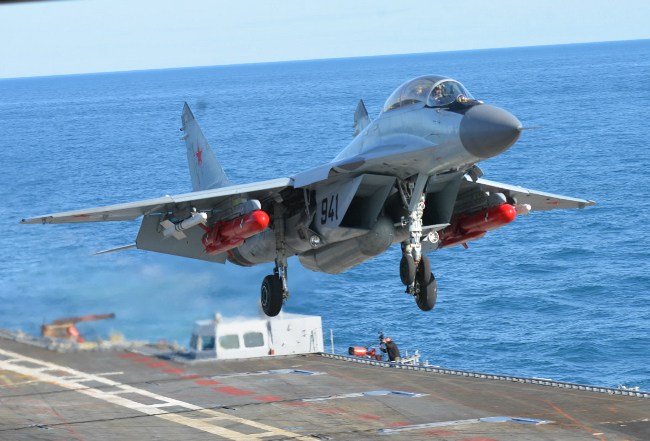
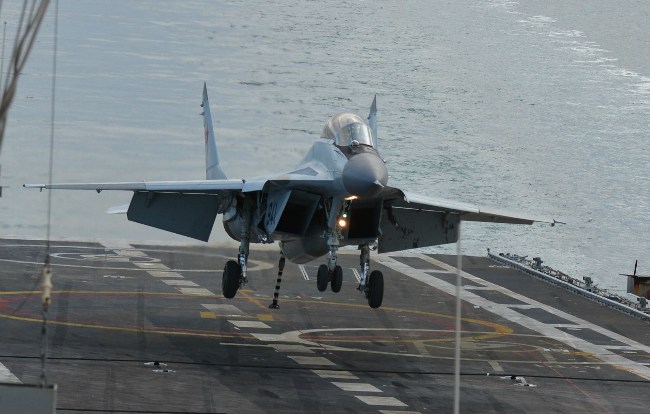
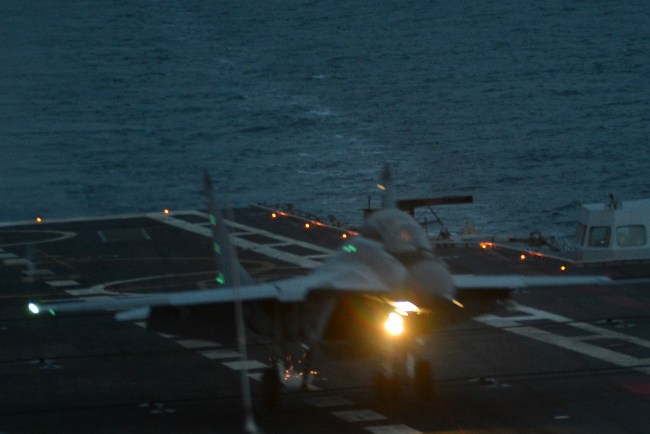
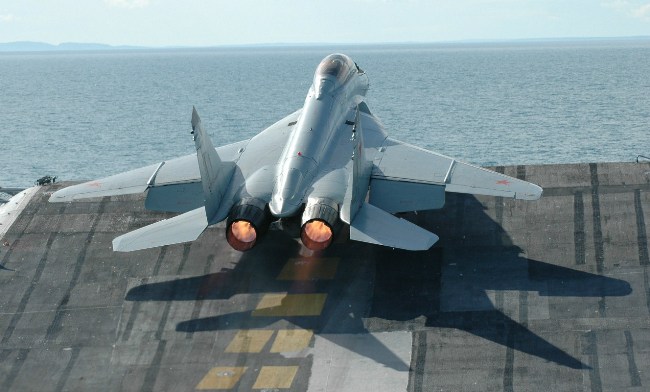
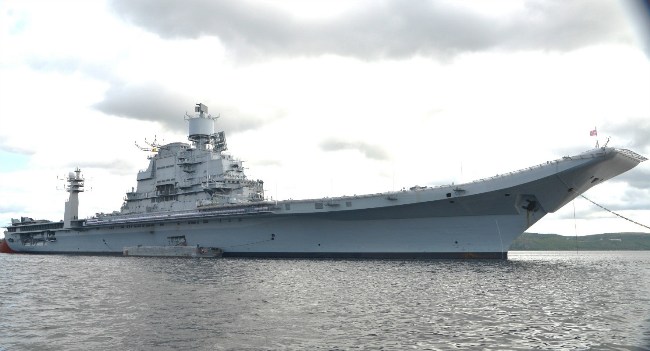
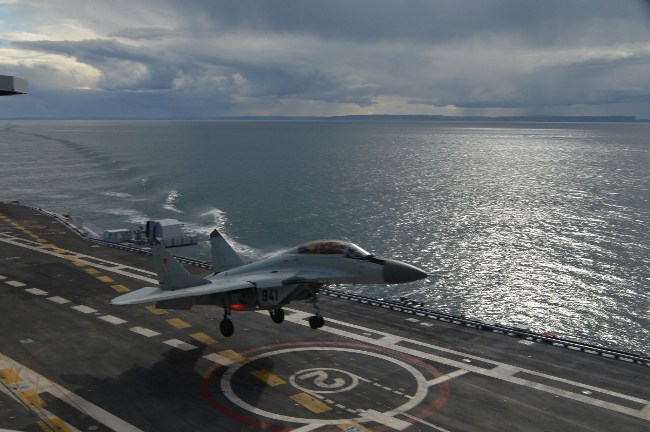
JangBoGoSome more nice pictures of Vikie during recent trials.
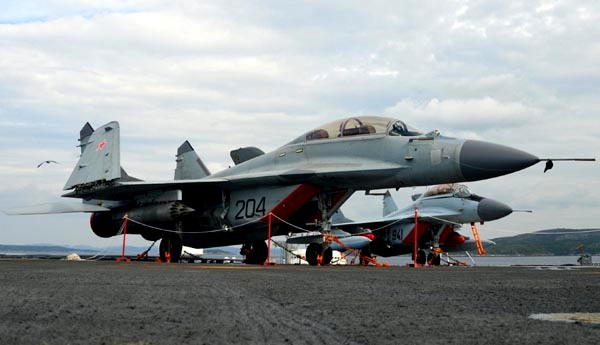
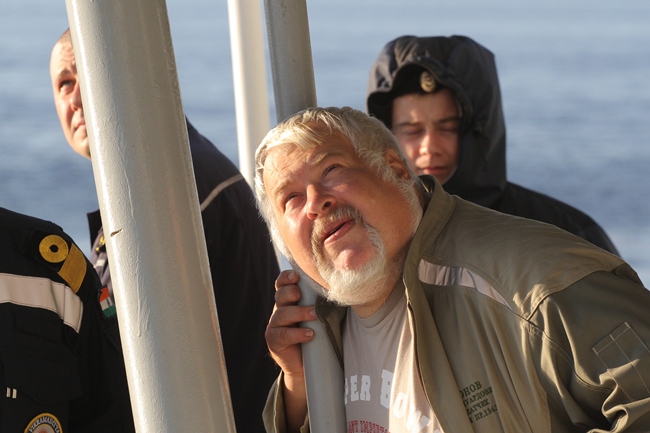
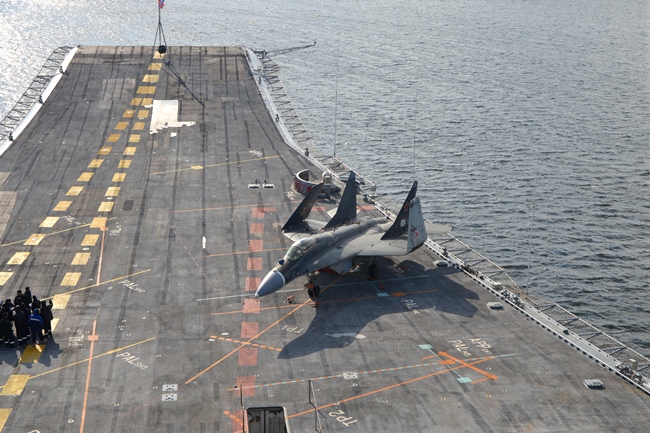
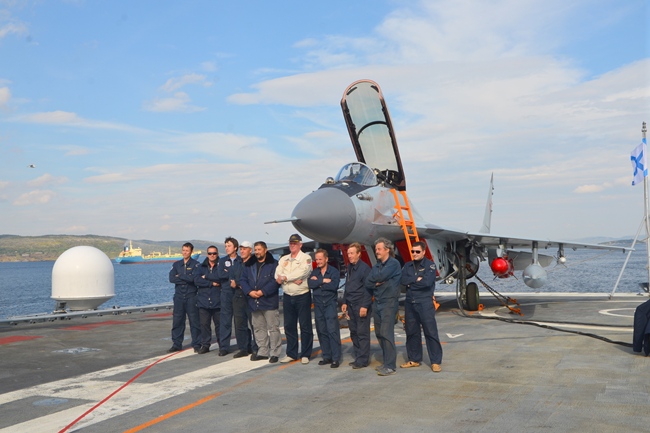
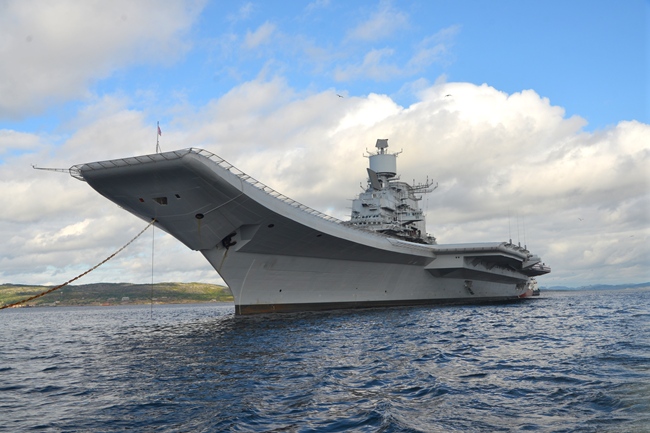
From the articles below. Please do use translator to read it.
http://www.aex.ru/docs/3/2013/8/22/1859/
JangBoGoMSphere you do know that the ship in question has an eight boiler HP steam plant right?. This means many hundreds of valves, joints and miles of piping and fixtures that WILL require critical routine maintenance…like every other HP steam plant that has ever gone to sea. That fact alone dictates a larger engineering complement than a diesel or turbine plant and higher associated training and logistics costs throughout the life of the ship. If you do not think this obvious by all means check and see what commercial shipbuilders are doing…steam plants do still turn up for specific requirements, but, large capacity low-medium speed diesels replaced them decades ago as the predominant prime mover for large merchantmen…vessels built with an eye to operational cost.
Even if the refitted steam plant in this hull has a perfect operational life and never once, hopefully, has an ‘event’ of the sorts not uncommon in steam plants the world over…it will still be expensive to operate, compared to the contemporary alternatives, and there a no shortcuts as having hp steam aboard ship is damned dangerous and kills people if not monitored properly!. You do not need to see a precise breakdown of the official cost per mile figures to arrive at that conclusion.
Unless of course the Russians have installed an engineering pipe fit that requires next to no maintenance and is impervious to vibration, heat, friction and mechanical shock loadings?. Perhaps TR1 could advise if they have and just kept it really quiet?.
Thanks for your concern.
Indian Navy/Navy men is/are getting readied for the Nuclear powered aircraft carriers and this “old steam carrier” will give them a good learning on how to operate complex steam systems & circuits. And when Indian Navy will go for Nuclear powered aircraft carriers, the major difference in the “headache” will be replacement of 8 x KVG-3D diesel fired boilers with 2 x N-power plants that will produce the required steam to operate steam turbines to propel the ship. ….. Well……… unless, Indian Navy changes its plans and go for an all electric propulsion.
JangBoGoEdit : It is indeed Alrossa at Sevastopol. I hadnt seen the name written unless I saw the larger picture. Any info on how many 877/636 of RuN already upgraded would be helpful.
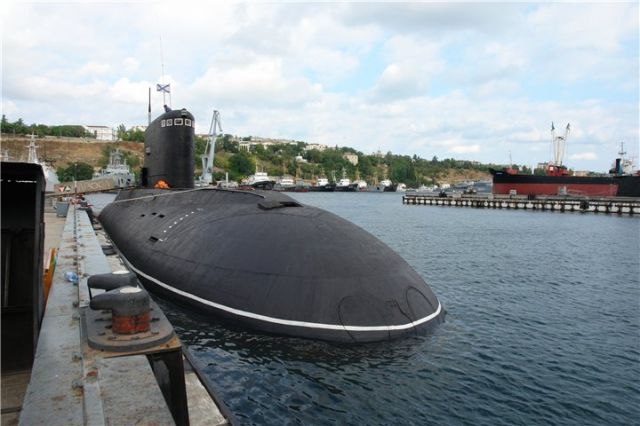
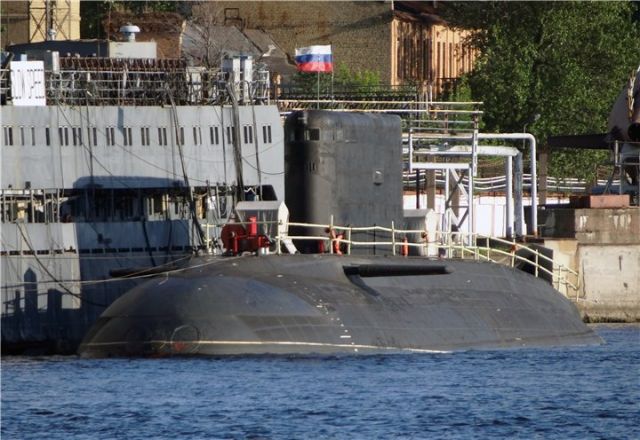
One of the best angle for capturing a 877…. the meaty hull is getting highlighted. A vertical fin is very much missed though. The over 9m hull will neatly hide any Yakhont/Oniks/Brahmos VLS for a clean look.
Below are some old figures (>7yrs) for the performance (estimate) of the various subs on pure battery and battery + AIP. And you bet, the pr.677 design do retain its predecessors edge when compared to the newer & lighter displaced scorpene & u214. With the new AIP, the ladas will likely be enlarging that performance gap. Then there was the new batteries, incl Li, that was being developed for the past 7-9 years and was mentioned by Igorr in his blog or some other forum.
Just hope China place an order for half a dozen more pr.1650 with AIP. This will allow good financial backing to speed up the new generation AIP for the pr.677. The old Kristal-27E was rated at a very good power output which dwarfs the Siemens AIP on the U-boats. I cant find that chart now, but it was around 4k KW or somewhat in that range for short bursts of top speed. The sustained power output is likely to be a 10th or higher of the max output.
JangBoGoIn case IAF needs a Su-35 class fighter…. then my view is that make it like the MiG-29M/M2/K/KUB
Transform the current MKI into a single seat fighter with the rear seat for fuel tanks. It will free up or add almost 200 fighter pilots.
JangBoGoOne thing that people often forget is also airframe hours. It was oft forgotten in the comparison between the Mirage 2000 & Mig 29 upgrade in the IAF, and it turned out the Mirage 2000 had more than twice the service life of the Mig 29. Which means for the same amount of hours you had to buy more than twice the number of Mig 29s.
Nic
I hope there is difference between how the West count their airframe life hours compared to what the Russian system is.
I’m not sure if IAF or Indian MoD have specifically put up cumulative numbers of flying hours both of these fighters have logged till now.
JangBoGoWell MiG-35 will cost even more to operate so whatever commonalities exist better make up for it big time,
Rafale is destined to have longer lasting engines, with less demand on maintenance, while consuming less fuel.
From an operational standpoint, that translate to better availability and sortie rate.
ed: on a 2nd thought, MiG-35 cost significantly less in purchase cost, so money wise it does work out,
so the primary objective may be western tech transferPowerplant: 2 × Klimov RD-33MK afterburning turbofans
Dry thrust: 5,400 kgf, 53.0 kN (11,900 lbf) each
Thrust with afterburner: 9,000 kgf, 88.3 kN (19,800 lbf) eachPowerplant: 2 × Snecma M88-2 turbofans
Dry thrust: 50.04 kN (11,250 lbf) each
Thrust with afterburner: 75.62 kN (17,000 lbf) eachOne thing i find awkward tho, is that the largest a/c is meant as the primary A2A platform,
while the smaller one is intended for strike :rolleyes:
RD-33MK have already transformed into RD-33MKM with 9,500Kg thrust (93kN). By the time first of the Rafale for India come (2017), it would have crossed 10ton mark in thrust and would be moving ahead with its earlier 90s plan for a 12ton class RD-33 series engine.
It would be interesting to see if anyone come up with a total life cycle cost proving that Rafale will be cheaper than MiG-29/35.
Its like saying that the total cost of ownership of a Merc C-class will be cheaper than a Skoda Octavia by the time both have outlived its utility/life.
I fail to understand how people can simply ignore and sidetrack the commonsense that a product that comes from the premium production & supply line (read cost wise) can really beat the one from lower cost production & supply line. There already is a good example of Mirage-2000 and MiG-29 in Indian service. Both of them are undergoing modernization and the M2K cost is just absurd. I hope the Indian MoD puts out the entire service record of the two fighters like the flying cost, spares & maintenance cost and the flight hours atleast til 2012….
JangBoGo^^^ sad state of affairs.
@TR1, Snake
whats the status of the Pr.11356 & Pr.22350. What are the time period we can expect them to start sea trials?
Also, saw a pic in balancers in pr.885 thread with the casing for Onix launchers. In that it can support 4 launchers per silo. I was of the view that pr.885 have 8 such slios with 3 launchers each for a total of 24 x VL missiles. But if it is 4 missiles per silo, then the missile load will be 32 x Onix/Yakhont/Klub/Brahmos.
Did i miss anything?
JangBoGoas scoot de boot says, they are very close in size
but do they really differ in design and capabilities?
it seems the cavour is already capable of operating fixed wing combat jets
Comparing the Cavour to INS Vikrant (IAC-I/Project-71) would be more useful…
Its no secret that there was a monetary deal with the Italians on the design but it another fact that no one in India associated with the programme or in the media want to acknowledge it now. Seems like all have forgotten about what the base of IAC actually is. I have no special love for the Italians considering that we got a ***** from Italy sitting on top and ruling the nation through her servants. But, I really hate when people fail to give credit where it is due. In this case not a single news article during the launch of IAC-I even mentioned the Italians.

In the above ariel shot, I can clearly see the foreend extremes of the hanger and I wont be surprised if it is exactly the same as Cavour. If Italians plan any full deck carrier in future, it would be similar to IAC-I, maybe with some changes to the skijump.
All the talk of indigenous design etc etc need to be taken with care. There is indeed lack of design capability in India for ships for size above frigates, let alone the carrier. There are certain gangs in India who want all Indians to believe that India is some sort of super-duper design house…. well, in that case, the same guys would also be able to modifiy the IAC-I with three more deck level and they would get a Jaun Carlos class of ship.
But no they cannot, coz they dont have the capablity. If they really did, they would not have been sending RFI for LPD/LPH/LHD to foreign vendors. And just in case, the capablity exist and still the RFI was send out for the ships & ToT, then every single entity associated with overriding the Indian ‘indigenious’ capablity in ship designing with the sole aim of creating benefit to themselves & foreign vendors at the cost of Indian tax-payers money shoud be dealt with properly.
JangBoGoMeanwhile, Indian Navy might lease 2-3 Kilo submarines from Russia.
I don’t think Russia have any upgraded Kilos to spare for India. If IN is talking about non-upgraded Kilos, then maybe its readily available But if they are to undergo modernization, then it will be another 2 years wait.
In my opinion, there are only two real options for Indian Navy to get submarine that is as modern and lethal as INS Sindhurakshak.
1) A deal with Vietnam for leasing their 2 x 636 (hope so, which are going to be delivered by the year end) with crew and operate them under Indian Naval flag. In a sense, Vietnamese operate/learn under Indian Navy. A win-win situation for both.
2) Leasing Pr.677 Saint Petersberg.
The problems encountered with the lead sub have been sorted out and it is atleast as good as what INS Sindhurakshak was. This will allow Indian Navy to also understand and utilize the probable future platform for its submarine fleet and help in giving valuable feedback to Russia. A win-win situation for both.
——
The collateral damage suffered by the other Sindhugosh class
http://www.balancer.ru/forum/punbb/attachment.php?item=345681
Btw, INS Sindhurakshak means Sindhu = water/sea/ocean/river/whatever and Rakshak = protector/gauardian.
Which means “Protector or the Ocean”. IN India’s case protector of her Sea(s).
But I find many online article claiming it as Sea Gaint etc. Hope its corrected.
JangBoGoAnd yeah, awesome pictures twin…. !!!
JangBoGo@Snake
Latest schedule for Vikra trials:
25 days (till end of July) in White Sea for sea trials including max speed runs and testing of aviation equipment.
From August till 15 October in Barents Sea – airwing trials, involving 16 MiGs and few helicopters.
15 November – transfer
I did expect more than two MiG-29Ks to participate in this years trials, but are you sure that the 16 x MiG-29K/KUBs are to be invloved in the trials? Does that mean the “Black Panthers” are going to fly to Russia and the INS Vikramaditya is coming home with its deck filled with airwing?
It would be a good sight to see, but just wanted to confirm.
I also hope that out Norwegian colleagues will repeat last years performance and thrown in their ‘helping hand’ during the sea & aviation trials by sending in their P-3 and other surveillance ships. It will definitely help in the crew preparing their interception missions…. but, hope this time the trail guys take some snaps of P-3 being intercepted by MiG-29Ks.
JangBoGoAlso, the recent case filed by a MiG-21 pilot regarding the safety issues and the MiG-21 violated his right to work in a safe environment.. The link is to discussion.


 Sign In








