What I first did was to use the “color sampler tool” (I) to select the brightest white and darkest black points in the picture and check the RGB values in the “info” panel. Thereafter go to Image/Adjustment/Levels (CTRL-L) and adjust the values of the white point in each of the RGB channels until they have all the same value (adjusting to the highest readout value). Do the same with the black point values, but this time adjust to the lowest value. This is called the 90% method. It may sound complicated, but once you understand the basic principle this method is quite easy to apply.
A good video tutorial on this method can be found here http://www.photoworkshop.com/adobe/softwarecinema/Eddie_Tapp/index2.html
Both the Easyjet and the Air Berlin are too magenta/red on my calibrated screen. I did a quick-and-dirty modification by adjusting the black- and whitepoint values in PS levels.
I’ve often looked at the histogram, but have no idea what it should look like.
This is a nice article on histograms: http://www.nikonians.org/html/resources/guides/digital/histogram_101/index.html
although from a Nikon-based site, it’s universally applicable.
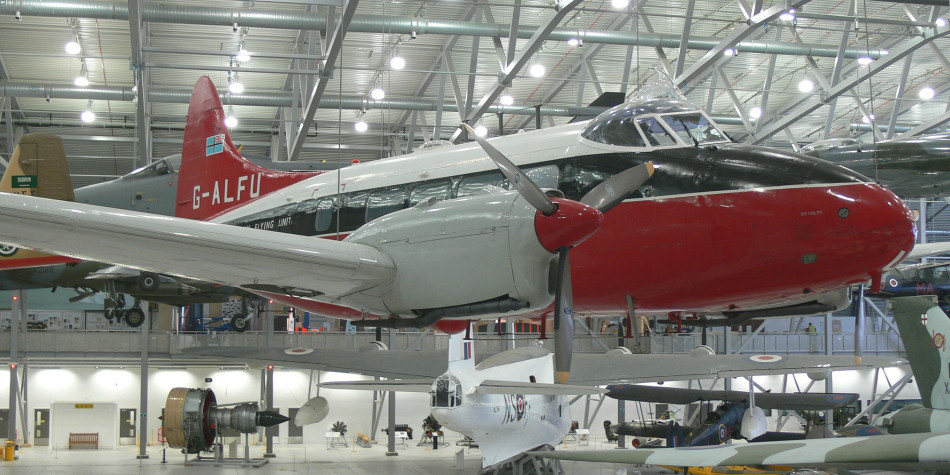
…….., plus the Dove in the AirSpace building….
Martyn
Martyn,
Thank you very much for that Dove picture. I actually flew that aircraft several times in 1970 during an Approach Radar Course at the College of Air Traffic Control at Bournemouth/Hurn Airport.
Gary,
I’ve been using Nikon camera’s since 1977 and for a digital camera I use the D2x. My suggestions for your D80:
– don’t use one of the vari-program mode’s, but select either the S (shutter priority) or the M mode for aviation photography;
– check the histogram for correct exposure, otherwise dial in a correction EV factor (e.g. EV +0.7);
– don’t use Auto-area AF, but select either single-area or dynamic-area focus and make sure that you initially have selected the central focus field;
– select either the AF-S or the AF-C focus mode (it shouldn’t normally make a huge difference for these kind of subjects);
– make sure that the lens mode has been set to A or A/M at the lens barrel with AF-S lenses, otherwise autofocus will not function!
– shoot in RAW mode (NEF) to be able to make corrections to exposure, contrast and white-balance in postprocessing).
Good luck!

The only thing I’d add to that is for static aircraft, how sharp your shot will be at shutter speeds of around 1/100th depends hugely on your focal length. If you’re at 250mm or even 300mm you’re quite unlikely to get a very sharp shot at 1/100th.
Quite true as a basic rule, but it won’t normally give you the desired prop blur. With some practice it is possible to get usable shots at much lower shutterspeeds. See my example above, in which a shutterspeed of 1/80th is used with a focal length of 200mm on a Nikon D2x, which compares to 300mm on a 35mm SLR.
Example of panning at 1/80 sec.
i was wondering whether to use the lens hood though?,does it improve photos?
Always use the lens hood !!! It prevents degradation of the image because of reflections and on top of that it is your best lens protection, even better that a so-called protection filter. I have the hoods on all the time, and the glass of even my oldest lens (30+ years) still is in pristine condition.
Enjoy your new lens!
A Friend with a D50 told me that he views the D40 as a lower-spec camera than the D50 (hence the lower monicker) But I can’t recall what the 2 key features he mentioned that were lacking?
Some of the specs of the D40 are actually better than those of the D50. The most important limiting factor of the D40 is that it only accepts AF-S lenses (with built-in focus motor). See this site for a comparison between the two camera’s. http://www.dpreview.com/reviews/nikond40/
What would be really handy is if you could post the EXIF data for your shots so we can have an idea exactly what your camera was doing when you pressed the shutter release.
For most aviation purposes you’re almost certainly better off not using auto. In auto the camera adjusts itself to expose correctly under the lighting conditions it sees, but not necessarily to create the best shot for your subject.
The shots actually contain the EXIF data and reveal that matrix metering and some mode of auto-everything was used, including auto whitebalance. However, exposures like 1/500 at f13 at ISO 200 under the given circumstances seem to be a bit too optimistic. One more tip: use the histogram to check the exposures!
Jamie,
To start with, your pictures don’t seem bad at all for unprocessed out of camera files. Maybe a tad underexposed. Most D-SLR files require some postprocessing, especially if you’re shooting RAW as I do. I took the liberty to do a little post-processing in photoshop. Nothing very special, just auto levels/autocolor, some lightening of the shadows and a little unsharp mask. What do you think?
I think these are from Cranwell, The Poachers, not the Macaws.
Nice photos though.
Thank you very much for your comments!
The Macaws during a display at RAF Wildenrath in July 1970.
A Varsity in action in better days (Biggin Hill 1970).
The previous identity of Yale G-BYNF was N55904 and Dutch owned (probably from the late 80’s until 2003). See also this picture taken in 1997 at Gilze-Rijen AFB in the Netherlands http://www.airliners.net/open.file/0966439/L/
My photos below were taken at an airshow at Texel Airport (EHTX) in 1989.