 jackjack
which one, A,B or C, i showed A you showed B and you wonder why they are different
why dont we keep it simple and stay with A, the air force one
was there a price increase on that ?
i’ve got nothing better to do at the moment than to play nonsense with you
jackjackPfcem, I see you got into another of your deliriums…and apparently still haven’t learn the difference between flyway cost and program price.
So, USNavy says F35 costs $196.6m in 2009 and will cost $187.6m in 2010 of flyaway price, only. That makes ~$240m of total procurement price in 2009 and ~$236m in 2010 and program price is still moot since the total number of manufactured aircraft is still unknown.
US Navy document (page 33)@JackJack,
nice estimation, LOL. How about comparing it to actual prices…and BTW, they even didn’t manage to get the number of actually manufactured aircraft right.
So much about LM’s projections.
thats funny the 2008 estimates got 2009 pretty close
do you want to be bothered to look up the 2009 or 2010 estimates for 35A 2014-18, then you can show us your price claims
even i know LRIP are as dam dear, the multi year price seems to be estimated about 70 in yr 2014$ for the f-35a from about 2015-18
jackjackWe can imagine lots of different prices for a plane because of the package sold with it.
But the flyway price is suppose to be a naked plane.
The F-35 was supposed to be nearly twice cheaper than eurocanard (60 millions€ each) so where are we now ?You wanted to say “the cost should decreased with each lot, unless another bad news happen” ?
is $91 mil for 2013 getting closer ?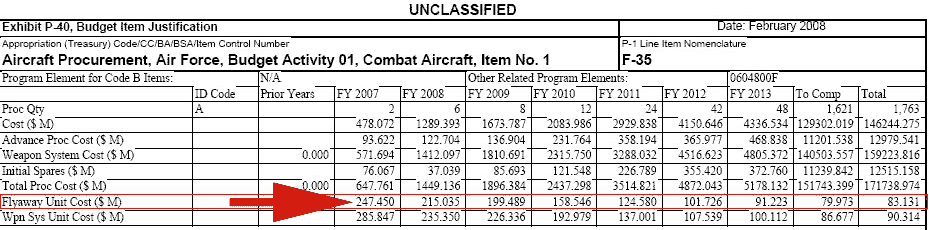
jackjackThe point is, not all fly US way.
who said they did fly the same, that was also covered in the post, have you even read it ?
jackjackit said it is the usa/nato way, which covers most all dact training that will discussed on this site
open the link, ask questions on the site if you like
gf who posted it is also a professional in defense as quite a few on that site are, so it does have cred
jackjackI’ve been away for quite a while and have lost all counts of whats happened on this forum, but about the Typhoon vs Rafale vs F-22 etc, I’ve been to Dubai while, I think so anyway, these exercises were taking place…Although I never heard much about them, if anything…had more better things to do, but, just my 2 pennies worth, if a particular fighter does better than another, say “X beat X 7-1″ or whatever, its not wise to say-or along the lines of; ” HAHA my fav fighter beat yours now whos the daddy now?”, you have to take into account that these type of exercises have so many different scenarios, like for example; You fly in a straight line at such knots at such heights and my wingman and myself will engage at such and such heights, knots and at a certain point you have to break off and try to get on one of six’s without one us on yours etc etc etc blah blah blah….Or whatever is planned. At the end of the day a lot of these types of exercises are for the GOOD for both sides cause its just training, finding out ones weaknesses is just as important as finding out strongest points.
i’m afraid it will fall on deaf ears, you may have seen my repost above from an expert in his field of DACT
these fanboys are a head strong bunch and why let reality get in the way of a good story
jackjacki think they say more than 20k, there is no official range public
jackjackjust a shame you cant upgrade a 4g frame to 5g, so the goal is be as good or better than 30 yr old planes with some new bits, now that sounds a plan
jackjackThis edge is eroding VERY rapidly.
WOW, so you think they have nearly caught up with a 30 yr old plane, its a dam shame they have moved on to 5g isnt it
jackjackread it again, its usa/nato
who was white at uae ? and no it wasnt uae
the top gun film has no reality to the way dact is conducted,
BTW, this guy is involved in dact, how many exercises have you been in and in what roll ?
my guess is its exactly the number i’ve been in
the first sentance said The guy who penned this has had long term exposure to air combat and dissimilar air combat training, so he is an expert in his field
jackjackTurkey was never interested in EF. Or at least, not its military. When was the last time Turkey bought non US fighter? Turkey would buy EF only if it has assurances, that this would raise all obstacles to her EU path. And you must consider that TuAF is “US to the bone” to this day. Already in Greece LM has the strongest lobby amongst airmen. Imagine how strong it must be in Turkey, where the military is much less controlled and where the military industry is run by the army. And the army has shares and acts as directing board.
The workshare that turkish industry will receive from F35 can’t possibly be offered by EF.
!
they seem to disagree with you
http://gbulten.ssm.gov.tr/arsiv/2006/11/30/01.htm
The Eurofighter consortium, maker of the Eurofighter Typhoon fighter aircraft, has raised the stakes in its competition with the U.S.-led Joint Strike Fighter (JSF) group to sell over 100 jets to the Turkish Air Force by offering a $9 billion local work share for Turkey’s defense industry.
The four-nation Eurofighter group is proposing to Turkey an “equal partnership with equal voting rights as other member nations have” and a $9 billion work share for its local defense industry if the Ankara government decides to buy 120 fighters, $6 billion work share for 80 aircraft and $3.2 billion work share for 40 aircraft.
http://www.defenseindustrydaily.com/eurofighter-makes-turkey-an-offer-02856/
Eurofighter officials said that the group has made Turkey an offer of its own for the estimated $10-12 billion fighter program. The consortium is offering Turkey “equal partnership with equal voting rights as other member nations” and a sliding scale of local work share depending on the number of fighters bought
jackjackdid you read this bit ? it said basically the opposite
Red air will usually consist of F-15s or F-16s (or whatever they can get) and will do their best to simulate that threat by limiting their radar modes, lock ranges, tactics, etc. Blue air will fly with their normal weapons loadout and will normally not have any restrictions other than operating their systems in a training/peacetime mode. There may be other restrictions imposed based on the objectives. Typically, the threat capabilities will start out low short range missiles and very benign tactics, then increase as the exercise continues, as long as the blue air players are learning something and they are ready to progress to the next level. If the blue air fighters are getting their butts handed to them, the threat level will remain low, but if they are doing well, the threat capability will increase so the training is useful.
Notice that the red air players are training aids. They are supposed to follow the rules and die like men when blue air is executing well. If, however, the blue air screws something up and they have an opportunity to kick some tail, they are expected to do so.
Violating the ROE by using a capability that is restricted, shooting beyond a specified range, or not adhering to an established ID criteria is considered a training rule violation and is dealt with severely.
Several pilots have been sent home from exercises and have even been reassigned because they didnt like to follow the rules.
jackjackThe guy who penned this has had long term exposure to air combat and dissimilar air combat training, so he is an expert in his field.
There are some serious misconceptions out there about how air combat training is conducted so I’ve decided to write a post about how it really happens. Everybody seems to want to cite a particular exercise as proof of their point, when in reality, they have no contextual reference for these results they are referencing. Realize that I am writing from a USAF/USN/USMC/NATO perspective. If anyone else can provide some information about how its done elsewhere, please chime in.
Air-to-air combat is an extremely complex and dynamic undertaking. The combination of speed and the ability to maneuver in three dimensions creates an environment that is constantly changing and rarely allows any of the participants to see and understand the entire picture at once. In order to be successful in this environment, participants must be highly skilled, (reasonably) intelligent individuals who fight in these types of battles regularly.
Fighter pilots from countries all over the world are expected to use hardware purchased with national treasure to defend their homeland against attackers or attack others as directed by their leaders. In order to effectively accomplish those missions, pilots must regularly train for air combat. Air combat skills are perishable and even the best pilots are not as keen as they might be if they haven flown in a while especially when flying in large force exercises where one decision may be the difference between success and failure.
Definitions: Air Combat Training (ACT) is a term used to describe a battle between similar aircraft. If 2 F-16s are fighting against 2 other F-16s, this would be an ACT war, whereas 2 F-15s fighting 2 F-16s would be termed Dissimilar Air Combat Training (DACT).
When planning a DACT exercise, planners typically will build an Offensive Counterair (OCA) strike package and Defensive Counterair (DCA) package with appropriate aircraft – this was displayed in the Cope India exercise when a strike package consisting of SU-30s, Mirages, and Jaguars attacked a target defended by F-15s. Besides designating types of aircraft and missions, planners will also draw up objectives for the exercise. These objectives can be very specific or quite broad depending on the situation.
A broad objective may be stated as building trust between countries or familiarize pilots with other air forces. More specific objectives may be effectively integrate air forces for lane defense. In order to accomplish these objectives, rules of engagement (ROE) will also be set.
ROE consist of weapons load, identification criteria, maneuvering limitations, tactics restrictions, and just about anything else you can think of. ROE can be pretty liberal or very restrictive, depending on the objectives, experience level of the pilots, or number and type of aircraft involved. If the objective is to build trust between nations, you can bet your ass that the rules are going to be damn restrictive to try to ensure there will be no accidents/dangerous or stupid stunts that would embarrass one side or the other or result in needless loss of life. This is why briefings are conducted, and pickup games are not allowed. (This is also the reason why this article about the Typhoons getting bounced by F-15Es is absolute ********.) Regardless of the particular ROE established, somebody needs to be the bad guy.
In most exercises there will be a threat aircraft and weapons designated as the training aid for the other side. In U.S. exercises such as Red Flag, this will be something like a MiG-29 with aa-10s and aa-11s, and will be referred to as opfor or red air. Red air will usually consist of F-15s or F-16s (or whatever they can get) and will do their best to simulate that threat by limiting their radar modes, lock ranges, tactics, etc. Blue air will fly with their normal weapons loadout and will normally not have any restrictions other than operating their systems in a training/peacetime mode. There may be other restrictions imposed based on the objectives. Typically, the threat capabilities will start out low short range missiles and very benign tactics, then increase as the exercise continues, as long as the blue air players are learning something and they are ready to progress to the next level. If the blue air fighters are getting their butts handed to them, the threat level will remain low, but if they are doing well, the threat capability will increase so the training is useful.
Notice that the red air players are training aids. They are supposed to follow the rules and die like men when blue air is executing well. If, however, the blue air screws something up and they have an opportunity to kick some tail, they are expected to do so.
Violating the ROE by using a capability that is restricted, shooting beyond a specified range, or not adhering to an established ID criteria is considered a training rule violation and is dealt with severely. Several pilots have been sent home from exercises and have even been reassigned because they didnt like to follow the rules.
By now it should becoming clear why one side or the other in these exercises often has a larger kill:loss ratio than the other. Red air is supposed to die even if there are more capable aircraft on the red side. This is how many of the surprising results occur in large exercises the threat level is tailored to the training needs of the blue air so they can learn from their mistakes in the debrief.
When conducting the debrief, kills must be assessed in order to find out what really happened. In order to do this, pilots must review the recording of the mission so they can evaluate their targeting and weapons employment. Red and blue air will get together, exchange data, and together decide who shot who and when. This is often an inexact science, however, with ACMI monitoring and extensive recording equipment in the aircraft, it is getting better. With results in hand, the blue fighters can then determine what they did wrong, and how to do better next time. This training is very effective for the blue air, but it usually sucks for red. What about exercises with real threat aircraft like MiG-29s, MiG-25s, etc? This is obviously the best training there can be, however, there is a problem.
When participating in an international exercise, both sides are probably going to hold some information back. This is not a you show me yours, I’ll show you mine’ game. In many cases, the shot data/weapons performance is classified, and not releasable to those on the other side.
How do you debrief an engagement when neither side wants to say what really happened? Nobody is going to walk into the debrief and say I shot that guy at this time and this range with this missile, because they are basically giving away their capabilities. There are a couple of ways to deal with this, one of which is to not relay any of the shot information, but to merely say ‘that guy is dead’ at this time. In that situation, no information (other than the f-pole) is released to the other side. However, astute people on the other side can extrapolate the data and figure out approximately when the shot was fired and can have a pretty good idea as to the performance of the missile. The other thing you can do is to establish a theoretical missile, with a nominal range to be used by both sides. This levels the playing field and rewards the side which executes better, rather than the side with the longer range missiles.
Detailed assessments that would normally take place to validate shots can’t/won’t happen in an exercise like this, therefore the overall results are not really accurate. However, as you say, they most certainly will debrief to get some results regardless of the potential inaccuracies. How valid the results are depends on how the exercise was planned.
As you can see, the results of these exercises (especially those released to the public) are quite likely not accurate. And, for one side or the other to claim victory in one of these exercises is either dishonest or just plain ignorance. .
It should be noted that these types of exercises are planned many months in advance. A key part of the training syllabus is to agree on the types of scenarios to be performed during initial planning.
Most of the learning experience occurs on the ground, not in the air. The evolution from Air Tasking Order to Mission Planning/C3I/Asset Coordination to Aircraft Generation is where air battles are won or lost. The mechanics of flying airplanes and shooting off ordnance is icing on the cake.
Iâm certainly not trying to stifle the spirited debate that goes on here. Its fun reading the arguments for and against various aircraft, however, be careful when youre quoting the results of some exercise when making your point!
I’m only saying that without details, all of this, “my airplane kicked your airplane’s butt” is entertaining, but silly. One valuable part of the exercise is simply watching how the other side operates, what kind of tactics they use (they may have been “modified” along with the weapons), how they talk on the radio, etc.
http://www.defencetalk.com/forums/air-force-aviation/dissimilar-air-combat-training-dact-1157/
jackjackAll that in mind most of the future buyers will buy a limited number of that “silver bullets” only. Most of the “peace-time” or “asymmetrical war” missions will be done by much cheaper to operate fighters. The budget realities will force that at all, when it does take some time to adjust to the new realities.
once air superiority has been achieved they send in UCAV’s
why is there a need for a LO’w fighter ?
as seems turkey is an example of dropping any hi-lo plans, dropping the EF proposal and increasing their f-35 orders to 120
jackjackI bet they feel stupid now about getting rid of the 3 test aircraft a few years back.
what ?
do you mean they were stress tested till they failed
there is one now they are taking to the range and blow in to pieces, for battle damage assessment
build em and break em, all part of the testing


 Sign In







