That wouldn’t be your your name amongst those written on the undercarriage door would it, you know the one I mean.
Incidentally how many have survived intact at Cosford, are they being kept in case of a bit of trouble with the Typhoons, these things happen.
My name is not on it, though my surname is on the side, I did play a part in the design of the scheme, seeing that I show the guy who did the basis of the design how to use the Software it was designed on (he is my brother). I also did the orginal CG profile that the scheme was designed on, and put forward some ideas that were used in the final scheme (though they ended up on another part of the airframe). if you want to see a large number of operational Jaguars in the future, you will have to go to India. The aircraft can ground run and will most likely be doing it at the next Cosford Air Show (though don’t quote me on that).
edit….Off topic….1000th post up, hadn’t noticed….and about something I was involved in. Off Topic
I believe they are still owned by the RAFor MOD and used for ground training aids.
Yes they are still MoD owned. The Spotty Jag (XX119) and the Pink one are used as aircraft handling/marshalling trainers to avoid too much damage to the paintwork. Pity to see the nose art on the pink one has gone, but not surprised, it was very un-PC. Spotty Jag scheme was designed by a guy who was born in Bishops Stortford AKA Canopener Al.
This is definately the one your mum remembers as this particular aircraft crashed on the playing fields of Bishop’s Stortford College
Well the location is spot on, the Boys College is to the west of the town. (My mum was only 11 at the time, and lived in South London at the time, her interest in aviation dates form the late 50’s in watching the Black Arrows do their stuff on the south coast (she loves the Hunter), plus the fact that her old man started working for DH Props at Hatfield about then). The reason she asked me last night was because she had been to a Trefoil guild (ex-girl guide leaders) meeting at the college, where the librarian of the college gave the Stortford branch at talk on the history of the school, and the fact that a Canberra had crashed within the grounds in 1954. The librarian didn’t know any details, hence the reason my mum asked me. I’ve been asked to pass them on to the school.
Cheers
Richard.
Concur, No cruise or another type of missile.
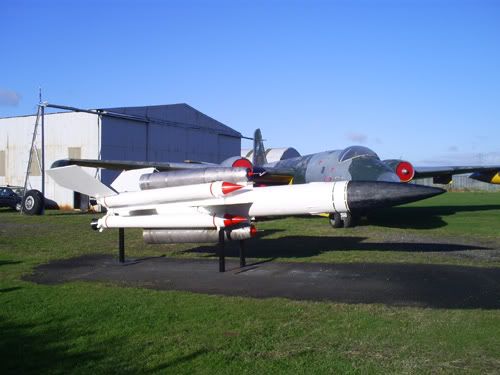
Almost complete Bloodhound mk 2
It’s a Bloodhound Mk 1 Mate, believe me, as is the one inside. Good restoration job though, It was a rust bucket when I last saw it at Kemble.
Found this site that lists a number of the gliders that took part in Op Tonga, including the 6 in the Coup de main assult on the bridges.
Hi,
Of the Halifax/Horsa combinations 3 were from No.644 Sqn and 3 from No.298 Sqn.
The Horsa were specially equipped with arrester parachute systems as were the Merville battery gliders used on the same night.
Regards
Ross
Cheers Ross, I knew the Horsa’s used by Howard’s force were fitted with a parachute system, is there any details of how it was fitted kicking about on the net or in a publication? One other request, does anybody have large-scale plans of a Hamilcar, I know Airfix magazine did one years ago. I need a port side view for a little project Iām putting together.
I read somewhere that there was a plan to build an airworthy Horsa replica for ‘The Longest Day’, that fell though due to the aviation authorities saying no to it being allowed to fly. On another (bit off topic) note, does anybody happen to know what mark of Horsa was used on the Peagus bridge op on D-day and the serials of the aircraft (any details about the Halifax tugs would be helpful as well).
http://www.youtube.com/watch?v=uHuTeOY-ca0
Why not just stick them on a test stand and light them off? :confused:
Not very environmentally friendly, thats why.
Considering the numbers fired in comparison to AMRAAM the Sparrow has quite a good record. Even the bad rap that it got during Vietnam was slightly unfair as the weapon accounted for a significant number of the total kills by US fighters and many of the issues were due to bad training, handling and maintenance. For example the USN earlier on during the war would constantly bolt the same weapons back on the wings regardless of launches and traps without significant maintenance. The AIM-7 required detailed and careful maintenance before and after each mission which wasn’t happening, once this had been picked up the ground crews given better training in the weapon system then things got better.
That was the biggest problem with the early Sparrow’s valve driven electronics, the fact that they have to have lots maintenance or they don’t work as designed. Plus the fact that the RoE made most engagement’s happen within its effective minimum range. Sky Flash and the 7M didn’t have those problems.
There are also advantages to non active missiles like Sparrow and Skyflash, with fire and forget systems like AMRAAM there is a risk that they will home on the wrong target once they go active.
Same problem as an IR missile at short range, however that is why the AMRAAM has the data link, so that it can be looking in the right place when the seeker goes active. That is of course if you remember to fit the data link to your Tornado F3, opps. To be honest, the fire and forget system in the AMRAAM does give you options in how you plan your engagement, which in employing a SARH weapon you do not have.

I remember 1999 , amraam and phoenix VS MIG 25
Yep, my mistake, I though it was earlier than 1999. Two AIM-54 fired by two F-14D’s, don’t know how AMRAAM were fired in the engagement by the Hornets. On the whole the record for the AMRAAM is a lot better that the Sparrow because of its design and more modern electronics. If the state of the art in the 1950’s had allowed an active radar Sparrow II to be built to the same specs as an AIM-120, the Sparrow III (SARH) versions would never have seen the light of day.
Read somewhere that AIM-7M SSKP was about 33% in GW1. AIM-120 record was very good until an incident back in 93 (I think) where a large number of AMRAAMS (and a few AIM-54s) were fired well outside their no escape zones at Iraq aircraft in the southern no fly zone by USN Hornets and Tomcats.
Ask Barry Heap at BAe, he was the IRP guy there the last time I was after information on getting copyright licences from BAe about 3 years ago.
What’s the differences between a Mk1 and 2?
Almost everything, only the basic layout and body diameter was the same. The inside one at NEAM is a Mk 1 believe me. PM me with an e-mail address and I send cutaway drawings of both marks straight out of the AP’s.
Bloodhound 1 is the wrong colour, they were never green in RAF Service. Chris Gibson should be passing on some stencil details to NEAM for the one outside that I passed on to him a few weeks back.