BIGVERN1966
I have sent it again so you may end up with it twice LOL, 😀
Trumper
Did get it twice 😀 😀 😀 Not sure if the aircraft is WT895 (all of 614’s aircraft were in the Red/White/LAG scheme when I started flying from Debden in early 1981). However, I’m certain that the pilot in the photo is Flt Lt John Knock (he did have a lot of grey hair).
Bigvern
BIGVERN1966The 20th TFW flew the ‘E’ model and ‘EF’………the ‘F’ model lived at Lakenheath with the 48th TFW.
Are you sure about the date of the perimeter fence crash Moggy?……..I thought the F-111’s went home early 93?
48th FW had an a couple of F-15E’s at Mildenhall in May 1993 (came down from Valley just to see it). 20th TFW had gone by then as far as I knew.
BIGVERN1966E Mail sent 🙂
Trumper, E-mail not Rx’ed on Yahoo 😡 Please try
BIGVERN1966I was in 1824 Saffron Walden Squadron,i went gliding at Debden and the name John Knock rang a bell.
It would,ve been late 1970’s, i am trying to find my old ATC log book .
I have a photo here of our squadron with the instructor and a glider but i am not sure whether it is him or not.
Rather than put the photo on here i can scan it and send to someone who could confirm whether it is the instructor and the glider.
Trumper
Scan it and send to. I’m sure I can ID the instuctor if he was at Debden or Wethersfield when I flew out of there.
Bigvern
BIGVERN1966From ‘Lost to service’ by C Cummings,
’17-Apr-83, [SIZE=1]WT895 Kirby Cadet Mk3, 614 GS, Wethersfield.
Broke up in air during aerobatics.
Air Cadet Ian Sutton 17
It is believed that Flight Lieutenant John Knock RAVR(T) died subsequently from his injuries.’
Geoff.
Cheers for the memory jog, Geoff.
I first heard of the accident on the 19th at my ATC Squadron (1096 Bishops Stortford) and by that time the instructor had died (either during the Saturday nignt or early during the Sunday), It was John Knock (I was going to put that name on my first post then had a bit of a brain fade, due to the fact that 614VGS had two RAFVR(T) Flight Lieutenants with the first name of John (Knock and Miller, CO’s first name was John (Martin) as well). One of them was at a dinning out night done for My ATC Squadron CO in 1987 (got invited as an ex Cadet) and though it was John Knock for some reason (It was John Miller on digging out a menu card this morning). The Cadet that was killed was a friend of a friend on 999 Squadron that I met at a couple of ATC camps at Binbrook and Swanton Morley in 1982 and 1981 respectively (I had met Ian Sutton once during the camps or on an exercise we did with Dummow in Hatfield forest).
As for the cause of the accident, what is listed is not the story that I was told by my Squadron’s adult WO Les Hudson (who was on the staff of 614VGS at the time (died in 1984) or what the Instructors at 614VGS told me about the accident when I did my Gilding proficiency course at Wethersfield in the August of 83. Somebody was telling porkies at the time as what is listed in the book is not what I heard.
As for the aircraft that crashed, It must be the only glider on 614 VGS that I never flew in during my time in the cadets. They had 3 Mk3 Cadets and 2 TX Mk 1 Sedburghs on strength at Debden and Wethersfield and I flew in all of them except WT895 (most of the AEF flights in Sedburghs (WB988 and XW150) with the exception of 2 flights in Mk 3 WT917). During the Gilding proficiency course all the flights were in Cadets WT917, WT913 and WE790 with my Solo in WT917 on 14.08.06 (Last line on the last page of my 3822 Glider flying log).
BIGVERN1966Yes it is not as uncommon as it sounds
The Mujahideen were using ATGM and RPG-7’s to engage aircraft in Afghanistan for years.
True, and they trained the Somali clans how to use RPG-7s to do it (there is a knack to engage a Helicopter with a RPG without burning your legs with the back blast).
I think that a helicopter was brought down in the Falkland War by ATGM fire (Although I can not remember which side did the firing or which side lost the chopper?). I am confident it was a Milan missile used to do it!
Nope, all Helicopters shot down in the Falklands by ground fire were killed by MG’s. The incident your thinking of was on the day that South Georgia was taken by the argies, when a Puma ws shot down by GPMG fire and a small warship was almost sunk with a 84mm Carl Gustaf
Then probably the most famous account of a aircraft being brought down by anti-tank fire would have to be ‘Blackhawk Down’ – when Somali gangs shot down a UH-60 Blackhawk helicopter with volleys of RPG-7 fire.
Which took Hundreds of RPG rounds to kill 5 Blackhawks (Two crashing in the city, the other 3 making it to safe landing areas but being write offs.
BIGVERN1966Actually, one of the major problems with parabolic antennas is that they are just as good as reflecting radiation as they are detecting it, giving a plane a huge frontal radar signature.
Next miniarticle – Basics of Datalink design.
Go nodeless is a good idea for starters 😉
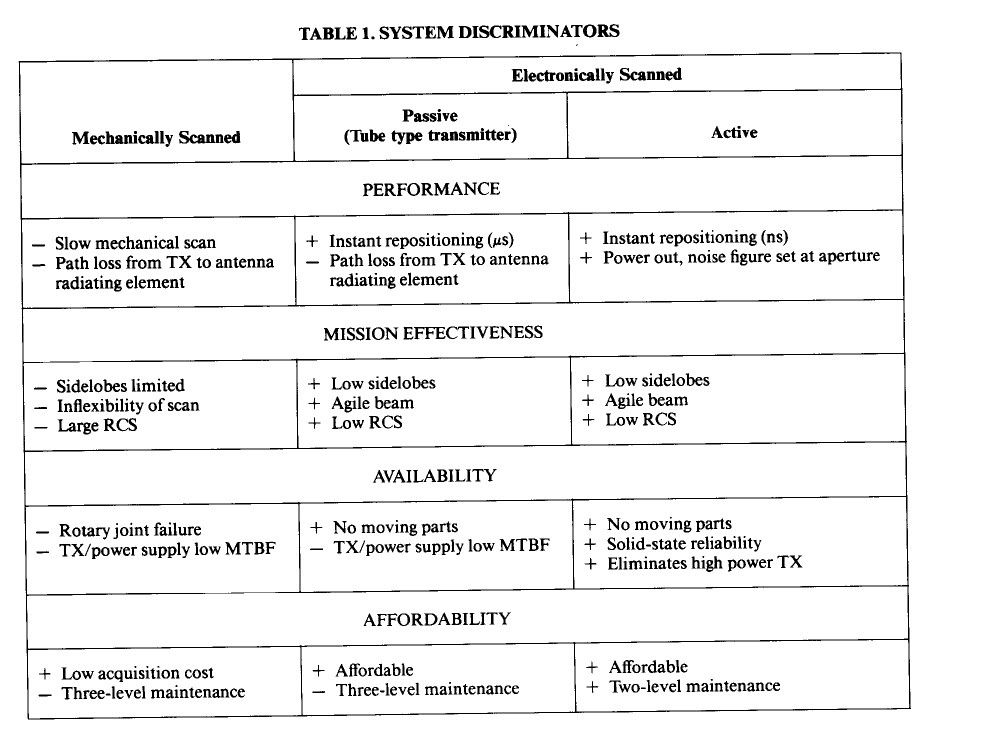
BIGVERN1966The PAR will have greater range due to better beam definition and lower sidelobes. The APAR has greater receiver sensitivity and no waveguide losses.
Courtesy Sumeet@BR,
Hit the nail on the head with that one Harry 😀 😀 😀 A TWT based system can be made active with computer controlled phase shifters between the Tube and each of the slotted waveguides on the array. The change of phase then changes the squint angle of the radiation out of the array. However its too heavy for a fighter and is only used on larger ground based radars that I know off (The last one I worked on used just that type of system to set start point of the beam (the radar in question then used FW In Pulse Sweep of the transmitted pulse to scan the beam).
BIGVERN1966According to the entry in British Military Aircraft Accidents by David Oliver it ‘broke up during aerobatics’ near Weathersfield.
That is doubtful, as I never saw 614 VGS do aerobatics with the Mk 3 at either Debden or Wethersfield. With their T21’s it was a different story however 😮 😮 😮
BIGVERN1966This must be the Cadet that crashed at Wethersfield in early 1983. If it was then the Air Cadet was from 999 (Dummow) Sqn ATC and his first name was Ian (surname may have been Sparrow), Instructor was the chief QFI on 614 VGS at Weathersfield (Was Flt Lt John Miller RAFVR if memory serves). From what I heard at the time the aircraft was on a pre Solo check ride, the cadet stalled the aircraft, dropped a wing and started to enter a spin from 150 feet while on finals. I did here a rumour that the people on the ground heard the Instructor call the cadet a stupid idiot before the impact. Other stories I heard at the time about the incident that the nose of the Mk 3 was crushed right back to the leading edge of the wing with the cadet being killed instantly and the instructor dying in hospital some time later.
BIGVERN1966Answers about range have been a bit vague. I’m asking just about effective range, not about other advantages. So far only the concentrated beam explanation made some sense but even that i don’t really see why a mechanically steered beam can’t maintain similar beam when tracking a long range target. Also, what crobato said, parabollic antennas also have great sensitivity and can created very tight beams. Is there meaningul tracking range advantage and if so why/how?
Proudfoot, you mentioned something about datalinks – please do go on about that.
Datalinks (more correctly called Tactical Data Links (TDL) in NATO or Tactical Digital Information Links (TADIL) in the US) are the method of passing information (radar picture, tactical information, resources information, mission orders Etc) between different agencies within a network or point to point system in almost real time. They are defined by the message format (Link protocol) and mode of network operation, not the method of transmission, which can range from copper land line though to UHF radio. Current link formats in the US/NATO are known as Link 1 through to Link 22, (Link 16 is one of the best known by its US name of the Joint Tactical Information Dissemination system (JTIDS)).
Current systems in Western use are listed on the FAS web site Here
BIGVERN1966The Dead Pool, Clint Eastwood being chased by an RC Car (with a bomb in it) 😀 😀 😀
BIGVERN1966The Dead Pool, Clint Eastwood being chased by an RC Car (with a bomb in it) 😀 😀 😀
BIGVERN1966when i was young i always got confused with the way we gave designations to exported aircraft.. types like Hunter Fmk-53, what was the Saudi Lightnings Fmk-55 or something.. i used to think how come the RAF uses Fmk-6s while we sold mk-55s to the Saudis 😀 😀 😀 .. why did the MOD use such designations…
The Lightning Mk 55 had some operation diffences to the F6, like it could carry bombs for starters. Most export aircraft have different equipment fits, hence the new mark numbers, plus the prefix number indicates its for export as most of those aircraft will be allocated a British XXNNN serial for their test flights before delivery.
BIGVERN1966that is a very good question… i would think for WW2 types it would be between the Spitfire, Mosquito, ME-109, JU-88.. for jet types i would think the MIG-21 would be head and shoulders above the rest, though i may be wrong.. 🙂
43 Marks of Mossie (of which 35 marks of which were actually built and operated).
30 Marks of Spitfire and Seafire (not counting wing or role sub versions)
Mig 21 – 50 different prototypes and production marks (this inculdes variants built in China) and upgrades.


 Sign In