 KKM57P
Over the transmitterlevel this is amplituden modulation (AM) and this produced likewise incremental frequency shift (harmonious disturbances) and not puls compression.
Frequency scanning is a frequency shift over the frequency. The frequency shift alter the lengh of your delay lines and this caused a phase shift and this is moving your beam.
If you must change the frequency, then must you change the delay lines lenght or your beam moves up or down and from one side to the another side.
Bring the proof that the PESA RBE2 can pulse compression.
KKM57P@OPIT
A delay caused a phase shift!
With a varactor shorten or lenght you the delay line.
Then your delay line is frequency dependently.
When you use only PIN-Diodes than is your frequnency spectrum limited and steplike. http://www.odyseus.nildram.co.uk/RFMicrowave_Circuits_Files/Phase_%20Shifter.pdf Figure 7.
Whith frequency shift without compensation moved your beam up or down and from right to left. It is however all the same whether frequency dependently or over a length variation of the delay line (pin diode) the beam alterd it’s position. Impuls Compression is thereby not possible. Because the beam moves with the frequency, side lobes and time sides lobes arise.
Two antenna elements, fed with the same phase
two antenna elements, fed with different phase
KKM57PHow build I an electronical phaseshifter?
http://www.odyseus.nildram.co.uk/RFMicrowave_Circuits_Files/Phase_%20Shifter.pdf
KKM57PQ:What are these diodes used for ?
A: Solid state phase shifters, whose job is to steer the beam.
WRONG!
That not only diodes that are varactor diodes.
Is a diode a activ element. No isn’t.
A diode is PASIV!
For what use an HF-Engineer an Varctor.
It needs the varactor for an electronic tunable delay line.
Without a varactor you can’t change the Frequency.
KKM57PNot only it isn’t true but the very same link you give prooves otherwise:
here is the description of a phased array radar using pulse compression on reception and emission:
http://www.radartutorial.eu/19.kartei/karte108.en.htmlAdditionnally, the RBE2 provides a number of features such as raid assessment modes, synthetic aperture imaging with doppler beam sharpening that speak volumes of it resolution power.
ASEA can use pulscompression!
Master-T is a combination of ASEA (electronically controlled azimut shift) and mechanical Radar.
SEAs with electronically controlled phase shifter is ASEA!
PESA can’t use pulsecopression!
The RBE2 (PESA) is a passiv device and passiv is always a Frequency Scanning Array!
The heart of the radar is the passive, phased array antenna which uses Thomson-CSF Detexis’ RADANT design featuring two solid state electronically controlled “lenses” working in the vertical and horizontal planes, each containing around 25,000 diodes.
In between the lenses is a polarising filter, enabling extremely accurate, instantaneous vertical or horizontal beam shifting within a 60í cone. (Polarisations switch, not scanning!)
KKM57PFrance Tanker Top Gun 😮
http://www.flightglobal.com/Articles/2006/12/01/Navigation/177/210889/Video+Confusion+over+location+of+KC-135+tanker+flight+over+desert+at+10ft.html
There are old pilots.
There are bold pilots.
There are however no old bold pilots! 😉
KKM57PFrequency Scanning Array = PESA
http://www.radartutorial.eu/06.antennas/an14.en.html
KKM57PEF max 23500kg wet, is 7500kg Weapon + extern 1,7t Sprit = 9,2t
load. It’s not magic, it’s advertising.
Dasault says 9,5t max. extern load not 9,5t weapon, that is a litle bit
different! 9,5t-9,3 = 200kg.
Dausault
Weight
Empty 10-ton class
Max 24.500 kg (54,000lb)
Fuel (internal) 4.700 kg (10,300lb)
Fuel (external) 6.800 kg (15,000lb)
Max external capability 9.500 kg (20,950lb)
External store stations
Total 14
Heavy stores & fuel “wet” stations 5
Load factors +9g/-3.2g
Max speed M 1.8+/750 kts
Approach speed 120 kts
Landing distance 450 m (1,475 ft)
Max climb rate over 1,000 ft/sec
Operational ceiling 55,000 ft
Radius of action (penetration mission) more than 1.000 NM
Combat air patrol loiter time over 3 hours
PESA CAN’T PULSCOMPRESSION THERFORE IS PESA A LOUD CRYING RADAR SYSTEM!
(PESA)Without puls compression need a radar more transponder power!
Pulscompression method combines the high energy of a long pulse width
with the high resolution of a short pulse width. The pulse is frequency
modulated, which provides a method to further resolve targets which may
have overlapping returns.
Now the receiver is able to separate targets with overlapping of noise.
The received echo is processed in the receiver by the compression
filter. The compression filter readjusts the relative phases of the
frequency components so that a narrow or compressed pulse is again
produced. The radar therefore obtains a better maximum range than it is
expected because of the conventional radar equation.
Puls compression
Lower pulse-power therefore suitable for Solid-State-amplifier
Higher maximum range
Better resolution
Better jamming immunity
difficulter reconnaissance
Therefore is the detetecting range and aperture of a PESA lower.
KKM57PGermany reveals secret Stealth fighter research
http://www.f-104.de/english/home_english.html
http://www.f-104.de/exponates/english/exp_lampyridae_eng.html
In 1987, a year before the Reagan administration revealed the existence of the F-117A, a fact-finding group of US Air Force officers was taken to a closed-off section of Messerschmitt-Bölkow-Blohm’s (MBB’s) plant at Ottobrunn in Bavaria and shown a three-quarter-scale wind-tunnel model of an aircraft that MBB had been developing under the tightest secrecy since 1981. According to high-level Luftwaffe sources, the Americans were startled by what they saw: a stealth aircraft, dubbed the Medium Range Missile Fighter or Lampyridae (Firefly), whose core design principle – deriving an efficient aerodynamic shape out of an arrangement of radar-deflecting flat panels or ‘facets’ – mirrored the technique employed on the then top secret F-117A. The demonstrator was subsequently tested in a series of tethered flights in a wind-tunnel complex owned jointly by the German and Netherlands governments.
KKM57Phttp://upload.wikimedia.org/wikipedia/commons/f/ff/Rafale_ag1.jpg
Maybe use a lineal.
http://www.eurofighter-typhoon.co.uk/Eurofighter/images/techimg/front.html
http://www.eurofighter-typhoon.co.uk/Eurofighter/images/structure.jpg
The EF use 70% CFK and how many used in the Rafale?
Rafale used widley metall on the surface and that gives greater
tolerances, reflection and that increase the Rafale RCS or you must use more expensiv RAM-Coatings.
Continus curvature only function with composits and CFK is a good radar
absorber. The greates RCS has the afterburner plume and the rafale was unabel to demonstrate supercruise in Signapore.
And who think a PESA has a low RCS should think again.
A PESA is a good radarreflector and have some draw backs.
Note that frequency scanning (PESA)reduces the value of using frequency change as a means of achieving other valuable effects (benefits of pulse compression). The absence of pulse compression reduce the detection range, solution, no frequency hoping, no beamsharping.
http://www.eurofighter-typhoon.co.uk/Eurofighter/structure.html
EF
The radome is comprised of a complex layered Glass Fibre Reinforced Plastic (GFRP) structure manufactured using very high tolerance automated processes. Since the material used to construct the radome must be transparent to microwave energy it is an obvious source of Radar Cross Section (RCS) reduction problems. To overcome this, BASE, British Aerospace Systems and Equipment who supply the radome structure have developed various Frequency Sselective Surface (FSS) materials which have been subsequently put to use in the Typhoon’s radome. FSS materials are composed of a precisely defined array of metallic elements contained within a conducting frame. The use of these materials (when laid up in the correct fashion) results in a reduction in the transmission of all out of band frequencies. Therefore the radome can be designed to be transparent only to those frequencies and polarisation’s used by the aircraft’s own radar. This of course should lead to a reduction in the aircraft’s radar cross section, from all frontal aspects at least.
The Eurofighter Typhoon cannot and is not classed as a stealth fighter. However the consortium did take measures to reduce the
aircraft’s radar cross section. Many of these Reduced Observable (RO)
features were tested over the years at BAE Systems covered radar
signature range at BAe Warton near Preston, NW England. Some examples of
this design include; the intakes which are shaped so as to hide the
engine compressor blades, the sloped intake sides, the fuselage recessed
medium range weapons, the wing hardpoint placement and design, radome
construction, etc. In addition Radar Absorbent Materials (RAM) developed
primarily by EADS/DASA coat many of the most significant reflectors,
e.g. the wing leading edges, the intake edges and interior, the rudder
surrounds, strakes, etc.
The actual radar cross section is of course classified, it is however
set out for the RAF in SR(A)-425. According to the RAF the Eurofighter’s
RCS more than exceeds these requirements. More recent comments from BAE
seem to indicate the radar return is around four times less than the
Tornado. During a recent press event BAE Systems stated that the
Typhoon’s RCS is bettered only by the F-22 in the frontal hemisphere and
betters the F-22 at some angles. Although the later comment is very
questionable it still indicates a real attempt to reduce the Typhoon’s
radar signature. This should enable a Eurofighter pilot to remain
undetected by his enemy until he his significantly closer than he may
otherwise be able to achieve.
KKM57PHow many CFK on a Rafale?
Only the tail fin an some minor things, this is not really good for an
low RCS. Which plane has intake and first compressor stage in straight
line –> Rafale and this is not good for a low RCS.
S-curved intakeduct –> F-22, EF, F-35, this reduce the RCS.
First IPA with ASEA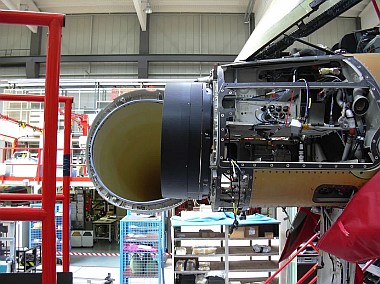
KKM57PAustria EF replacement the MiG-29

KKM57PF135 running to hot
http://www.sbac.co.uk/community/cms/content/preview/news_item_view.asp?i=10527&t=0
Some propulsion analysts suggest that the engine’s combustor–where fuel and air are mixed and ignited–is too small because, to save money, it was derived from the F-22 engine.
KKM57P“CAPTOR-E” ready für Tranche 3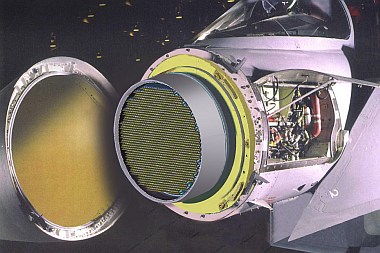


 Sign In







