 KKM57P
CAPTOR-E” ready für Tranche 3
KKM57PSource Maeder (Janes)
Pierre Sprey was one of three designers who conceived and shaped the
F-16; he also led the technical side of the US Air Force’s A-10 design
concept team. James Stevenson is former editor of the Navy Fighter
Weapons School’s Topgun Journal and author of The Pentagon Paradox and
The $5 Billion Misunderstanding. This article is adapted from a briefing
they produced for the Straus Military Reform Project of the Center for
Defense Information.
The F-22: not what we were hoping for
The F-22 fighter aircraft’s focus on stealth brings big disadvantages in
cost, weight and manoeuvrability, argue Pierre Sprey and James Stevenson
For decades, the US Air Force has pushed the F-22 as its fighter for the
21st century. Advocates tout its technical features: fuel-efficient,
high-speed ‘super-cruise’; advanced electronics; and reduced profile
against enemy sensors, known as ‘stealth’.
However, on measures that determine winning or losing in air combat, the
F-22 fails to improve the US fighter force. In fact, it degrades our
combat capability.
Careful examination of actual air-to-air battles tells us that there are
five attributes that make a winning fighter. These attributes shaped the
F-15 and the F-16.
They are: (1) pilot training and ability; (2) obtaining the first
sighting and surprising the enemy; (3) outnumbering enemy fighters in
the air; (4) outmanoeuvring enemy fighters to gain a firing position;
and (5) consistently converting split-second firing opportunities into
kills.
The F-22 is a mediocrity, at best, on (4) and (5). It is a liability on
(1), (2) and (3).
The most important attribute – pilot quality – dwarfs the others. Air
combat history from both small and large wars makes that obvious. After
the Israel Air Force (IAF) swept Syrian MiGs from the sky in Israel’s
1982 invasion of Lebanon with an 82-0 exchange ratio, the IAF Chief of
Staff told US congressional staffers that the result would have been the
same had the Syrian and Israeli pilots switched aircraft.
Great pilots get that way by constant dogfight training. Between 1975
and 1980, at the Navy Fighter Weapons School (‘Topgun’), instructor
pilots got 40 to 60 hours of air combat manoeuvring per month. Their
students came from squadrons getting only 14 to 20 hours per month.
Flying the cheap, simple F-5, the robustly trained instructors
consistently whipped the students in their ‘more capable’ F-4 Phantoms,
F-14 Tomcats and F-15 Eagles. Today, partly thanks to the pressure on
the air force’s training budget from the F-22’s excessive purchase and
operating costs, an F-22 pilot gets 12 to 14 hours of flight training
per month. For winning future air battles, this is a huge step backward.
For half a century, the air force has been attempting to get the jump on
enemy fighters through expensive, complex technology.
Billions of dollars were spent trying to perfect long-range radar
missiles to achieve ‘beyond-visual-range’ (BVR) kills. Extraordinary
kill rates, as high as 80 to 90 per cent, were promised when projects
were being sold. Success rates in actual combat were below 10 per cent.
Simple, more agile, shorter-range infra-red missiles and guns were far
more successful and effective.
Worse, the ‘identification friend or foe’ (IFF) systems that must
distinguish enemies from friends before launching BVR missiles failed in
every war. As recently as Operation ‘Iraqi Freedom’ in 2003,
misidentified allied aircraft were lost to US systems. The air force now
tells us the only way to get the jump on enemy fighters supposedly
launching BVR missiles is with stealth. But stealth solves neither the
problem of less effective, high-cost BVR radar missiles nor the IFF
conundrum. Moreover, stealth has failed to make our fighters invisible
to radar and it brings crippling disadvantages.
In Operation ‘Desert Storm’ in 1991, according to the Government
Accountability Office, so-called stealthy F-117s were significantly less
effective bombers than the air force described publicly – there is
anecdotal evidence that ancient Iraqi radars detected them. In the war
against Serbia in 1999, non-stealthy F-16s had a lower loss rate per
sortie than the F-117s. The F-22 will not be invisible to radar in real
combat, where it cannot control detection angles and radar types.
The most obvious disadvantage stealth brings to the F-22 is
extraordinary cost; it grossly reduces the numbers we will buy. New
Department of Defense data shows the total unit cost of the F-22 has
grown from about USD130 million to over USD350 million per aircraft.
Result? The original buy of 750 is now down to 185.
Moreover, stealth plus the F-22’s complexity result in unprecedented
levels of maintenance downtime. That further reduces numbers in the air;
185 F-22s will support about 120 deployed fighters. They will be lucky
to generate 60 combat sorties per day: a laughable number in any serious
air war. In World War II, the Luftwaffe could field only 70 of its
revolutionary jet: the Me-262. It caused alarm among Allied pilots but
had negligible effect on the air battle.
Furthermore, the stealth requirement adds significant drag, weight and
size. Size is the most crippling. Why? Because real-world combat is
visual combat. Because the F-22 is much bigger than most fighters, it
will be detected first, reversing the theoretical advantage it derives
from stealth. Topgun had a saying: “The biggest target in the sky is
always the first to die.”
Once seen, the F-22 has trouble outman-oeuvring the enemy. Its weight
hurts the key performance measures of turning and accelerating. Put
simply, both the F-15A and F-16A out-turn and out-accelerate the F-22.
Finally, stealth harms the F-22’s quick-firing ability. To retain
stealth, the gun and missiles must be buried behind doors that take too
long to open to exploit instantaneous opportunities.
The air force will argue strenuously that we are wrong and the F-22 has
excelled in air-to-air exercises against all comers. However, our
information is that these are ‘canned’ engagements in which the F-22 is
pitted against opponents in joust-like scenarios set up to exploit the
F-22’s theoretical advantages and exclude its real-world vulnerabilities.
There is a way to find out who is right. A serious test of F-22
capabilities would pit it against pilots and aircraft the air force does
not control using rules of engagement dictated by combat and the ratio
of F-22s to enemies that the tiny F-22 inventory should expect in
hostile skies.
We both would be delighted to observe any such realistic exercises and
to report back to this magazine. Nothing would please us more than to
find that we are wrong and US fighter pilots have been given the best
fighter in the sky.
KKM57PAll aerodynamic instable airplanes have a picht up problem!
Anedrale plus long lever arm reduce the wing drag.
An advantage of a Canards is, pitch control is provided by symmetric operation of foreplanes and wing flaperons.
http://news.bbc.co.uk/1/hi/world/europe/1818077.stm
Some observers have claimed that many criticisms of the Eurofighter have come from US aerospace companies alarmed at the prospect of losing customers to the Eurofighter.
Also, designing a fighter to be stealthy can sometimes mean tradeoffs when it comes to manoeuvring performance.
So what will be the Eurofighter’s main competition?
The Joint Strike Fighter (JSF), which the US is developing in co-operation with the UK, is due to enter service after 2012.
But this project has hit serious technical problems and is under threat in the US Congress.
The US Air Force has already begun to take delivery of another superjet, the F-22 Raptor.
This is very stealthy but costs twice the price of the Eurofighter, and reports suggest that RAF’s Eurofighters have flown highly successful missions against the F-22 during recent exercises in the US.
————-
Furthermore, the stealth requirement adds significant drag, weight and
size. Size is the most crippling. Why? Because real-world combat is
visual combat. Because the F-22 is much bigger than most fighters, it
will be detected first, reversing the theoretical advantage it derives
from stealth. Topgun had a saying: “The biggest target in the sky is
always the first to die.”
KKM57PThe german name for the F-104 Witwenmacher (widowsmaker)!
KKM57PAlexander Lippisch fixed the F-102 with the antishock cones.
Wrong!
Whithcomb only the second or 3th!
The area rule was first discovered by a team including Heinrich Hertel and Otto Frenzl working on a transonic wind tunnel at Junkers works between 1943 and 1945; it is used in a patent filed in 1944. The design concept was applied to a variety of German wartime aircraft, including a rather odd Messerschmitt project, but their complex double-boom design was never built even to the extent of a model. Several other researchers came close to developing a similar theory, notably Dietrich Küchemann who designed a tapered fighter that was dubbed the Küchemann Coke Bottle when it was discovered by US forces in 1946. In this case Küchemann arrived at the solution by studying airflow, notably spanwise flow, over a swept wing.
http://en.wikipedia.org/wiki/Area_rule
http://de.wikipedia.org/wiki/Otto_Frenzl
KKM57PGerman Air Force introduces LIBELLE as standard equipment for EUROFIGHTER
Laage Air Base, January 31, 2005
On January 31st, the German Air Force introduced LIBELLE G-Multiplus® for its operational EUROFIGHTER pilots of Jagdgeschwader 73 “Steinhoff” at Laage Air Base. This concludes the operational verification phase on GAF MiG-29 and F-4F exactly three years after the first LIBELLE flight on MiG-29.
The EUROFIGHTER version of LIBELLE G-Multiplus® was especially developed under contract by the German “Bundesamt für Wehrtechnik und Beschaffung” (Federal Office of Defense Technology and Procurement) to provide an optimum in G-Protection and High-Altitude Protection to the pilots without the use of Positive Pressure Breathing at G (PBG) or any pneumatic bladders.
The German EUROFIGHTER is the first fourth generation aircraft to incorporate the innovative LIBELLE Pilot Flight Ensemble.
The LIBELLE system’s principle enables the pilot to make full use of his physical and mental abilities and to maintain unrestricted situational awareness even during extreme flight manoeuvres. LIBELLE’s primary protection properties as well as optimized comfort and reduced heat stress provide a solid base for an effective and successful mission accomplishment.
KKM57PIs the F-35 stealth when the afterburner is in use?
No, its not!
Alan Brown, Lockheed
Jet Wakes
The driver determining radar return from a jet wake is the ionization
present. Return from resistive particles, such as carbon, is seldom a
significant factor. It Is important in calculating the return from an
ionized wake to use nonequilibrium mathematics, particularly for medium
and high altitude cases. The very strong ion density dependency on
maximum gas temperature quickly leads to the conclusion that the radar
return from the jet wake of an engine running in dry power is
insignificant, while that from an afterburning wake could be dominant.
http://www.itnu.de/radargrundlagen/05.bistatic/bs04.en.html
One F-117 downed and several damaged F-117!
“The disguising effect is additional at VHF- frequencies not only
ineffectively, but almost additional unsuitable by resonance (Mie-
scattering!).” This is the reason why a SR-71 with it 100 times better
RCS as a F-14 is visible for the FAA radar.
http://www.eurofighter.com/News/Article/default.asp?NewsItemId=131
http://www.lowobservable.com/Protos.htm
F-22 money wasting? http://www.pogo.org/m/dp/dp-fa22-Riccioni-03082005.pdf
KKM57PReal stealth is mesured against its five signature – infrared, sound,
visual, electronic, RSC.
How stealht is the F-35 in visual, IF and VHF?
An Afterburner is not very usefull for stealth.
A F-35 RCS like a strandball ist not stealth!
The USAF defines stealth with only partial siganture –radar– and that
only in its forward quarter, and only enemy fighter radars at the same
altitude.
Also, it is physically impossible to design shapes and radar absorptive
material to simultaneously defeat low power, fighter radars and high
power, low-frequency ground based radar.
KKM57PAIM-120 AMRAAM 150 kg
AIM-9L Sidewinder ~90kg
SC
http://www.eurofighter-typhoon.co.uk/Eurofighter/engines.html
RCS
http://www.eurofighter-typhoon.co.uk/Eurofighter/structure.html
KKM57PAccording to EADS, the maximum speed possible without reheat is Mach 1.5
in what EF GmbH regard as a ‘clean’ configuration – eg without tanks but
with four BVRAAMs and two IR AAMs. (Supercruise performance drops to
Mach 1.3 with a full air-to-air weapons load, including tanks). Rafale’s
supercruise capabilities have been described as marginal with the
current engine (the aircraft failed to demonstrate the capability during
the Singapore evaluation). EF demonstrate Supercruise with full combat
load during the Singapore evaluation.
KKM57PIgor Lesikov 10.30.1967, the highspeed record attempt ending in a deaster, he overstressed the E-266.
The E-266 exploded and Lesikov dies thereby.
The stronger E-266 can’t break the absolut speed worldrecord!
“High speeds reduced lateral stability” = inertia coupling!
Therfore has the serien MiG-25 greater sidestabilisators, greater fins,
less powerfull engines.
MiG-25 radom melting!
“E-266 radom…They were not subjected to significant
structural loads but experienced high temperatures
and had to be replaced with steel or titanium
honeycomb structures.”
That means –> No Radar and therefor no guiding for the R40!
This is not very usefull for a interceptor! :diablo:
KKM57PYou should not forget the FAI conspiracy.
http://records.fai.org/general_aviation/aircraft.asp?id=675
It’s a E-266M with stronger RD-F = (R-15BF2-300) 2 x 14000kp.
14000kp is a little bit more thrust as 10980kp (RB-15BD-300)
E-266
http://records.fai.org/general_aviation/aircraft.asp?id=383
500km Rekords without payload!
SR-71
http://records.fai.org/general_aviation/aircraft.asp?id=779
KKM57PThe development of the A-12 OXCART spyplane in the late 1950s created
another problem for aircraft and engine designers. The high speeds
reached by the A-12 would cause the skin of the aircraft to get hot.
Temperatures on the OXCART ranged from 462 to 1,050 degrees Fahrenheit
(239 to 566 degrees C). The wings, where the fuel was stored, had
external temperatures of more than 500 degrees Fahrenheit (260 degrees
C). Even with the higher flashpoint, fuel stored in the wings could
explode. As a result, the engine designers at Pratt & Whitney sought a
fuel with an extremely high flashpoint. Working with the Ashland Shell
and Monsanto companies, the engine designers added fluorocarbons to
increase lubricity (or slipperiness), and other chemicals (borane) to
raise the flashpoint. The resulting fuel was originally known as PF-1
but later renamed JP-7. JP-7 has such a high flashpoint that a burning
match dropped into a bucket of it will not cause it to ignite.
Engine designers and fuel chemists created JP-7 with a high flashpoint
that would not explode in the aircraft’s tanks, but this also made the
fuel hard to ignite within the engines themselves. Because JP-7 is so
hard to ignite, particularly at the low pressures encountered at high
altitudes, these planes used a special chemical called tri-ethyl borane
(TEB), which burns at a high temperature when it is oxidized (combined
with air). Another problem that the A-12 encountered was that the engine
exhaust was easily seen by radar. The engine designers added an
expensive chemical known as A-50, which contained cesium, to the fuel
for operational flights that reduced its ability to be detected by radar.
Don’t we confound plasma with ionization?
When we should need 5000°C for ionsiation how should this work in
your car? Modern cars has ionsensing.
http://users.tkk.fi/~vvartiov/Scitech_ion/main.html
Or why works this?
http://scitation.aip.org/getabs/servlet/GetabsServlet?prog=normal&id=JETPEZ000127000001000042000001&idtype=cvips&gifs=yes
Flame Ionization Sensor Integrated Into a Gas Turbine Fuel Nozzle
Not a MiG-25 can carry 2T at 1000km at 2970km/h.
A E-266M with RB-F (2x15000kp) can do this.
2 Times more titan as a MiG-25 and 36% more thrust.
The E-266M is more a MiG-31.
I can’t find any MiG-25 worldrekords!
What I can find is this:
http://records.fai.org/general_aviation/aircraft.asp?id=779
A serien SR-71 with 1T is 450km/h faster as a spezial E-226M at 1000km.
The same firebar storys–>
Maximum MiG-25 acceleration (g-load) rating was just 2.2 g (21.6 m/s²)
with full fuel tanks, with an absolute limit of 4.5 g (44.1 m/s²). This
was significantly poorer performance than the previous generation F-4
Phantom. One MiG-25 withstood an inadvertent 11.5 g (112.8 m/s²) pull
during low-altitude dogfight training, but the airframe had to be
written off due to deformation.
KKM57PYou mean hypergoles TEB triethylborane and I mean Cerin-Glycol-Borane fuel addetiv. :rolleyes:
KKM57PThe MIG-25 manual do not mention any water for compressor
precooling. That was misinformation from old books.
The orginal manual is a wrong old book? 😀
The fuel control system is equipped with a water-methanol injection
system, which further enhances some of the most powerful afterburning
engines ever installed in a combat aircraft. blablabla :rolleyes:
But the russian sources state that the MIG-25 had SR-71 locked on
radar sight many times. Remember that SR-71 is the main target for MIG-25.
It could not kill low flying cruise missile, but Blackbird was
target type which the MIG-25P was built for.
Again and again. :rolleyes:
Locked on VHF without A-50.
VHF –> meter waves.
Meaningless for SAMs.
The MiG-25 Safir use centimeter waves and for this is the SR-71
invisible.
A-50 is very expensiv!
A another counter measure against the R40 is the use of Boron based
fuel addetives. Anytime you see colour photos of SR-71s showing a green
hue/colouring of the engines exhaust it is likely burning Boron based
fuel addtives. A another option are flurine.
The ionisation occurs as a result of the carbon atoms present in the
exaust gas.
There is no RAM which could endure Mach 3 speed, even today, not to
speak for 60-s.
The canted vertical stabilisers are built in such way for stability reasons.
I said earlier, it had a corrugated uderwing surfaces, which was
unacceptable for a stealth aircraft.
Fine, your MiG-25 is unabel to exeed Mach 2,5! 😮
The upper 2/3 of the front on the left side ruder is a Radar neutral
GFK cover over the HF-Antena.
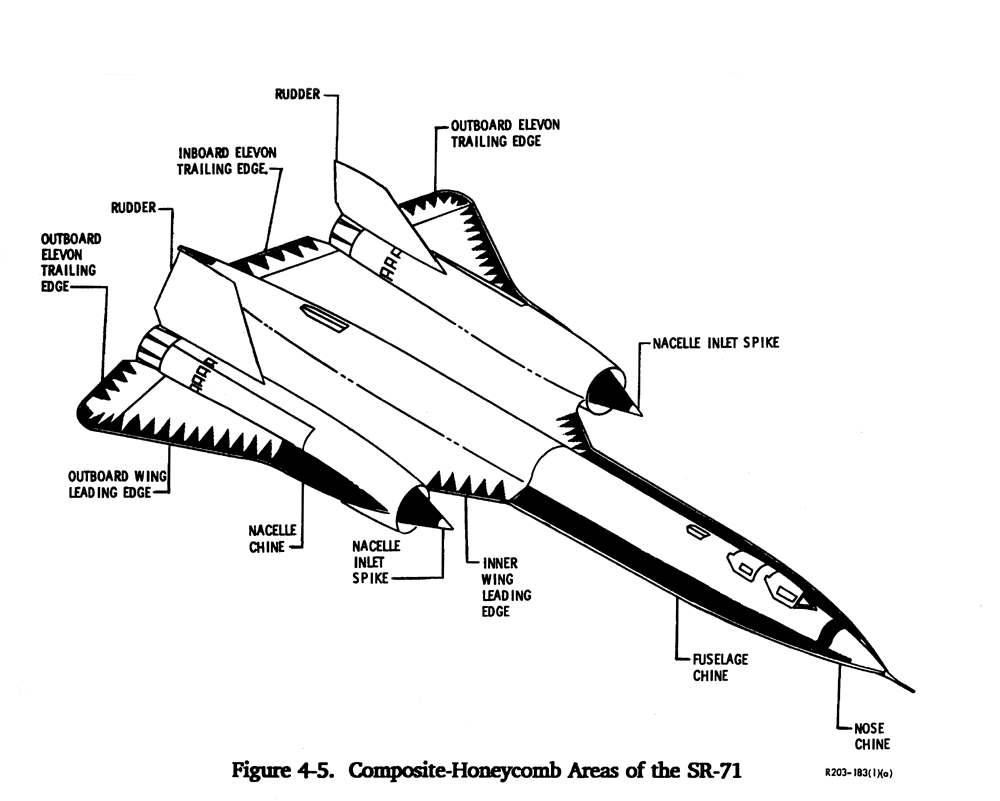
SR-71
Construction: Titanium Monococque with some super-high-temperature
plastics.
Epoxy with asbestos and ferrit, Epoxy graphit, Carbon-Carbon etc.
The canted vertical stabilisers are built in such way for stability reasons.
There is a tremendous advantage to positioning surfaces so that the
radar wave strikes them at close to tangential angles and far from right
angles to edges. To a first approximation, when the diameter of a sphere
is significantly larger than the radar wavelength, its radar cross
section is equal to its geometric frontal area. The return of a
one-square-meter sphere is compared to that from a one-meter-square
plate at different look angles. One case to consider is a rotation of
the plate from normal incidence to a shallow angle, with the radar beam
at right angles to a pair of edges. The other is with the radar beam at
45 degrees to the edges. The frequency is selected so that the
wavelength is about 1/10 of the length of the plate, in this case very
typical of acquisition radars on surface to air missile systems. At
normal incidence, the flat plate acts like a mirror, and its return is
30 decibels (dB) above (or 1,000 times) the return from the sphere. If
we now rotate the plate about one edge so that the edge is always normal
to the incoming wave, we find that the cross section drops by a factor
of 1,000, equal to that of the sphere, when the look angle reaches 30
degrees off normal to the plate. As the angle is increased, the locus of
maxima falls by about another factor Of 50, for a total change of 50,000
from the normal look angle. Now if you go back to the normal incidence
case and rotate the plate about a diagonal relative to the incoming
wave, there is a remarkable difference. In this case, the cross section
drops by 30 dB when the plate is only eight degrees off normal, and
drops another 40 dB by the time the plate is at a shallow angle to the
incoming radar beam. This is a total change in radar cross section of
10,000,000!
:diablo:
Actualy not.
All ordinary fighter turbines are of mixed impulse/reaction type.
Therefor is the Soloviev D-30F6 for the MiG-31 a bypass turbojet!?
It’s works similar a J-58.
The fairy tale storyteller:
Belykov, chief MIG engineer say that it is not true.
In Egypt, there was not even need for engine maintenace after Mach
3,2 flights. Sources: MIG-Belyakov, MIGS-Butowski, among others.
Therefor 5 monts no MiG-25R flight over Sinai!?
However, at speeds above mach 3, the force of the engine sucking fuel
through the pumps overwhelmed the pumps’ ability to limit the flow. At
this point, the engines effectively became ramjets, as air began to
bypass the low pressure compressors, accelerating out of control until
the pilot could regain throttle control through using firewalls or
compressor stalls, or the tanks ran dry. However, a more probable series
of events (rip off the W/M nozzels or Firebar’s Superamplifier
Perpetummobile Vortex Generator) would be the eventual destruction of
the engine as the suction force of the compressors began to pull various
engine parts through the ignition chamber and turbines.
At high angle of attack, the upper MiG-25 vertical tail, comes into a
region of lower pressure, and loses much of its effectiveness.
You can fly Mach 2,83 only at a straight line.


 Sign In







