 KKM57P
Why? well simple there is no superiority of canards versus LERXes and tailplanes.
What have this all to do with stealth?
Su-27, F-15, F-14 etc. are are greate RCS nightmares.
Su-27 straight inlets ducts with moveable ramps and gaps and dents, 90° corner cateye reflector (Tail) and ventral fins.
F-14 straight inlets ducts with moveable ramps and gaps and dents, 90° corner cateye reflector (Tail) and ventral fins. 90° here and there.
F-15 straight inlets ducts with moveable ramps and gaps and dents, 90° corner cateye reflector (Tail) . Somtimes self destrution through longerons untercut or disintegrating leading edges.
Against Eurocanards : no cateye reflector, s-curved inlets duct, etc. etc.
KKM57PThe Kfir was a stable design and had unmoving canards.
The Viggen too, stable and non maneuvering Canard.
KKM57PThe fact it is moveable LERX makes it able to control the vortex, and contrary to a canard wont have the added drag and reduction of lift to the wing and blends perfectly with planforming and stealth
The fact this what you mean is not a LERX where is that the ROOT! Then is the sweep angle not usefull enough and when angled down can’t this structure produce a vortex. This picture shown that the T50 use a mini LERX.
I think you need urgently a pair of spectacles the hinges line for this structure is not in the right position for planeform. Then is the misaligment to the differter unmissable, this is planeform only in your dream.;)
KKM57PThe T-50 uses LERXes see
right above the inlets
Sure a moveable moustache or a very close coupled Canard.:diablo: But this is more a moveable differter the sweep angle is not great enough to produce a usefull leading-edge vortex.;)
One benefit obtainable from a control-canard is avoidance of pitch-up. An all-moving canard capable of a significant nose-down deflection will protect against pitch-up. As a result, the aspect ratio and wing-sweep of the main wing can be optimized without having to guard against pitchup.
Daniel P. Raymer, Aircraft Design: A Conceptual Approach, Section 4.5 – Tail geometry and arrangement.
KKM57Psustained much superior to the Viggen which shows you using tailplanes is as good as Canards and in stealth tailplanes are easier to adapt to planforming.
But a LERX is not stealth compatible and a F-22 had no LERX and the tail planes are greater as a Canard shown that the tail plane is less effective as a Canard.
The F-22 tail is direct positioned in wing slipstream, sacrifice aerodynamic for RCS. The F-22 show that the YF-22 had a traveling wave problem at the tail. Now the F-22 tail leading and trailing edge point in the same direction and sacrifice in the rear quarter a low RCS.;)
KKM57PNo – the F-22 pumps out 37klb of thrust in peace time – they announce that at airshow demonstations. There are youtube videos of that. Bill Sweetman estimated the total thrust – presumably in wartime – at 39klb-40klb per engine.
So in the current peace time setting the F-22s max TWR is 1.70. While it suffers lower thrust drop off at supersonic speeds/high altitudes compared to higher bypass ratio engines found in the other new designs.
Max TWR mean TWR at empty weigth not a really usefull combat configuration.;)
KKM57PNo wrightwing, MiG-31 top speed is M2.83 with missiles, it could be higher but was limited to M2.8 due to hazards to engine and airframe life in routine use.
-So you see, missiles has nuffing to do with it, although i can see how that would suit you.;)
We should not forgte the cook time for missiles.;)
KKM57PSo, perhaps the combination of instability and canards allows for similar or better sustained turn rates with a lower TWR? It does seem to be the case.
The TWR for a F-22 is 1.08 (1.62) and for a Typhoon 1.18 (1.65 max). Where please is 1,08 more as 1,18 or 1.62 more as 1.65?
KKM57PIn Europe the delta wing has been used to make relatively compact designs, the canard delta wing configuration allows them to create relatively small designs.
First rule for Dogfight, “The biggest target in the sky, is always the first to die.”
KKM57PThe Delta wing has its regimes where is more efficient but at low speeds it is not as efficent as a straight wing.
A straight wing is inefficient at high speed and not transonic, supersonic capable and really not a good choice for area ruling! It’s bad for a low RCS. :diablo:The delta wing works on subsonic, supersonic and hypersonic–> Space Shuttle. :rolleyes:
KKM57PHow much does the AoA help in a turning battle if both pilots have helmet-cues missiles?
Nothing, it’s good for the Airshow circus. But in the real live bleed high AoA too much energy and make a sitting duck out your jet.
KKM57PMy whole point was there is no reason to consider an airplane with canards superior to one with tailplanes or a tailess delta, the F-15 has a higher TWR than the AJ-37 and a big wing giving it the edge over the Kfir and Viggen.
But the AJ-37 can thing do that a F-15 can’t do. The AJ-37 lands on small ordinary highways whit carrier like rates of descent. A big wing alone make not a good fighter or a B747 would be the master of dog fight. The JA-37 intercepts the SR-71 routinely. ;)The Saab Viggen (Thunderbolt) is a short coupled fixed Canard. The flaps on the Viggen Canard is used for STOL purposes only and not for steering input.:diablo:
Canards are used to improve the AoA mostly of delta wings in modern fighters, this is because the delta wing main trade offs is low AoA handling and flow separation relatively at low AoA, this is partially compensated by the fact it has low drag and a big wing area.
Is the angle of attack increases the leading edge of the delta-wing generates a vortex which remains attached to the upper surface of the wing, giving the delta a very high stall angle. A normal wing built for high speed use is typically dangerous at low speeds, but in this regime the delta changes over to a mode of lift based on the vortex it generates.
The Mirage 2000 prototyp without Canards achieve easily a AoA of 26° at 110 knots and outclassed the F-16 at the Farnborough Airshow 1978.
At higher AoA inertia coupling can appears a F-16 problem and less steering autority can caused a super stall.
What happens on a conventional wing at higher AoA without LERX?
Pitch-Up (Sabre Dance).
The phenomenon of pitch-up is directly related to inherent properties of all swept wings. The wingtips of a swept wing aircraft operate at a higher local lift coefficient than inboard sections of the wing so the wingtips are more heavily loaded than inboard sections. In addition, swept wings tend to generate spanwise flow of the boundary layer (along the length of the wing from root to tip rather than across the wing from front to back). The combination of these factors means that at a high angle of attack the wingtips stall before the rest of the wing.
KKM57Pwhat you are saying has some truth by its own, the best stealthy platform will be the one with less elements such as flying wing or something like the aircraft envisioned by Lippisch in the 1940s
and that is what the americans did with the bird of prey
Less elements mean you can concentrate the radiation in one direction away from the source.
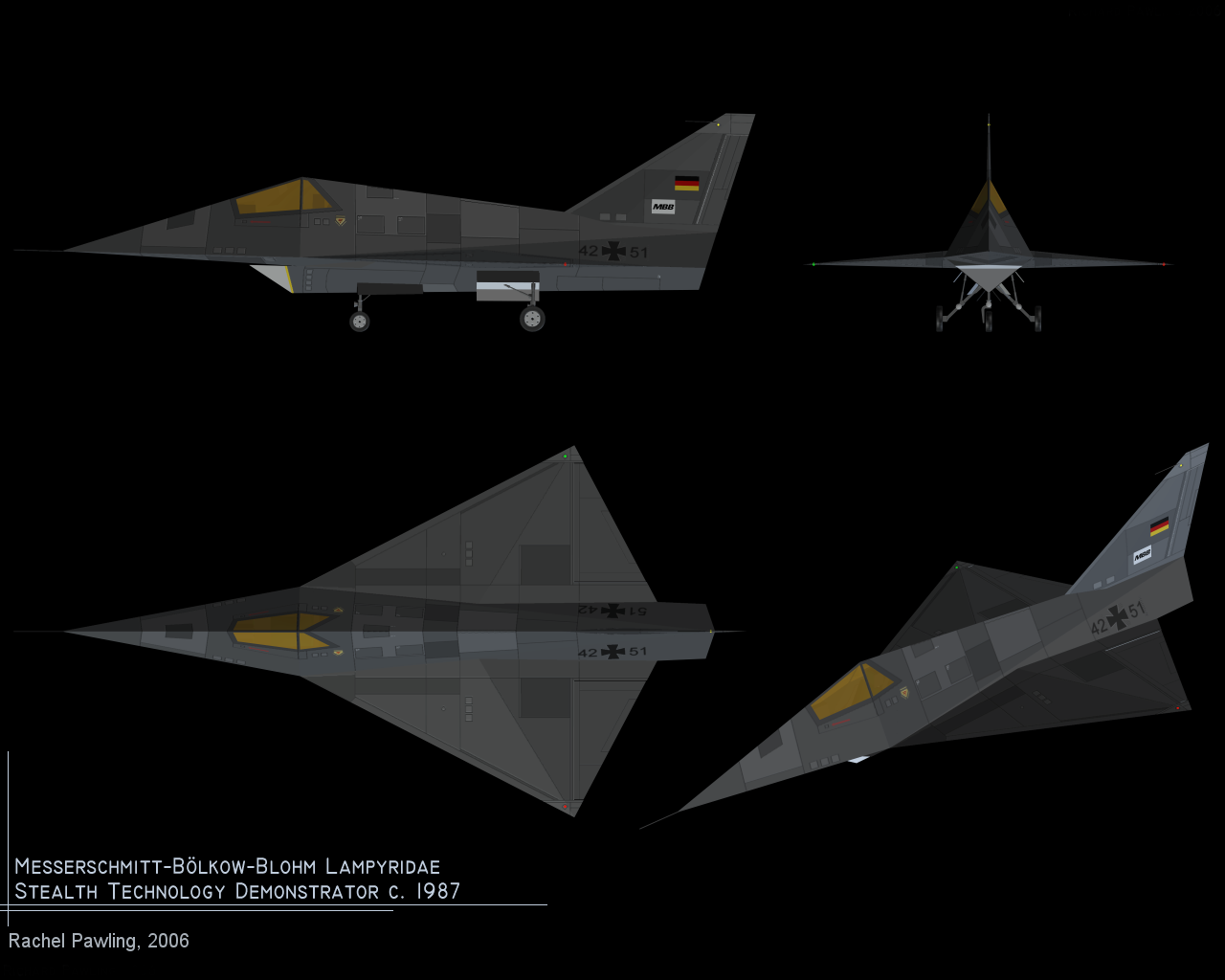
Or the MBB Lampyridae
http://www.f-104.de/exponates/english/exp_lampyridae_eng.html
KKM57PThat is planform aligment and the inlets do have the same angle with respect the vertical
But planeform should point in the same direction, you should only have one peak and not multiple peaks or near indefinitely peaks caused by twisting. This contradicts planeform.;)
Maybe look again on a Typhoon inlet and you see no 90°, the same at a Rafale.
A Typhoon and a Rafale are not copareable whit a vintage F-15.:rolleyes:
KKM57Pboxy intakes, vertical tails, externally-mounted ordnance, yada yada yada.
What boxy intakes?
A vertical tail whitout a horizontal tail is not a two or tree corner reflector like conventional tail. The leading edge and trailing edge for the needed surplus vertical tail (F-22) is longer as the leading edge on the Canards. A F-22 then flying without drope tanks and should able carry the HARMS inside and not outside.
And BTW, if the F-22 were truly serious about low RCS, they shouldn’t have this boxy^2 vertical tails at all.
The YF-23 would be the better choice for a low RCS design!
The best leading edge for a low RCS is the non-existing leading edge!
That a wing shild not the stab leadinge edge see we on the planform aligment not only on the leading edge but rather on the trailing edge of the stab.


 Sign In








