 ME453
ME453That’s odd Andrew, I sent Rob a PM a couple of weeks ago and received a scan of his father’s wartime logbook on the 23rd, very interesting it is too. Is that what you’re after?
Max
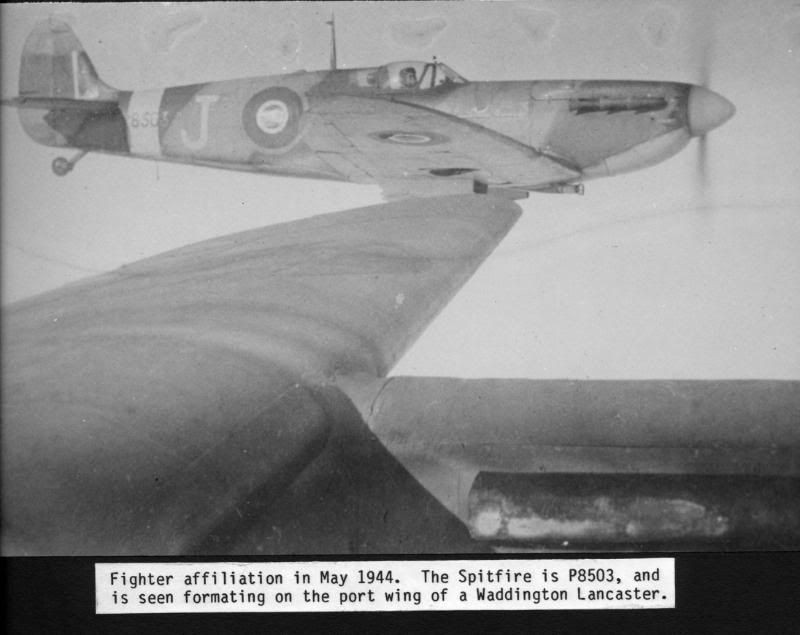
ME453Good morning gents, an interesting thread to which I can add the photo below of “Skyscraper”, this from the Waddington photo albums:
I was hoping to find the dates via the ORBs of specific flights on specific days of their Hurricanes and Spitfires but from Andrew’s post above it seems sadly not.
Regards
Max
ME453I asked a friend of mine, Dennis Over, who was a rear gunner in 227 squadron for his opinion about the phrase “the sting”, this is his reply:
I have not come across the description “Sting”. His description of the situation begs a couple of questions.
If he had his head held down protected by his hands & was in the standard FN rear turret then his head would have been almost touching his control column grips. His reference to the term sting may have been part of the frequently used term, “sting in the tail”, the sting being the triggers on the control column.
I am assuming that he had his turret in the normal landing or emergency position on the port beam. bracing himself against the side of the turret under which circumstances his head would have been very near the rear of the stbd. Brownings.
Max
ME453That’s a very interesting diagram. The wind speeds are surprisingly high (or maybe they are not at 20,000 feet?) considering a bomber would be cruising at about 210 – 220 mph.
Do you know how the winds were actually measured by the winfinders? I’ve never really given it much thought but were they using ground references visually, or by using H2S, or were the winds calculated when the bombers were still in range of GEE?
That’s a good question which Brian has already had an input in contributing his knowledge on other forums….I’m hoping to get the “definitive” answer from my nav. contact shortly!
Max
ME453Brian, regarding navigator’s charts, I have a copy of one for the Ladbergen raid on 3 March 45 and it clearly states on it “statue miles”. You may also be aware that Jim Cave (and I) are in correspondence with Peter Hoare who was a nav. on 83 PFF squadron at Coningsby. He has stated that during late 44 and 1945, air speeds were measured in knots, but the conversion from mph to kts was not a straightforward one! More to come from Peter on this topic but I have an article that he wrote decribing the Bohlen operation on 5 March in which he says “The route to the target 729nm consisted of nine legs…..” and later on “our planned IAS to this point was 150kts, which gave us a TAS of 184kts…” It kind of answers my original question on Lanc-Archive because Gus Belford was writing about exactly the same operation and he was using kts in his description.
Regards
Max
ME453The answer then is in the first post; 821/45 = 1945? I’m the one who initiated the “wind-finding” thread on RAF Commands (as part of a discussion we’ve been having on Lanc-Archive!!!), so I’m pleased, I hope, that we’ve got an answer. Thanks Smirky!
Max
ME453A couple of small points to add to this interesting discussion: firstly regarding “running lights” or whatever you might like to call them: they were most definitely a “No, no” once heading for enemy territory, but worthy of comment in the ORBs of 467 squadron if somebody accidently, or neglectfully, turned them on over the target. Secondly, I’m in contact with a pilot of 467 squadron (Jack Lindquist) whose career with the squadron was cut short when his Lancaster was in collision with another over the Dortmund-Ems canal in September 1944 (I think only 2 crew survived from the 2 planes). And yes, a couple of hundred bombers were expected to bomb a target such as the DEK in a 20 minute period. Many books describe knowing that other planes were near because of the turbulence that could be felt from the slipstream. Damn scary.
Max
http://www.galgos.co.uk (undergoing a big upgrade!)
ME453No Si, they don’t exist in digitised form, and it’s next to impossible to get anything similar out of the MoD. Many researchers have been frustrated by the MoD’s intransigence.
Regards
Max
ME453Sywell show
I’ll keep my fingers crossed for Sywell too. I was there, having travelled up from Dorset, for a Tiger Moth flight on 5 August en route to East Kirkby: the cloud was on the deck and it was hissing down. Needless to say, I didn’t get my flight (now scheduled for Dunkeswell next Friday…..will the weather last?!)
I thought Sywell was a lovely airfield, and I liked The Aviator too!
Good luck chaps.
Max
ME453vandalism
Vandalism is just that….mindless, pointless. I was railing about this to my wife only yesterday. Near where I live on Portland is a sculpture park where artists of all abilities have tried their hand at carving Portland stone, the initiative has been going for ten years or more. One of the most successful is a guy who carves animal heads, the heads are “emerging” from huge, rough blocks of stone – there’s an elephant, a bear, a dinosaur (don’t think I can spell pterodactyl!) and a bison. The latter has a fine pair of horns which the sculptor has carved separately, polished then cemented in position. It’s been there a couple of years, but now? – the tip of one horn has been broken off! WHY, you have to ask yourself…what has it achieved apart from desecration? Sadly, in my opinion, no amount of education or any other “treatment” is going to alter the minds of people who get their kicks by spoiling the work of, or enjoyment of others.
Max
ME453I write as an experienced primary school teacher. The history curriculum for primary age children includes one unit called “Britain since 1930”. I’ve taught the unit for many years and without exception my pupils are fascinated and often overawed about the fairly recent past, which of course includes WWII.
I cover the Depression, the build up to war in Germany, the plight and increasing targetting of the Jews, the outbreak of the war and major features in it including the bombing campaign, the “Home Front” and evacuees, etc etc.
It is such a popular topic, amongst both boys (the fighting, bombing etc) and girls (being a “mum” evacuee etc) that I link many other areas of the curriculum to it. Most children still have living relatives who can recall some aspect of those turbulent times, so it becomes personal and “alive”. The topic, by the way, lasts 15 weeks, and is followed by the Tudors (another fascinating time!)
So chaps, it’s not true to say that children are not taught about the past and have no respect for those who worked and died for our freedom today; they certainly are in Year 5 in St Augustines Catholic Primary School in Weymouth!
regards
Max
ME453A very vivid and clear description Moggy; if your VIP day was last Wednesday, I was there as well though I’d requested the flight engineer’s position to try to re-live what my namesake went through at start-up in 1945. I fully endorse all your comments, including it being over all too quickly, however I took quite a lot of video footage of the day which I’m putting together at the moment. If you want a copy of it, pm me with your address and I’ll send one as soon as it’s ready.
Regards
Max
ME453Damn! Just answered my own question with a bit of Googling
3/4.5.44 a force of 362 Lancasters attacked the German 21st Panzer Group base at Mailly. 5 group lost 42 Lancasters from this force of 362. It was confirmed that the German night fighter A/C had a device code named “Nazos” which enabled them to home onto our H2S sets when transmitting.
Moggy
Just a small point of correction Moggy, the nightfighter homing device was “Naxos”.
Regards
Max
PS: and a bit more info!
467 SQUADRON RAAF, WORLD WAR 2 FATALITIES
Date of Death: 4 May 1944
Source:
AWM 64 (1/427) (1/432) AWM 237 (63) (64)
NAA : A705, 166/21/147, 166/9/302
Commonwealth War Graves records.
W R Chorley : RAF Bomber Command Losses of the Second World War : Page 209, Volume 1944.
Aircraft Type:
Lancaster
Serial number:
JA 901
Radio call sign:
PO – N
Unit:
467 Sqn RAAF
Summary:
Lancaster JA901 took off from RAF Waddington at 2149 hours on the night of 3/4th May 1944 to bomb military camps at Mailly-le-Camp, France. Bomb load 1 x 4000lb and 16 x 500lb bombs. Nothing was heard from the aircraft after take off and it did not return to base. Ten aircraft from the Squadron took part in the raid and one of these JA901 failed to return.
Crew:
RAAF 422038 PO Dickson, C Captain (Pilot)
RAAF 423700 Flt Sgt O S Furniss, (Navigator)
RAAF 426606 Flt Sgt S D Jolly, (Bomb Aimer)
RAAF 426882 Flt Sgt R I Hunter, (Wireless Operator Air)
RAF Sgt P J Weaver, (Flight Engineer)
RAF Sgt H Skellorn, (Air Gunner)
RAAF 424403 Flt Sgt H H Forden (Air Gunner)
Captured German documents recorded that the aircraft was shot down early on the morning of 4 May 1944 at Merz on Seine, 14kms south of Rommilly, France. Both Flt Sgt Jolly and Flt Sgt Hunter survived the crash and evaded capture. The remaining five crew members were killed. PO Dickson and Flt Sgt Furniss are buried in the Droupt-Sainte-Marie Churchyard Cemetery, while Flt Sgt Forden and Sgt Skellhorn are buried in the St Remy-Sous-Barbuise Churchyard. St Remy is a village some 22kms north of Troyes, Aube, France.
Sgt Weaver (RAF) is buried in the Terlingthun British Cemetery on the northern outskirts of Boulogne, locality Pas-de-Calais.
In his statement Flt Sgt Jolly reported “Returning from the target the aircraft was on fire presumably as a result of enemy aircraft. The Captain instructed the crew to abandon. I heard no one acknowledge. The aircraft was under control but on fire when I abandoned
at approx 5000 feet. I saw one chute in the air possibly the Flt Engineer. No contact was made with any of the crew after landing.”
Flt Sgt Hunter reported “The aircraft was on fire when I baled out at approx 5/6000 feet. I had extensive burns. I was in the hands of the Resistance movement and in hospital until liberated by the Americans on 28 August 1944. Do not think the Navigator and two gunners left the aircraft.”
ME453Thanks again for the extra picks (keep ’em coming)
Thanks ME453 but I do have copies of that interesting book, I put an ad in Flypast 13 years ago (asking for info on Colerne) and got a great response.
I recieved a huge amount of information on the Hastings era from a ex Hastings pilot from 24 squadron (Chris Green) including photocopies from his logbook.Me453 did you live near Colerne when Brigand RH831 crashed on approach on 8th march 1956?
Yes, I was approaching my 8th birthday at that point, but I have no recollection/knowledge of the incident.
Max
ME453Brigands
I don’t have any photos I’m afraid, but as a lad in the mid-1950s, I lived near Colerne. We used to regularly see black Bristol Brigands flying around, which I believe were based at Colerne, and of course Hastings were 2-a-penny! I used to look forward avidly to the Open Day each year: Dad was a pilot during WWII so we were a very air-minded family. My first flight ever was from Colerne, it cost Dad 10/- (50p to you youngsters!, though worth a hell of a lot more) and was in a de Havilland Rapide: the pilot I recall was a woman wearing a purple and white striped blouse, and the seats were wickerwork. I have a photo somewhere of my brother and me sitting in the cockpit of a Meteor, but the other highlight was a game in one of the hangars – a model aircraft with a dart slung under its belly (held on presumably by an electromagnet). The plane “flew” down a sloping wire across a target, we pressed the “tit” for bombs gone to try to hit the target with the dart. I also remember the closing event was Jet Provosts staging an “attack” on a fortified position, bombing with flour bags or similar. Great fun, and happy, innocent uncomplicated pre-pc and health and safety days!!
Regards
Max
PS I assume you have “Action Stations 5: Military airfields of the South-West”? If not, I can scan and send you copies of the pages for Colerne.


 Sign In







