 Nitin_V
The above seems merely a statement of what was displayed, not whats going intothe frigates for sure.
The origial poster mentioned ATGM’s as well…now would the frigate carry ATGM’s for ship to ship battles. 😉
Nitin_Vso pakistan is getting the z-9 too?
the pakistanis seem to expect everything that china makes after all.
They are the only reliable supplier which Pakistan can afford. A single vendor relationship, as it were.
Nitin_VAtleast i do not put false dates on old stories and try to present as new one 😀
You actually do. Among your other traits, selective quotation and outright falsehoods. In fact, the rate at which you are going I wouldnt be surprised if you even had halitosis. Go look that word up. 😀
I’d pity you, but for the fact that you lie shamelessly. 😀
Nitin_VTusker pod for the Jags, part of the Tempest EW system- also part of the MiG27 upgrade

The Open Architecture Computers etc

The Tarang Radar Warning Receiver
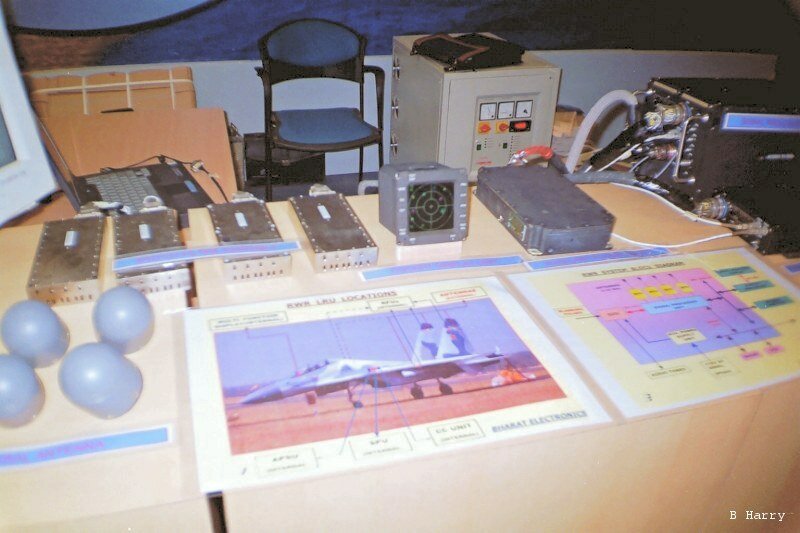
The airborne IFF Interrogator

The Indian RLG is also ready now. More on that later.
All pics, copyright B Harry delivered for the express purpose of showing Star49 to be the disingenuous obfuscator that he is.:D
Nitin_VAnd you have asked about JF-17 stealthness proof. here it is and it is authoritive source.
ROTFLMAO. Some blurb from the manufacturer and you cite that as proof??
Wheres the proof that the FC1 is stealthier than the F-16?
Give us technical details. Whats the RCS, when were the tests conducted, by whom and where.
It seems all you are capable of is lying. Go sit in your corner. Wear your hat. 😀
You have been repeatedly shown to be a two bit hack with no credibility. This adds to that. 😀
Nitin_VAll your report is bogus. Every thing is from outside sources and mixingit up. It is from same JED online source.
ROTFLMAO. Child, the BR report predates JED.
Second, as I said , I have the original HAL report. I dont need a moron like you to tell me whats what. 😀
Everything I posted is authoritative. In fact, I shouldnt be posting it. But then again, you are such a dunce, it really doesnt matter. You are too foolish to understand most of the terms I referred to. 😀
using technolgy from russian for mission computers.
Nonsense. The quote reads: “The other avionics and mission computers planned for India’s Su-30MKI multi-role aircraft are to be incorporated in the upgraded MiG-27 aircraft as well. HAL is already under contract to build 140 Su-30MKIs over the next 17 years using technology transferred from Russia”
Only an idiot would not notice that the quote refers to the Su30MKI’s and not the Mission computers.
The Su30MKI’s Mission Computers, Display processors, Radar computers, RWR’s and a host of other equipment are all Indian. 😀
Go figure. OR sit in your corner with your dunce cap. 😀
Here, this should be another kick upon your posterior!

http://www.bharat-rakshak.com/IAF/Info/Vetrivale.html
Indian avionics have been received and acknowledged enthusiastically by the Russian principals. The core avionics designed by the Bangalore-based Defence Avionics Research Establishment (DARE) consists of Mission Computers, Display Processors and Radar computers which are now manufactured by HAL’S Hyderabad Division. The other DARE product Tarang RWR which is manufactured by BEL at its Bangalore facility, alerts the pilot to all surrounding “threats” such as radar-controlled guns and missiles for initiating evasive action or counter-measures. Tarang which was originally designed for the MiG-21bis modernisation programme is now a standard fitment in most of IAF aircraft. The DRDO has effected transfer of technology for the manufacture of all avionics to the PSUs after establishing the design soundness of such equipment through evaluation of prototypes. These avionics equipment have also been certified for their airworthiness in meeting the demanding standards of Russian military aviation. The integrated communication equipment and radar altimeters are of HAL’s own design, already well proven in other aircraft applications. The cumulative value of such indigenous avionic equipment is estimated to exceed Rs. 250 lakhs per aircraft.
The expected size of the Su-30MKI fleet of IAF is around 180 aircraft. A very beneficial effect of this approach, in the IAF entrusting all of the core avionics to a single development agency, is that DRDO has been able to design the 3 on-board computers with maximum commonality of hardware and software amongst them using a modular approach to design. This obviously results in major cost and time savings in development; it also benefits the user in maintenance and spares inventories. In fact the DRDO has gone a step further and come out with a new design of the Core Avionics Computer (CAC) which can be used with a single module adaptation across many other aircraft platforms. Thus the CAC which is derived from the computers designed for the Su-30MKI will now be the centre piece of the avionics upgrades for the MiG-27 and Jaguar aircraft as well. The CAC was demonstrated by DRDO at the Aero India exhibition at Yelahanka and attracted a good deal of international attention. Taken together with the systems already developed indigenously for the LCA (such as the Digital Flight Control Computer and HUD), clearly Indian avionics have a significant export potential in the burgeoning global market for avionics modernisation.
The bottom line is that India buy technology from several sources and for several projects
ROTFLMAO. And that really brns you, doesnt it? Why o why- I thought that the mighty flighty PAF could buy Raptors and Flankers anytime it chose? What now? 😀
so it is difficult to keep track of it and later rename it as if is indigenous which further complicate the matters.
BS. You have been caught with your pants down and now you are vainly struggling to cover your privates. 😀
A host of sources point to the LCA derived avionics present in the IAF ‘S fleet upgrades and Su30MKI’s.
Keep your rants specific to tinpot nations which suck upto Kim Jong Il.:D
Nitin_VPoor Star 49. Waah Waaah waaah. Look at them evil Indians.:D
http://csirwebistad.org/aesi/pages/coreavionics.htm
Core Avionics for Combat Aircraft Upgrades
RP Ramalingam, Director, PM Soundar Rajan, Project Director, Defence Avionics Research Establishment, BangaloreAvionics systems play a decisive role in the mission effectiveness of today’s combat aircraft. Most of the countries across the world operate combat aircraft which are at-least twenty to thirty years old. Upgrading their avionics is the only means of keeping them effectively operational. But this upgradation should be carried out in a timely and cost effective manner in order to be fruitful. To achieve this, a concept of “Core Avionics” has been evolved. Avionics systems tend to be very complex and are aptly called “system of systems”. They are expensive and consume a lot of time to design, integrate and test. Core avionics addresses the central integrating technology with a basic common set of functions required for any combat aircraft. It consists of modular hardware and software that performs core mission functions. These modules could be configured for use in ground attack or air-superiority avionics. In practice, the concept of core avionics has been applied to three aircraft programmes, currently in progress (of which one has been inducted into service). The core concept is evolutionary and expands itself to accommodate advancements in electronics and information technologies.
Introduction
Avionics systems have grown in importance and complexity and have equaled or surpassed the airframe or engine in terms of contribution to mission effectiveness and cost. The growing number of avionics upgrades of old aircraft across the world. substantiate this. At DARE we have taken due note of this and have established competence to design, develop and integrate avionics systems. The avionics system in general consists of sensors, processing subsystems, Control & Display subsystem and weapon system. The main subsystems which play a pivotal role, termed as Core Avionics are the Mission Computer cum Display Processor which also hosts the interfaces for all the other subsystems. This paper describes the concept of core avionics hardware and software and brings out the evolution of practical systems.
Core Avionics
Combat aircraft avionics systems can be broadly divided into two areas.
Sensors such as INS /GPS for position sensing; Laser Rangers for air-to-ground target ranging; Radar for air-to-air target detection and ranging – depending upon the role of the aircraft (ground attack / air superiority / multi-role) suitable sensors can be selected.
Core Avionics – consists of processors that collect information from the sensors, perform weapon and navigation computations and present the required cues and information on a Head Up Display, Multi-Function Displays and Up Front Control Panel. The Core avionics computer will also interface to a data logging /retrieval system. All these functions are generic – they are required on any upgraded aircraft. Aircraft specific interfaces are required to interface with stores management systems, Air data systems etc.Background
DARE took up the development and delivery in quantities of Mission Computers, Display Processors and Radar Computers for the Su 30 avionics upgrade. The requirements were analysed and instead of building three different computers DARE developed nine functional modules. The chassis was also common across the computers. These modules use state of the art processors. They are designed as independent modules to do a specific function such as generating computer generated imagery for display on HUD or MFD. But they are able to communicate with the main processor module through high speed Dual Ported RAMs. This makes development of software for these specific functions as independent activities. Also, HW changes in one module does not affect the other modules. Hence this approach reaps the benefits of Open System Architectures to the full. Later when proposals for upgrade of the MiG 27 aircraft came up, DARE could respond with a ready solution by configuring the Display Processor of the Su30 avionics. The evolution is brought out in the following table.Su 30 Computer
MiG 27 CAC
Jaguar CACCommon Modules
Main Processor Module
Yes
Yes1553B interface Module
Yes
YesColour Symbol Gen. Module
Yes
YesStroke Symbol Gen. Module
Yes
YesDiscrete Interface Module
Yes (qty 2)
YesPower Supply Module
Yes
YesChassis
Yes
YesAircraft Specific Modules (for CAC only)
Video Switching Module
Yes
YesAnalog / Synchro Interface Module
Yes
YesCore Avionics Hardware
The Core Avionics Computer (CAC) developed by DARE is housed in a aircraft industry standard 3/4 th ATR chassis with an option rear mount ARINC 404 connector or front mounted 38999 series connectors. The tray is mounted in the equipment bay/rack of the aircraft and the computer is plugged in to the tray. It is forced air cooled and weighs less than 8 Kg. It works on both 115V 400Hz AC and 28V DC aircraft power supplies and consumes less than 80 W of power. It is modular and houses the following modules which are built using COTS components.
a) General purpose processor module is based on Intel X86 processor. Upgradable 2MB of Flash and 2MB of high speed memories hosting real time operating system kernels enhance programming capability.
b) Colour Symbol Generator Module hosts a i486DX4 based Raster symbol generator with Anti-aliased Graphic Library which generates a STANAG 3350 compatible Video (RGB) output to drive Multi Function Displays.
c) Stroke Symbol Generator Module hosts a i486DX4 based vector symbol generator and drives one Head Up Display with 1024×1024 pixels resolution
d) Mil-Std-1553B Interface Module is based on powerful 1553B controller chip supported by a i386EX processor and provides up to two dual redundant buses with Bus Controller / Remote Terminal options. In addition it provides for eight Receive and three Transmit ARINC 429 interfaces. It also interfaces analog inputs for various levels and ranges.
e) Analog Interface Module provides 32 analog outputs, 8 synchro inputs and three synchro outputs. The module supports Russian / NATO standards and Synchro / Resolver formats.
f) Discrete Interfaces module supports 64 inputs and 32 outputs. Various input / output levels such as 28V, 5V, Open/Close etc are supported. Outputs are capable of driving high current relays.
g) Video Switching Unit accepts various sensor videos and routes them to various displays / recorders.
f) Dual Mode Power supplymodule works on 115V 400Hz, 1 Phase / 28V DC aircraft power supply, the AC power being the primary source.
g) Chassis is force air cooled. It houses up to nine functional modules and conforms to 3/4 ATR; with front mounted 38999 circular connectors.
CAC Architecture
CAC architecture is based on Open System principles. Intelligent functional modules communicate with the Main Processor module via Dual Ported Random Access Memories. Each of the modules are treated as extension of the Main Processors memory map. The mother board runs the basic address, data and control lines of the Main Processor. This results in maximum possible data transfer speeds between the Main Processor and the modules. This also allows easy expansion as the interface between modules could be done in software.
CAC Architecture
CAC Functions
The following are the functions of various modules of the CAC
a) Through the CPU module:
Control of the 1553B interfacePrimary mission, navigation and weapon computations
Air Data Computations
Control of the UFCP for avionics system moding and data insertion and data readout.
Management of the display system (MFDs and HUD)
Management of the Stores (weapons) system
Reading and writing of mission data from the Data Loader Flash Disk.
Coordination of LDP and FLIR for navigation and targetting functions
Auto-pilot functionb) Through the Colour Symbol Generator and Monochrome Symbol Generator Modules:
i) Raster mode writing on the MFDs in colour (mixing with external sensor video)
ii) Stroke Mode writing on the HUD in monochrome.
c) Through the Intelligent Dual channel 1553B interface board: Provide for the exchange of data among avionics subsystems in the primary and reversionary modes; Control of the ARINC 429 channels; Interface air data system, hand controller etc through the analog inputs.
Through Discrete Interface Module Interface aircraft discretes including the HOTAS switches to the CPU board and Interface the CAC’s discrete outputs to the stores management system.
e) Through Synchro and Analog output Module interface the automatic flight control system and Crash Data recorder system.f) Through the Video switching module provide for switching the video signals in the avionics system to the MFD, HUD and the Video Tape Recorder.
Core Avionics Software
Software is the backbone of the core avionics concept. There are many functions that are required to be performed in modern fighter planes, which are common. These functions are reusable in most of the aircrafts, with due modifications. Following paragraphs highlight some of such functions, which form the core of the avionics that can be adapted to different aircraft:Navigation Function:
The heart of the navigation function is the basic sensor, which provides either position directly, or velocities at every instant. From the basic data of the sensors the navigation parameters are deduced by a common algorithm and logic, which forms part of the core functions.
Presentation function of guidance and other parameters:
Integrated multi purpose display devices are becoming increasingly inevitable items of the modern fighter aircrafts. The Head Up Display and the Multi Function Display are extensively used for displaying basic flight parameters, guidance cues and warning information. Over the period many standards have evolved in presentation of the parameters through these displays. This situation brings about the commonality and standardization in symbolic representation of specific parameters. This in turn leads to common algorithms and logic. The symbol library and the control logics developed for the Su30 are reusable in most of the aircrafts.
Weapon delivery algorithms:
The basic equations governing the trajectory of weapons like bombs, rockets and bullets require very few parameters specific to the type of weapons. Once they are released from the parent vehicle, the behavior of these projectiles is predictable knowing the initial conditions of release and the environmental conditions. The sensors used for weapon aiming calculations eventually give the range of the target from the aircraft along with elevation and azimuth angles, irrespective of the type of sensor, be it radar or laser. Hence common algorithms are usable by providing the specific parameters to the weapon being delivered.
Guidance Functions:
There are many guidance functions starting from guiding the pilot to reach the required take-off attitude through guidance to release the weapon at the right moment and more. All these functions are re-usable by feeding the base parameters specific to the aircraft and the weapons selected. “Quickening” of the guidance cues also to a great extent is governed by mathematical equations, though the coefficients in the equations are empirically derived through simulation and fine-tuned during flight trials.
The core guidance functions are:
a) Homing Guidance
b) Navigation Guidance as per Flight Plan
c) Speed Guidance
d) AOA and ILS guidance for landing
Aircraft Upgrade Programmes
The Core Avionics Concept derived from the successfully inducted Su30 MKI programme has resulted in two new upgrade programmes. The MiG 27 Upgrade programme is progressing well under challenging time frames. This has been possible only because the hardware and software resources from the Su30 programme are being re-used. The software development process could be started even before the development of the I/O modules. 90% of the Symbols are also being re-used. The Jaguar Upgrade programme also utilizes identical computer hardware and the symbol library. The computer modules have been designed to interface with Russian as well as Western systems. The Core Concept has also resulted in common symbologies across the fleet resulting in ease of conversion training.
Conclusion
The concept of Core Avionics has been discussed. Using the functional modules, both hardware and software, developed for Su 30 in MiG and Jaguar upgrades has resulted in considerable financial benefits and has made the upgrade development feasible in terms of time frames. With this approach, other aircraft could be upgraded in a cost effective and timely manner. We could have ‘time to first flight ‘ as low as 12 to 15 months from the programme go-ahead for a new upgrade.
Oh BTW, the CAC has now been replaced by the more powerful PowerPC based Open Architecture Computer for the follow on MiG27 and Jaguar batches. Again developed via the LCA.
How sad for Yahoo who is seeing Stars. 😀
Nitin_VAnyway i donot put any stock on this worthless aircraft.
ROFL. So now because you have been caught with your trousers down and have been shown to be a BS’er, the a/c is worthless?
The MiG 27’s fly low, have an intensive flight training program. Unlike another AF I could name which sends its pilots as mercs elsewhere because it cant even afford to train them. 😀
Just to remind that Russians are watching even the smallest of activity and will show there stance at appropriate time.
The Russians can watch. You can merely gape.:D
Nitin_VThis will further burst your Indigenous bubble.
ROFL. Why dont you read what HAL itself says. I have the original report from HAL and DRDO with me.
Wait. They dont give all that to children. Figures. You wouldnt have it. 😀
Nitin_VYou should know that you cannot play this game with me. There is a Big difference between Indigenous upgradation and collection of components from various sources for Integration purposes This is more of integration programme rather than local development as mentioned by this report. your own link gives about Litening pods and SuperKomar radar. and I am not sure from where the communicaiton and navigation system comes from.
You truly are stupid. 😀
Of all the people in the world, you chose to pick me for debating Indian defence upgrades! ROTFL. 😀
1.The Mission Computers are from the DARE of DRDO, from the LCA program. They are combined with the display processors and are integrated in a single system called the CORE AVIONICS COMPUTER.
2.The HOTAS controls are from the DRDO and HAL developed for the LCA.
3.The Communication equipment is from the INCOM package- the INDian COMmunication system.
4.The IFF is from HAL.
5.The RadarWarning Receivers are the Tarang made by BEL-India designed by DRDO and BEL. Also present on the MiG 21 Bison.
6.The chaff dispensers are now being made at Bharat Dynamics Ltd, Hyderabad.
7.The overall design, system architecture and upgrade responsibility rests with HAL.
8.The Stores Management System is from the LCA and is designed by ADA.
9.The Self Protection Jammer is the Tempest, from DRDO.
Its also present on the IAF’s Jaguars as the Tusker pod.:D
Enough thrashing or do you want more yet? 😀
10.Certification is by CEMILAC and ASTE. Test flights are conducted by the HAL Test crew seconded from the IAF.
11. Airframe life work based on studies done by HAL and NAL.
So much for systems collected from elsewhere and similar nonsense.
The installation of a new Radar Warning System together with automated flare and chaff dispensers will bring the MiG-27s up to modified MiG-23BN standards as far as countermeasures are concerned. Sensor updates include Forward Looking Infra Red (FLIR), Laser Designation Pod (LDP), L-Band Homer and Reconnaissance Pods. It is believed that the Israeli Litening pod has been selected as to fit the FLIR/LDP requirements. The system is already in use with the IAF and was combat proven during the Kargil war of 1999. Indeed the decision to go for a podded system rather than an integral one was dictated by the flexibility that such systems offer. The British Vinten VICON 18 Srs 601GP(-1) 241 kg (531 lb) long-range (450 mm lens) optical pod has been selected as the standard recce pod and has already entered IAF service. The MiG-27s are also being endowed with radar capability. To this end, it is believed that trials with the Russian Komar pod mounted radar have already begun. The Komar is a light weight version of the multi-mode Super Kopyo being installed on Indian MiG-21s as part of the its upgrade program. The installation of the radar would give the MiG-27s anti-ship and some air-to-air capability. Other foreign equipment that form part of the upgrade include Data Link systems and Night Vision Goggles (NVG).
HAL (Hyderabad Division) systems being considered are Secured Communication System INCOM-1210A, radio altimeter RAM-1701A, 1FF- 1410A and stand-by UHF Communication System COM-1150A, Besides the existing conventional weapons, new weapons such as 1000 lb laser guided bombs. For improvement in cockpit air-conditioning, a new turbo cooler will be installed. The system developed by HAL (Lucknow Division) is capable of handling an additional mass flow of 250 kg/hr which would reduce the cockpit temperature by some 7°C. Indications are that the existing Weapon Control System has been retained, but a new weapon interface box has been developed for the integration of new weapons. For in-flight refueling, a non-retractable in-flight refueling probe is being installed. The whole process will necessitate modifications to the structure, plus aircraft fuel and gauging systems. Alongside, an oxygen storage facility (now limited to supply for about two hours) will be increased by providing additional cylinders. The aircraft’s systems will be mated with the next generation of PGMs now entering IAF service.
The upgraded aircraft will offer the IAF strike force greater flexibility and keep the MiG-27 force viable well into the first quarter of the 21st Century.
As can be seen the upgrade involves many components of INDIAN origin and select imported subsystems.
These are the MFD’s, the Vinten Recon pod, the Komar radar and the Litening.
Your ignorance has been shown and you have been caught with your pants down. Again.:D
And I can only ROTFL at you citing an Indian Govt report which touches briefly upon the upgradation process, integration being one of AURDC and DARE’s responsibilities.
A few minutes back you were squealing about PAC/GOI reports being BS
Shameless flip flopper. 😀
Go sit in your corner and suck your thumb.
Nitin_VGlad they didnt choose the Boeing version of the JSF- the 32 whatchamacallit.
It looks butt ugly.
Nitin_VDate is on the front page. The Report is old. You can just read from the report that they havent even assigned a contractor.
Great to see you see reason after a spanking. So now the date shone like a torch, I presume. :p
Nitin_VIt seems that India want avionics upgrade only and even in that MIG will refuse to certify the aircraft.
Selective quotation indeed. So basically now you admit that India upgrades its MiGs on its own.
Heres what you “missed” highlighting from your own article. ROTFL.
The Indian Defence Research and Development Organisation signed a memorandum of understanding to develop two prototype aircraft with HALat the Aero India show this month, but has not releaseddetails of the programme.
Any kid could find details of the upgrade program. Here let me help you out. Take my finger.
http://www.bharat-rakshak.com/MONITOR/ISSUE2-6/rupak.html
Equipping some eight operational squadrons (Nos. 2, 9, 10, 18, 22, 29, 51, 222) and one training establishment (TACDE), the MiG-27ML forms the backbone of the Indian Air Force’s strike fleet. The IAF’s MiG-27 fleet is also relatively young, with the oldest airframe at 16 years and the youngest at 4. These two factors have ensured that upgrading the MiG-27 is high on the IAF’s list of priorities. The bulk of the equipment and avionics fitted on the MiG-27 were developed in the 1970s and requires replacement. The IAF’s upgrade program aims to keep the type in frontline service till 2020. Unlike the IAF’s MiG-21 upgrade program, the MiG-27 upgrade will primarily be an in-country affair, with Hindustan Aeronautics Limited’s (HAL) Nasik Division acting as the primary contractor. To this end HAL is expanded the Design Department at the Nasik Division into a full-fledged Bureau, re-designated as the Aircraft Upgrade Research and Design Centre (AURDC), in 1996. AURDC is heavily involved in the re-design and structural modifications of the aircraft as part of the upgrade. It is believed that the first aircraft have already been taken in hand for re-building and upgradation. The IAF has recently earmarked some US$ 200 million for the upgrade of 50 aircraft for this financial year. It is expected that at least 140 of the 180 aircraft will be upgraded as part of this program.
Update parameters for the MiG-27 are as follows:
Performance improvement for multi-mission tasks including accurate ground attacks and Stand off precision attacks, offensive air support and suppression of ground air defenses
Installation of modern flexible system architecture to reduce pilot’s workload and thus increase efficiency through better man-machine interface.
Modern weapon integration to enhance mission capability
Enhancement of mission reliability.
Fitment of a sophisticated EW suite to enhance survivability in hostile electronic environment, enhancement of the pilot’s comfort and efficiency through improvement in cockpit air-conditioning;
Increase in aircraft range with in-flight refueling
Finally reduction in the maintenance requirements.The capabilities of the aircraft are being enhanced by the incorporation of modern avionics systems consisting primarily of two Multi-Function Displays (MFDs) Mission and Display Processor (MDP), Sextant Ring Laser Gyros (RLG INSI), combined GPS/GLANOSS navigation, HUD with UFCP, Digital Map Generator (DMG), jam-resistant Secured Communication, stand-by UHF communication, data link and a comprehensive Electronic Warfare (EW) Suite. A mission planning and retrieval facility, VTR and HUD Camera will also be fitted. The aircraft will retain stand-by (conventional) instrumentation, including artificial horizon, altimeter and airspeed indicator, to cater for the failure of HUD and the MFDs.
Litening LDP
The installation of a new Radar Warning System together with automated flare and chaff dispensers will bring the MiG-27s up to modified MiG-23BN standards as far as countermeasures are concerned. Sensor updates include Forward Looking Infra Red (FLIR), Laser Designation Pod (LDP), L-Band Homer and Reconnaissance Pods. It is believed that the Israeli Litening pod has been selected as to fit the FLIR/LDP requirements. The system is already in use with the IAF and was combat proven during the Kargil war of 1999. Indeed the decision to go for a podded system rather than an integral one was dictated by the flexibility that such systems offer. The British Vinten VICON 18 Srs 601GP(-1) 241 kg (531 lb) long-range (450 mm lens) optical pod has been selected as the standard recce pod and has already entered IAF service. The MiG-27s are also being endowed with radar capability. To this end, it is believed that trials with the Russian Komar pod mounted radar have already begun. The Komar is a light weight version of the multi-mode Super Kopyo being installed on Indian MiG-21s as part of the its upgrade program. The installation of the radar would give the MiG-27s anti-ship and some air-to-air capability. Other foreign equipment that form part of the upgrade include Data Link systems and Night Vision Goggles (NVG).
HAL (Hyderabad Division) systems being considered are Secured Communication System INCOM-1210A, radio altimeter RAM-1701A, 1FF- 1410A and stand-by UHF Communication System COM-1150A, Besides the existing conventional weapons, new weapons such as 1000 lb laser guided bombs. For improvement in cockpit air-conditioning, a new turbo cooler will be installed. The system developed by HAL (Lucknow Division) is capable of handling an additional mass flow of 250 kg/hr which would reduce the cockpit temperature by some 7°C. Indications are that the existing Weapon Control System has been retained, but a new weapon interface box has been developed for the integration of new weapons. For in-flight refueling, a non-retractable in-flight refueling probe is being installed. The whole process will necessitate modifications to the structure, plus aircraft fuel and gauging systems. Alongside, an oxygen storage facility (now limited to supply for about two hours) will be increased by providing additional cylinders. The aircraft’s systems will be mated with the next generation of PGMs now entering IAF service.
The upgraded aircraft will offer the IAF strike force greater flexibility and keep the MiG-27 force viable well into the first quarter of the 21st Century.
In flight refuelling, modifications to the structure plus fuel system, Oxygen storage improvements, better turbo cooler- all developed via the LCA- all these are merely avionics in the bizarre world Star49 inhabits. 😀
Go get yourself an education.:p
Nitin_VI have to find out where the engines are overhauled
Best of luck. Given your record, I wouldnt bet on you finding the broad side of a barn door! 😀 😮
BTW, your sourceless quote talks of earlier problems with the MiG27, which were rectified, not of the present upgrade. Which goes to show you know squat. Again.
Nitin_VThis is old new from 1999-2000 trend report. Sukhoi is already the contractor since 2002. Dont try to put current dates on old news items
Read the link and the date therein 27 DECEMBER 2004 on the MAIN PAGE, That is what I merely posted. Dont try to be dumber than you already are. Or lie more than you already do What does it say if an article clearly mentions India as a partner ? Pretty much proves you to be dishonest when you imply the opposite. 😀


 Sign In







