 black eagle
black eagle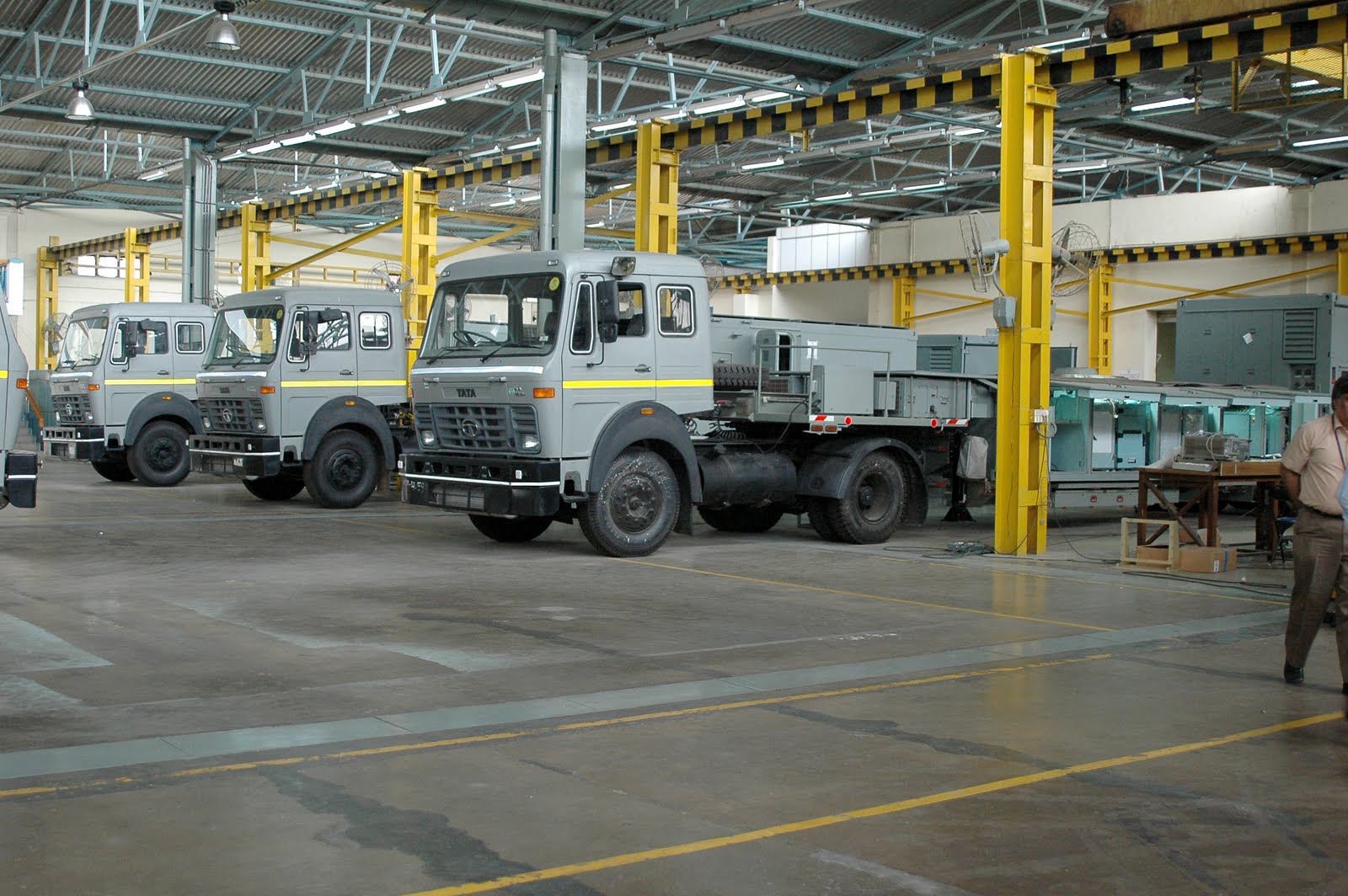
Vehicle-mounted sub-systems of the IAF’s first Akash squadron, nearing completion at BEL, Bangalore. The first Akash squadron will be deployed at Gwalior Air Base by March 2011.
First Akash missile system to fill gap in air defence
by Ajai Shukla
Business Standard, 23rd Nov 2010
BEL, Bangalore
With crucial Indian defence and nuclear establishments and vital infrastructure facilities open to an enemy air strike, many in India’s military consider the shortage of anti-aircraft guns, missiles and radars as our single greatest security vulnerability.
For two decades, the Ministry of Defence (MoD) has blocked overseas purchases, to allow the Defence Research & Development Organisation (DRDO) to indigenously develop anti-aircraft missile systems for replacing the obsolete Russian weaponry currently dotted around key headquarters, air bases, atomic power plants, nuclear installations and facilities like the Bhakra Nangal dam.
It has been a dangerous gamble. If war had broken out, the ineffectiveness of these Russian systems, especially the 50-year-old Pechora missile, would have forced the Indian Air Force (IAF) to use its combat aircraft more for defending Indian ground forces against enemy fighters than for attacking targets in enemy territory.
But that gamble is finally beginning to pay off, with India’s first modern air defence system readying to roll off the assembly line. On an exclusive visit to Bharat Electronics (BEL) in Bangalore, Business Standard was given the first-ever media look at an operational Akash missile system, which will be delivered to the IAF by March 2011. This first Akash squadron will protect the Gwalior Air Base, where the IAF bases its Mirage-2000 fighters.
BEL will follow this up quickly with a second Akash squadron by December 2011, which will safeguard Lohegaon Air Base at Pune, a major base for the front-line Sukhoi-30MKI fighters. Meanwhile, another defence public sector undertaking, Bharat Dynamics, will build six more Akash squadrons, most of these for the IAF’s new fighter bases along the Sino-Indian border, including Tezpur, Bagdogra and Hasimara.
“BEL is building two Akash squadrons for Rs 1,221 crore,” says Ashwini Datt, BEL’s Chairman and Managing Director. “The ground infrastructure would cost another Rs 200 crore, so each squadron effectively costs about Rs 700 crore. That is not just significantly cheaper than foreign procurement, but also permits better maintenance and allows for continuous technological improvements.”
DRDO and MoD sources say the Indian Army is close to ordering a high-mobility version of Akash, mounted on T-72 tanks, that can move alongside tank forces. One of the army’s three strike corps, which attack deep into enemy territory, has no anti-aircraft “area defence system”; the other two strike corps are equipped with the vintage Russian SA-6, designed in the early-1960s. This makes them dangerously vulnerable to enemy fighters if they advance deep into enemy territory.
The Akash – developed by the DRDO, in partnership with BEL, under the Integrated Guided Missile Development Programme – is a sophisticated amalgam of systems working in concert. The heart of the Akash is a mobile Rohini radar, which can detect an aircraft when it is 120 kilometres (km) away; automatically, a coded electronic interrogator ascertains whether this is an IAF aircraft, or a civilian airliner. With the target identified, the Rohini radar alerts the Akash squadron headquarters, which then controls the engagement.
As the enemy fighter races in at about 15 km per minute, the task of shooting it down is allocated through a secure digital link to one of the squadron’s two missile “flights”, which are normally about 25 km away, to cover the maximum area. The designated Flight Control Centre locks its sophisticated 3D phased-array radar onto the enemy fighter and calculates the launch parameters for an Akash missile to shoot down the target at its maximum range of 25 km.
Meanwhile, the flight’s four Akash launchers raise their missiles to the launch positions and swivel automatically towards the incoming aircraft. At the calculated time of launch, the Flight Control Centre electronically passes a launch order to one of its four launchers. An audio signal starts beeping and the missile operator presses the launch button, which is quaintly labelled “MARO”. A “ripple” of two missiles roars off the launcher, seconds apart, to increase the chances of a hit. The 3D radar guides the missiles throughout their flight, homing them onto the enemy aircraft. The DRDO claims that a two-missile “ripple” will destroy an enemy fighter 98 per cent of the time.
The dangerous shortage of India’s air defence resources has been known to Business Standard for some time, but can only now be publicly revealed, with the induction of the Akash remedying the situation. The number of installations that need protection – each is termed a Vulnerable Area (VA) or a Vulnerable Point (VP), depending upon how large it is – has steadily increased. In a letter written on December 4, 2002, to the MoD, the IAF’s Air Marshal Raghu Rajan pointed out that a study by the military’s apex Chiefs of Staff Committee, ordered by the Cabinet Secretariat, had identified 101 Indian VAs/VPs in 1983. That went up to 122 in 1992; to 133 in 1997; and is now understood to be well above 150.
Without the anti-aircraft resources needed to protect these VAs/VPs, the outdated Pechora missiles, which began service in 1974 with a designated life of nine years, have been granted repeated extensions. The Russian manufacturers extended the life to 15 years; when they refused any further extensions, the DRDO extended it unilaterally to 21 years. By 2004, only 30 Pechora units of the 60 originally imported were still in service.
On January 15, 2003, the IAF boss, Air Chief Marshal S Krishnaswamy, wrote to the MoD saying that 60 per cent of India’s VAs/VPs could no longer be provided anti-aircraft protection. The IAF’s top officer wrote: “By 2004… terminal defence of VA/VPs would be only notional… We need to import minimal number of systems to meet our national defence needs.”
Seven years later, the roll-out of the Akash from BEL will begin to fill this gap
http://ajaishukla.blogspot.com/2010/11/first-akash-missile-system-to-fill-gap.html
black eagleArihant ?:dev2:
The pic says so. but i am not so sure…
black eagleblack eagleVayu article on LCA
Mod Edit: Please do not reproduce scanned magazine articles into these forums as it is a potential breach of UK law. Thank You.
black eagleRUSTOM-1 First flight video
black eaglehttp://www.domain-b.com/defence/air_space/iaf/20100927_phalcon_awacs.html
IAF may induct up to 10 Phalcon AEW&CS
27 September 2010
That should settle what the IAF thinks of its Phalcons. 😉
but wasn’t the IAF suposed to place a follow on order of 3 phalcons? why 2 then??
black eagleAgni-II Plus to be launched in 2011: DRDO
Director-General of the Defence Research and Development Organisation (DRDO) V.K. Saraswat said on Friday that Agni-II Plus, a modified version of the Agni-II strategic missile, would be launched next year.
Speaking to journalists on the sidelines of the valedictory function of the Post Induction Training School (POINTS) at the Defence Institute of Advanced Technology (DIAT) here, Dr. Saraswat said it would have a higher range, higher performance, with respect to the thrust and weight ratio than Agni-II, which has a range of 2,000 km.
He said that BrahMos Aerospace Ltd, a joint venture between India and Russia, would be launching the aircraft version of the super-sonic missile. “It is being developed and it will be integrated with Sukhoi. Within a year, the first development trial will be conducted. Right now, scientists are in the process of checking if it is in need of any modification.”
Dr. Saraswat said the DRDO was developing ballistic missiles with both short and long-range radars which were highly manoeuvrable.
On the indigenous light combat aircraft (LCA) Tejas, negotiations were going on to acquire the GE4141 engines and this would be completed within a month.
black eaglePhotographs from Ilyushin IL-76MF First Flight on September 30th 2010
2010-10-07 As reported earlier, the upgraded IL-76MF heavy lift transport aircraft made its first flight in Tashkent, Uzbekistan on September 30th 2010. This new generation plane is intended to make a strong case for sale to India as New Delhi has been acquiring U.S. C-17 and C130J Hercules aircrafts which are more expensive than the Russian air lifter.
India has an estimated requirement for over 25 military heavy lift planes over the next 10 years. Here are exclusive photographs from the first flight of the Ilyushin IL-76MF in Tashkent.


black eagleIAF to conduct test trials of Beechcraft T-6C trainer
BY: brahmand.com
The Indian Air Force (IAF) will conduct field evaluation trials of Beechcraft T-6C military trainer from October 11, at the IAF Station Jamnagar, according to a report.
Under the five-day test trials, the instructor pilots of Indian Air Force will evaluate the trainer aircraft. The T-6C is being considered as a replacement for the IAF’s HPT-32 Deepak 2 trainer.
According to the Hawker Beechcraft Corporation (HBC), the company is vying for a contract that specifies an initial purchase of 75 aircraft and options for follow-on orders that could eventually exceed 100 aircraft.
A decision on the contract is anticipated in the coming months.
“The T-6C offers the Indian Air Force the world’s most proven and cost-effective training system available,” Jim Maslowski, HBC president, US and International Government Business, said.
“It accommodates instruction in instrument flight procedures and basic aerial maneuvers and, including its predecessors the T-6A and T-6B, has accounted for more than 640 deliveries worldwide,” he added.
HBC will also demonstrate the T-6C’s maintainability as part of the evaluation.
Beechcraft T-6C military trainer is integrated with modern features; it is equipped with advanced avionics suite that greatly expands advanced training opportunities, including a head-up display, up front control panel, three multifunction displays, hands-on throttle and stick.
The aircraft can also accommodate external fuel tanks with its hard pointing wing, its systems has capabilities of today’s front-line strike fighter aircraft.
Currently, the Beechcraft T-6 is used to train pilots from approximately 20 different countries.
black eagleIndia flags delays in delivery of Russian defence systems
BY:PTI
India today flagged the delays in delivery of Russian defence systems such as Gorshkov aircraft carrier and nuclear submarine at an inter-governmental meet.
Defence Minister A K Antony and his Russian counterpart Anatoly Serdyukov, who met here over the last two days, also decided to take forward the joint fifth generation combat jets (FGFA) and mutirole transport aircraft (MTA) projects over the next 10 years, under which India would get about 250 to 300 of FGFAs and 45 MTAs.
They signed a protocol for furthering of defence ties between the two nations and continuing till 2020 the military technical commission, a unique arrangement, that the two nations have.
“There are some areas of concern such as the delays (in delivery of defence systems). All these issues, we discussed over yesterday and today,” Antony said at a joint press conference with Serdyukov here after the 10th Inter- Governmental Commission for Military and Technical Cooperation (IGC-MTC) meeting.
However, he said, the two sides also decided to find a satisfactory solution to the issue, with Serdyukov assuring Antony that he would take “personal interest” in the projects and satisfactorily solve the problems they were encountering.
“I am happy about the outcome of the meeting,” he added. He pointed out that India and Russia were pursuing a large number of joint projects for defence systems and equipment for the Army, the Navy, the Air Force and the DRDO including BrahMos supersonic cruise missiles.
India had bought Gorshkov in 2004 for USD 974 million and its delivery, originally fixed for 2008, has now been finalised for 2012-13 after India fulfilled the Russia’s demand for USD 2.34 billion early this year.
In the case of the Akula-II nuclear powered submarine, the two sides have now reportedly postponed the delivery to March next year, though India was supposed to get it last year after trials.
Serdyukov seconded Antony’s views on the numerous joint projects, but said he too had raised certain issues with his Indian counterpart, which the two sides agreed to resolve to the satisfaction of both.
Noting that there was a “great volume” of joint projects between the two countries, Serdyukov said, “it is but natural that in such a number of projects we have some delays. I underscore that it is critical to these projects.”
Noting that FGFA and MTA would be the “flagship” Indo-Russian joint projects for the next 10 years, Antony said India would get about 250 to 300 of FGFA and 45 MTAs.
He said the two countries had already signed the shareholders agreement for the MTA project, while a joint venture was being finalised for the same.
“We have discussed all issues and these have been resolved satisfactorily. We are in the final stages and the proposals are currently with Indian government for some technical formality. We will finalise them very soon and sign the final agreements (for FGFA and MTAs) within a few months,” he added.
black eaglePAK-DA not for us : IAF Official
BY: IDRW NEWS NETWORK
Denying rumors a serving Indian air force official have told idrw.org that , “IAF never ever considered nor did Russians ever presented any proposal on it ” has quoted by a serving IAF official when asked on rumors of India’s interest in PAK-DA development or purchase .
PAK DA (or PAK-DA), is a next generation strategic bomber which is being developed by Russia. It stands for Perspektivnyi Aviatsionnyi Kompleks Dalney Aviatsyi which means Future Air Complex for Strategic Air Forces. The PAK DA is going to be heavily based on Russia’s current supersonic bomber Tupolev Tu-160 and is expected to have it’s maiden flight by 2015. and enter service by 2020-25 time frame .

Currently, the Russian air force has Tu-95 and Tu-160 strategic bombers, as well as long range Tu-22 bombers. Indian Navy is past was interested in renting four Tu-22M bombers , but officially no explanation was given byIndian Navy on backing out, but sources close to idrw.org have told us that high maintenance cost and further expenditure on up-gradation of this aircraft’s which had to be borne by India and it is been also told that Tu-22M on offer where not in best of shape in terms of maintenance and airframe life where possible reason why Indian Navy turned away from this aircraft’s.
Rumors of Indian interest or Russian proposal of PAK-DA sparked of lately when India’s Strategic Nuclear Command requested to have its own separate fighter bombers for nuclear platform , Russian offer or PAK-DA purchase seems to be pure media speculation and doesn’t hold ground . but demand of SNC for immediate purchase of new aircraft’s for this jobs is still under review by Goverment of India .
black eagleTop Contenders for Indian Strategic Forces Command (SFC) Nuclear Strike Fighter
BY: IDRW NEWS NETWORK
Indian Strategic Forces Command ( SFC) surprise decision to have its own Mini-air force and its plans to acquire 40 fighter planes capable of delivering nuclear weapons have raised some eye-brows in fighter aircraft manufactures around the world . Indian Strategic Forces Command ( SFC) which was first created in January, 2003 has already submitted a proposal to the defense ministry for setting up two dedicated squadrons of fighter aircraft which will act as “mini- Air Force”.
It will be first time for the SFC to possess its own nuclear strike fighter force. At present, the SFC has to depend on the Indian Air Force for carrying out the nuclear tasks under its command.
SFC is is responsible for the management and administration of the country’s tactical and strategic nuclear weapons stockpile. at present nuclear-capable fighters such as the Mirage 2000, Su-30 MKI and Jaguars form the back bone of SFC aerial nuclear platform .
TOP Contenders for SFC Nuclear Strike Fighter as per defence expert Rakesh sharma along with IDRW TEAM are
*Su-30MKI- Russian designed Su-30MKI fighter jets are “possibly the best logical ” choice for SFC Aircraft requirements since Indian air force is already operating them in large numbers , it also will be easy to maintain and operate this aircraft’s because IAF already has huge infrastructure in place for their serviceability and maintenance.
* RED HOT
*Su 34- The Su-34 (also known as Su-27IB) fighter bomber, designed specifically for carpet bombing and carrying of large weapons payload ,The two crew members sit side by side in a large cabin like a large bomber , it also has greater space for longer flights and comes with its own toilet for crew , this aircraft is best utilized for bombing missions and shares lots of spares commonality and ground tools ,machinery with Sukhoi-su 30 mki which IAF operates.
* HOT*

*Dassault Mirage 2000 – 5 – Indian Air force currently operates around 50 of this jets and under recent Indo-French deal all older variants will be brought up to to DASH 5 Standards , Mirage-2000H at present represent nuclear strike force of Iaf , but production of this jets have long been stopped by French but United Arab Emirates which operates around 60 plus Mirage-2000-9 and Mirage – 2000E is looking to sell them and instead buy French made Rafale omni role fighter aircraft , Aircraft’s will be quite similar to current standard of mirage 2000-5 aircraft’s operated by IAF , which in turn will keep the cost of operation and serviceability down .
* MILD*
*Rafale : Repeated offer by French for direct purchase of 40 aircraft’s off the shelf and requirements of exact same numbers by SFC did raise eye brows in Indian defence community , is MMRCA path has been already been predicted and French will get a consolation prize in terms of 40 orders for Rafales ? well its yet to be seen which path government of India takes ,advantage Rafale has is that many of the ground machinery and support tools have commonality with Mirage-2000h which Iaf currently operates , but major disadvantage will be that cost of purchase which will be huge since Rafale comes with huge price tag ,and it will like Su-34 be easy spot for enemy to recognize them has nuclear carrying aircraft even if they are heavy escorted by other air superiority jets .
* LOW*
black eagleHow India is undoing China’s string of pearls
BY: Nitin Gokhale / Defence Editor, NDTV.
One of the least understood and less scrutinised facets of India’s diplomacy is perhaps New Delhi’s ‘Look East’ policy, now nearly two decades old.
Launched during Prime Minister P V Narasimha Rao’s regime primarily to try and integrate India’s newly liberalising economy with that of the Asian ‘tigers’, that policy is now quietly evolving into a more robust military-to-military partnership with important nations in that region.
Over the past three months alone, top Indian military leadership has made important trips to key nations in South-East and East Asia — Vietnam, South Korea, Japan Philippines, Indonesia, Thailand and Singapore.
Indian Army chief General V K Singh was in Vietnam in July, furthering an already strong strategic relationship. General Singh’s visit was the first in a decade by an Indian army chief.
Apart from meeting his Vietnamese counterpart, Deputy Chief of General Staff Pham Hong Loi, the Indian army chief discussed with Vietnam’s National Defence Minister Phung Quang Thanh, the road map to implement the 2009 memorandum of understanding between the two ministries of defence.
Two areas where India and Vietnam will focus their immediate attention were training of military personnel and dialogue between experts on strategic affairs on both sides.
General Singh’s visit will be followed by Defence Minister A K Antony’s mid-October trip to Hanoi when he will participate in the first-ever regional meeting of political leaders in the defence field.
As the current chair of ASEAN, Vietnam has invited India to the ASEAN+8 defence ministers meeting. The 10-member ASEAN will be joined by Australia , China, India, Japan, New Zealand , Russia , South Korea, and the United States at that important conclave.
Although Indo-Vietnam political and diplomatic ties can be traced back to Jawaharlal Nehru’s time, it was only in the post 1990s that the two nations decided to build and strengthen military-to-military relationship.
This development was a result of two main reasons — one historical, the other contemporary.
To begin with, both India and Vietnam had borne the brunt of Chinese aggression — India in 1962 and Vietnam in 1979.
And two, the collapse of the Soviet Union, for long a security guarantor for both India and Vietnam in Asia, left New Delhi and Hanoi without an all-weather, all-powerful friend.
Both India and Vietnam, who have long-pending territorial disputes with China thus decided to unite against their common adversary. Located on the edges of South-East Asia, Vietnam is ideally placed to prevent China’s expansion into the South China Sea.
So, for over a decade now, India has been providing Vietnam with assistance in beefing up its naval and air capabilities in an attempt to deny China total supremacy in the South China Sea.
Both New Delhi and Hanoi traditionally sourced majority of their military hardware from the erstwhile Soviet Union. That commonality has meant that both can share expertise and resources available with their respective armed forces in terms of handling and maintaining the Soviet-era weaponry.
India, for instance, has repaired and upgraded over 100 MiG 21 planes of the Vietnamese Air Force and supplied them with enhanced avionics and radar systems. Indian Air Force pilots have also been training their Vietnamese counterparts.
The Indian Navy, by far larger than the Vietnamese navy, has been supplying critical spares to Hanoi for its Russian origin ships and missile boats.
After Antony’s 2007 visit to Vietnam, the Indian and Vietnamese coast guards have engaged in joint patrols, and both navies participated in a joint exercise in 2007.
But Vietnam is not the only nation India is inching closer to in China’s immediate neighbourhood.
Antony, who is fast emerging as a quiet but effective player in India’s military diplomacy, in early September became the first Indian defence minister ever to visit South Korea, a pro-US, anti-China nation in the vicinity.
He led a top-notch team of military and civil officials like Defence Secretary Pradeep Kumar, Vice-Admiral RK Dhowan, Lieutenant General K T Parnaik, DRDA Chief Controller C K Prahlada, and Sundaram Krishna, special adviser to the defence minister.
The visit was a follow-up on the declaration issued by both countries during President Lee Myung-bak’s state visit to New Delhi in January, when it was decided to elevate bilateral relationship to a ‘strategic partnership’.
Although nowhere near the level of Indo-Vietnam defence cooperation, the newly evolving India-South Korea partnership is being seen as a vital component of India’s game plan to counter China’s increasing footprint in the subcontinent.
Seoul is a perfect counter balance to the China-North Korea-Myanmar-Pakistan axis that New Delhi and US regard as a major irritant in the Asia-Pacific region.
Moving eastward, India is actively pursuing deeper defence cooperation with Japan. Last week, for the first time, India is expanding its defence ties with Japan, a newfound strategic partner in the region.
Air Chief Marshal P V Naik, chairman of India’s Chiefs of Staff Committee, the senior-most Indian military officer, led an Indian delegation to Japan on September 28 to participate in the first military-to-military talks between the two countries.
Naik’s visit comes just weeks ahead of a trip by Prime Minister Manmohan Singh to Tokyo in late October.
Naik’s visit is a follow-up to Antony’s discussions in Japan last year, when the two countries expressed their commitment to contribute to bilateral and regional cooperation, which in other words is an effort to build regional partnerships to counter the growing influence of China.
High level visits apart, the Indian Navy has been quite active in its friendly forays into the Pacific. A flotilla of Indian warships is about to complete a month-long deployment to the Pacific that included visits to Australia, Indonesia, Singapore and Vietnam.
So while Indian strategic thinkers have been busy sounding frequent alarms over China’s increasing forays into the Indian Ocean and have often overstated the fears of Beijing’s ‘String of Pearls’ around India, New Delhi’s defence establishment has quietly put in place India’s own counter measures to woo and bolster China’s neighbours as a long-term strategy.
Whatever the consequences of this strategy and counter-strategy, one thing is sure: The Indian Ocean and its periphery are poised to become the new playground for the 21st century version of the Great Game in the years to come.
black eagleAir to land attack brahmos – a befitting answer
BY: The Indian Express Limited.
One of the mightiest Air Force of the world is proud of its professionalism, weaponry and most of all of its highly skilled daredevils manning the fighting machines both in the sky and on ground. This wing of the Indian Defence Forces is celebrating its 78th Air Force Day.
The challenges that Indian Air Force faces today are complex in nature. The combination of external threats, the need for dealing with internal security concerns and help required to be rendered in case of natural calamities, pose a variety of problems and challenges. Moreover, a vast area with different terrain and severe climatic conditions call for a highly dedicated, trained and eveready force capable of delivering and thus, winning the trust of common man in the country.
Apart from other operational capability building measures, one of the most significant and dividend paying action on part of Air Force has been, the induction of BRAHMOS weapon system in its inventory. While the work on integration of air launched BRAHMOS missile with Su-30 MKI is in progress, the mobile land attack version has been intended by the Indian Air Force.
The combination of these two versions of BRAHMOS weapon system is bound to prove a force multiplier for the Indian Air Force. With this weapon system, the reach of the Indian Air Force will be enhanced substantially. The mobile land version, on one side will be a potent weapon system to deal with hostile war waging machinery on ground, especially air bases and important installations. On the other hand, the air launched BRAHMOS missile will give the Air Force a much awaited capability of engaging with all type of land /sea targets, much beyond the reach of other available weapon systems. Intelligent exploitation of the combined capabilities of Air Force and the BRAHMOS weapon system will ensure unmatched flexibility with speed, accuracy and destruction power. The Indian Air Force armed with BRAHMOS will be capable of resisting the adversary right from the inception stage of hostilities, by inflicting irreparable damages to the hostile Air Force and its installations on ground and destroying vital operational and logistics bases contributing towards adversary’s war waging capability.
BRAHMOS felicitates the IAF on the 78th Air force Day!


 Sign In








