 jackehammond
I wonder if anyone has considered using bait ships to trim the number of pirates in the area a bit?
Dear Member,
There was an article in USNI Proceeding from a US Navy captain suggesting reviving the old Q-ship tactic.
But in all reality, the piracy threat from the coastal ports of the former Somalia can not be beat till the UN Security Council passes a Chapter 5 resolution exempting anti-piracy patrol warships from the Geneva Convention 1949. I know you will find the above statement absurd but most warship captains on these patrols would agree. To wit, the Royal Navy could never have stopped the Arab Black African Slavers of East Africa or the Moro Pirates of SEA if the GC 1949 had been in effect. It would have been IMPOSSIBLE! (The US Navy had anti-slavery patrols off of west Africa after the War of 1812, but the captains operated under restrictions similar to the GC 1949. So when they found a ship with slaves, shackles or rebuilt as a slaver they would just hold it (ie firing their cannons to attract attention) till a RN warship showed up. Then the would leave the ship and allow the RN to handle the subject with hemp rope.
Finally, here is another totally stupid question, but think about it: To wit, most of the vessels seized by the pirates are flagged either Panama or Liberia. Where are the Liberian/Panamanian Navy ships and guard members manning weapons on those flagged merchant ships?
Jack E. Hammond
.
jackehammondAnything is possible I suppose, but I had heard that it was done for logisitic reasons.
No point carrying two different type of rocket pods down south.
Dear Member,
No I remember the RAF Harrier pilot stating it was done for safety concerns.
Jack E. Hammond
.
jackehammondKS-1A: Boxed Launcher
http://i42.photobucket.com/albums/e338/Hyperwarp/Hobbies/Military/PRC/Missiles%20-%20Munitions/KS-1A/post-131-1195672552.jpg
http://i42.photobucket.com/albums/e338/Hyperwarp/Hobbies/Military/PRC/Missiles%20-%20Munitions/KS-1A/post-131-1195672071.jpg
http://i42.photobucket.com/albums/e338/Hyperwarp/Hobbies/Military/PRC/Missiles%20-%20Munitions/KS-1A/post-131-1195672075.jpgMore:
http://i42.photobucket.com/albums/e338/Hyperwarp/Hobbies/Military/PRC/Missiles%20-%20Munitions/KS-1A/post-72-1197635355.jpg
http://i42.photobucket.com/albums/e338/Hyperwarp/Hobbies/Military/PRC/Missiles%20-%20Munitions/KS-1A/post-72-1197635365.jpg
Dear Member,
The missile looks exactly like a 1950s Swiss SAM project that some nations bought for training, the Contraves/Oerlikon RSC-57/58
Jack E. Hammond
.
jackehammondDear Member,
We can lock horns on this till the cows come home. But the fact was that the US and the UK were preparing for war with Japan, because they knew Japan had to do something (either cave in) or fight. They expected Japan to fight. They just did not expect Pearl Harbor. So like someone who gets beat in a fight in a bar, we declared it was not a fair fight (if there is such a thing in war) because Japan did not declare war first. The reality is most nations have always declared war “after” the hostilities have begun. The US should have expected it. It was how the Russo-Japanese War began.
Jack E. Hammond
.
jackehammondI don’t think posters were bashing you, just proving that somebody gullible started this off. I’m sure it wasn’t meant as a joke.
It just reminds us of the horror and cowardice of the attack. It was a rather large mistake on Japan’s part, for they paid for it with the totally justified Nuclear attack some years later. Hiroshima cost 100,000 lives but it saved millions.
Dear Member,
Two words/phrase thrown around a lot to much today are “cowardice” and “sneak attack”. And it is the way with December 7th. The US knew the Japanese were going to do something when they forced the Dutch to suspend oil shipments and the British to reopen the Burma Road. They just did not expect the Japanese to take such a huge gamble and attack Pearl Harbor. And just because the senior US Army general and the US Navy admiral totally ignored the November 27th War Warning telegram and took no precautions does not change that fact.
Jack E. Hammond
.
jackehammondLY-60N (not in PLA service)
Operating range: 1 ~ 18 km
pic no. 4 : LY-60N fired from a PN vessel
Folks,
Looks an awful lot like the Israeli DERBY does it not?
Jack E. Hammond
.
jackehammondFolks,
What about the UK RED TOP that equipped the Lightening. Did it not have a very long range interception ability?
Jack E. Hammond
.
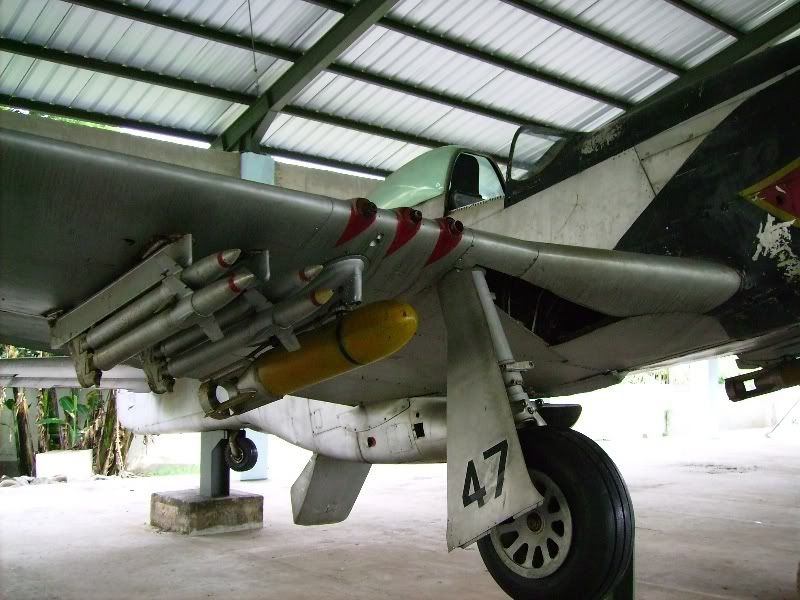
jackehammondPhoto of Oerlikon 80mm SURA air to ground rocket on Indonesia P-51D at museum display
.
jackehammondNice pics!
I also love those XFV-12s 😀
Cheers 🙂
Dear Members,
The USN aviation community had high hopes for the XFV-12 even though many aviation engineers stated it could not fly. And it never did. Was one of the biggest embarrassments for the USN since the end of WW2. The XFV-12 was unique in an effort to save time and money part of the fuselage of the F-4 and A-4 cockpit were used.
Finally, the USN SCS designs were used as the bases for the one aircraft carrier that Spain built for its Harriers.
Jack E. Hammond
jackehammondStarburst combined the Javelin missile and Starsteak-style laser beam-riding guidance.
Mercurius Cantabrigiensis
Dear Member,
Do you have confirmation of that statement other than the internet? Internet sources are giving three types of laser guidance. Do you have access to a Jane’s Weapons, etc????
Jack E. Hammond
jackehammondI’ve read recently, to the surprise of my ailing memory, that Sea Cat was still in widespread use by the RN during the Falklands War. I had thought it had been replaced by then.
Does anyone have any info on its success or otherwise against the A4s etc?
Dear Member,
All indications were that the Seacat scored no hits. The Seacat was designed to engage aircraft either in diving or shallow diving mode. Not at wave top. The Argies at San Carolos did not have to go to altitude to hunt their targets. They came right up the sound at wave top. And firing a Seacat at super low altitude would run it in the water most likely. Also, it was to slow. A lot of those present talked of watching Seacat launches commented on them trying to catch the attacking aircraft. After the Falkland’s War SHORT introduced a fix where the Seacat missile had a altimeter radar that maintained it at a minimum height. I don’t know if anyone took SHORT up on that fix. Also the makers of the Sea Wolf offered a conversion for the Seacat launchers to take Sea Wolf and use the Seacat CLOS guidance already installed on warships. As far as I know no one took that offer up either.
Last, the biggest success was the Sea Wolf after the fixed that one software glitch where the automated fire control system would ignore targets not flying directly towards it (ie the reasoning being that missiles that were going to miss the warship were not worth engaging). At one time one of the two Sea Wolf warships with the Falkland’s task force engaged four A-4s and shot down three of them in quick succession in the auto mode. Luckily for the two Sea Wolf warships the civilian engineers for the Sea Wolf stayed with the warships instead of getting off at Ascension Island.
Jack E. Hammond
BTW> The Argies had Tigercat (three round lightweight ground version of the Seacat) at Port Stanley. They had about the same luck as the RN Seacats. The big success was the one French ROLAND firing battery they had that nailed a Harrier (RN/RAF?) and of all things a BOMB in mid air!!!!
jackehammondThe Gerät 36 was a 533.4mm naval rifle serving in trials and firing a 2200kg shell. The Japanese 36cm/45 5th Year Type (actually a 48cm gun) fired a shell of about 1750kg. The American 18in/47 Mk A/O fired a 3850-lb shell. The British 18in/40 Mk I, which served aboard Furious and a few monitors, fired a 3320-lb shell; thus it rates third among the guns I can think of, but first among those that served afloat. The Japanese 40cm/45 Type 94 (actually 46cm) fired a 1460kg shell, though some sources claim it was actually as heavy as 1520kg, which would edge out the 18in Mk I. I’d be interested to know which source said the British 18in shell had a 20-lb lead over the runner-up.
Dear Member,
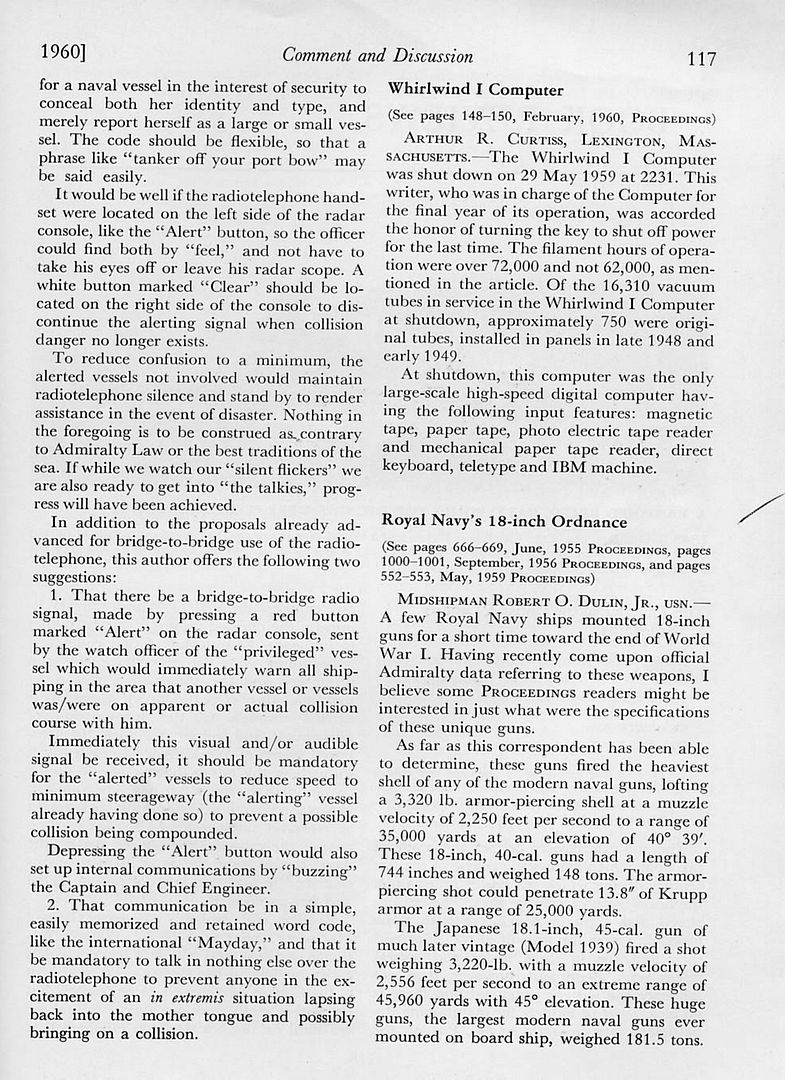
The information came from an August 1960s back issue of the USNI Proceeding by a naval officer (note – I mistakenly stated 20lbs when it was 100lbs). The only comparison it gave was between the Japanese WW2 18 inch naval cannon and the British 18 inch naval cannon. It seems the author was unaware of the other cannons you mentioned (as I am). But even with a 100 lbs higher projectile weight (ie the British 18 inch cannons) the Japanese 18 inch cannon had a substantial lead in muzzle velocity and range. Also the author stated the British and Japanese naval cannons were the only ones to ever be mounted on warships. Which I have no knowledge to know if true or not true. Thanks for the additional information.
Jack E. Hammond
Click thumbnail for page of article
jackehammondDear Member,
THANK YOU!!!!!!!!
Jack E. Hammond
jackehammondWell, I’ll take a guess. I’ll assume it was a WWII-era weapon, since that’s all I know. How about the German Gerät 36?
Dear Member,
That is a land weapon. Surprisingly it is the WW1 18 naval cannon that saw limited service which is the winner by 20lbs!
Jack E. Hammond
jackehammondFolks,
Trivia: What was the largest naval cannon to fire the heaviest shell in history?
Jack E. Hammond


 Sign In







