 Wingex
Interesting News! 🙂
Brazil is interested in cooperation with Russia to develop a fifth-generation aircraft…
http://www.itar-tass.com/c134/915287.html (translate google)
In Spanish: http://www.defensa.com/index.php?option=com_content&view=article&id=10452:el-ministro-de-defensa-de-brasil-admite-la-posibilidad-de-que-el-pais-entre-en-el-proyecto-del-caza-ruso-de-quinta-generacion-t-50&catid=55:latinoamerica&Itemid=163
I hope that take this opportunity!
WingexHi to all, I found these news…
What is your opinion about?
IAF Sukhoi-30 jets have a design flaw: Air chief
Air chief NAK Browne today said the IAF has identified a “design flaw” with the Russian-made supersonic fighter aircraft Sukhoi-30 though nothing is wrong with its “airworthiness”. “We have identified a Fly-By-Wire problem with the aircraft. It is a design issue and we have taken it up with the designing agency,” he told reporters on the sidelines of a function held to mark Golden Jubilee celebrations of Armed Forces Medical College (AFMC) here.
Referring to the December 13, 2011 crash of a Sukhoi-30 MKI fighter aircraft near here, the Air Chief said that more checks were being implemented to ensure that such incidents do not happen again.
The aircraft had crashed at Wade Bholai village soon after it took off from Lohegaon air base. Two pilots of the fighter plane managed to bail out safely.
“There is nothing wrong with the aircraft or its airworthiness. I have myself flown the aircraft,” he said.
On proposed acquisition of the French Rafale aircraft, Browne said the negotiations in this regard were progressing well and could be finalised by the end of the financial year.
In reply to a question, he said the IAF had an “elaborate plan” at hand to change over from old to new fleets.
Earlier, the Air Chief released a postal stamp brought out by the Department of Post and Telegraph to commemorate the AFMC Golden Jubilee
“There was a problem in the fly-by-wire system… This is a new thing. Pilot did not get any warning. There were no indications in the cockpit and the aircraft was out of control,” the IAF chief told PTI here. He said the pilot “tried his best to control the aircraft for 15-20 minutes” before ejecting out along with the Weapon Systems Operator (WSO)…”
PM to raise Su-30 MKI engine failure with Russia
Prime Minister Manmohan Singh is expected to red-flag serviceability, product support and pending upgrade of India’s frontline Su-30 MKI multi-role fighter with President Dmitry Medvedev at the annual summit meeting on Friday in Russia.
Top government sources said that Air Headquarters has urgently
requested the Prime Minister to raise the issue of engine serviceability with his Russian counterpart after few incidents of engine failures have occurred in the long range twin-engine fighter. The Su-30 MKI is powered AL-31 FP engine, whose variant also powers the Chinese Su-30 MKK fighter.While the Indian Air Force is tight-lipped about the issue and would like to play it down, the top brass has conveyed to government that “shaft bearing failures” have occurred in some engines. “In peacetime, the fighter can land on the other engine but this can be a life and death situation in adverse conditions, said a senior official.
India to provide new nuclear reactor site for Russia
Sources said that IAF had conveyed to the Russian manufacturer of Su-30 MKI that it needed to make design changes to prevent any future engine failures. However, the manufacturer raised objections to the lubricants used by the IAF in the Su-30 MKI engine. But after it was proved that the engine was still failing despite the use of oil recommended by the manufacturer, the IAF decide to escalate the matter to the government level. Since it was inducted in 1997, Su-30 MKI has performed well with IAF despite three crashes, none of which have been attributed to engine failures.
The other issue of concern is the pending upgrade for Su-30MKI fighters, which have now been in IAF service for over eight years. While the Air Headquarters wants the manufacturer to upgrade avionics and weapon platforms, the matter is stuck not on technical but on the commercial aspects as the original manufacturer is bargaining hard for better price.
WingexNews about Su-35S…
Su-35 fighters made 500 test flights
Moscow, April 4. The 500th test flight was made on the Su-35 flight tests program. The aircraft was piloted by the Hero of Russia colonel Sergei Bogdan, the distinguished test pilot. In February 2008 it was him who took off for the first time in that modern super-maneuverable multi-functional fighter.
At present, the Joint State Tests (JST) of the airplane are going on. In March this year the fourth production Su-35S was delivered to the JST. The Su-35-1 and 2 carried out preliminary flight tests, during which the main established flight and technical characteristics of the on-board equipment and super maneuverability features were fully confirmed, stability and controllability characteristics, the characteristics of the power plant and the work of the navigation system were tested.
The plane reached the maximum ground-level speed of 1,400 km/h, speed at altitude — 2400 km/h, the ceiling — 18 thousand meters. The detection range of targets in the “air-to-air” mode is over 400 km. This is significantly higher than that of the combat aircraft currently in service. The onboard OLS (optical locator station) can detect and track multiple targets at ranges exceeding 80 km. The aircraft complex is ready to undergo tests for combat use.
The analysis of the amount of work already done allows a conclusion that Su-35/Su-35S has a much better flight characteristics compared to analogue aircraft in service. The airborne equipment of the plane allows solving a wider range of tasks set by tactical and technical requirements.
The potential characteristics incorporated in the aircraft will allow it to exceed all tactical fighters of the 4th and 4 + generations, such as “Rafale” and EF 2000, modernized fighters like the F-15, F-16, F-18, F-35 and to counter the F-22A fighter.
The serial production of the Su-35S is going on at the Sukhoi’s Y.A.Gagarin Komsomolsk-on-Amur Aircraft Production Association (KNAAPO) in accordance with the state contract signed in 2009 to deliver 48 aircraft to the Russian Ministry of Defence by the year 2015.
Wingexafres reading author’s revelations of that ‘117M'(?) engines are installed on T-50 and early T-50s will have radar from Su-35 (obvious problems with geometry he has), his credibility goes in death spiral. he should be sniffing forums better next time.
Thank of god!…:p I also thought that this article sucks!
Regards 🙂
Wingex?
The article describes Su-35S’s commercial aspect and technical capabilities, without any subjective remarks / opinions.
Oh… I’m so sorry :(, I was wrong of link!!!
This is of link about PAKFA: http://svodka.net/analitika/obozrenie/241192
WingexHi to all, I found this article about the PAKFA, the autor attack strongly the concept: http://http://vpk.name/news/65186_su35__vozdushnyii_boec.html
What do you think about?
Wingexhardly think so as Davidenko’s project family shapes are readily seen here
oppositioners were talking of ‘aerodynamics better than that of T-50 and F-22′ (I guess they were addressing novel aerodynamic shapes of Boeing-released early NGAD concept) and ability to carry even two Kh-55Ms(!) in weapon bays (no more, no less – ‘and here we have PAK DA’ was a citation) with unrefueled range of 5800 km (that was the moment when I started to rise eyebrows, previous time it was when I read that they tried to push project to POTR via Zhirinovsky – you hardly can find worse way to put credibility in your enterprise)
I’ve asked some guys from industry about the case, but all I get are humble smiles
WTF?! OMG?! :Eek: 2 kh-55 in weapons bays, and competitive with NGAD (next generation)… this proyect was the middle of T-50 and TU-160 class!
Why did not take the project?… I don’t understand!!! :Confused:
*Do you think that “this proyect” could be the “russian NGAD”?
Wingexlast project, they say, has ‘right aerodynamics’ and abilities compared to Boeing’s NGAD/F-X
Hi, these abilities compared to Boeing’s NGAD/F-X…they refers to the “current T-50” or to the “alternative PAK FA”?
Regards
WingexTHE LINK DOESNT OPEN
Sorry, My mistake (double “http”) Now… This is fixed: http://sp.rian.ru/Defensa/20110919/150700942.html
Wingex@Wingex, firstly, you need to understand this is not an airborne radar with the functionality of say a downscaled NG L-band AESA aboard ‘Wedgetail’, nor is it the anti-stealth ‘silver bullet’ like what Carlo Kopp says it is. You need to look how the system will be employed aboard the Su-35S in the near future. Most likely it will complement the formidable ‘Irbis’ X-band radar. When the pilot/software suspects a VLO target @ BVR it will conduct a short, focused search of the area with the L-Band active array, if confirmed the ‘Irbis’ will then direct a track beam @ the target to compensate for the L-Band’s low resolution.
The ‘Irbis’ is immensely powerful (~20kW peak power) and the L-band affords the Su-35S pilot long range detection and the ability to engage a stealth fighter @ a significant BVR- which is in itself crucial for the survivability of the ‘reduced RCS’ (though non-stealth) Su-35S.
For the PAK-FA the integration of the L-Band array will be much more sophisticated & automated, operating in conjunction with the X-Band (later Ka-Band conformal) AESAs, EO-DAS and ECM/ESM/EW suite, so as to leave the smallest possible electronic ‘footprint’ in order not to compromise the PAK-FA’s stealth.
When ’51’ was presented to PM Putin for the first time @ Zhukovsky last year, Pogosyan spoke candidly of PAK-FA’s design philosophy and how important stealth was for it’s operational effectiveness including engagements “at the greatest possible distance”.
These are just my speculations, but I’d like to take the middle ground between ‘just for IFF’ (as the current, open source literature admits to) and the ‘all singing, all dancing stealth terminator’ like some with an agenda would have you believe.
Ok… I now understand.
Then, the SU-35S could fight effectively with the F-22 Raptor… look at the news: http://http://sp.rian.ru/Defensa/20110919/150700942.html (Spanish)
WingexI understand your sub analogy, Privateer454, perhaps a scenario something like this:
T-50 detects suspected VLO target with X-Band operating in LPI, then cues L-Band* to confirm VLO target exists and is hostile, then uses X-Band and/or EO-DAS to obtain firing solution and/or launches missile with dual-band seeker (already being tested by AGAT and slated for use on T-50’s A2A missiles).
Imagine an F-35 pilot who strongly suspects there’s a PAK-FA ‘out there’, but the PAK-FA pilot’s already certain there’s an F-35 and has already despatched a BVR AAM with a dual-band seeker to the F-35’s approximate location.
So, in essence, the L-Band is not like a conventional radar banging away non-stop. It is a tool to be used as and when required and for only seconds at a time- like a narrow beam torch to make sure the pilot’s seeing what he thinks he’s seeing.
This could be why Butowski (and others) repeatedly refers to it as a ‘radar’ for “target identification”. JMTs.* The L-Band array will have to be cued because it is fixed and will consequently have poor azimuth coverage- so the T-50 will have to align itself with the suspected target.
Thanks you so much for the clarification… (especially in the definition of radar)
*Now, Is possible (in the future) that the radar (L-band) can be independent of the rest (X-band)?
Regards… and sorry for my english 😮
WingexWhile L-band IFF is not revolutionary (so why make a big deal about it in a trade show display?), why would you add the weight and complexity by putting 3 or 4 foot long IFF antennas in the wing leading edges and not in a nice small conformal antenna? Why force the need to install not one conformal, but rather two very directional IFF’s in each wing LE and likely one additional for the rear? Sorry, but explain to me how installing IFF transceivers that large makes any sense at all. You don’t add needless weight to an agile combat aircraft so you can have the world largest combat aircraft IFF set. Unless you are insinuating the IFF will be L-band and located elsewhere and the wing LE arrays will be Ka band…
This is “THE QUESTION” now! :confused:
This is confusing, because the “PAK-FA” will have innovative and new technology… and these “L-Band” only work for “IFF”… so it’s not very innovative really 🙁
Regards
WingexNice pics. Although you have to wonder where Carlo Kopp gets such in-depth technical information….
What about the rear quadrants? I thought the PAK-FA was supposed to have 360-deg situational awareness? Why are there no antennae for the non-leading wing edges?
Well… Then Carlo Kopp is lying! :(, that’s awful!
Now, what’s the difference and advantages between “common IFF” and “L-band (IFF)”???
(number 1)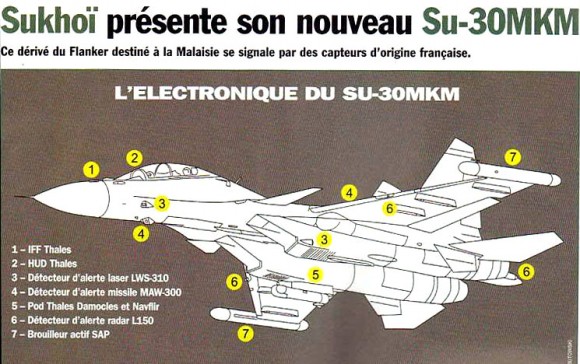
And… for other hand, how does the PAK-FA would have 360-deg situational awareness??? (excluding the “101KS” suit/EO DAS)
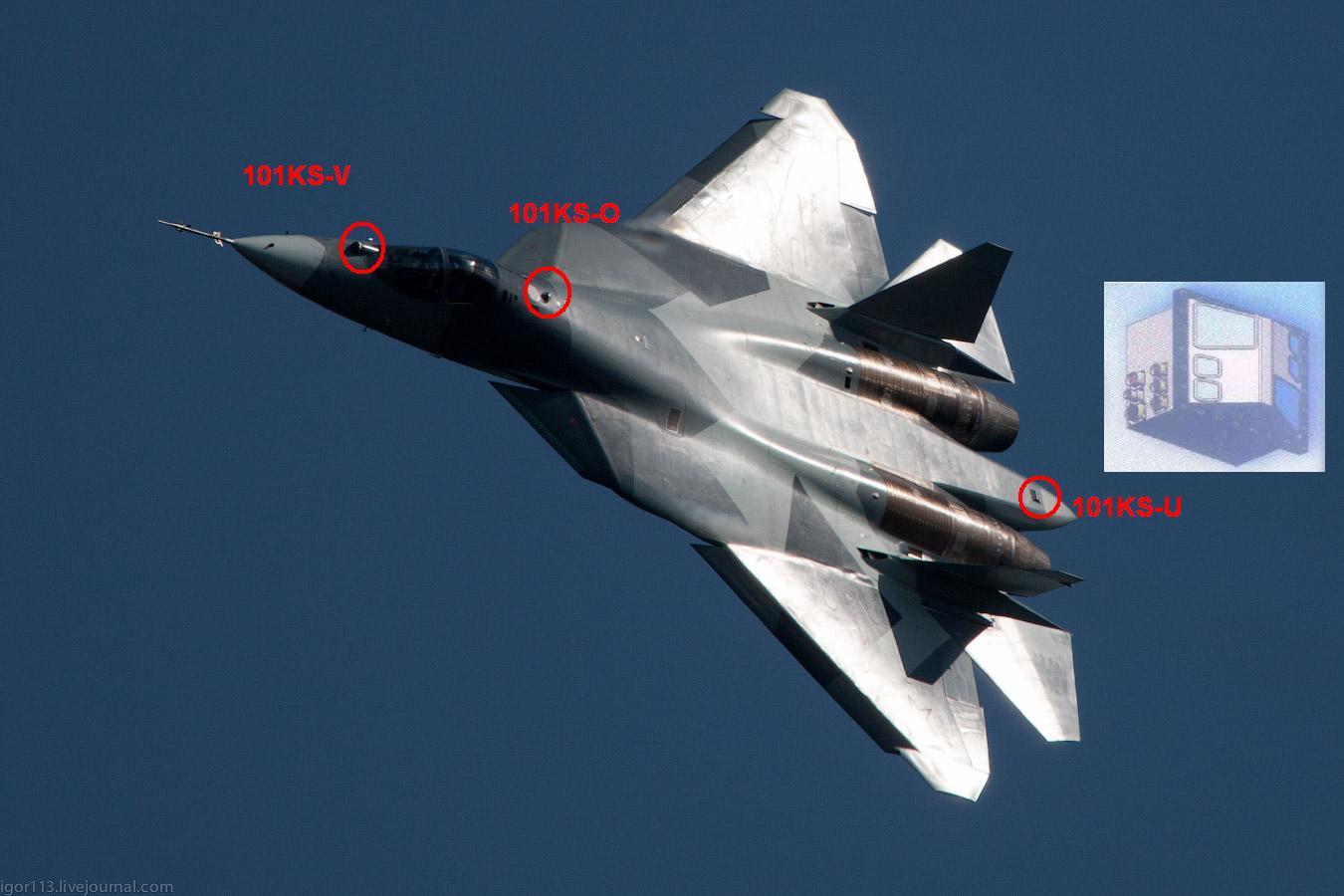
*Sorry for my english
WingexI think that I believe paper from NIIP staff more than Mr.Copp wishful thinking (with all my respect). Moreover, I know what Article 4283E is:)
Time will tell.
Ok, no problem :)… I respect your opinion, but I still thinking that the “L-BAND” is much more that only “IFF”
Maybe, NIIP staff has presented “a part” of the features of this band… really I hope so.
This is an extract about to the “L-BAND” by Carlo Kopp
Tikhomirov NIIP in Moscow are developing an L-band AESA radar system intended for embedding in the leading edges of fighter wings. A demonstrator of the L-band AESA subsystem was publicly displayed at MAKS2009.
This paper analyses the operational potential of this design, and performs a range of performance estimates based on manufacturer disclosures and known design features.
The design has clear potential to provide a genuine “shared multifunction aperture” with applications including:
1) Search, track and missile midcourse guidance against low signature aircraft.
2) Identification Friend Foe / Secondary Surveillance Radar.3) Passive angle tracking and geolocation of JTIDS/MIDS/Link-16 emitters at long ranges.
4) Passive angle tracking and geolocation of L-band AEW&C/AWACS and surface based search radars at long ranges.
5) Passive angle tracking and geolocation of hostile (i.e. Western) IFF and SSR transponders at long ranges.
6) High power active jamming of JTIDS/MIDS/Link-16 emitters.
7) High power active jamming of satellite navigation receivers over large areas.
8) High power active jamming of L-band AEW&C/AWACS and surface based search radars at long ranges.
9) High power active jamming of guided munition command datalinks over large areas.Performance modelling for a range of feasible configurations indicates the radar will deliver tactically credible search range performance.


In addition…
A high performance L-band AESA is not constrained in its basic usage to supporting Counter-VLO search/track and IFF/SSR functions alone. Because the L-band is used by so many disparate services, coverage of this band opens up numerous other applications, once such an AESA has been installed:
1) Passive angle tracking and geolocation of JTIDS/MIDS/Link-16 emitters at long ranges.
2) Passive angle tracking and geolocation of L-band AEW&C/AWACS and surface based search radars at long ranges.
3) Passive angle tracking and geolocation of hostile (i.e. Western) IFF and SSR transponders at long ranges.
4) High power active jamming of JTIDS/MIDS/Link-16 emitters.
5) High power active jamming of satellite navigation receivers over large areas.
6) High power active jamming of L-band AEW&C/AWACS and surface based search radars at long ranges.
7) High power active jamming of guided munition command datalinks over large areas.


Regards
WingexIFF. that’s all
Mmm… I don’t think so, look at this report about to the “L-BAND” by Carlo Kopp: http://www.ausairpower.net/APA-2009-06.html
*This radar (L-Band) is very interesting…
Regards


 Sign In







