 Indiaecho
The best bit of the Sale of the Century theme isn’t the music but the announcement – “Now, from Norwich, its the quiz of the week…”
IndiaechoThe best bit of the Sale of the Century theme isn’t the music but the announcement – “Now, from Norwich, its the quiz of the week…”
IndiaechoInkworm makes a very pertinent point in his post – with the very high level of footfall that many large supermarkets (certainly my local Sainsburys’ was very busy earlier this evening) enjoy supermarket entrances must be a potentially lucrative spot for fund raising activity, and it may well be worth charities using such spots even if they have to give up 50% of the take.
But are Tescos really being as evil as many seem to be suggesting here?
Knowing that their entrances are prime areas for this sort of activity, why shouldn’t they charge charities to use these areas and seek to make a bit for their own charities as well? And isn’t it better for them to link the amount that the charity pays to the amount collected rather than set a fixed fee?
After all, had Tescos chosen to charge £50 for the pitch (and I bet they would charge a commercial organisation a lot, lot more than that for it), and thrown in a couple of free drinks for the collectors as well, in the example we are all talking about, the charity would have made a loss. As it happens, the charity has made £23 and a similar amount is going to Tescos charitable organisation as well – everyone wins.
When I give money to charity, I know that some of it is going to cover the charity’s costs, and it isn’t all going to the people that the charity is trying to help. I don’t see how this is different.
IndiaechoInkworm makes a very pertinent point in his post – with the very high level of footfall that many large supermarkets (certainly my local Sainsburys’ was very busy earlier this evening) enjoy supermarket entrances must be a potentially lucrative spot for fund raising activity, and it may well be worth charities using such spots even if they have to give up 50% of the take.
But are Tescos really being as evil as many seem to be suggesting here?
Knowing that their entrances are prime areas for this sort of activity, why shouldn’t they charge charities to use these areas and seek to make a bit for their own charities as well? And isn’t it better for them to link the amount that the charity pays to the amount collected rather than set a fixed fee?
After all, had Tescos chosen to charge £50 for the pitch (and I bet they would charge a commercial organisation a lot, lot more than that for it), and thrown in a couple of free drinks for the collectors as well, in the example we are all talking about, the charity would have made a loss. As it happens, the charity has made £23 and a similar amount is going to Tescos charitable organisation as well – everyone wins.
When I give money to charity, I know that some of it is going to cover the charity’s costs, and it isn’t all going to the people that the charity is trying to help. I don’t see how this is different.
IndiaechoMr Creosote – no problem posting the photos – I’m glad you enjoyed them.
I had used to be a regular passenger at the airport as well, using the VLM service to Brussels at least weekly, and it is fascinating how the airport has increased the range of services over the last few years, culminating in the JFK route. During my four hour visit there were very few (if any) periods when there was not something on the move.
I have had a pm for a photo of G-LCYM as well – here she is arriving from Zurich:-

G-LCYM by IndiaEcho Photography, on Flickr
IndiaechoI’ll bite!!!
I don’t see the problem. I often fly with Ryanair, and when I do I make an informed choice over what I am letting myself in for.
Yes, it is irritating trying to book a ticket and having to go through all of the stages (“Do you want car hire? Do you want an approved cabin bag?” etc) before I get the final price but it isn’t that stressful in the greater scheme of things, and I always check the final price against a couple of other airlines as well (and while Ryanair maybe the masters of these extra charges, plenty of other airlines like them as well).
If I don’t like the Ryanair offer, I book with someone else. That is a choice I make regularly (sometimes they get my business, sometimes they don’t), and many millions of others manage to do so too.
I would much rather put up with this ‘inconvenience’ and get to where I want to go for a lot less (even when these extra charges are taken into account) than pay the sort of fares that the national flag carriers were able to get away with charging in the past before airlines like Ryanair were around.
I remember the first time that I saw a Ryanair aircraft – it was when they operated just the one Embraer Bandeirante between Gatwick and Waterford. Who would have thought then that they were going to revolutionise the airline industry in Europe and allow many millions to travel who would not have otherwise had the opportunity to do so.
It is about time that we celebrated the success of Ryanair rather than trying to knock them at every opportunity.
IndiaechoThanks for that Newforest – it is a most interesting link.
IndiaechoThanks very much.
Neil
IndiaechoI have just finished “Outlaws Inc.” by Matt Potter.
Subtitled “Flying with the World’s Most Dangerous Smugglers”, Potter tells the story of ‘Mickey’, an IL-76 pilot and his crew as they travel the world in search of cargo for their Ilyushin, and more than often than not find themselves hauling freight of somewhat interesting provenance, be it illicit drugs, diamonds or weapons.
The first half of the book is probably the best, as Potter outlines how the collapse of the Soviet Union saw the emergence of a large number of independent airlines using aircraft liberated from the military. Too many aircraft chasing too few cargoes saw the emergence of an ask no questions policy by crews anxious for work. The laissez faire attitude of the authorities in places like Sharjah (that probably won’t come as a shock to readers of this website), saw standards slip further.
In second half Potter tries, less successfully, the role of investigative journalist. He suggests that the aircraft are in fact owned by the criminal organisations providing their cargoes. Following a powerful indictment of many aid agencies and the lack of auditing they do of both the aircraft they charter and what happens to the supplies they ship on these aircraft, he then criticises the corruption that exists in many African and Central American (amongst others) states, that allows these aircraft to operate without any supervision or regulation.
However, he never finds these “Mr. Bigs”, and the book is rather let down by the final 50 pages, where the evidence base seems to get increasingly flimsy, and I found his conclusion that the world’s IL-76 and AN-12 fleet is ultimately controlled by only 3 men hard to believe.
This shouldn’t, though, detract from a book that, while maybe not being as good as I had hoped at the outset, was still a good read.
IndiaechoI have just finished “Outlaws Inc.” by Matt Potter.
Subtitled “Flying with the World’s Most Dangerous Smugglers”, Potter tells the story of ‘Mickey’, an IL-76 pilot and his crew as they travel the world in search of cargo for their Ilyushin, and more than often than not find themselves hauling freight of somewhat interesting provenance, be it illicit drugs, diamonds or weapons.
The first half of the book is probably the best, as Potter outlines how the collapse of the Soviet Union saw the emergence of a large number of independent airlines using aircraft liberated from the military. Too many aircraft chasing too few cargoes saw the emergence of an ask no questions policy by crews anxious for work. The laissez faire attitude of the authorities in places like Sharjah (that probably won’t come as a shock to readers of this website), saw standards slip further.
In second half Potter tries, less successfully, the role of investigative journalist. He suggests that the aircraft are in fact owned by the criminal organisations providing their cargoes. Following a powerful indictment of many aid agencies and the lack of auditing they do of both the aircraft they charter and what happens to the supplies they ship on these aircraft, he then criticises the corruption that exists in many African and Central American (amongst others) states, that allows these aircraft to operate without any supervision or regulation.
However, he never finds these “Mr. Bigs”, and the book is rather let down by the final 50 pages, where the evidence base seems to get increasingly flimsy, and I found his conclusion that the world’s IL-76 and AN-12 fleet is ultimately controlled by only 3 men hard to believe.
This shouldn’t, though, detract from a book that, while maybe not being as good as I had hoped at the outset, was still a good read.
IndiaechoThanks very much for your comments – two BA 747s did a go -around while I was there. It is a pretty spectacular sight!
IndiaechoYes – the viewing stand is about 1/3rd of the way along runway 27R.
I have never been there, so I maybe wrong, but while you will get a good view of anything landing or taking off on 27R you won’t be able to get any photos due to the large number of fences (and a road) between you and the runway. If they are coming in on 27R you would be better off going to the end of the runway.
If they are using 09L for landing (it isn’t used for take offs), most aircraft will have turned off the runway before they get to the viewing stand.
IndiaechoThis is the first of Rutherford’s books that I’ve read, and I’m impressed. I like a book I can get into which has interesting characters. I like the fact that the fictional characters are mingled with real historical figures, it has inspired me to read more about New York’s history to find out more about some of the characters. I think I will definitely read more by him, I like the look of “London” as well.
London is an excellent choice for your next ‘Rutherfurd’ – the chapter on the Great Fire is brilliant, and you can’t go wrong with his first book, Sarum, set in Salisbury, either.
IndiaechoThis is the first of Rutherford’s books that I’ve read, and I’m impressed. I like a book I can get into which has interesting characters. I like the fact that the fictional characters are mingled with real historical figures, it has inspired me to read more about New York’s history to find out more about some of the characters. I think I will definitely read more by him, I like the look of “London” as well.
London is an excellent choice for your next ‘Rutherfurd’ – the chapter on the Great Fire is brilliant, and you can’t go wrong with his first book, Sarum, set in Salisbury, either.
IndiaechoI have to agree with Frakky that Luton has one of the best spots of any UK airport by the crashgate. Impossible to get to by public transport though, unless you want a very long walk.
I don’t agree with Tommyinyork regarding Birmingham though. Excellent views from Sheldon Country Park:-

HB-JZM by IndiaEcho Photography, on Flickr
and you can get shots like this from the terminal area:-

EI-EGD by IndiaEcho Photography, on Flickr
East Midlands can be worth a visit as well. Get a bus towards Castle Donington, get off at the Nags Head pub just before you get to the village and then walk to the crash gate from where you can get photos like this:-
G-DHLG by IndiaEcho Photography, on Flickr
Heathrow is always worth a look as well, and much as it is criticised by many, there are still some decent spots and you are not going to see as many aircraft anywhere else in the UK. I have just posted on a seperate thread some of the best locations.
Don’t forget London City either – take the DLR to the Royal Albert stop (don’t go to the airport) which offers an excellent view across the dock to the runway and apron, along with seats if you are there for a while. Time your visit carefully though – while the airport is well worth a visit from 0700-0930 and 1700-2000 outside these periods it can be very quiet. This is typical of the photos you will be able to get – the Fokker is on the runway:-
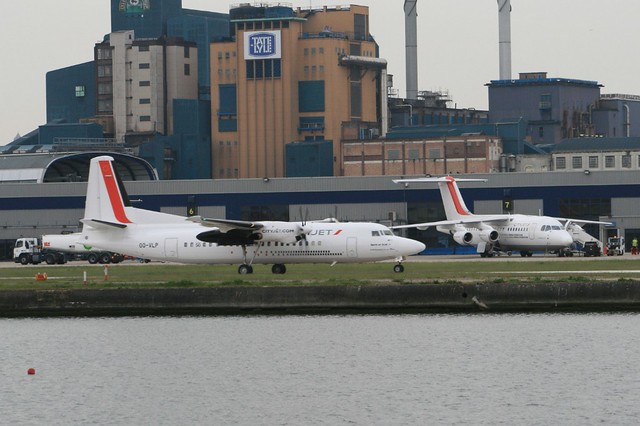
OO-VLP by IndiaEcho Photography, on Flickr
I always enjoy a visit to Southampton as well, although you have to time your visit carefully and like Flybe if you are to see much action. It can be reached easily by train, with a station at the airport. This photo was taken from the short term car park adjacent to the terminal – I have never had any problems there, but there are signs saying that photography is forbidden, and if you didn’t have a car it might be harder to hide from security:-

G-JEDP by IndiaEcho Photography, on Flickr
I hope this helps, and gives you ideas for some trips out!
Neil


 Sign In







