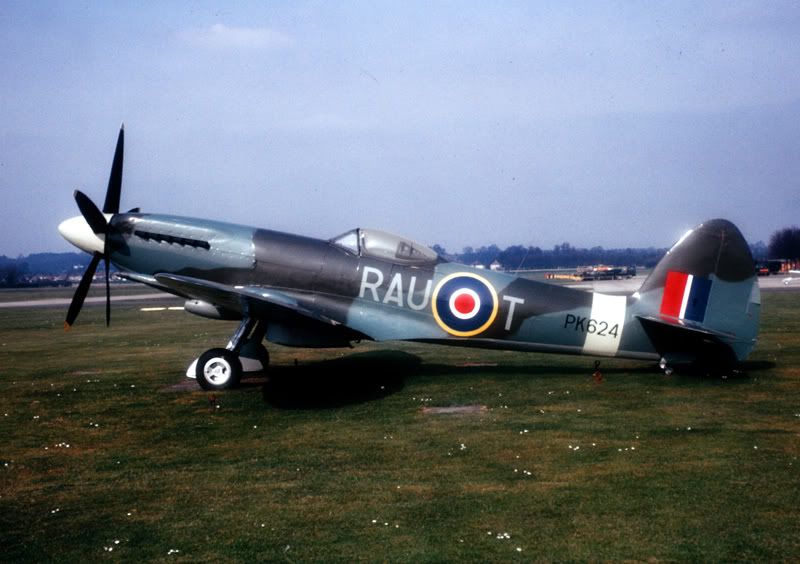
‘135 W’ – 135 Wing? Once owners of MH434, ML407, etc.
In Second World War as well as Winter War, Red Army soldiers used to be given 100 g of vodka daily.
IIRC this was spirit, not vodka.
IIRC, too, there was a Lancaster in the RAF named “Spirit of Russia” by its crew.
PPS, Trent Aero, HFL, WoGB, TFC, Harry Stenger, Charles Church, Airframe Assemblies, Ambrion Aviation, Franco Actis, Craig Charleston, ARC, Aerofab etc etc built!:)
I see. I thought you were talking about historically accurate, factory-applied position. Sorry about the confusion.
53″ on a high back
Supermarine, CBAF, or Westland-built?
RAUT (Polish, rather old fashioned) – PARTY, esp. EVENING PARTY
Very fitting for an old lady.
As for the cowlings, I don’t know if the terms were correct, but I meant that some have the earlier flatter type as can be seen on MK202, whilst some have the later ‘Bulged’ (I’ve seen it refered to as this) such as (can’t make out the serial) OU-Y.
Paul, I will gladly take a bet that no Spitfire in this shot has the top cowling panel more bulged than MK202. There was a difference in cowling production technology (and consequently in cowling shape) between the Supermarine-built Mk IXs and those built at CBAF. I don’t think they were interchangeable. If any of the Spitfires in this photo were built by Supermarine (very few LF.IXs came from Supermarine, and even fewer survived until D-Day time) they could have the “flatter” cowling. MK202 is certainly not one of them.
249 squadron I am sure, but who would suggest the colour of the all over finish?
Royal Blue?
More likely in Malta, I suspect a Mk VC originally fitted with two 20mm cannons per wing and then had the inner cannons removed and perhaps two outer .303 Brownings fitted.
Quite. The question is, why they chose to remove the inboard cannon, not the outboard? And there were many more like this.
Or, more generally, when the armament was standardised in Mk IXs etc. as 2×20 + 4x.303 why was the inboard station chosen for the cannon, not the outboard? After all, the installation like here allows to get rid of the extension tube, saving a little weight (and probably a little drag as well). And of course the switch to (e) wing would be so much easier later on.
flat top & blown top cowlings
?
what is clear on the aircraft where you can see them, is that they have the ‘universal’ wing with cannon extension and ‘chimney pot’
Paul, can you really see it in the photo? Gosh, I will have to see a doctor about my eyes.
Only very slightly off-topic: AVM Park inspecting fighters on Malta.
Mark,
In this photo you posted it is clear that the cannon barrel has just the conical shroud, no extension tube between the wing l/e and the shroud. So this cannon is fitted in the outboard bay of a ‘universal’ wing. Whether there is a 0.5 in m/g in the inboard bay is anybody’s guess.
Also, to be pedantic. MK732 was built with a Merlin 66, so it was either LF.IX or LF.IX(e), but not an F.IX.
3rd May 1998 saw what was effectively a ‘Diamond 16’ led by Rod Dean
Can’t locate any photos from 2000, but found this of 3/5/1998.
There should be an accident record card available on microfilm at the RAF Museum archive.
Ian,
The first question that springs to mind here is: was he told he would be promoted to W/Cdr (permanent rank) or was he told that he would be appointed to a post which entialed the acting rank of W/Cdr?
Ooops!
Hopefully the photo gets there this time.
This is a photo believed to show two Polish Spitfire pilots on 302 Sqn’s MA843 WX-F, one of the numerous Spitfires in MA800-MH400 serial range that seem to have been built from the outset with the ‘single chimney pot’. To me the cannon here looks like perfectly standard ‘C’ wing unit, certainly without the distinctive ‘B’ wing ‘chimney pot’ on the wing leading edge. The photo was taken at Northolt during late September or early October 1943.
Off topic, the sergeant near the fuselage is Alfred Krzysztof Wlodarski who had flown operationally with nos. 315 and 316 Sqns. He was subsequently killed in an accident while ferrying Typhoon IB JR127 on 14 July 1944.
The F/Sgt near the cannon is Kazimierz Benzinski, who served with 302 Sqn and then joined the RAF after WWII, flying Spitfires well into 1950s. During his service he flew several survivors in Polish or RAF squadrons: MJ783 WX-F and MK959 WX-F in 302, TB863 in 691 and 17 Sqns, and possibly also VN485 in 80 Sqn in Hong Kong.