 eagle
eagleFor the others , who has the capacity to build a fighter on their own? Typhoon partners have at least partial expertise, but none will be able to develop one on its own, if anything, because they won’ t have the cash needed.
I recently watched this interesting F-14 video. Go to 11 minutes to find about the Grumman design philosophy: One new thing at a time – Airframe (F-14A), engines (F-14B), avionics (F-14C/D). The Typhoon partners, once they complete the development of the T3 system, are going to have a very capable multirole avionics set. EJ200 engine is already good, so the only thing that’s missing is a new airframe. I don’t think it’s beyond the technological and financial capabilities of the partner nations to develop a new airframe on their own. Well except maybe Spain.
eagleBest make them choose incompatible engines to the Saudi order.
Saudis have both F100-229 and F110-129 engined F-15s.
eagleDoesn’t it have 9 hardpoints in total, four on each wing?
Also, i can’t understand why VKS has not fielded twin launchers for A2A munitions yet.
It isn’t really needed for flankers, but what about Migs?
I can think of two reasons:
– With the new 8 hardpoint wings, there are always 4 AAMs stations available, even in an A/G configuration with 3 tanks. No need for more.
– There isn’t enough space: pic
eagle750 aircraft is what the program was intended, at inception, to deliver. 187 or 280, it’s not replacing the F-15 in either case.
BTW if 280 had been ordered the ‘min reqd’ would have been 360. If 360 had been ordered the ‘min reqd’ would have become 450. It’s just the way the system works (world over).
The point is USAF didn’t choose to buy only 187 F-22 because of F-35.
Min requirement of 360 does seem realistic, given the number of F-15Cs slated for upgrade. 179 of those plus the Raptors is about 360 jets, which is the required number to have 240 combat coded aircraft (10 Sqns à 24 aircraft).
eagleSingapore (24)
Singapore has 40 SGs: Report.
I’ve also read they might be looking for more.
eagleThe capabilities of the F-35 played a major role in the capping of the F-22 production run. That should tell you more than enough about the USAF’s intentions.
Is that the same USAF that said it needed 360 aircraft, 280 minimum? It wasn’t USAF’s intention to cap production at 180 examples, rather they were told to make do with that and hope for the best with F-35.
So in essence you are correct that the JSF was initially designed with a focus on air to ground employment but always called multi-role and required to complement the F-22.
1700 F-35 complementing 650 or 480 or even 360 F-22 is not quite the same as 1700 vs 180 though… Also, from an USAF point of view, CALF was to complement the F-22 originally. JSF is basically CALF plus many pounds of compromise. A bit more range and payload was added aswell to be fair.
eagleI dont remember seeing time limit of 1 minute for F-15C at mach 2.3 in it’s manual , can you post the photo of that page?
The 1 minute limit refers to flight above Mach 2.3, if I understand the chart correctly. Vmax itself is limited to 6 minutes, read here.
[ATTACH=CONFIG]244805[/ATTACH]
eaglesource?
[ATTACH=CONFIG]244793[/ATTACH]
eagleWas definitely post 1978 as the C model Eagle didn’t start production until mid 1978 and the Israelis didn’t use the F-15 for A2G work until 1985.
The source makes it pretty clear that cost was a major factor. The F-16 and F-18 were the only two airframes down selected with the F-15, F-14 and Tornado all rejected and Dassault didn’t even bid in the end so it is clear they were after something smaller and more sustainable.
Thanks for the info, definately have to read up on Israeli F-15s some more.
The F-15 can’t compete on cost, that’s for sure. Doesn’t matter if it’s against F-18 or F-35.
Payload-range is another story. But for smaller air forces, I would prefer numbers over capability anyway, up to about 50-70 airframes. So if the choice is between 40 F-15 and 50 F-35 f.e., I would go for Team Lightning.
eagleLM’s site have a lower F-16 internal fuel capacity: 5,920 lb / 2,685.2 kg
http://www.lockheedmartin.com/us/products/f16/F-16Specifications.html
Seems to be different numbers all over the place(which one to believe is any ones guess…).
Regards
F-16 internal fuel capacity is hardly a secret.
Internal useable fuel: 7116lbs / 3230kg for single seaters, 5874lbs / 2666kg for twin seaters.
The CFTs hold 1528lbs / 693kg useable fuel.
This is from the flight manual, but other sources give (roughly) the same numbers, at least the ones I know.
eagleOther than during the testing phase where MDC loaded A2G weaponry on to it the F-15 was not being used by any operator in an A2G role, especially given we are talking about 1978 when it was not down selected for the Canadian competition. It had no laser designator pod and had minimal A2G radar modes.
The C Eagle has been used in the A/G role by the Israeli Air Force (A-D models) and for a short period by the USAF. That was post 1978 though, at least I think so. Given that the F-18 had its first flight in 1978, it hadn’t demonstrated anything at that time so I would say the Eagle was in the lead back then. I can see the advantage the Hornet had though, as it was required to fill the A/G role for the US Navy, the risk for the F-18 ending up without all the required capabilities was pretty much zero. Whereas with the F-15, the Canadians would have been the only major operator of light grey Eagles in the A/G role.
The lack of a targeting pod wasn’t solely an F-15 issue. According to this source, Canada got AN/AAS-38B pods in 1998… I’m sure by that time, it would have been possible to have a pod on the CF-15.
Remember the article was written in 1990 and is assessing the competition that took place in the late 1970s. Given the F-18 was at that point still in development the Canadians probably expected it to outrange the F-16.
Who knows. In my book, the F-15 would have been the best choice back then, just as it is now. I might be biased though 😉
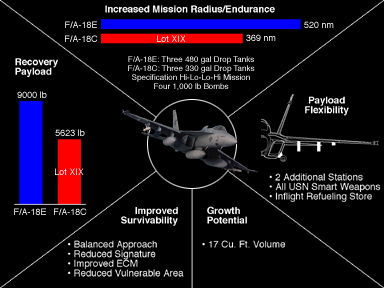
eagleAre you sure about that? The Hornet is bigger and heavier but also carries much more internal fuel than the F-16.
Pretty sure. The F-16 also has more range than the F-15, at least F-16A vs. F-15A.
Best source I could find at the moment:
eagleWell the F-15 had essentially no A2G capability for a start.
Not true, the F-15A-D had a robust A/G capability right from the start with Mk 82/84, GBU-10, Mk 20 and CBU-52/58/71 bombs. If I’m not mistaken, the only thing missing compared to what the Canadians initially used on their CF-18s is rocked pods.
Page 33
The F-16 outranges the F-18. Better radar (and associated BVR capability) favoured the Hornet though, as was the case in Switzerland.
eagleThe F-16 diagram above also includes a jamming pod and a LANTIRN pod, both of which are internal on an F-16 Block 60. (which would not only reduce drag, but would allow the F-16 to add a centerline fuel tank)
Only the navigational part of the LANTIRN system is internal though, consisting of a FLIR mounted on the nose and terrain following modes provided by the AN/APG-80 radar. The targeting system is still in a pod.

As for drag, the Greek flight manual gives the same basic airframe drag with or without CFTs, sub- and supersonic – quite remarkable imho.
eagleAnd over the subsequent years, the F-16 proved itself to be a safer aircraft than the F-18.
F-16 accidents
F-18 accidents
That data isn’t really useful in this case as it doesn’t say anything about accident cause. I’m pretty sure the F-18 has a higher loss rate because naval aviation is more dangerous f.e.
Here’s some good data:
USAF Single Engine Fighter/Attack Engine-Related Class A Rates
USAF Twin Engine Fighter/Attack Engine-Related Class A Statistics
Compare F-15 and F-16 engine related loss rates with the same engine.
Usually, things like that are considered when selecting a fighter. If you go for a single engined jet, you fully expect to lose a certain percentage more of your fleet over its lifespan. Unless of course the choice is purely political and/or only the initial lower cost of single engined jets are considered (for political reasons…). That being said, I think statistics show that single engined jets are still cheaper considering everything. Not counting possible loss of life of course…


 Sign In








