 eagle
eagleIf I carried more weapons, and if
I had enough gas, and if
I could actually hit the target, and if
I had some more REALLY expensive electrons so I could find you, and if
My motor didn’t quit, and if
My wings didn’t crack,
…
I’d look like this: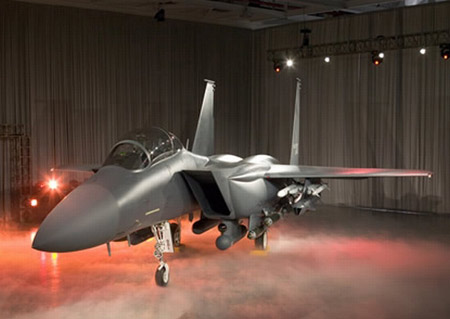
😀
eagleYoure cerainly not the first.
Didnt the T-37 fleet suffer from weight increases over its lifespan? Unlike the F-16, the reason wasnt upgrades but residua of some sort. 🙂
eagleI cant see why the F22 is listed as the best from 07 onwards as they are still not yet in service fully and serviceable. I would go for the FA18 EF.
The F-22 is in service since late 2006 iirc.
I’d add the Gripen from 1997 to 2007 and the Swiss and Suomi Hornets for about the same timespan.
And of course the correct time for the F-15 is from 1975 to 2035 😀
and btw, this thread is rather pointless.
eagleThe model in the AFM photo reminds me of the F-15 actually. Wings and tails look very similar.
Now all they need to do is clip the wingtips. 😀
eagleHere is some information from the annual issue of Janes Book of Aircraft 2003/2004 Pages 121 to 126;
“Mirage 2000-5 (2nd generation Mirage 2K started production in November 1995), can carry MICA active missile on 4 hardpoints (rated up to 400 kilograms each). The MICA missile weighs 243 pounds (100Kg). Indian AF name for Mirage 2000-5 is Vajra (Divine Thunder).”Adrian
Where does it say that the Indian AF Mirage fleet is equipped with MICA?
eagleThe data do look ok. But when I remember well, the empty equipped should have been ~14365 kg or more than 4 tons less as quoted above.
14,5 tons was the number in YF-22 days. I dont know if that was an official target weight or just the YF-22s weight.
By the way ~ 4 tons heavier than a similar sized Su-27 from the 80s.
I can not see such big miscalculations related to computer design mistakes only. The volume of the design was known as the weights of the related materials. For me it does look alike, that the promises about weight of such materials was not kept at first. As quoted before, the later F-35 did run in similar problems. Some weight could be saved by reducing the size of the weapon-bays for example. The rise of available power is no weight reduction!
The weapon bay size of the F-35 wasnt reduced. Just those of the F-35B for which a bay to accomodate two 1000lbs weapons was always planned. Then for commonality reasons, it was to get the standard 2* 2000lbs weapon bay. Later, to save weight, it was again reduced to the original planned size.
Anyway, I was quite surprised to learn the real weight of the F-22. For a plus-minus F-15 sized fighter, its really heavy.
From what I know, its a little more than 18tons empty, not OEW. That should be around 19 tons. The AMRAAM launchers alone add some hundred kilos.
edit: for internal fuel, I get 3082 US gallons or 11666 liters or ~9333kg.
edit 2: when I use liter numbers, I get 13029 liters or 10423kg. Strange…
eagleWhat is the cost of an A-4 compared to a F-35? (even accounting for inflation).
OK, thats a point. But cost of fighters has increased generally as there are less of them both in absolute numbers and in types making each type more complicated.
The engine doesn’t have to break by itself – these things are meant to be prepared to go to war after all… any kind of shrapnel in the engine and you lose the aircraft. In a 2 engine machine you might limp off home, and replace the engine saving the machine for future use.
True, F-15, F-18 and A-10 showed that. But in peace time, single engine fighters are cheaper over total life time (including losses) if you have a fleet of at least 72. There was a study about that somewhere. With engines getting more reliable, that number will go down.
In war time, youre probably going to loose a few more planes. But it doesnt make much difference.* Many of the damaged planes are not repairable in time. See the A-10s in Desert Storm. Many of them were left behind after the war because repair was deemed uneconomical.
Selecting two engines is mainly a question of engine power. Fighters are generally designed with one engine if there is a suitable one around.
* except for the involved crew of course.
eagleThe USAF wanted the F-16 for their own reasons and didn’t care what the Navy wanted, especially with the Navy not buying the F-111 while the USAF was stuck by contract to purchase them.
The Navy did not want the F-16 because of all the changes that would have to be made in order to make it compatible with carrier operations. Some of the changes between the land based F-16 (Model #1600) and the aircraft carrier version (Model #1601) were;
1) The fuselage is stretched, both forward and aft.
2) The wingspan is wider and each wing has a increase in area of 57 square feet.
3) The flaps are larger.
4) The distance between the trailing edge of the wing to the stablator is greater.
5) The area of the stablator is greater and the width is greater.
6) The fuselage area ahead of the cockpit is broader.
7) The chord of the wing is longer.
8) It would be powered by the P&W401 engine.
9) The stablators are larger in area and their span is greater.
10) The Navy version of the F-16 would be manufactured by LTV!Plus materials in many areas would have to be changed to deal with the “salt water enviroment.” After all these changes, the performance of the F-16N would be significantly degraded, far more than a modified YF-17.
Aviation Week Magazine had two issues with articles on the changes involved. There were the issues of Jan. 20, 1975 Pg 28 and Jan. 27, 1975 Pg 17.
Adrian
Thanks for the insight. Thats exactly what I was thinking about. There were plenty of reasons to dump the naval F-16. The single engine story was just an excuse.
eagleIt can also reach speed greater than M1.6 clean (been there, done that, got the T-Shirt).
Thats interesting. Because the 1.6 figure was from an official source if im not mistaken.
Can you comment if that speed is reached with radar blockers installed? Do they even affect performance?
eagleThat is a reason why I disagree with the JSF – its alot of money for a single engined machine – any kinda engine damage in conflict (or even peacetime) and your losing the airframe.
A-4? A-7? F-8?
The Navy didnt have a problem with those apparantly. This no-single-engine-jet-idea is in reminiscence of the F-16/F-17 thing iirc. The Navy didnt want the F-16 so they absolutely needed two engines. As if there were no other reasons.
Take a look at the F-16 Block 52. afaik, there havent been any losses due to engine failure.
Besides, it would cost even more if another engine were added.
eagleWhere would these F-16s come from? The way I see it, only A models are available. USAF has no Cs to spare except retired ones with little to no service life left and theres no other C operator with surplus airframes.
Rafale > F-16A.
eagleWhat PW engine did the Saudis get initially? -229 I suppose?
And why only 65 engines? Thats not even enough to equip half of the F-15S fleet.
eagleNice. Internal wiring is rotting away and they put a new radar in front of it. 😀
I wonder how much weight savings this new radar brings. The first AESA for the F-15C added around 150kg compared to the standard fit requiring another ~250kg of ballast…
eagleThe F-15 is less complex aerodynamically speaking than the F-16s, its wing design is too simple and what has kept it as a good fighter has been superiority in numbers, better avionics and inferior adversaries.
The wing is not too simple, it is optimised for a specific flight regime where it excels. Above or below that, it looses performance of course.
In western military exercises such as Red Flag the F-16 has shown that as a dogfighter few western aircraft can figh it, in BVR even the Panavia Tornado has beaten the F-15 and in WVR the F-16s have proven to be difficult targets.
The Tornado is very good in BVR, do you think it never beat F-16s or what?
Sometimes, Tornados and the like also shot down F-15s in WVR fights. That happens, and the F-16 is not immune to that. What really counts is the total exchange ratio.
eagleI added about 1000lbs on the empty weight. The 7500kg for the F-16 is based on a given empty weight of ~6800kg. It is hard to find substantial figures, if you have good sources feel free to share.
I have found 16285lbs here and here
6800kg looks more like the YF-16 weight for which I found 6600 something kg.
According to Everest Riccioni. With external fuel top speed will drop to about ~1.5 to 1.6.
Do you know how much external fuel that includes?


 Sign In







