 Rajan
Rajan^^^
One question that does arise is why was the trainer delayed so much?
The aerodynamics of single seater vs twin-seater can’t be too different. Or is that on the first flight itself they wanted to check out the dual controls??
Regards,
Ashish
Actually there are many differences between air force version and trainer/naval versions. Their aerodynamic also considerably changed, specially the LEVCON and fore plane. These needs lots of changes in flight control system as well. So it took time. And the ADA was very careful for the first flight of the new version of LCA (trainer). Any accident would be a major setback for the entire Indian defence industry. You know Indian media.
The LCA mk 2 will evolve from LCA naval version as well.
Rajan^^^ There were talks by the officials about LCA programme by 1983 the actual project started only by 1988. GS is quite outdated and not always accurate specially about Indian projects. Lots of errors.
RajanWow, only like 20 years behind schedule. Congrats for this enormous success!
If you don’t know how to count than this is for you….
http://en.wikipedia.org/wiki/Hindu%E2%80%93Arabic_numeral_system
LCA Trainer
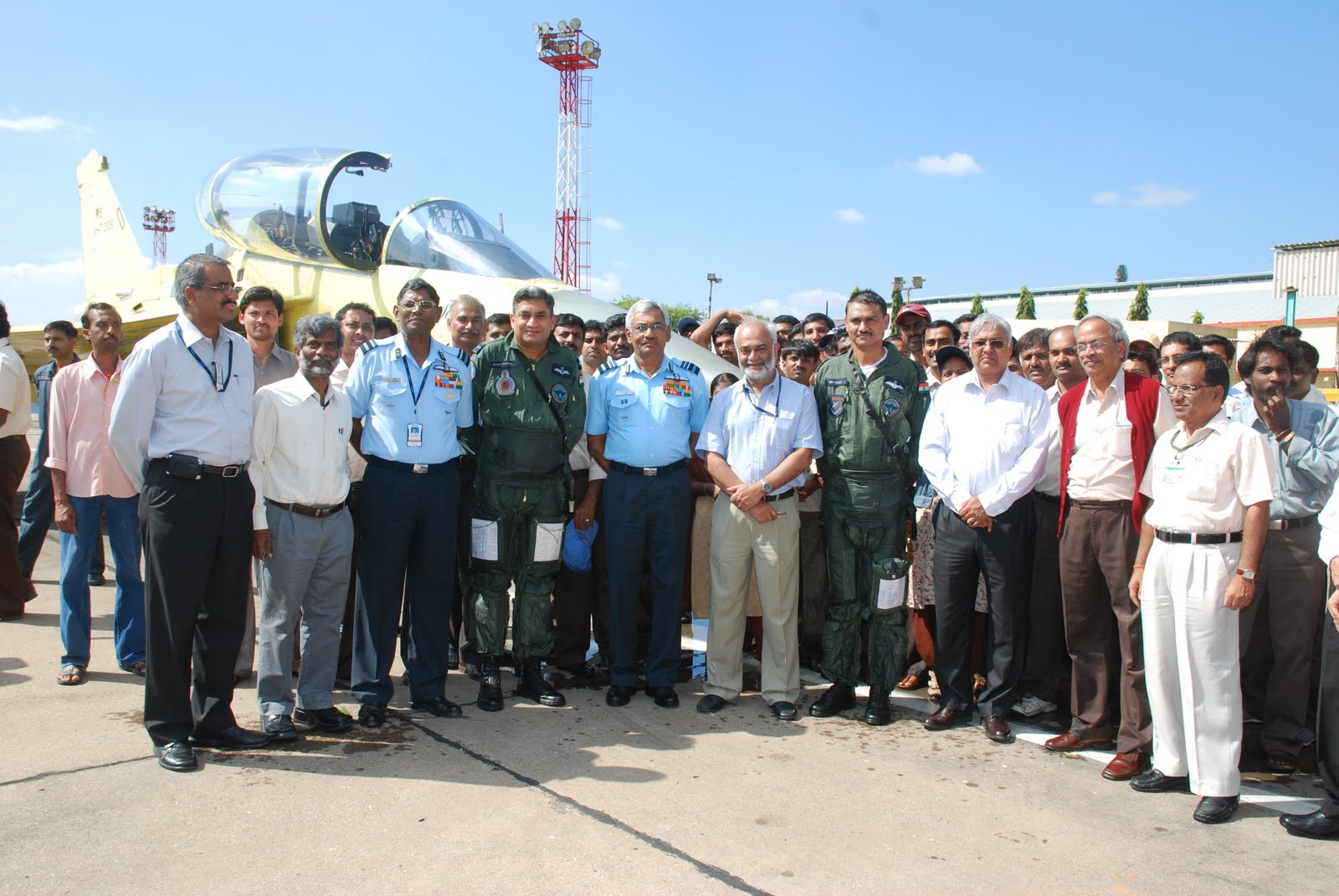
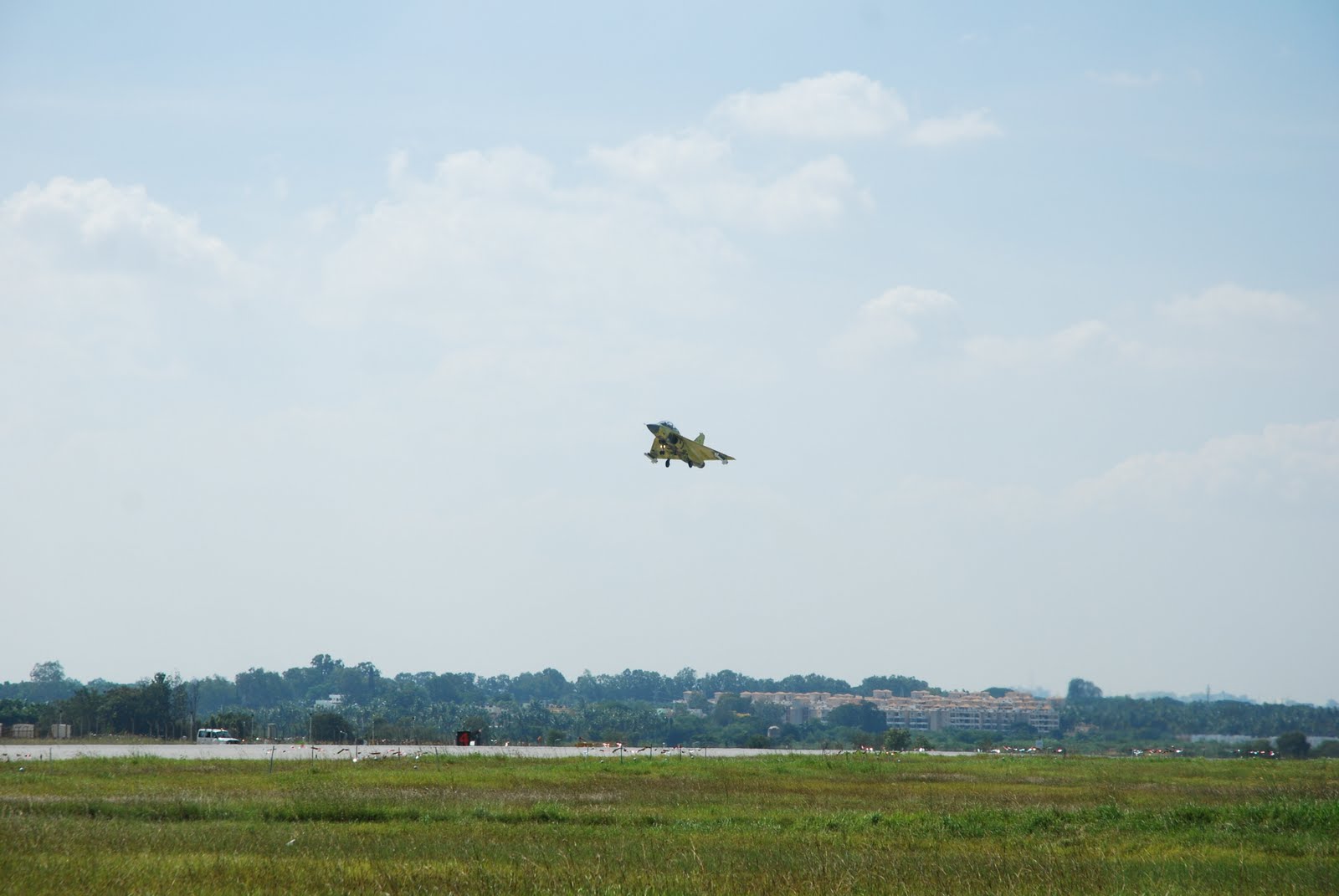
http://ajaishukla.blogspot.com/2009/11/news-flash-pv-5-tejas-twin-seater-makes.html
This is the DRDO release, issued at 18:30 hours today:
TEJAS TRAINER MAKES SUCCESSFUL MAIDEN FLIGHT
Two seater (Trainer) version of Tejas (PV-5) made its maiden flight on 26 Nov 09. The flight took off from HAL,Airport at 1300 hrs. The successful maiden flight covered an altitude of 9km and Mach number 0.85. The prototype was flown by Gp Capt Ritu Raj Tyagi of the National Flight Test Centre (NFTC). Air Cmde Rohit Varma, Project Director (Flight Test) flew in the rear cockpit. Wg Cdr (Retd) PK Raveendran, Group Director (Flight Test) was the Test Director. Extensive preparatory work that has gone in resulted in the first flight profile being executed with clock work precision. All the objectives set out for the flight were achieved and all the systems on board the new prototype performed well through out the sortie.
Successful flight of Tejas trainer is a major milestone for Tejas programme and a significant achievement for all the stake holders in the programme, which include ADA, HAL, NAL, ADE, CEMILAC, DGAQA, Indian Air Force and Indian Navy. With the Tejas scheduled to be cleared for Initial Operations with the Indian Air Force by end 2010, successful maiden flight of Tejas trainer has given a fillip to the programme. The trainer when fully developed will have the full operational capability from the rear cockpit as well. As Tejas Trainer has a lot of commonality with Tejas Naval version, even Tejas Navy programme would see accelerated progress as a result of the successful first flight.
As the first flight coincided with the programme review by the Air Force, the historic event was witnessed by Air Mshl NV Tyagi, AVSM, VM, VSM, who was the Chairman of the Review Committee along with Mr Ashok Nayak, Chairman, HAL, Chief Controller, DRDO Dr D Banerjee and Mr PS Subramanyam, Programme Director (Combat Aircraft) & Director, ADA.
RajanThe deveoper trials had foriegn INS system and all have been successful the failed user trials used india INS system hmm.
Wrong info by the reporter. The indigenous INS system tested earlier and was successful. These two Agni-2s failed, actually produced by BDL not DRDO. They need to improve production quality.
RajanGood to start now. Many countries are way ahead in this area. DRDO should be more cautious about the tests and media.
DRDO to develop unmanned combat aerial vehicle
TNN 26 November 2009, 12:51am IST
BANGALORE: The Defence Research and Development Organization (DRDO) will start a programme to develop unmanned combat aerial vehicle (UCAV). It can detect, identify targets and even fire weapons. At a defence conference on Wednesday, scientific advisor to defence minister, V K Saraswat, said UCAVs will be controlled with command and control centres (CCC) spread across the country.
“This will enable one CCC to take over if another becomes defunct. DRDO will also design a high-altitude medium endurance UAV at the ADE laboratory in Bangalore. The first experimental flight took place last week,” he said.
DRDO is also developing a long-range tracking radar in collaboration with Israel, which can detect small targets between 600 km and 800 km. It can detect objects as small as 0.1 square metre.
“Companies are going to play a major role and the project is worth Rs 6,000 to Rs 7,000 crore,” he said.
Saraswat also delivered a lecture on `next generation IT for next generation defence’ at the 5th National Conference on `IT In Defence 2009′, organized by the Computer Society of India and DRDO.
“Modern warfare will not be fought in battlefields but in the boardrooms of various institutions. Technology leadership is shifting to the civilian sector and there is demand for real-time, reliable ad manageable information. In future, about 95% of all military communication will be via commercial satellites,” he explained.
Information warfare will be three fold: defensive via firewalls; offensive via virus, bugs and denial of access, and thirdly, monitoring by being intrusive.
“Cyber warriors will carry out cyber war through espionage, propaganda and other methods. War gaming is also catching up,” he said.
“Robots will play a major role in future wars, be it insect robots or cyborgs. There is a clear trend towards multi-core chips.
“Future wars will be fought using space- based radars, robots, hypersonic technologies and UAVs. Cognitive technology threat warning system, where the mind of a soldier can be monitored, is in infancy right now, but will play a major role in future,” Saraswat said.
India to develop unmanned combat aerial vehicle
IANS
Time Published on Wed, Nov 25, 2009 at 14:50 in India section
UNMANNED: Scientific advisor to Defence Minister A K Antony informed the press about the project.
Mumbai, A Year After 26/11
November 26, 2009
Bangalore: India will soon embark on developing an indigenous unmanned combat aerial vehicle (UCAV) for surveillance, detection and destroying specific targets, a top defence official said on Wednesday.
“We will soon embark on designing and developing an unmanned combat aerial vehicle, which will not only do surveillance, but will also help detect the target and destroy the identified object,” V K Saraswat, scientific advisor to Defence Minister A K Antony, told reporters.
An UCAV or ‘combat drone’ differs from ordinary UAVs as it is designed to deliver weapons.
The pilotless vehicle can carry greater payloads and have wide range and manoeuvrability in the absence of a cockpit and associated equipment.
The ambitious project will be taken up by the Aeronautical Development Establishment (ADE) of the state-run Defence Research and Development Organisation (DRDO) in Bangalore with private industry participation.
“The controls of a combat drone will be rested with multiple command control centres. The centres can be geographically at different locations. Even if one centre becomes defunct, the drone can be controlled and guided by other centres,” Saraswat, who recently took over as director general of the DRDO, said on the margins of a conference.
“The UCAV will work in a multi-layer manner for which ADE is developing the required technology, including sensors,” Saraswat said after inaugurating the fifth national conference on ‘NextGen IT for Indian Defence’.
The ADE is already developing a medium altitude long endurance unmanned aerial vehicle (MALE UAV) codenamed Rustom for the three Indian defence services – army, air force and navy.
The MALE UAV is still in the experimental stage.
The first trial of the prototype, developed by Taneja Aerospace and Aviation Ltd, resulted in a crash Nov 16 near Hosur in Krishnagiri district of western Tamil Nadu, about 40 km from here.
The Rustum UAV, with a wingspan of 20 metres and weighing 1,800 kg, has a maximum speed of 225 km per hour and can operate at an altitude of 30,000 feet.
“The Rustom UAV will be able to execute surveillance of the enemy territory up to a distance of 250km and carry a variety of cameras and radar for surveillance,” Saraswat said.
The remote-controlled UAV took off from a private airstrip at Belagondapalli village on the outskirts of Bangalore. After hovering over the Taneja private airstrip for a few minutes, it lost direction and crashed onto an adjacent coconut farm, an ADE official said.
“The aerial vehicle was test-flown for research. The remote control device developed a snag and that led to the crash,” the official added.
http://ibnlive.in.com/news/india-to-develop-unmanned-combat-aerial-vehicle/105939-3.html
RajanRajan,
The GS100 is likely to be there, even if its not on the website. Thales has been working on making a modular series of radars based on the same technology platform, which they refer to as the S3RD. The Ground Master 400 is basically the high end of the current series of AD radars using this basis. The GS100 is likely to be the mid-end. The G1000 is a different project altogether, meant for long range BMD, think of it as the French GreenPine.
I checked it again. There is nothing called GS-100 at present of whom the new radar should be based. The SR3D platform used as base for many newly developed radars including GM-400 most of them are long range. So I will not be surprised if they come up with something based on GS-1000. Though it is a BMD radar it also has excellent low level coverage.
RajanOut of fifteen Agni missile launches four failed. Most notably two consecutive failed tests of Agni-2 missiles, though it have done well before. I think DRDO will come up with a better solution specially with some new technology like they did earlier.
RajanThere is nothing called GS-100. I guess he wanted say GS-1000 BMD radar. Earlier there were reports that IAF selected GM-400, now this! A BMD radar to be modified for low-level role.
GS-1000

Thales wins Indian Air Force low-level radar deal
November 20th, 2009 | Uncategorized | Posted by Pierre Tran
DUBAI – Thales has won a contract to supply the Indian Air Force 19 low-level transportable radar systems based on the Ground Smarter (GS) 100 sensor, the defense company announced at the air show here.
Thales will build six of the 19 radars at its Limours facility, southwest of Paris. Under a technology transfer agreement, its local partner Bharat Electronics Ltd (BEL) will build the remaining 13 units in India, the French defense company said Nov. 15.
Each low level transportable radar system comprises the GS 100 radar, operational and communications shelters, an energy subsystem, mobility subsystem and quarters for personnel.
“This contract reinforces our position in the Indian region as a major supplier of air defense radars,” said Richard Deakin, Thales senior vice president and head of the air systems division. “BEL is a leading supplier of defense electronics systems and subsystems and plays a leading role in a number of major Indian defense programmes.”
The GS 100, based on the SR3D radar platform, is a mobile, modular and multifunctional sensor designed to track complex target manoeuvres at very low altitudes, Thales said.
The sensor can detect and track targets up to a range of 180 km. The SR3D platform is also used in the Ground Master 400 long range radar, launched into the market in 2007.
No financial details were given. The international competition for the radar was launched in 2003.
RajanMost probably the missile tested yesterday was Agni-IIA. There were indications that Agni-IIA will be tested by end 2009. There did this earlier wrt Shourya.
RajanCentre okay with Boeing aircraft to replace ageing IL-76 fleet
So they went for C-17 GM-III! I think its one of the fastest defence purchase in India’s history. Ten for $ 2 bn is not a bad deal considering high price of other aircraft deals with USA bu still much more compared to IL-76 (considering payload).
RajanQuestion:
Answer:
Finally:
Regards,
AshishPS: Chorry. Couldn’t resist ….:D
rotfl!
I think he must have some sources for that. 😀
RajanNo on the the F16,when new missiles get integrated the software is updated for release on new and old blocks.
IRIS-T uses the Sidewinder rail and harness umbilical to the fighter, if software is updated the F16 should understand what its talking to and make use of all modes offered by missile.
Another missile the ASRAAM can in theory can be fired off any aircraft wired for Sidewinder, if the software isn’t updated for Sidewinder then the missile pretends to be a Sidewinder.
Is there any link/source/news that PAF may go for IRIS-T? Present in an exhibition does not mean that PAF already integrated it.
RajanJust a general comment about WVR. Please note that this is abs nothing to do with what is being discussed in this thread vis-a-vis PAF participating in these exercises.
http://www.janes.com/defence/air_forces/news/idr/idr010529_1_n.shtml
A third lesson is that WVR is an equalizer. “An F-5 or a MiG-21 with a high-off-boresight missile and HMD is as capable in a 1-v-1 as an F-22,” comments a former navy fighter pilot, now a civilian program manager. “In visual combat, everybody dies at the same rate,” says RAND’s Lambeth. Indeed, he says that a larger fighter like the F-22 may be at a disadvantage. In the early 1980s force-on-force exercises at the navy’s Top Gun fighter school, F-14s were routinely seen and shot down by smaller F-5s flown by the navy’s Aggressor units. An F-22 which slows down to enter a WVR combat also gives up the advantage of supersonic maneuverability.Regarding planes like F-22, MKI, typhoon, Rafale etc., they have their promary advantage in BVR. If their opponent survives BVR (for whatever reason) and enters WVR with a decent missile/HMD combo, the outcome would be far from certain. Every ounce of manuverability helps the pilot when it comes to survival, but modern missiles have become a lot manueverable than their opponent, i.e. fighter aircrafts.
Thats correct but 4th generation fighters with HMD and a decent missile will fill it’s shortcomings against 4th+ generation fighters with TVC, unstable config, HMD and a decent missile. Various exercises already proved that. IAF goes for regular exercises with air forces of US, UK, France, Russia, Singapore and many other countries. They most probably exchange information with Israelis as well, so the most advanced HMD+decent missile those are in PAF service, are not a surprise for the IAF. We have gone throw it.
Though MKI has good BVR capabilities, I think MKI will do better in WVR than BVR. Survival chance of the adversary fighter is minimum there.
RajanIf we have to rely on these opinions then there is the usual my plane is better fight. Rajan, the MKI is not a superduper plane. The fight depends on many factors and superior planes have been shot down very often and even in huge numbers.
If you guys give some facts then we can continue.
Here are my facts…
Before posting try to read some more comments, specially to whom I am commenting. I was replying to quadbike’s post as he said, if PAF F-16 A/B have an exercise with F-22, this will be ‘help’ against SU-30MKI in WVR. Now I said that MKI and F-22 are totally different aircraft wrt WVR capabilities. F-22 is the best operational fighter until now, but MKI is really a ‘superduper plane’ in WVR when it is fighting against other similar generation fighters. So an exercise with F-22 will not help to take MKI. If he tells the same after PAF doing an exercise with Malaysian SU-30MKM than its correct. Thats it.
Otherwise please do not waste bandwith.
There are important people here to think about that and you are a new member here, so don’t think about bandwidth.
RajanBack in RedFlag 2008, The American Pilots said they could handle the India Su 30s better because they have been DACTing with the TVC equipped F 22. Exercises are hardly about winning or losing but about keeping your skills sharp, so exercising with F 22 would help PAF Viper Pilots when taking on the Su 30 MKI at least in WVR.
The F-22 will not participate against PAF F-16. So there is still minimum chance of F-16 killing a SU-30MKI. Above all there is no similarity about F-22 and SU-30MKI’s maneuverability. ‘If’ you out-maneuver a F-18E will you out-maneuver EFT at the same time? No. Both are very agile and maneuverable but different.


 Sign In







