 Rajan
RajanI will not call the BMD systems mentioned as mere subsystem , but are critical systems for the BMD system , and DRDO did a very smart thing here by either co-developing or TOT’ng these critical system from respective countries.
There is no need to reinvent the wheel and it just speeds things up.
Yes the Ka band seeker has been co-developed wth Russia as confirmed by Dr Saraswat , yes the brochure will tell you its developed by BARC , ECIL etc.
Most likely the brochure of ATV , LRTR will also say the same.
Well we paid for it and codeveloped and customized it whats the harm in calling it Indian system as long as we are not breaking any International Law by doing so and AFAIK we are not.
And I admire Dr Saraswat that he is candid enough to admit it , atleast he is honest here
Thanks for the info. ATV and LRTR have lots of forgien helps/inputs we know them and DRDO publicly accepted it. But the seeker…. I doubt anyone will allow such type of brochure when it is co-developed or ToT! Only ver few countries developed Ka band ARH seeker, so it is a very high tech product which cannot be easily tech transferable. I think group of labs like SAMEER, ECIL, BARC and DRDO has the capability to develop such seeker with out foreign help.
I think there is more to Barak-NG program that meets the eye , India and Israel might be co-developing many strategic systems and Barak-NG is a nice cover and controversy to fund these systems , ofcourse you also get Barak-NG with it.
I wish that is true rather than 600 crore going to some Babu’s pocket.
RajanNerpa is the property of Russia and they would be paying for any extra cost involved with its repair , India has yet to get the yet to leased sub.
:confused: I dont know if they want to play another dirty game with India just like the Gorshkov. They will put the burden on our shoulder which is actually their fault. But at last the Indian armed forces have to suffer. India and Russia are time tested friends and I appreciate it but these types of blackmails are dangerous.
RajanVideo of Akash trials and test firing….
http://livefist.blogspot.com/2009/04/video-akash-sam-trials-test-firings.html
RajanRajan for one even Dr Saraswat had admitted that the ABM system is not entirely developed.
Either we had got TOT or co developed the following
LRTR – derivative of Israel Green Pine ( Long Range Tracking , Fire Control for PAD )
Master-A – Firecontrol for AAD
Ku Band seeker – Russia , seeker for AAD and PAD
Yes many sub-systems of the BMD are taken from abroad. But why can’t we utilize those technologies for future systems??? We got lot of experience with Akash SAM as well.
LRTR uses experience from Green Pine but the system is still developed by the DRDO with Israeli help. I have read an article about Indian radar development as well as LRTR, but forgot where it was! I will try to find it. There they even mentioned that the T/R modules of the LRTR are Indian! DRDO already edevloped a indigenous FCR as well to replace the Master-A from Thales. We can go for a JV but we must utilize our past experiences as well, without fully depending on foreign seller for everything. I think most of the money required for development of the Barak-NG is Indian, so it should be developed in India not in Israel. But almost entire system is Israeli with little Indian contribution.
I dont know about the PAD’s seeker, whether it is Indian or not but seeker for the AAD is definitely Indian. It is a Ka (not Ku) band active radar seeker jointly developed by the ECIL, BARC, SAMEER and the Program AD team.
RajanThe P-15B’s will be very capable ships regardless and will work well with in the Indian Navy or possible Allied Battle Group!:D
:D:D
I would love to see Indian, American and Japanese ships fighting side by side against their common enemy! 😉
Some more pics of the P-15A Kolkata class DDG…..
They have a lot of works to do, I don’t know how they will manage to meet the deadline…
http://4.bp.blogspot.com/_zUe7sq7m3h0/SdRssOxRwKI/AAAAAAAAAmw/vMKdC0zmRuI/s1600-h/Kolkata.JPG
RajanWhat US gave us was something they had created against us few decades back , now they see billions of $$$$ to be made milking India and its strategic program effectively curtailed it well full steam supporting the deal.
Yes they will gain from the deal, but if they don’t get anything why they will support us?! This deal is good for both India and US, not just alone India or US. We should remember that India is a signatory of the CTBT or NPT! Then also we got many exceptions from IAEA and NSG just like the signatories!
The GOI did not attack Pakistan because that would have disturbed the US GWOT , since our GOI is so deeply in love with US that it puts their interest over our own.
That is partially correct! Again I am repeating what I have said in my previous post, this current GoI is very weak internally. It failed India to punish the terrorist and make IA ready for an attack. They are seduced the promises made by the GoP. But again this is not anything new! Remember December, 2002??? The then GoI also failed to attack Pakistan for the same reasons.
The defence forces are always ready and you fight with what you have and when you are required to do , there is nothing like an ideal time and ideal day to fight. That is what the defence service are trained for , that is why we spend 2.5 % GDP on defence budget.
That is a common thought! But reality was far away from this. In a natural way we think that we have an edge over Pakistan to punish the terrorists. But IAF was the only force that was fully ready for the war! The IN was partially ready with no aircraft carrier, no good submarine, Krivaks are not fully OK, P-17s, Gorshkov and Scorpenes are yet to come!!! The IA was in worst condition!!! Their artillery and tank forces were not upto the mark to have a ‘full combat edge’ over PA!
We really spend 2-2.5% of the GDP, but if the people in chairs don’t have any intention to make the forces a potent one we will not be able to win a war!
The GOI is happy with status quo and as long as the elites **** can be protected ,who cares about the life and property of common citizen of the country , well this time around few rich and other nationals died , Mr Chidambaram said sorry , did he say sorry when hundreds of ordinary citizen died in Train blast in Mumbai or blast in Delhi and else where ?
200% agreed! Thats why people asked a question, “Why should I vote? For whom?”
The greatest joke is a comment from Chidu, ” If there is any other attack before the vote, we will see you!!!!!!” So they really don’t care about the 26/11, they need second one to retaliate…. 😮
RajanIndian Express
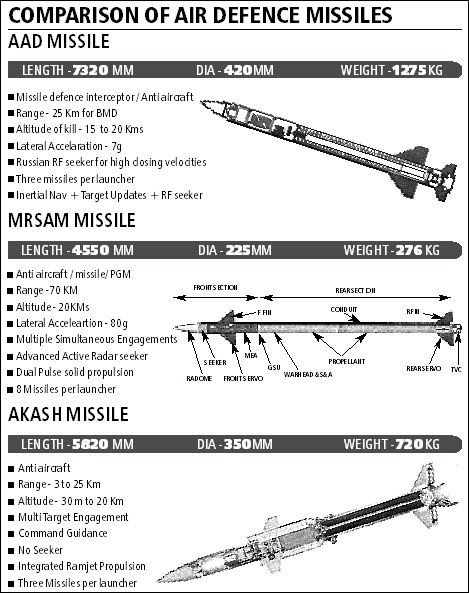
What a BS!!! The IE always tried to halt indigenous efforts with foreign sales. These lies are the latest edition to that. They are trying there best to downgrade the AAD. I am not against the MRSAM deal but they could modify the AAD as a potent air defence missile with Israeli help!
Facts about AAD:
1. It has 100 km+ range as a air defence missile according to Dr. Saraswat.
2. Altitude of kill is 30 km not 15-20 km.
3. As it is a hypersonic missile lateral acceleration is far more than 7g. Even if it is a BMD missile.
4. AAD has an indigenous Ka band active radar seeker not Russian one!
RajanMust read on how we are royally taken by US with Nuclear Deal
No more room for manoeuvre
Bharat KarnadA new coalition government assuming power after the general election will be shocked to find that its foreign and military policy manoeuvring space has been severely shrunk by the outgoing Congress party-led regime. Recovering Indian independence and initiative will require, in the main, wriggling out of the tight corner the country has been pushed into by the civilian nuclear cooperation deal with the US.
The nuclear deal which, according to ministry of external affairs insiders, took up fully 90% of Manmohan Singh’s time, proved beyond doubt the Prime Minister’s abysmal understanding of international power politics, which consists of sucking up to Washington at every turn. It explains why his government, for instance, refused to order a military response to 26/11. Singh apparently feared that doing so would lead Pakistan to redeploy its forces eastward, undermine the US strategy on Afghanistan-Pakistan and upset the US. But given that the US perceives its interests to be global, not upsetting Washington is a recipe for immobilizing Indian foreign and military policy.
Disregarding a hallowed foreign policy principle from Indira Gandhi’s time of abjuring treaties with the potential to hurt the country’s nuclear programme and limit its weapon options, Singh signed the nuclear deal. The 18 July 2005 joint statement and the subsequent enabling US law, the Henry J Hyde United States-India Atomic Energy Cooperation Act of 2006, make amply clear the American intention to use the bilateral agreements as legal device to shoehorn the heretofore untrammelled Indian nuclear programme into the non-proliferation treaty net (refer deputy secretary of state James Steinberg’s 24 March talk at the Brookings Institution).
Singh’s raison d’etre for the deal was his claim that it will help the country achieve “energy security”. A handful of us critics, including stalwart nuclear scientists P.K. Iyengar and A.N. Prasad, argued at length in our public writings why such and other claims were as fraudulent as Singh’s assertions in Parliament—which were belied by the safeguards agreement, that the deal secured for India recognition as a nuclear weapon state. Moreover, by agreeing in effect to forswear testing, he has ensured that the Indian deterrent will lack credibility because its most potent thermonuclear weapons are untested, unproven, and unreliable.Again, as forewarned, the deal that Singh hatched will be used by the radical non-proliferationists in the top posts in the Obama administration to squeeze this country. Instead of a free flow of civilian nuclear technology that the Prime Minister promised, India will be under the gun to sign the Comprehensive Test Ban Treaty (CTBT) and the Fissile Material Cutoff Treaty (FMCT) and, heedless of the Chinese strategic build-up, to square up on nuclear armaments with a strategically irrelevant Pakistan, a country with a gross domestic product that is less than one quarter of the market cap of the Bombay Stock Exchange.
Consider President Barack Obama’s appointees who will be shaping his India policy. At the steering wheel is the special adviser on non-proliferation at the White House, Robert J. Einhorn, a long-time opponent of India’s nuclear military programme, whose views are faithfully echoed by under secretary of state for non-proliferation and international security-designate Ellen O. Tauscher. Until she was picked for the job, Tauscher, a Democrat Congresswoman from California, was distinguished mainly by her toxic rants against nuclear India. Her priority, in line with Einhorn’s, is to compel India to sign the CTBT.
“Trying to stop Tauscher from getting” her way, writes her friend Joseph Cirincione, who heads the non-proliferation-minded Ploughshares Fund, would be “like trying to stop Sherman from marching to Atlanta”. For those not familiar with the US Civil War lore, this reference is to the Union Army Gen. William T. Sherman’s “march to the sea” through the rebellious southern states that destroyed the economic heartland of the Confederacy, including its biggest city, Atlanta, which was torched.
Tauscher, the “smash and burn” specialist who makes her predecessor John R. Bolton from the George W. Bush era look positively tame, will be at the diplomatic cutting edge, assisted by arms control expert Rose Gottmoeller, as assistant secretary of state for verification and compliance. Sharing a punitive mindset, these three will insist that India sign the CTBT, quickly agree to an FMCT and comply with every last provision in the Hyde Act, such as the “Obama Amendment”. This clause expressly prevents India from reasonably stockpiling uranium fuel for the lifetime of any imported reactors, rendering the reactors a dead investment and India hostage to behaviour that the US deems good. This Act also requires India to be in “congruence” with the US on Iran. If the current US attempts at a rapprochement with Tehran fail, this clause too will kick in. In short, the implementation of this Act in toto will entail a neutering of India.
Do you reckon any new coalition government will have the gall to stand up to the US and its enforcers, Messrs Einhorn, Tauscher and Gotmoeller? Because Singh, should he return as prime minister, has shown he doesn’t.
Bharat Karnad is a professor in national security studies at the Centre for Policy Research, New Delhi. Comments are welcome at [email]theirview@livemint.com[/email]
A better friendship with USA is in India’s interest, specially in 21st century. What India gained from the IAEA and NSG, other countries, except USA could not give us. But still we are not US’s ally or puppet, note that we have stronger relation with Russia and Iran!
About not attacking Pakistan after 26/11 is not related to US, actualy India was not ready. IA was not ready, GoI was not ready. Above all Pakistan is not a responsible nuke power, we yet to have a operational BMD. Now here it is not Indira Gandhi but Manmohan Singh! GoI failed India to flex her muscle and punish the terrorists! This govt is very very weak. No where near upto the mark…. 😮
RajanThe SM-2 & ESSM are larger, longer-range missiles than the Barak-NG & Barak-1. In physical performance, Barak-1 is more like RAM than ESSM.
I know that. I was talking about no of VLS on board two ships.
Scooter thanks for the info.
RajanAn Indian space shuttle takes shape
T.S. Subramanian
Reusable Launch Vehicle-Technology Demonstrator to fly within a year
— PHOTO: ISRO

An engineering model of the Indian space shuttle called “Reusable Launch Vehicle-Technology Demonstrator” at the Vikram Sarabhai Space Centre, Thiruvananthapuram.
CHENNAI: An Indian version of the space shuttle will be test-flown from the spaceport at Sriharikota in a year’s time. The Reusable Launch Vehicle-Technology Demonstrator (RLV-TD), as it is called, will be a combination rocket-aircraft: the aircraft with a winged body, which is the RLV, will sit vertically on the rocket.
The engineering model of the aircraft is ready at the Vikram Sarabhai Space Centre (VSSC) in Thiruvananthapuram. The first stage of the Satellite Launch Vehicle-3, flown in the early 1980s, will form the booster rocket. Weighing nine tonnes, it is called S-9.
After it takes off like a rocket, the booster will release the unmanned aircraft, which will go into space. At the end of the mission, the aircraft will land in the sea.
K. Radhakrishnan, Director, VSSC, said in an interview: “The next year we expect the prototype of the RLV-TD to be ready for flight-testing. This will be a milestone for ISRO.” The RLV “will open a new dimension in the launch vehicle technology and transportation system of ISRO.”
According to Dr. Radhakrishnan, ground testing of the booster rocket was done at Sriharikota in December 2008.
S. Ramakrishnan, Director (Projects), VSSC, explained how the rocket-aircraft would look: “The aircraft will stand over the rocket, nose-tip up, and its tail will be interfaced with the rocket. In other words, the entire RLV will stand vertically on top of the booster.” The engineering model of the prototype RLV was ready at the VSSC. “It will undergo various structural and load tests,” Mr. Ramakrishnan said.
The booster rocket will take the RLV to a specific altitude, release the RLV and fall into the sea. On re-entry into the earth’s atmosphere, the RLV will land in the sea, to be recovered.
“Re-entry, descent and recovery are the three issues which we are trying to understand,” Mr. Ramakrishnan said. But in the first trial-flight in 2010, the RLV will not be recovered from sea because it will not be cost-effective to do so. “But we will get the data on the re-entry, deceleration and return from the telemetry.”
There were several issues that the ISRO was trying to understand in the mission, Dr. Radhakrishnan said. These included the aerodynamics of the RLV, compared to the rocket, and the controllability of the vehicle. “The control system must be fast-acting. That is the basic challenge. The digital auto-pilot is important for the ascent phase and the descent phase.”
The third important challenge was the heat generated when the RLV re-entered the atmosphere. Dr. Radhakrishnan said: “You need to have hot structures [which can withstand the re-entry heat]… Today, we have a handle on the materials.”
The ISRO had a long way to go before it could build an operational RLV, he said. “This is the first TD towards that.”
http://www.hindu.com/2009/04/01/stories/2009040161821100.htm
This is from AI-2009….
http://img13.imageshack.us/img13/5893/rlvtdlauncherimg0032pr4.jpg
WT model….

RajanHelp me understand.
What is “passive” millimeter wave imaging?
An active seeker as on Brahmos, is by definition emitting, and the Brahmos is unlikely to be depending on opponent emissions to image a target!
I think this is a miss.
The passive millimeter-wave camera (PMC) is a second generation millimeter-wave (MMW) imaging system. I think they can use it just like active/passive seeker onboard other missiles for image/video generation via Brahmos. Note that Millimeter-Wave Imaging is used for terminal guidance of missiles. Brahmos is better with advanced algorithm ‘distinguish between similar kind of targets’. The PMC I mentioned because after 20th Jan failed test many news report mentioned about video feedback via Brahmos.
RajanThe Hobart class Destroyer’s are 6,250t, they are not 3,000t ships. While the design is that of the F100 class designed by Navantia, they will be built in Adelaide, South Australia.
Oh, and with ESSM quad packed into some of its VLS cells it is definately not going to have less firepower then the 6,800t Kolkata class destroyers in terms of its primary mission (AAW) though with 8 Harpoons it only carries half the number of SSM’s.
Hobart class has total 48 VLS for ESSM/SM-2 but the Kolkata class (P-15A) has 48 VLS for Barak-NG alone. It will be equipped with 32 Barak-1 point defense SAM as well as 16 Brahmos. But still the Hobart class costs two times more than P-15A. But the writer was comparing P-15B with Hobart class not P-15A. The P-15B will be equipped with long range LACM, I do not know how it will cost less than P-15A!!! He may be talking about the main ship body not the weapons and sensors.
RajanIs that a 76mm OTO Gun???:confused:
Yes, it is OtoMelara 76 mm Super Rapid Gun.
Navy’s destroyer project sets sail
Ajai Shukla / Mazagon Dock Ltd, Mumbai March 30, 2009, 23:49 IST
The Indian Navy’s firepower is going to be significantly boosted with the addition of four heavy warships. The navy’s design chief, Rear Admiral MK Badhwar, has confirmed for the first time, to Business Standard, that the Defence Acquisition Council (DAC) — the top procurement body in the Ministry of Defence (MoD) — has cleared Project 15-B, the construction of four 6800-tonne destroyers by Mazagon Dock Ltd, Mumbai (MDL).
There was no competitive bidding for Project 15-B, since MDL is the only Indian shipyard large enough to build destroyers, which are significantly larger than frigates. MDL is currently completing Project 15-A, the construction of three destroyers of the Kolkata Class; Project 15-B (the class has not been named yet) is a “follow-on project”, i.e. it is only incrementally different from Project 15-A.
Asked when manufacture will begin, Admiral Badhwar said, “The Indian Navy has asked MDL for a quotation. Once that is received, an MoD Contract Negotiation Committee (CNC) will negotiate a price with MDL for the four destroyers. After the price is agreed upon, the MoD will accord final sanction for the project.”
The navy intends to drive a hard bargain with MDL. Admiral Badhwar explains, “The three Kolkata class destroyers built under Project 15-A cost about Rs 3800 crore each, i.e. about Rs 11,000 crore. Project 15-B should logically be cheaper.”
At that price, Project 15-B will save more than a billion dollars per warship. Australia bought its F100 frigates (at 3,000 tonne, significantly smaller and more lightly armed than the destroyers that will be built under Project 15-B) from Spanish shipyard, Navantia, for the equivalent of Rs 9,000 crore per frigate.
Crucial to how cheaply, and how fast, Project 15-B can be built is the issue of how different these warships will be from their predecessors in the Kolkata Class Project 15-A. Project 15-A has taken longer than anticipated because it incorporated significant changes and upgrades from its predecessor, Project 15 (three Delhi Class destroyers). But Project 15-B, MDL hopes, will have fewer design challenges; it will differ from its predecessor only in weaponry and sensors.
Vice Admiral HS Malhi, chairman and managing director (CMD) of MDL explains, “If there are no major changes in Project 15-B, we can definitely cut down the build time. If the vendors can use the same manufacturing equipment, if the same drawings can be used, it makes a big difference. Standardisation is the key.”
Admiral Malhi points, as an example, to the US Navy’s DDG-51 programme, in which 62 destroyers have already been churned out with standardised hulls and propulsion systems.
MDL’s CMD points out, “If you have that kind of production line, the speed of building and the cost of building comes down dramatically.”
This is the Catch-22 situation facing Indian warship-building. The shipyards want larger orders of warships with standardised designs. But the Indian Navy has tended to place smaller orders of 3-4 ships; the navy says construction delays by the shipyards mean that designs get outdated by the time the ships are rolled out.
This impasse, however, appears to be dissolving. The design similarities between Projects 15-A (three destroyers) and 15-B (four destroyers) could effectively combine those into a combined seven-destroyer order. Similarly, Project 17-A is being planned as an order for seven stealth frigates.
MDL believes that, since Project 15-B is a follow on of the 15-A, the design and planning period will be less than 1½ years. Once the design is finalised, the navy wants the first destroyer to roll out within four years, with the others completed at one-year intervals. By that ambitious timeline, if the order is placed on MDL by end-2009, the first 15-B destroyer would be commissioned in mid-2015.
http://www.business-standard.com/india/news/navy%5Cs-destroyer-project-sets-sail/353456/
RajanThis is the actual press release from the official Indian PTI news agency:
http://www.ptinews.com/pti%5Cptisite.nsf/0/B38920E18A38B1BB65257589004A0EF8?OpenDocument
Bolded to show the original text – which also mentions “new sensor” – so hardware upgrade to the original seeker or new seeker by itself?
I think it is a new one, because the technology tells that the capability the Block-II version needs imaging/mapping technologies whether radar/IO/terrain. Also notes that after the first failure news sources mentioned something like ‘video feedback’ from the missile to the command center.
A BR member posted this interesting source about development of Passive Millimeter Wave Imaging by the DIAT.
http://www.diat.ac.in/achiev.htm
ACHIEVEMENTS
Past projects successfully completed
1.Design, Development and Performance Evaluation of Passively Q- Switched LASER Pumped Nd:YVO4 LASER.
2.Optical Fiber based precision measurement System for Industrial Application.
3.Design and Development of Micro-controller based Optical robot
4.Design and Development of Remote Setting Device for Underwater Mine.
5.Design and Development of fiber Optic Distributed Pressure Sensor.
6.Design and Development of Fiber Optic Gyroscope.
7.Fiber Optic Multi parameter Sensor for Aircraft flight Control system
8.Software to Estimate Environmental Changes.
9.Passive Millimeter Wave Imaging Passive Millimeter.
10.Multispectral Classification Algorithm
11.Target Detection
12.CW CO2 Laser
RajanMore pics of the INS Shivalik…
Col Ajai Shukla
http://ajaishukla.blogspot.com/2009/03/some-more-pictures-of-ins-shivalik.html


 Sign In







