 Rajan
RajanYeah, and he has the cheekt to post something like that and add “no flames”, what did he expect, if we posted something similar regarding Indian missiles we would have had all of them crying…..
I didnt posted any anti-pak statement, i commented some truth. Neither from India. GS,FAS, Armscontrol are not Indian site……. 😀
if we posted something similar regarding Indian missiles we would have had all of them crying….
yeah. please post……… 😀 😀 😀
RajanPakistan
http://www.armscontrol.org/factsheets/missiles.asp
Hatf-1 Operational 80-100 km/500 kg Domestic Production
Hatf-2 Tested/Developement 190 km/500 kg Domestic/China
Hatf-3 (Ghaznavi) Tested/Development 280 km/500 kg Domestic/China
Tarmuk Development 300 km/800 kg Domestic/China
Haider-1 Development 350 km/? kg Domestic Production
Shaheen-1 Tested/Development 750 km/500 kg Domestic/China
Ghauri-1 (Nodong-1) Tested/Development 1,300+ km/700 kg Domestic/N. Korea
Ghauri-2 Tested/Development 2,300 km/700 kg Domestic/N. Korea
Shaheen-2 Development 2,500 km/1,000 kg Domestic/China
Ghauri-3 Engine Tested/Devlpm’t 3,000 km/? kg Domestic/N. Korea
RajanGlobal Security, FAS, Arms Control and many sources said that Pakistan’s Nuclear tech is chinese & missiles are NK/Chinese.
RajanIndia, Russia negotiate partnership for a new missile
NEW DELHI, MAR 2 (PTI)
After their recent success in developing a supersonic cruise missile, Brahmos, India and Russia are negotiating a partnership for developing an ultra long range beyond-visual-range air to air missile.
The missile is at present being developed by the Russian guided weapons builder Novator and highly placed sources here indicated that India was involved in the project by way of investment and technical participation.
The missile, designated so far as R-172, is being developed by the Russians to be integrated with the fifth generation aircraft SU-35, with New Delhi likely to be a customer for its export version.
The new missle, the sources said, was aimed at engaging high asset airborne targets such as AWACS aircraft, air to ground surveillance and mid air refullers, which normally operate from stand off distance during battles.
The proposed acquisition assumes significance in the wake of recent media reports that Pakistan was in the process of purchasing such a missile from western countries to counter India’s moves to acquire Israeli AWACS and the recent induction of Uzbek IL-78 mid-air refuellers by the Indian Air Force.
The Defence Research and Development Organisation (DRDO) is also currently developing a beyond-visual-range air to air Missile Astra. The DRDO Chief Dr V K Atre recently told PTI that the missile was still in technology demonstrator stage and no tests had been undertaken of the new missile.
Meanwhile, after undergoing six highly-successfull flight tests since mid 2001, the naval version of the 290 kms range Brahmos missile has been approved for installation on all surface warships of the Navy.
Defence Minister George Fernandes recently said that the Brahmos naval version had achieved all mission objectives and had been cleared for placement as a major weapon system on all surface warships.
Facilities for production of Brahmos have already been set up at Bharat Dynamics in Hyderabad and the first of the naval ships would be armed with the missiles within the next three months by joint teams of Russian and Indian experts, officials said.
The air-breathing Brahmos anti-ship missile is powered by a liquid Ramjet engine, has a maximum speed of Mach 2.8 and can carry a warhead of upto 300 kgs to a distance of 300 kms.
The DRDO, along with full-fledged trials of the Naval version of the missile, have quietly also undertaken some trials for the land based version of the missile, which is to be mounted on specially modified Tetra Chasis.
DRDO sources said that the land version of the missile could be ready for induction into the army by another 15 months after undertaking user trials.
The air force is also gearing for the missile with modifications, which is planned to be integrated with the SU-30mki. However, scientists said that this programme could take upto 30 months.
RajanAFTER BRAHMOS MORE COLLABORATIONS?
An IDC Analysis with inputs by Sayan Majumdar
New Delhi, 12 April 2004
The BrahMos collaboration came about when the Russians realized they had rupees lying in India, which they may not be able to repatriate after 2005. The Indian Navy and DRDO identified the Yakhont missile as suitable for future missions and as an excellent tri service and under water missile with potential.
Hence instead of merely importing the missiles from NPO Mash, a joint stock company was formed with joint investment from India via DRDO and Russia via their funds in India. In this manner BrahMos Aerospace could import missiles, equipment and personnel from Russia and the Russians got their rupees out as payment in dollars and their investment in India remained intact.
This example needs to be emulated for future requirements as well, for example the fast firing 30mm AK-630M-MR-123-02 guns and AA/Air Defence Artillery Systems for the three services. The Ordnance Factory Board can very well follow the example of BrahMos Aerospace and even Larsen and Tubro, which is looking to make Amur Class submarines in India, can investigate a similar arrangement.
Sayan Majumdar reports that after successful joint-development of the BrahMos ASCM (anti-ship cruise missile) the Indo-Russian scientists and defence manufacturers had again teamed up to resurrect the formidable Russian Novator KS-172 ultra-long-range AAM (air-to-air missile) project. Novator design bureau unveiled its mock-up KS-172 AAM, a projected 6 metre long, 750 kg, 400 km range AAM in early 1993 at an air-show in Abu Dhabi. It also made a short and sudden appearance at the Moscow Air-Show in late 1993, in anticipation of a very high-level military delegation.
The mock-up of the KS-172 underwent refinement and in the Moscow Air-Show appeared in many ways similar to the Buk (SA-11 Gadfly) SAM (surface-to-air Missile). Russian officials later hinted that air-carriage tests of SAMs had been carried out using a Sukhoi-27 “Flanker”. They were speculated to be SA-11s by foreign media used for form-and-fit tests.
Designed to fulfill the BVR (beyond visual range) role for “outer-air battles”, an aircraft usually of Sukhoi-27/30/35/37 “Flanker/Super Flanker” family, equipped with KS-172 (also referred to as Article 172) would be able to engage ultra-high-value airborne platforms like AWACS (airborne warning and control system), IFR (in-flight refuelling) and LRMP (long range maritime patrol) platforms, without necessarily having first to deal with their fighter escorts. Development of powerful radar like the formidable NIIP N-011M “Bars” (Snow Leopard) for the Sukhoi-30MKI “Super Flanker” of the IAF, would provide the necessary guidance to the ultra-long-range AAM. The Bars radar is capable of detection of airborne platforms with “generous” RCS (radar cross section) at ranges in excess of 300 km.
It is possible that an optimum combination of command, inertial and active-radar guidance would be used in the various phases of flight. Whereas IFF (identification friend or foe) remains a problem because of incorrect and absent returns and “spoofing”, friendly AWACS platforms like Phalcon may be deployed for reconfirmation of enemy airborne targets at extended ranges. In the long term, development of Electro-optical seeker technology coupled with on-board threat database will let the KS-172 missiles themselves determine the legitimacy of a target.
Thus IAF Sukhoi-30MKI armed with KS-172 could be launched in co-ordination with other surface-strike missions and split at an appropriate time to head for the enemy AWACS. They could penetrate from above the scan zone of the AWACS, destroy or threaten it and force a retreat in the patrol pattern. Alternatively, Sukhoi-30MKIs could be guided by Phalcon AWACS platforms to enter hostile airspace at the altitude of the enemy AWACS at high-supersonic speeds and shoot it down.
The timing of such missions is critical and therefore should be launched when the enemy AWACS was about to take up a patrol. The objective would be to attain AWACS asymmetry in our favour as soon as possible and then decimate the enemy Air Force mercilessly.
For anti-AWACS missions two other missile systems are worth mentioning and Indo-Russian cooperation should also extend in these spheres. First is the hybrid rocket-ramjet propelled Vympel R-77M, a 3.6m long development of the R-77RVV-AE (AA-12 Adder) AAM with a projected range of 160 to 200 km with similar optimum combination of command, inertial and active-radar guidance. Second is an AAM version of Zvezhda Kh-37 (AS-17 Krypton) ARM (anti-radiation missile) with 100 km range, which employs passive homing against AWACS targets. This system is rumoured to be present in the Russian Air Force inventory.
KS-172 may also be developed into an ASAT (anti-satellite) weapon. The Sukhoi-30 in this case serves as the launch platform at high altitude while missile guidance is provided from ground stations.
-INDIA DEFENCE CONSULTANTS
RajanAn old but good news
India Develops ‘Silent’ Radar
Bangalore: India has developed a low-probability intercept radar that cannot be detected by an incoming aircraft and can escape from an anti-radiation missile attack.
The radar for naval applications has been developed by scientists of the defence PSU Bharat Electronics Limited (BEL).
“This radar is one which is protecting itself by not allowing the incoming aircraft to detect its presence,” BEL’s chairman and managing director V K Koshy told newspapers here on Wednesday.
This is different in the sense that a normal radar sends out a warning to incoming aircraft that it is being tracked, he pointed out. “The low probability intercept radar developed by BEL does the radiation in a special way at a very low level of power,” Koshy said.
Dubbed as a “silent radar”, it can be saved from anti-radiation missile attack by the aircraft since it cannot be detected by the aircraft, he noted.
According to Koshy, the main features of the new radar, are: nil personal hazard, high resolution, fully solid state and low power consumption.
BEL has also developed a handheld secure radio, as well as digital satellite news gathering system to provide live news coverage, he added.
Courtesy: The Times of India, April 17, 2003
RajanIndia, Russia to collaborate in cutting edge defence projects
19.24 IST 17th July 2004
By IndiaExpress Bureau
In tune with growing collaborations among western nations in defence sector, India and Russia are on the path to jointly work in cutting edge defence projects, Indian Ambassador to Moscow, Krishnan Raghunath, said.
“The principle has been established and we have a future,” Raghunath said in an interview published by ‘Indian Defence Review’ (IDR) quarterly in its latest issue.
“Certain areas in the defence sector for further R and D are being discussed with India,” he affirmed.
Raghunath also dispelled notions that discussions on jointly developing the fifth generation fighter were taking inordinately long.
He gave the example of the first Indo-Russian collaboration in cutting edge technology, the supersonic Brahmos missile. Work on developing the missile started in 1995 and the first test took place only after six years.
“Building a futuristic fighter aircraft is not only complex but costly as well. These things take time,” he observed.
Ambassador Raghunath, who is completing his three-year stint in Moscow next month, pointed out that Indo-Russian defence partnership was in tune with the growing trend of collaborations among western countries on major defence projects.
He gave the example of eight western nations jointly developing the fifth generation Joint Strike Fighter. Russia is similarly reaching out and is collaborating with the French to develop the MiG advanced trainer.
RajanDefense News
June 7, 2004
India’s New Naval Ambition
Plan for Blue-Water Force Includes Ballistic Missile Sub
By Vivek Raghuvanshi, New Delhi
India also is building its own nuclear submarine, the Advanced Technology Vessel (ATV), and now expects to roll it out by the end of 2005, two years earlier than originally planned.
The submarine is the result of a classified, $1.5 billion program run by the Navy, the state-owned Defence Research and Development Organisation, and the state nuclear research agency, Bhaba Atomic Research Centre.
Either the Akulas or the ATV could be used as missile boats, Slade said. The ATV is based on Russia’s Cold War-era Charlie-class nuclear-powered cruise missile sub, with eight vertical launching tubes. India leased a Charlie-class boat from Russia between 1988 and 1991.
“Akula originally was intended as a cruise missile carrier, but was redesigned for attack,” Slade said. “But it has 26-inch diameter torpedo tubes that could be used to launch missiles. Rough calculations indicate that the Indians might be able to get five or six missiles of six to seven hundred mile range on an Akula.”
With that kind of range, Slade said, India could strike about 80 percent of what it would consider a target in China.
Indian vs. Chinese Subs
“From a military perspective, it’s a long way from India to Northern China. But it’s not a long way from the North China Sea to Northern China.”
The expansion of the Indian Navy comes as China also presses ahead with a major naval modernization effort that includes new nuclear attack and ballistic missiles submarines, analysts said.
“The Chinese submarines aren’t very good,” Slade said. “The five Han-class attack subs represent a very early level of nuclear submarine technology. They are dangerous, extraordinarily noisy, not well armed, and their sensors are primitive and limited. They have one boomer, the Xia, but it’s not entirely clear what its status is.”
The Xia is not very good, Slade and other analysts said, in large part because it’s a Han attack boat that has been crudely increased in size by cutting it in half and welding in a 12-missile section.
“It has the same flaws as the Han, only louder,” Slade said. “Two new classes of sub are coming down the road, one a hunter killer, the Project 093, that may be based on a Russian design, and the Project 094, a missile sub that is a 093 with a missile compartment added.”
China’s diesel submarine force is of either the antiquated Romeo type, or derivatives with only a handful of more modern Kilo boats.
“The Indians have a more modern force with their four German Type 1500s and eight, with two more coming, Russian Kilos,” Slade said. “It’s more modern, and if the Indians get the two Akulas they want, they should be able to clean the Chinese clock.”
RajanRussian N-sub by 2006 likely
Srinjoy Chowdhury
in New Delhi
May 31. — The Indian Navy is likely to acquire a Russian nuclear-submarine in two years with the final decision on the deal, being negotiated for the last four years, having been taken earlier this year.
The Akula class nuclear-powered submarine is a high-performance vessel and having one will give the Navy an incredible boost, taking it into the big league. The Russians have agreed to give India one of the newly-commissioned N-submarines for about a decade.
Asked about the acquisition of the nuclear-submarine, the defence ministry today declined to comment. High-level defence sources separately confirmed that the decision was taken at around the same time the deal on the Admiral Gorshkov aircraft carrier, also acquired from the Russians, early this year. No announcement was made and an official said the Russians wanted India to be quiet about it.
Initially, the Russians were keen on giving India an earlier vessel, but later it was decided that the Navy would get a newer submarine. The inter-governmental agreement for the Akula was signed about four years ago. Officials are tight-lipped about the price of the lease (a N-submarine cannot be bought or sold), but according to sources, the initial offer was for about Rs 1,700 crore.
For the Russians, the three deals — for the Gorshkov, the Akula and the lease on four Tu-22 long-range reconnaissance aircraft — were in a sense part of a package. The deal for the aircraft is yet to through.
India had leased a N-powered submarine from Russia — the INS Chakra — in the Eighties, but now the crew would have to be trained on this vessel. Naval officers are tight-lipped about training schedules.
In Russia, the Akula-class submarines are called the Bars Class. In India, it could be called the Project I. The first Akulas were built in the mid-Eighties but the newer ones have a more silent signature, meaning they are more difficult to track down. India has started work on a N-submarine in a Larsen and Toubro yard. They could be ready in four-five years. The Akula can carry deadly long-range cruise missiles. They are accurate and have strategic value. They also have anti-ship missiles and torpedoes.
http://thestatesman.net/page.arcview.php?clid=2&id=72872&usrsess=1
RajanLCA has been in development for more than 20 years and even if it is a great success for Indian Aerospace Industry, its configuration is obsolete even now.. tailless delta configuration with no canards was new in the 60s, when Mirage III came out, buddy…
Then why F-16XL aero dynamics is very similar to LCA?
Aero Dynamics of LCA
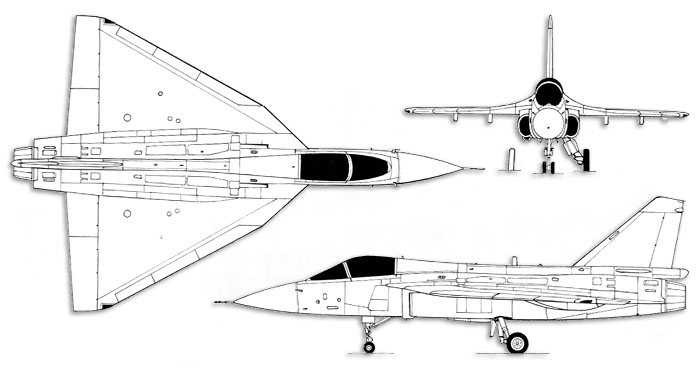
LCA aerodynamic configuration has been evolved to meet the demands of modern combat. Extensive wind tunnel testing on scale models and complex computational fluid dynamic analyses have optimised the aerodynamic configuration of LCA, giving it minimum supersonic drag, low wing loading and high rates of roll & pitch.
The tailless compound delta planform helps in keeping LCA small and light. It also means fewer control surfaces, wider choice of external stores and better close combat, high-speed and high-alpha characteristics.
LCA has been designed to be unstable. Relaxed static stability gives improved aerodynamic efficiency and enhanced agility and manoeuvrability.
The wing shielded side mounted bifurcated Y-duct air intake with optimised diverter configuration ensures buzz free air supply to the engine, at acceptable distortion levels.
A number of aerodynamic devices have been developed to further improve aerodynamic efficiency, excellent flight performance, safety, damage-tolerant design, reliability and maintainability of LCA.
RajanNLCA Features

RajanLCA cockpit : looks like spacecraft

RajanRemain options for Pakistan (after F-16 from USA, Mirage from France, old F-16 from Belgium, Gripen from Sweden)
one after another…………………….
1.Rafale
2.EF Typhoon
3. F22 Raptor
4. JSF
5. X-43
atlast the best ac in the world J-10, J-10A, J-10B etc etc
and also J-XX, J-12, J-14 & Dingdong ac from North Korea.
GO PAKISTAN GO!!!!!!!!!!!!!!!!!!
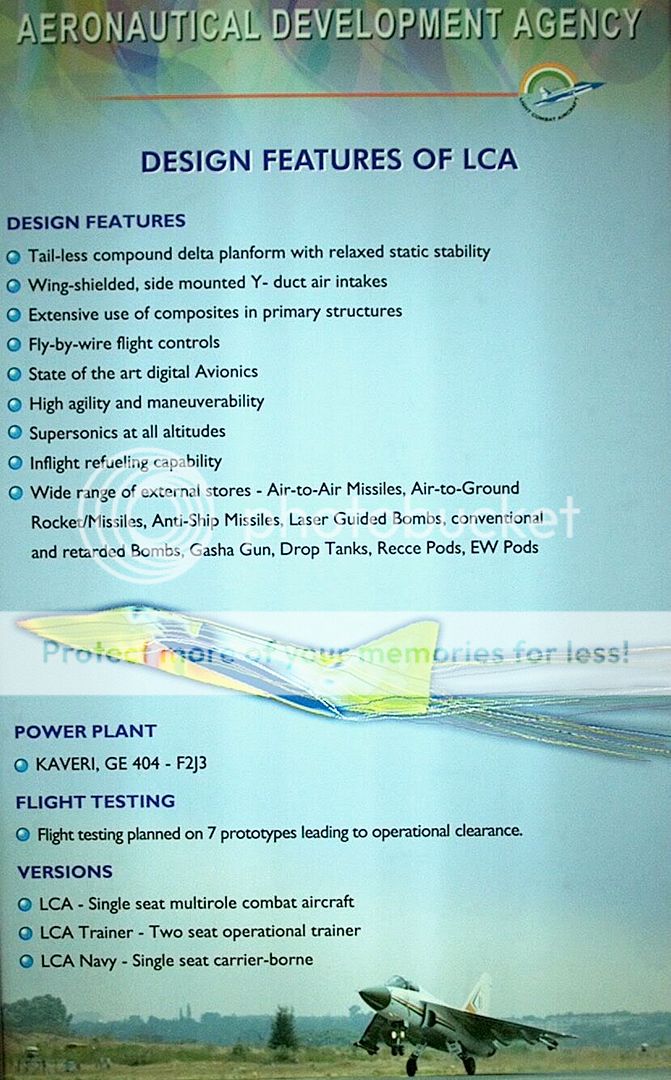
RajanDESIGN FEATURES OF LCA
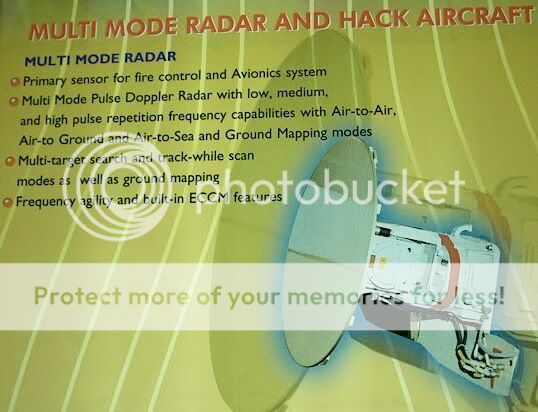
RajanLCA Radar :


 Sign In







