 fatnav
I was lucky enough to do my first tour on the PR.9 and preferred the position in the 9 to other marks of Canberra, and I have time on eight marks. Yes visibility was more restricted than lying in the nose of the PR.7, for example, but it was very useable. For survey work the downward looking Recce sight was superb. The ability to accurately measure drift was very useful, particularly if the Doppler unlocked. The feeling of having all of the nav kit available at all times was extremely helpful and you had the confidence of always being strapped in to Martin Baker. All in all an excellent solution.
fatnavGetting back to the original question, Air Gunners could fill either position. Talking to a friend who was a Gunner on 460 Sqn, he changed positions on a regular basis. Whilst many crews flew almost unchanged and therefor tended to stay in the one position, others changed crews for a variety of reasons and filled whichever position was required. In my friend’s case his nominal crew pilot broke a leg, and his crew filled in on other crews for a couple of months.
fatnavAs a comparative youngster I was converting onto the Canberra at Cottesmore in 1972. One of the nav instructors told me he was one of the navs used flying the Lancs in the film, and, though he enjoyed the flying, said what a tight fisted outfit the producers were. As a thanks to the real aircrew involved they put on a barrel of beer in the Officer’s mess at Hemeswell. This was because the Mess at Scampton had changed, and they used clips from this party in the film itself.
fatnavI remember Seletar as an enthusiast’s paradise in 74 & 75. Six week detachments to Tengah gave plenty of time to get to Seletar to be rewarded with USAF aircraft such as EC-47P and C-130s various. There were a couple of South Vietnamese Hercs in ’74, but these had been re-painted in USAF colours by ’75. Civilian? aircraft included a DC-6 of Bird Air and C-46Rs of Continental Airways, both known Air America operators. Genuine civilian aircraft included a HU-16 and Volpar Turboliner in Indonesian marks among others. To be allowed to wander around without hindrance was a real joy.
fatnavThe original markings of the Singapore armed forces was a red/ white/red roundel, the same as Peru. This was in use in Singapore in January 1974, but had been replaced by the current styalised ‘S’ by the summer of 1975.
fatnavThanks for airing this BeefyBoy. I was a back-seater on 16 on Red Flag in 78.
Hadn’t seen this before, but it sure brought bacik some great memories.
fatnavTo add to comments about my choice being the F-14, it was seemed more agile than the F-15 with its variable geometry as well as having the advantage of a two man crew. Certainly if we got an F-15 180 degrees out at low level we did not see it again, not the case with the Tomcat.
As far as the F-4 is concerned it had a dreadful turning performance for a fighter. As an interceptor against long range bombers it was a good platform, as is the F.3 but they are not fighters I would like to fly in close combat conditions.
fatnavHaving flown against the F-14 & F-15 on Red Flag (on Buccs), and against the F-4 & F-16 on the ACMI (on Hawks) there is no question in my mind, it has to be the F-14…..AWESOME.
fatnavavpin starts
My favourite story of using Avpin involves the Canberra PR.9….yes she used avpin too. When transitting through airfields that were not used to the PR.9 it was common practice for the Nav to stay outside the aircraft on start-up in case of an avpin malfunction or wet start….i.e. no light up.
It was in 1973 and we were staging back to Wyton from Akrotiri. With the standard westerly jetstream across the Med we needed to refuel en-route and as Malta was closed to us at the time we used Istes, the French equivalent of Boscombe Down. Sure enough on trying to start the port engine we had a wet start. The method was to wait for 30 seconds or so and then use a piece of kitchen roll or something similar to wipe away the excess avpin from the drain hole to reduce the risk of that igniting on the second start. The other thing was to hit the leading edge of the wing, between the engine and the fuselage which was where the avpin tank was, to get rid of any air bubbles. I went to a French ground crewman who was watching this performance and borrowed a large monkey wrench from him. Using this I went and applied a few good thumps to the leading edge, then bingo she started beautifully. Surprise surprise the starboard had a wet start also and the pantomine performance was repeated before that too lit up.
A rather perplexed Frenchman was given back his monkey wrench before I climbed into the nose and we departed. I often wonder at his subsequent conversations on how the mad Anglais start their engines.
fatnavAs a baby nav who graduated from Nav School with a provisional posting to Victor Tankers, I would have to nominate the V bombers. Why…pity the poor rear crew who were sat in a black hole, facing backwards and without the insurance of Martin Baker.
fatnavThis effort has to be applauded. As the former chairman of the Pembrokeshire Aviation Society I cannot emphasise enough how much the Sunderland and this recovery means to the local population. There are still visits to PB as it was known by many who served on flying boats various and it would be a fitting memorial to have a real Sunderland on display. Moves are on hand to try to obtain one of the old PB hangars to display the many artifacts already preserved.
I can thoroughly recommend anyone visiting the area to visit the old gun fort museum at Pembroke Dock where there is much to interest the aviation historian including the engine recovered from the Sunderland to date.
fatnavI have two aged programmes from my schooldays that really started my love affair with aviation.
The first is from RAAF Mallala in Sep 1956 where the highlight for me was the Co-ordinated mock attack on a Lincoln by two Mustangs.
The second was Farnborough 1957, shortly after my arrival back in the UK, when my highlights were theEnglish Electric P.1B AND THE Saunders-Roe S-R.53.
Happy memories.
fatnavAs someone who had the trial of having been carried from Tengah (Singapore) back to Brize with just the refuelling stops (and change of flight crew) I was heartily glad that the Belfast was retired and that I was not likely to have to experience it again. It was not only slow, but had an amazingly complex undercarriage retraction system that was often going wrong.
There was also the famous story of a Belfast crew missing their half hourly radio check whilst on a long overwater stage who when checked on replied ‘All okay, steaming slowly south easterly, no sign of scurvy on board.’
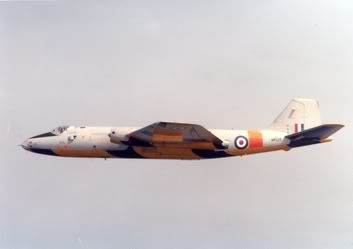
fatnavJust for Les B
Thought you needed cheering up after slipping a Canberra shot in with Thunderbirds.
fatnavWell done Glanini, it is indeed a C-47 of the short lived South Arabian Federation (as it was called after Aden was given independence and before it was overthrown internally to become South Yemen). It was photographed at Hurn shortly before delivery in Sep 67.


 Sign In







