 Vetinari
С Днем победы!
The aviation part of the Victory Day:
http://www.youtube.com/watch?v=5-h8ulL8MuI
http://www.youtube.com/watch?v=CAU4LLzTnxc
VetinariThe only Russian engineer that was involved for sure with the development of PAK-FA and is a forum poster works at KnAAPO and seems pretty confident (even proud and happy) with the design of the airplane and has never complained about anything significant. Unforutnately, he has never stated anything concrete about the airplane either, only information that has been already declassified.
VetinariTopol-M night launch:
http://www.youtube.com/watch?v=QIzXI-mlJjs
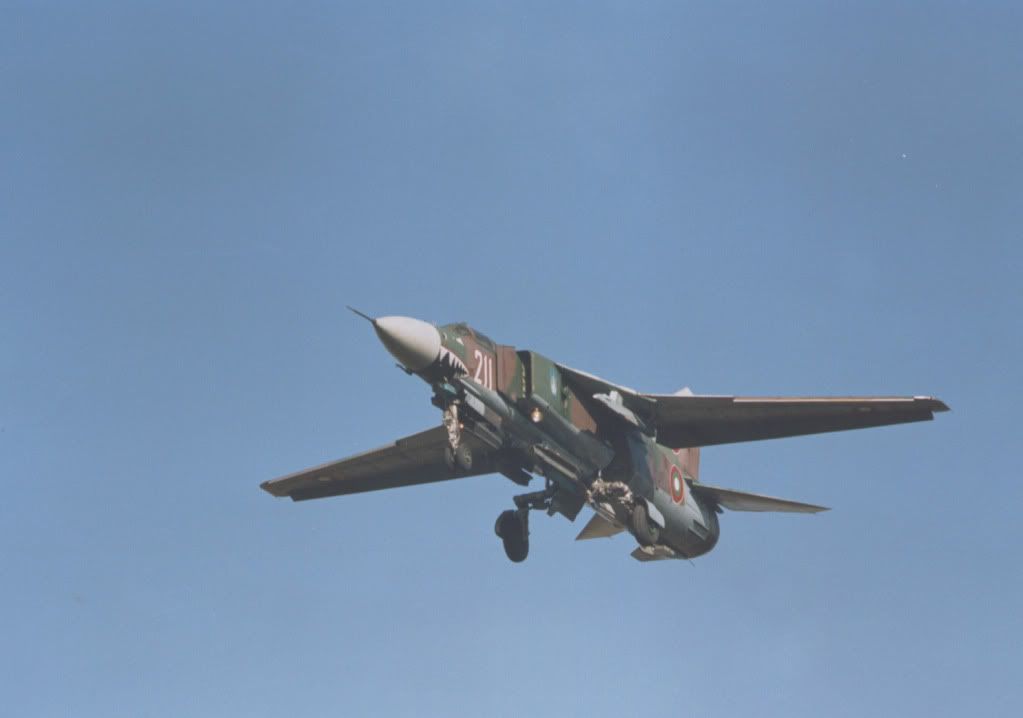
VetinariFrom my information 204 and 219 went to the Ivory Coast along with 2 Mi-24D. There is a rumor that 219 was the very last MiG-23MLD assembled.
flex, if you are interested in pictures of Bulgarian 23s – see this link:
http://www.airgroup2000.com/forum/viewtopic.php?t=2360&start=1065
VetinariI just tried – after a bit in several other forums + my own thoughts – a first summary of details (some are already mentioned here):
1. The cockpit-canopy reminds my very much (like the T-50 at all) of the YF-23 -but there seems to be a strange middle frame..
Andi
The canopy will be f-22 style, no frames. A few months ago there was some leaked documentationon the net about the bid contract. I think it should be ready by this year’s end or something.
VetinariBefore suhkoi.ru got nuked, there was some info that the first pictures will appear in something like 3 hours. Although, seriously, isn’t there at least ONE person in the whole city who is standing with a camera, laptop, and internet on a rooftop? Why are the FSB so efficient? The bird is safely back, but those guys in Russia just have to keep torturing us for a few more hours…
VetinariIt has landed.
VetinariThe first flight will be on the 29 January.
Первый полет ПАКФА состоится 29 января
Отраслевые источники российской оборонной промышленности сообщили, что первый полет истребителя «Сухой» Т-50 (ПАКФА) может произойти в период до следующей пятницы, 29 января.
В декабре 2009 года самолет был доставлен на аэродром КНААПО для испытаний и уже проведены наземные пробежки, где испытывались система управления, тормоза и другие элементы. Любопытно, что прототип был доставлен в КНААПО на дальний восток России, хотя традиционно первые полеты прототипов самолетов с 30-х годов прошлого века традиционно проводились на испытательном аэродроме в Жуковском под Москвой.
«Передачу» самолета в КНААПО можно расценить как стремление скрыть прототип от глаз мировой прессы, по крайней мере, во время первых полетов.
На сегодняшний день, несмотря на многочисленные спекуляции со внешним видом истребителя, не существует ни одной достоверной фотографии Т-50, нет даже изображения макета самолета.
VetinariThey had the early Soviet version of AEGIS – the Mars-Passat phased array on the Gorshkov (it is also on Kuznetsov), but as far as I know they never had it working properly. So now it will be removed from Gorshkov and replaced with something else, probably the Fregat series?
The sonar was also removed, I think I have seen pictures showing that its dome is now empty.
VetinariThe closed cities are not that closed any more, and you should keep in mind the fact that from the shore one can also spot a SSBN going out of the bay. Members of submarine crews appear from time to time on russian forums for example. Today’s communications give countless abilities to track people.
As far as silencing submarines go, you should keep in mind that:
1. The military is not about sending lone warriors with golden swords against hordes of dragons. Duels sound great, but I don’t think there is much of that idea. It is a game of coordination, tactics, teamplay, and quite often numbers and brute force. When one wants to get a submarine away from a base undetected, he could create quite a lot of acoustic chaos and support the submarine in the ways I already explained . And he would always have more resources than the few SSN’s in front of the base.
2. There are active sonars beside passive ones, and submarine warfare (and every warfare) is not about keeping all your units quiet and silent like in a movie. There’s no shame in sending 971s with active sonar to search the area or Delta’s that you know will be detected. The US subs will know that there is a 971 out there, but it doesn’t matter as long as the strategic asset on patrol (SSBN) remains hidden. Note that the range of the active sonar is much greater than that of the passive, and the US/UK subs do not have the option of using them.
3. From most wars there is the general conclusion that a 10-20-30% advantage of an enemy in some technical aspects is of no significant strategic advantage if the opponent could keep the initiative and have the better tactics. The Delta IVs may not be the most silent submarines out there, but they are pretty advanced and half of them have just passed mid life overhaul/upgrade. If properly employed, you will be in real throuble if ypu try to detect one while it is out on patrol (especially if it managed to slip undetected from the port). The Arctic Ocean is rather huge and you have half of the ice in the world cracking around you + an enemy with great understanding of the surrounding hydrological conditions.
4. Which brings us to the next point – no matter how advanced your sonar is, in the proper combination of water currents you could be practically blind while on passive sonar.
5. The next point is “do the russians really want to be undetected most of the time”. You know, it could be great training and gathering of technical data if you can arrange for one of you old and completely studied SSBNs to be followed by the new state-of-the-art american submarine. Submarine patrols are a game, and the game could have many more objectives than a mere “stay undetected”. The situation is not boolean 0/1 lost/won.
As far as French and British submarines go – the chances for two SSBNs hitting accidently each other are even smaller than two sattellites flying into each other, and I think that fortune this month has been already generous.
You do not expect anyone from the French or British navy to admit that they were following the other side or playing a game of cat and mouse, now do you? We didn’t even knew anything happened out there for 2 weeks, and I can bet that the only first-hand witnesses already have signed declarations not to tell the press anything. At this moment, we do not know ANYTHING about what happened.
VetinariWell, detecting that a submarine is on a long patrol isn’t that difficult. Besides sattellites you need just one person in the entire city, internet access, and a basic idea who is in the crew of which submarine (a rather easy task in a relatively small city and given the fact that people tend to take photos in front of their subs). You can also try to monitor internet activity of the crew and their relatives (this is even easier and cheaper). Also, submarines returning from a long patrol are welcomed by their relatives (which could be a sizeable crowd). Thus, detecting that a submarine was on a patrol is NOT a difficult task.
As far as tracking the submarine by using a Virginia/Sea Wolf/Los Angelis – I can bet that it is not easy given the fact that the russians will know much better the hydrological conditions in the area, have the support of underwater microphones, probably an ASW ship or two, an attack submarine using an active sonar to check the area in front of the base, ASW aircraft, active decoys and so on (we are not even mentioning the tactical ideas on how to get the sub out of the base – you can even send 3 SSBNs out and then have two of them return on the next day).
Keep in mind the fact that Sea Wolf may be silent, but not undetectable. A person on a russian forum who probably knows much more about their navy than any of us here stated a specific occasion when the North Fleet tracked a Sea Wolf.
VetinariAfter a report of a state comission on Saturday on the condition of Admiral Nakhimov, now it is almost certain that after 5 more years and an extensive and costly modernization the cruiser will join the Russan Navy.
VetinariI would just like to point out once again that the AMRAAM is not a magical weapon, as far as I remember they had 3 or 4 of them fired against MiG-29s in Serbia in order to bring down one airplane. And this happened given the fact that the opponent had no ECM whatsoever, no radar, almost no GCI support, and RWR that was not always functioning => no chaff. All that against an attack from multiple directions (the attackers having the advantage of high altitude and thus more energy for the missiles) with AWACS support. I can’t imagine an easier target.
In any large-scale engagement between F-35 and Su-35BM/Rafale/Typhoon on relatively equal terms, I would not rely on 4 AMRAAMs only. Given that you will probably have to fire 2 missiles per target or go for single missile/single target, the success rate won’t be high. You should consider the fact that once you are left with 1 missile or no missiles at all, you need to get out of the situation fast. This means that the BVR engagement (we assume that the F-35s will have the first shot, given better stealth) will not start at close ranges, as the F-35s would have to risk running into a dogfight with the surviving enemy planes without having anything to shoot at them. One should mind the fact that once detected, the F-35 will be chased by the enemy, and supercruising won’t help that much at short dashes when the enemy uses their afterburners and his radar is scanning the back of your aircraft (no stealth). This means that the AMRAAMs will have to fly further, which increases time for detection/reaction/countermeasures. The opponent’s airplanes will have time to try and outmanuever/bleed the energy out of the missiles. Also, complex ECM could be employed easily within a formation of aircraft. I know how great “home on JAM” sounds like, but the opposing aircaft could use a relatively loose formation while constantly changing the number and position of aircraft that are activating their ECM (could be done on automatically). For example, if you are effectively jamming the incoming AMRAAMs from the left of your formation, the missiles will turn towards it. Then you switch to employing ECM from the right of the formation, forcing the missiles to make a turn and so on. Here I do not even count the possibility that some of the enemy fighters have dedicated ECM pods or that there are dedicated aircraft trailing the fighter formation and providing additional ECM support.
Thus, I can’t see how an F-35 with 4 AMRAAMs could score more than one kill against a relatively sophisticated enemy, and this is done given the fact that the enemy airplanes are twice or four times cheaper than yours. Also, they carry more missiles, so even a few survivors with R-73/4 or ASRAAMs could mangle your F-35s when they have ran out of missiles.
VetinariAs for why russian shipbuilding programs face delays – this has more to do with inadequate funding and subsystems being not ready. For example, there is no need to hurry with the second 20380 corvette because the surface to air missile complex (with 9M96) is still not ready, it is much easier to wait for it rather than try to plug it into a completely finished vessel. For tests of propulsion systems and so on – you have the first 20380.
I think that the case with the 22350 is almost the same, the SAM system is not quite ready.
The 955 program is the same – you have no missiles for the boat, why complete it? The Bark failed and the Bulava is also late, so there is no need to have the boat anchored for N years waiting for the missiles. It has been said that progress on the second submarine of the class is actually quite fast, and somewhere I read that the hull is almost ready.
VetinariI wonder if the Russians would be interested in the not-so-far future in integrating a more “ground-like” version of the S-400/500 system on their ships. It would easily rival if not exceed anything anyone would be fielding in service, especially with improvements to the current design.
They are actually designing such a system, it is called Poliment (also a ground variant which is S-400’s little brother – it can use only 9M96E1 and 9M96E2 missiles and possibly 9M100 (ground version of R-77)). It will be deployed on the Gorshkov frigates, and some elements from it will go into the 20380 (it will use the 9M96E1 missile with guidance from Furke-E, although the radar could be replaced because it is quite problematic).
As for the AShM missiles – do not uderestimate them, aside from dancing in the final phase they can also use different tactics – 2 missiles flying one after another at a distance ot 100 or so meters 5 meters from the water surface could mean that the radar will only see one of them. A larger and more sophisticted missile could include its own ECM equipment and chaff, have a RAM coating. Also, a salvo could include missiles with anti-radiation, active, home-on-jam, and heatseeking seekers. In this way the efficiency of the passive countermeasures could be reduces significantly.
Also, (an idea that just occured to me) if one fires a coordinated salvo, one missile could take the lead and explode let’s say 8 km from the target and have only chaff without a warhead. In this way it can blind the ship radar for a few seconds and get a “tunnel” for the rest of the salvo. The same could be true for a dedicated ECM missile.
All in all, it comes to the point where you have to build a ship/missile by determining the possible opponents in order to stay on budget and have the needed capabilities.


 Sign In







