mig-31bm
MBDA and Mitsubishi are teaming up to produce an AESA version especially for the F-35.
http://aviationweek.com/awin-only/japan-britain-collaborate-meteor-guidance
You mean the JNAAM ?

mig-31bmIf iam not wrong 6 aim-120 configuration for F-35 require missiles not to be parallel , so that they have space for the wing , but if we put Meteor instead of AIM-120 , the intake may get in the way.
mig-31bmWhy? The size difference is small.
As far as i remember , Meteor fin need to be clipped to fit inside F-35 , i dont know how big is the intake exactly but even in clipped version tail fin +intake on Meteor still appear to be bigger than AIM-120’s fin
mig-31bmB-b-b-bullsh!t.
The NEZ would be based on tail chase. Now for AIM-120C that’s around 30km at 50,000ft. Four times that would be 120km in tail chase. No way could an AIM-120D manage that in tail chase, or even half that. Seriously, you think a missile gained 300% kinematic capability from a re-configured guidance profile LOL?
120 km in tail chase is impressive indeed but do we know the speed of launching platform and target in the picture?
mig-31bmSource?
This
mig-31bm^ AIM-120D allows more missiles to be carried compare to Meteor
mig-31bmwho cares about the length. I don’t see why you guys went two pages arguing over a 2 meter difference.
Longer often mean heavier, heavier lead to worse T/W. But longer often give better L/D ratio.
mig-31bmThis thread go on so much longer than i expected
mig-31bma relative of mines is a mid level officer in the Kazakhstan air force and some of the new documents cite a need for a new fighter after 2025.
according to my relative, what is being looked at is the Russian Pak-fa and the J-31, because J-20 isn’t available for export.the goal is to replace the mig-29 and mig-31.
what do you guys think would be good. both technical aspects and political aspects are important
some benefits of Russian:
we have very good relations with Russia
most of the time, we receive domestic prices for Russian weapons
most of our weapons are Russian
easier interoperability with Russian alliessome benefits of J-31:
KZ military still seeks to diversify
cheaper
Pak-fa has some issues with the Indian side
I would go with the J-31, much cheaper and enough for Kazakhstan, PAK-FA can fly further and has bigger radar, may be even more agility but will be expensive, and you won’t be able to afford many of them. Quantity has quality of its own.
i’m not so knowledgable on military aviation, but follow it as a hobby.
I recommend this piece from garry https://basicsaboutaerodynamicsandavionics.wordpress.com
good read
mig-31bmIgnore JSR, don’t waste your time with him
mig-31bmi would assume it came from here
http://dailycaller.com/2016/01/22/american-gripen-the-solution-to-the-f-35-nightmare/
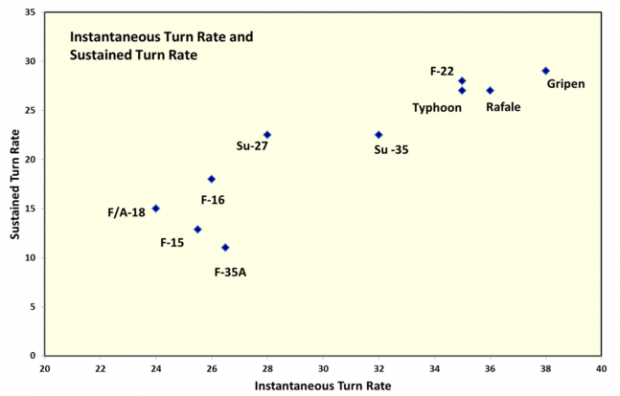
look like whoever wrote the piece just put turn rate of various aircraft at different altitude and speed together , and call it a table comparision. If you pay attention , it look like sustain turn rate of F-35 is taken at 15k feet while of F-16 is taken at sea level , drag index 0 , f-15 value also look like it is taken at 15k feet , value for Rafale , Typhoon , Gripen , F-22 on the graph are basically ass pull and have no support evidence.
:highly_amused: I see , funny how they think Su-35 has higher instantaneous turn rate than su-27 , by up to 4 degrees/second
mig-31bmfrom memory read on these very discussion board..
From here ?
http://forum.keypublishing.com/showthread.php?137530-SAAB-Gripen-and-Gripen-NG-thread-4
mig-31bmBesides, you speak about STR of both.. the reality is: Rafale about 27°/s, Mirage about 20°/s… there’s no comparison – starting with crossing 180° and turning one towards the other; the rafale ends behind the Mirage in about 26 seconds.. less than two circles
Do you have a source for either of those ? it hard to believe that Rafale sustain turn rate is even higher than F-16 instataneous turn rate at sea level
mig-31bmDoes anyone know why did they changed the wing configuration from delta in Mirage III to normal in mirage F1 then back to delta in Mirage 2000 ?
mig-31bmbecause parabolic antennas are as close as ideal as possible. Planar antennas have slightly worse characteristics (but are easier to integrate in an airplane)
Absolute nonsense, parabolic antenna suffer significant from feed blockage and spill over sidelobes
A plannar array with Taylor -radiation pattern can reduce level of sidelobes to as low as – 40 dB something a parabolic antenna cant even dream of
When the beam arrives at the target, it is coherent (i.e. the beam impacting the target has a nice wavefront perpendicular to its traveling direction). The reflected signal is also coherent
No and no , coherence beam = same phase , ESA radar need to steer their beam so the wave cant be coherence.
For reflection , target is not a flat plate , even a slight change in shape will result in phase different between the reflection that come from differnt part of target (consider that wavelength of X band is merely 3.75cm your earlier assessment that radar will reject all signal that isnt in phase is absolutely and completely wrong)
By definition of a track, it requires multiple pulses.
The technique is called monopulse because it can be done using a single pulse ,
Mono a combining form meaning “alone,” “single,” “one”
http://www.dictionary.com/browse/mono
you can argure that the radar need to detect target first before changing to monopulse tracking , but that still far from intergrate hundreds measurements of signal overtime like what done on RWR
In practice, monopulse mode works by slaving the antenna pointing mechanism* to the signal difference and this points the radar straight at its target after a few pulses.
Your mistake is thinking that the difference between the return signals are translated into an angle difference with the beam center (like saying “beamwdith is 5° and the delta in azimuth is xx so I know that my target is 2.3° below center so I know know it within 0.2°). This would require a very carefully calibrated radio chain which would be a waste because by slaving the antenna to the signal difference until it reaches zero, very accurate tracking can be achieved.
Dont put words in my mouth.And you are wrong, what you described is sequential lobing , not monopulse
monopulse works by generate 2 or 4 beams at the same time and compare reflection from the beam. It either use amplitude comparision or phase comparision
For amplitude comparison monopulse, all four beams squint away from the antenna boresight by a small amount ( usually such that they overlap at the half power beam width point of the beam).The beams often have different polarization. When the reflected signals are received they are amplified separately and compared to each other, indicating which direction has a stronger return, and thus the general direction of the target relative to the bore sight.
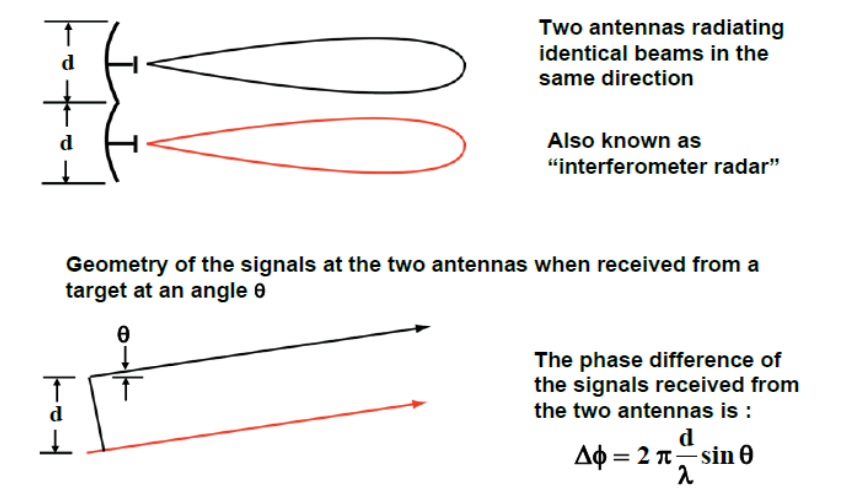
For phase comparison monopulse, the system use 2 separate antennas (can be 4 antennas too ) and illuminate the same volume in space. Instead of being squinted like in amplitude comparison monopulse system ,the beams are kept parallel in phase comparison monopulse system. Because the beams are parallel ,if the target is at the centre ,the radar reflection will arrive at the 2 antennas at the same time and has the same phase.On the other hand, if the target is at an angle to the bore sight then the radar reflection will arrive at one antenna later than the other
https://basicsaboutaerodynamicsandavionics.wordpress.com/2016/08/11/radar-fundamentals-part-ii/


 Sign In