 mig-31bm
@Andraxxus: the following quote is a quote of the test pilot, i made one word in bold, now note the headline: OBJECTIVE amaç
now read what this evaluation focugsed on, its to the very right of the word “focused”
You purposely cut aways the part mentioned high AoA control law
OBJECTIVE
The test was designed to stress the high AoA control laws during operationally representative
maneuvers utilizing elevated AoAs and aggressive stick/pedal inputs The evaluation focused on the
overall effectiveness of the aircraft in performing various specified maneuvers in a dynamic
environment. This consisted of traditional Basic Fighter Maneuvers in offensive, defensive, and neutral
setups at altitudes ranging from 10,000 to 30,000 feet MSL. The Flying Qualities criteria were that the
aircraft response would be positive and predictable and that there should be no undesired, unexpected,
or unpredictable aircraft responses. Qualitative observations were made regarding the high AoA
capability, cues that the aircraft was entering a low energy state, as well as various human factors
considerations.
mig-31bm-F-35’s both KPP threshold and achieved sustained turn performance datas are better than what F-16 blk 50’s performs *clean* at same flight conditions (flight manual data), assuming F-16 carries fuel for equivalent combat persistance.
So, once again, there are many more indications that F-35 will be more maneuverable than F-16, then F-22 being more maneuverable than F-15.
I found this
so F-35 can sustained 30 bank turn at mil power , 30K feet , mach 0.9 , but i dont know to convert it to how many G F-35 could sustained with full afterburner ?
Btw Andraxxus , is there anyway to estimate instantaneous , sustain turn rate of missiles such as R-27 , Aim-120 ,Meteor at different altitude such as 30K ft , 50K ft , 70K ft ..etc ?
mig-31bmBy putting a maneuvering RV with a radar sensor on the pointy end of the missile.
what kind of RV can maneuver inside the atmosphere while still keeping their mach 15-30 speed?, and ( not to mention the fact that it have to be very agile because missiles seekerwont be able to detect target from significant distance )
mig-31bmHow exactly they make a ballistic missile hit a moving target though?
mig-31bm@Robbiesmurf Since your very post obviously implied ME not answering to your “how afterburners work” question…
I was delibaretely not answering your question because you were polluting the several different threads by constantly asking highly irrelevant to the topic question “how afterburners work” and you were not asking it to learn from the answers, but to prove yourself (by asking a question that no one can answer, then answer it yourself); make us acknowledge your “extensive knowledege” about jet engines. .
this is spot on :eagerness:
mig-31bmit’s clear that this report is forgotten, time for a revival
the pilot already explained it , didnt he
First of all way too much is being made of this test and some players are taking things seriously out of context to grind axes. So, what is of primary importance is to understand what the test objectives were. The FLTS’s out at Edwards don’t fly unless they have a clear objective to gather technical data, that’s what Developmental Test is all about. So, what were the objectives? From the report
OBJECTIVE
The test was designed to stress the high AoA control laws during operationally representative
maneuvers utilizing elevated AoAs and aggressive stick/pedal inputs The evaluation focused on the
overall effectiveness of the aircraft in performing various specified maneuvers in a dynamic
environment. This consisted of traditional Basic Fighter Maneuvers in offensive, defensive, and neutral
setups at altitudes ranging from 10,000 to 30,000 feet MSL. The Flying Qualities criteria were that the
aircraft response would be positive and predictable and that there should be no undesired, unexpected,
or unpredictable aircraft responses. Qualitative observations were made regarding the high AoA
capability, cues that the aircraft was entering a low energy state, as well as various human factors
considerations.Please note that the object wasn’t to see how the F-35 stacked up to the Viper as a dogfight, rather it was to press the limits of the high AoA control laws and then report out the flying qualities in that regime, using various specified maneuvers. The Viper was there to make things dynamic and unscripted. Also, please note “elevated AoAs and aggressive stick/pedal inputs” are also preludes to departing an aircraft, so the evaluation of the effectiveness was how does the anti-spin logic effect high AoA BFM. Of course that’s exactly what the JPO statement said.
The tests cited in the article were done earlier this year to test the flying qualities of the F-35 using visual combat maneuvers to stress the system, and the F-16 involved was used as a visual reference to maneuver against
Next take a look at the setups
MISSION EXECUTION
The sortie consisted of standard administration to the Sea Test Range. Ranging exercises were
conducted to familiarize the target aircraft with F-35 visual cues. An offensive capture/tracking task was
completed by the F-35 from 6,000 feet slant range with a 3,000 foot vertical offset at 22,000′ MSl and
400 kts. All other testing consisted of traditional BFM setups starting at 22,000′ MSL and 440 kts for 6K
and 9K fights and 20,000′ MSl at 380 kts for 3K fights. The neutral fights began at approximately
18,000′ to 20,000′ with no limitations on airspeed or altitude following the check away. The floor was
10,000′ MSL. In all, there were seventeen engagements. No loads or other aircraft limits were
exceeded with unrestricted throttle, stick, and rudder inputs.All I have handy right now are the Block 50/52 performance charts, but they’re close enough to the 40 to show that the 3K, 6K and 9K setups are right at the sweet spots of the Viper’s performance.
Two 370’s Drag Index 70
22,000′ MSL 440 KCAS is 0.96M
20,000′ MSL 380 KCAS is 0.81M
Note assuming KCAS not KTAS since that’s what displays in the HUD and the EM chart below
Puts things in perspective here. So, the Viper was flying right around it’s corner and max instantaneous, while the F-35 was supposed to go elevated AoA and see if the control laws would prevent the plane from departing when performing elevated AoA BFM. The Viper was at a clear advantage all along, but it wasn’t there to win, it was there as a visual reference to maneuver against. The whole point was to put the F-35 in a bad position and see what the control laws did. Which is exactly what the JPO said.While the dogfighting scenario was successful in showing the ability of the F-35 to maneuver to the edge of its limits without exceeding them, and handle in a positive and predictable manner, the interpretation of the scenario results could be misleading.
Turns out the early law are biased towards departure prevention(not a bad thing early in a program), not exactly an Earth shattering discovery, and that there’s plenty of margin available to improve performance, again not exactly Earth shattering. At least a sizable subset of these critics aren’t old enough to remember that the first wave of FBW A/C went through similar cycle or didn’t pay attention/forgot that Super Bug and Raptor did also.
Now with the critic’s original argument discredited they take something else out of context…Wash, lather, repeat, the cycle continues. They’re always certain their right but curiously avoid making a stand in the face of a rigorous technical argument.
mig-31bmwrong
1/ you always carry as much fuel as possible when you start and/or refuel in the air… if you need maximum agility, the F-35 is stuck with all its fuel inside while the f-16 can still drop its tanks if needed
F-35 can dump fuel
https://www.youtube.com/watch?v=y0YUK-FeW4o (0:46 )
2/ as seen with the leaked report, even with half fuel onboard, the f-35 can’t match an f-16 with two wet bags (and don’t try to sell me the “unfinished controls software” BS, the claims about its fabulous agility were made by Beesley and co years ago…
there wasn’t anything in the report about the fuel state of the F-35 and F-16 , also according to pilot the test was to test the software respond of F-35 at highAoA
Please note that the object wasn’t to see how the F-35 stacked up to the Viper as a dogfight, rather it was to press the limits of the high AoA control laws and then report out the flying qualities in that regime, using various specified maneuvers. The Viper was there to make things dynamic and unscripted. Also, please note “elevated AoAs and aggressive stick/pedal inputs” are also preludes to departing an aircraft, so the evaluation of the effectiveness was how does the anti-spin logic effect high AoA BFM. Of course that’s exactly what the JPO statement said.
All I have handy right now are the Block 50/52 performance charts, but they’re close enough to the 40 to show that the 3K, 6K and 9K setups are right at the sweet spots of the Viper’s performance.
Two 370’s Drag Index 70
22,000′ MSL 440 KCAS is 0.96M
20,000′ MSL 380 KCAS is 0.81M
Note assuming KCAS not KTAS since that’s what displays in the HUD and the EM chart below
Puts things in perspective here. So, the Viper was flying right around it’s corner and max instantaneous, while the F-35 was supposed to go elevated AoA and see if the control laws would prevent the plane from departing when performing elevated AoA BFM. The Viper was at a clear advantage all along, but it wasn’t there to win, it was there as a visual reference to maneuver against. The whole point was to put the F-35 in a bad position and see what the control laws did. Which is exactly what the JPO said.
http://forum.keypublishing.com/showthread.php?135460-test-pilot-quot-F-35-can-t-dogfight-quot/page9
mig-31bmIf it had been designed with all the space inside for what was later hung on the outside it would have looked like a modernized F-105 or a single-engine Tornado. And if you need to do air-superiority you can unbolt the CFTs, hang 370gal tanks and go do it, while Foat Wuff Fats remains Foat Wuff Fats whatever you do.
if the f-35 pilot want it to be more agile, they can simply carry less fuel, when fueled to reach the same distance the f-16 isn’t actually more agile than f-35
and you forget that mission doesn’t always go according to plan, just because your formation was tasked with CAS mission doesn’t mean there will be no SAM or enemy’s fighters on the way
mig-31bmOoohShiny, I have provided you with ample sources – even your own sources defeat your argument. The cruise missile is NOT a stealth optimised target: it has a low RCS because of its small physical dimensions, that is why it’s X & L band plot are not divergent.
small physical dimension is what make the cruise missile alot more vulnerable to L band compared to stealth fighter or bomber ( surface wave, resonance )
You CANNOT extrapolate this observation to purpose built stealth aircraft designed to have low RCS from 8-12GHz.
most if not all stealth fighter are designed to be stealthy in Xband (8-12 Ghz )
It’s high time you give that undergraduate ‘study’ the respect it is due – namely digital toilet paper, instead of going out of your way to rewrite the ‘Laws of Physics’. I’d be particularly worried that no computational EM mesh/simulation was presented and all but frontal aspect was appallingly bad- but anyways, back in the real World:
L band frequency is 1-2 Ghz , wavelength is only from 15 -30 cm so that not the same as SIAR that you posted as example here
https://books.google.co.uk/books?id=NBzVBAAAQBAJ&pg=PA5&lpg=PA5&dq=radar+beam+width+stealth&source=bl&ots=ygC1UcB3e1&sig=pAOPwHv537OCSlJxcSzVa0QhyVE&hl=en&sa=X&ved=0CB4Q6AEwAWoVChMIlprWhJKByAIVClUaCh3psQYa#v=onepage&q=radar%20beam%20width%20stealth&f=false
the SIAR system in their example use 25 receive , 25 transmitting antenna , in circle of 50 and 90 meters respectively , with 3 meters wavelengh ( so the frequency is only 10 MHz , that very difference from L band )
you tried to confused people , again :stupid: , btw , how many SIAR in existence yet , or they are still theoretical, development stage ?
Oh, and here’s a little snippet for your friend who thinks he can re-invent the laws of aerodynamics too:
http://www.pacificaviationmuseum.org/pearl-harbor-blog/lockheed-f-104-starfighter
No i didnt talk about the NF-104 with the rocket
normal F-104 can cruise at over 70K ft despite having higher wingloading than F-15C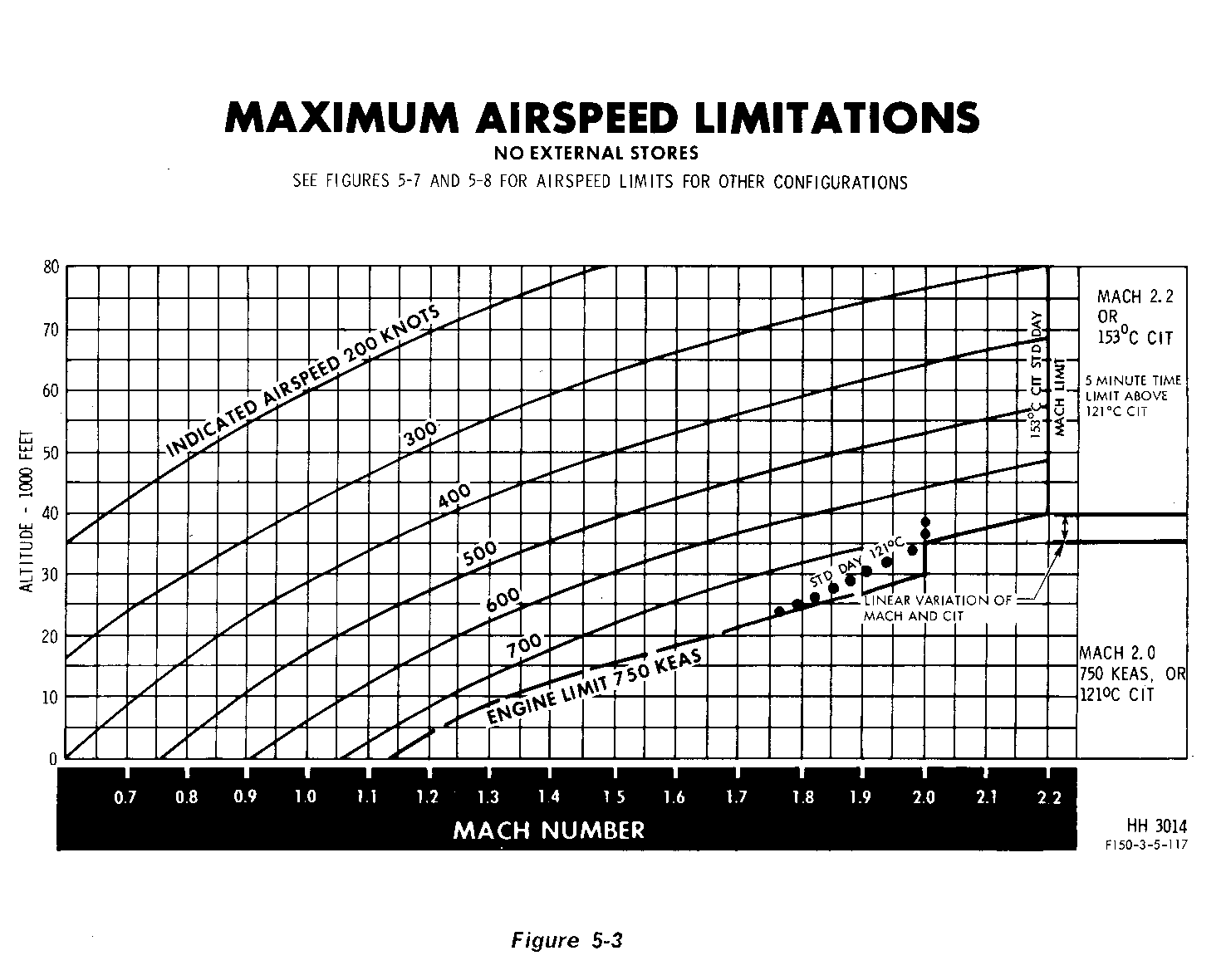
Cruised at 2.0 Mach (310 KIAS) at 73,000 feet burning 100 pounds per minute. ‘BT, DT’ [3]. Using T/O flap setting would out-corner the F-4.
http://www.916-starfighter.de/Sounding%20off%20about%20the%20Zipper.htm
as explained , thrust is very important for high altitude flying , the F-15’s engine loss too much thrust compare to the F-104’s engine , hence it cant fly as high as the F-104 despite having lower wing loading
Bonus : Mig-25 can easily reach 70K ft despite wingloading of 598kg/m2
So no one try to invent anything new here , it just you misunderstanding the information
mig-31bmMy working area was also what you turbo machinery, Known in the RAF as A Tech P.
My specialists were: BAC Lightning, HS Buccaneer, Hawker Hunter, Sepecat Jaguar and HP Victor. After that it was Boeing 707,737 & 747 plus Douglas DC8,9 &10. If I were to add all the stuff I serviced casually (visiting a/c) I could probably add another 20 types or so.
Yes I have a good understanding of how a/c work.
Seeing as you are a turbine man, how does reheat increase the thrust? I don’t need the figures, just the basic working.
Robbie, if there is some parts you disgree with Andraxxus, just point it out and explain why you disgree, that would save time and alot better than asking everyone about afterburner
mig-31bmI am not, you are answering in a linear fashion. I am not responding to what you are addressing to joe. I am answering to what you posted as a response to my post.
Ok, it was rather confusing because you respond right after Sakura, and didn’t specified what you were talking about
Beam width is important because its properties change in space, to simplify.
I still dont understand what you are trying to say what that statement, can you explain your point with more details?
mig-31bmI’ll go past everything you said, and ask you. You do realise there is such a thing as a beamwidth, right? If you look it up,
yes i do , and actually i mentioned it in this topic when discussing about radar gain
but i dont really get what you are trying to say by mentioning beam width here
you’ll realise that what you say makes very little sense. That is why I said pull it together you are incoherent.
No Falcon ,you can ask any pilots , radar engineers , weapon designers ..etc and they will all tell you ” fighter , missiles doesn’t have same RCS from all aspect ” , and ” even stealth fighter will have aspect that they have massive RCS “
anyway this article would help
http://www.airforcemag.com/MagazineArchive/Pages/1999/February%201999/0299radar.aspx
Achieving a lower RCS degrades the ability of enemy radar to detect, track, and engage aircraft. Lower RCS means aircraft are detected much later. A combat aircraft’s RCS varies with aspect and with the frequency of the radar attempting to track it. According to theoretical principles, very low frequency radar waves may often be able to detect such aircraft. However, if RCS reductions are optimized to the higher frequencies of fire control radars, significant benefits can be achieved.
Lowering the aircraft’s observability to radar allows the aircrew to complete more of a mission before becoming vulnerable to radar-controlled weapons. This provides the attacker the advantage of avoiding the threat and minimizing the time in the “red zone” where detection leads to valid Surface-to-Air Missile shots. Also, stealth enables attacking aircraft to get closer to their targets. For example, shrinking SAM rings makes the SAM site and the targets it attempts to defend much more vulnerable.
For the purposes of this analysis, aircraft radar signature levels fell into five categories. Starting with the least advanced, they were:
Conventional-no signature reduction and a large RCS.
LO1 and LO2-levels of RCS reduction in the stealth zone but still not as low as aircraft may achieve.
Very Low Observable 1-highly desirable and achievable RCS reduction.
VLO2-hypothetical extreme not likely to be achieved.
To simplify the data presentation, Figs. 510 portray each radar signature type only in the “mid-range” VLO1 form.
A Tale of Three ShapesCombat aircraft in today’s inventory employ a number of different techniques for reducing their Radar Cross Sections, which are of three different shapes. The Fuzzball, Pacman, and Bowtie shapes are highly simplified symbols for basic signature patterns. Actual signatures are considerably more complex, of course, and information about them is restricted. The three shapes are used to depict how general patterns of RCS reduction give attackers a revolutionary edge.
Fuzzball. A conventional, non-stealthy aircraft has a Fuzzball signature (Fig. 1), one which is constant from all aspects. Fuzzball is the ideal shape for a stealthy aircraft, with uniform reduction at all angles. It could in theory achieve remarkable results at the lowest levels. Theoretically, a perfect Fuzzball with a uniformly reduced cross section at -55 decibels would deny any radar return. However, a stealthy Fuzzball RCS is purely hypothetical and is used here only for illustrative purposes.
Pacman. This signature type (Fig. 2) is a simplified approximation of the RCS of a conventional aircraft retrofitted to reduce signature in the front aspect only. Within certain parameters, modifications can reduce RCS and improve survivability. For example, the Navy’s new F/A-18EF will emphasize front-aspect stealth. Applying Radar-Absorbent Materials to forward surfaces, shielding inlets, ducts, and canopies, and minimizing ordnance and other protrusions are some of the measures that can lower RCS from the nose-on angle. Rear and side aspects would not be reduced. Thus, in this notional case, a retrofitted aircraft might have a signature reminiscent of the creature in the early 1980s Pac Man video game.
Bowtie. This hypothetical signature type (Fig. 3) is smaller in front and rear aspects than it is from the side. That would form something like a man’s bow tie. In simplified form, the theoretical Bowtie shape has a 15 dB reduction in RCS in its front and rear aspects. The Air Force’s F-117, B-2, and F-22 and the triservice Joint Strike Fighter are designed to be true stealth aircraft that are low observable from all aspects. Hypothetically, true stealth aircraft may achieve their smallest signature levels in the front and rear aspects. This might form a shape like a man’s bowtie
P/s : instead of playing guessing game let just explain your point
mig-31bmMan…. please pull it together, you are incoherent.
in coherent about what ? , no aircraft have same low RCS from all aspect , even stealth aircraft are no different , i said that from the start of the thread , you can see from all these graph and simulation i posted , even something like Aim-9 can have massive RCS from certain direction ( 20 dBsm from side aspect ) , that not something that can be avoided , designers only try to reduce RCS from most important direction such as frontal
many people claimed that stealth fighter will suddenly extremely easily to detect as long as you have a low frequency radar , or that stealth only work in X band , now that simulation ( from professor , weapon producers ) showed that stealth aircraft still have relative low frontal RCS even at 1ghz .suddenly , people want to change their argument to ” very high RCS at narrow side aspect make stealth aircraft unsurvivable” ? really ?
mig-31bmIt would only be an insult if it was untrue.
not only it untrue ,but also ironic that you said it after making many mistakes :rolleyes:
Aaah yes, you’re the ‘King of DSI’ too…but .
i didnt talk about DSI , iam talking about your assessment that fighter with lower wing loading will always be better at high altitude , and your conclusion that F-35 will turn worse than J-20 from a single sustain G figure at unknow altitude , unknow speed , unknow weapon and fuel load :rolleyes:
which then i replied by posted this , have you already forgot ? 😉
yes fighter can turn easier at low altitude , no **** , the point is however you cant concluded which can turn better, J-20 or F-35 from a single sustain G value at unknown speed , unknown altitude , unknown fuel load and unknown weapon load
For example :
at sea level both F-16 and F-15 can sustain 9G
but at M0,8 15000 feet
F-16C = 6,5G with 27% fuel (@22000lbs )
F-16C = 5,9G with ~50% fuel (@24000lbs )
F-16C = 5,1G with ~100% fuel (@28000lbs )F-15C @35000lbs = @10k feet = 7,6G, @20k feet = 5,1G. On average: 6,4G @ 15k feet with ~50% fuel
F-15C @42000lbs = @10k feet = 6,2G, @20k feet = 4,4G. On average: 5,2G @ 15k feet with ~88% fuel + empty CFTs.
and remember F-35 carry alot more fuel , F-16 , f-15C may need 100% fuel to reach the range that f-35 may need only 50-60%And aircraft with higher wingloading does not neccesary have less maneuver at high altitude than the one with low wingloading , you have to factor in engine design as well , some lose more thrust at high altitude than others
Forexample :
F-15 have wingloading of 358 kg/m2
F-16 have wig loading of 431 kg/m2
F-104 have wing loading of 514 kg/m2
but F-16 can barely fly to 50K ft , F-15 can barely fly to 60K ft while F-104 can still going at 70K ft
I wager only one of us has university-level qualifications in mechanics of fluids
“University level education ” but doesnt even know how to read a simple graph ??? :p
Seriously, Goodbye now…and say hello to my ‘ignore list’.
yeah Goodbye :highly_amused: you seem to get butt hurt so easy when someone pointed out your mistake or having different opinion
mig-31bmReally?! English is neither of our first languages but I don’t use it as an excuse to hide my intellectual flaws. Can you see @ 8GHz? Do your squares match? Not fixing ‘evidence’ much?
[ATTACH=CONFIG]240607[/ATTACH]
it start shifted because the distance between 0 Ghz and 2 Ghz isnt exact 8 square , but only approximately ,however if you read what people written in their simulation, you will see that they didn’t analysed frequency between 1 Ghz and 2 Ghz , but only from 1 Ghz to 100 Mhz and from 2ghz to 10 Ghz
Now , if point C was used to represent target RCS at 1 Ghz then the line they draw fromC would be connected directly with point B , instead they draw the line directly from point A to point B , which mean point A was used to represent target RCS at 1 Ghz
Mr. ActionJackson, save us from this brain-musher!!
Mig-31bm, you’re a fruitcake. Goodbye.
:rolleyes: you seem to prefer insulting people instead of using well-reasoned argument 😉 do you
didnt work well in previous thread , did it 😉 http://forum.keypublishing.com/showthread.php?136221-Is-the-J-20-the-least-maneuverable-5th-gen/page4


 Sign In








