mig-31bm
Having seen many of your posts, not just to me but to others I can only say: “I name thee Troll”.
Btw your answer to point 3 isn’t correct.
How exactly am i a troll? but you aren’t ?
you are the one who throwing insult at me first , also the one who keep asking people rhetorical questions with pretentious altitude and get butt hurt when they don’t answer , you also keep saying people are wrong without actually explain your point on why you think they are wrong , if that isn’t the same as trolling i dont know what is
P/s : yes, my post aren’t perfect, i made mistake sometime ( which everyone does) but at least i will admit iam wrong when people point that part out, and i dont go around accuse people of trolling just because they have different opinions
mig-31bmIt rather does, and that is no common stealth fighter shape.
It only show what is possible to achieve in theory, reality is far different.
:sleeping: oh come on , Now you are being dishonest , what exactly unconventional about the vettera design compared to normal stealth fighter design ? ( i mean the unconventional part you think will that help it achieved RCS of around -30/-40 dBsm in very wide frontal arc while normal stealth fighter design cant do that )
It always amusing to hear the argument for stealth aircraft based on other countries acquisition.
and it actually true , countries still try to acquire stealth fighter to compete with others who have modern AWACs , IADS , interceptor
I have never said Stealth is no advantage, did mine words on the F-22A vs F-15C not make into your mind? Go and read it, then you understand the real advantage offered by low observability.
you said stealth offer no advantage when enemy have AWACs or modern IADS , which is wrong , proved by F-22 exercise and by BAE Eurofighter simulation that you cited yourself
and with frontal RCS of around 0.5 m2 according to you , F-22 will only offer around 6 % in detection range reduction compared to fighter that have RCS = 1 m2 like F-16 ( again same kind of radar of course )
B-2 was changed from high profile to low profile flight, utilizing the same measure to defeat radar via exploitation of curvature of the earth. Just the same as Tornado, Su-34, F-111, Su-24, etc
actually , you are being dishonest again here , B-2 low profile flight was a fall back capability , secondly , it was to avoid Russian defense when they are linked ( as i have explained earlier here http://forum.keypublishing.com/showthread.php?134882-F-35-News-Multimedia-amp-Discussion-thread-(2015)-Take-two&p=2244183#post2244183 ) ,radar position very wide apart can have a chance to look at stealth fighter from angle where they have high RCS spike
[ATTACH=CONFIG]239612[/ATTACH][ATTACH=CONFIG]239613[/ATTACH][ATTACH=CONFIG]239614[/ATTACH]
In the end, it stealth made no difference. Just in how much the delivery platform cost.
:confused: so you contradicted with your own statement above ?????
Average RCS means everything.
Yours explanation is so laughable, so comical, I will not bother addressing it. Yours theoretical aircraft with its -30 dbsm and average 10 dbsm is a fanciful creation of the mind. Let us stick to reality, shall we?
alright , you want reality ? fine then
1 ) E-3 , E-2 in exercise was unable to detect F-22
2 ) General Hostage said : F-35 specially designed to effectively neutralise S-400 and their cousin
3 ) Euro fighter producer , in their own simulation , have to position their AWACs out side F-35 60 degree frontal cone to be able to detect it ( and we know AWACs use L , S bands )
if stealth fighter really did have frontal RCS of 0.4-0.5 m2 like you claimed earlier then they wouldnt be able to achieved these feat above ( since only 50 % reduction in RCS will only reduce radar detection range by around 6% )
Perhaps you should procure a copy and say what lie on page 45.
You said that exercise happened ,and was written in that magazine so the burden of proof is on you actually
https://en.wikipedia.org/wiki/Philosophic_burden_of_proof
Depends on the jamming, and in Kosovo, B-2 did indeed fly with escort.
Do you have any source to proved that B-2 fly with escort in Kosovo ? and what escort was that ? F-16 ? F-15 ? or F-18 ?
I never meant B-2 in its actual employment in missions that it carried out use low profile approach, why would they.
You should pay better attention to mine wording.
alright : your statement was ” B-2 was design to fly at high altitude and now they have to fly like su-25 ” how else should i understand it ?
1. F-22 is a lot more capable, why your General Hostage said so!
2. What weapon does the F-35 clear to be carried that F-22 cannot?
3. There was a plan for naval F-22, and only one version of the F-35 is capable to do that.
1 ) F-22 fly at much faster speed , allow it to run aways easier and intercept bomber faster , it also carry 2 times the amount of AAM ( at least until F-35 reached block 5 and have 6 AAM internal )
2 ) 2000 pounds JDAM , JSM , JSOW ..etc
3 ) modify an aircraft for naval use required alot of work and money , it also reduced aircraft performance ( due to strengthen air frame and bigger wing )
Simulation of an scenario is the different from completly theoretical aircraft with more theoretical and academic RCS.
but a simulation is still less real than an actual exercise , doesn’t it ? , in actual exercise E-2 , E-3 doesn’t help 4 gen fighter detect , attack F-22
No, they are carrying a mixture of air to air and air to ground.
Eight F-35s on attack mission, with both type of munition, it rather realistic
if eight F-35 on attack mission then some of them would carry both AGM and AAM while some of them would carry only AA and fly as escort ( normal USAF procedure is to have some fighters in formation fly with AA weapon only as escort ) , also F-35 can carry SDB or SPEAR that allow it to attack from much further distance
But that simulation not mine point.
what you mean by ” not your point” ? , you posted it to show that AWACs can detect stealth fighter , you just over look the part where they state that AWACs have to stay out of 60 degree frontal cone to do that
http://www.flightglobal.com/news/articles/eurofighter-boasts-typhoon-reign-over-f-35-345265/
In an internal simulation series, Eurofighter found that
four Typhoons supported by an airborne warning and control system (AWACS) defeated 85% of attacks by eight F-35s carrying an internal load of two joint direct attack munitions (JDAM) and two air-to-air missiles, Penrice says.
According to Laurie Hilditch, Eurofighter’s head of future requirements capture, the F-35′s frontal-aspect stealth can be defeated
by stationing interceptors and AWACS at a 25º to 30º angle to the F-35′s most likely approach path to a target.Firstly : the red line : is what you happened to “forget” to quote :rolleyes: , these F-35 are in air to ground configuration
Secondly : look at the blue line : have you stopped for a moment and think for yourself , why do BAE need to station their AWACs at 25º to 30º angle to the F-35′s most likely approach path to a target ?:rolleyes: , funny how AWACs with their super powerful radar ,using S/L band frequency still have to be position at 25º to 30º angle relative to the F-35′s path to be able to detect and send Typhoon to intercept it :highly_amused: that mean BAE know that even with AWACs using S/L band frequency they still have no chance of detecting F-35 at 50-60 degree frontal arc ( 25-30 degree each side equal 50-60 degree total )
p/s : just so you know, the simulation is from Typhoon producer, so it is likely that they pump up their fighter as much as they can while at the same time put down F-35 as much as they can, and even then they know it is nonsense to show AWACS to be able to detect F-35 at military useful distance in 60 degree frontal arc, thus they have specific say they position AWACS in 30 degree angle relative to F-35 fly path
Allow me to rectify with statement made by Chief Test Pilot Paul Metz.
This tactical advantage, directly correlated to average radar cross section, is very much eroded and simply non-existent in multiple vs multiple aerial confrontation, it even worse with
seriously Glyph , you should carefully read what you cited , because your graph proved my point once again , look at it ( the red line ) , it basically pilot wanted to know where the high and low RCS spike located :
We looked at the cockpit problem from the outside in when we sat down with the avionics engineers. For example, we asked what did the pilot really want to know and at what time did he need to know it. We broke the airspace surrounding the Raptor into spheres or ‘globes‘ where the pilot wanted to know specific things about the enemy and tactics. For example the pilot would like to know when he is flying undetected by the enemy. This area of ‘cloaked’ operation or the ‘engage-avoid’ globe allows him to move with impunity in the battle arena. I-see-you-but-you-can’t-see-me affords the fighter pilot a certain degree of aggressiveness and tactical positioning prior to using his weapons. It allows him to not only position himself to maximum advantage but he can also vector friendly forces and his own flight members into positions of advantage: something akin to the perfect ambush. Five globes were subsequently defined to give the pilot knowledge about his surroundings, ranging from the engage-avoid globe where the F-22 is invisible to the defensive zone where the enemy can see and hit you with his weapons.
AWACS addition, or AWACS that operate in L-band.
actually most if not all AWACs operate in L/S band ( i used to think AWACs operate in Xband too :D)
Do you even understand low observability?
Yes ,and iam surprised that i actually have to explained to you why stealth have a certain shape
The desired stealth capability (i.e., low radar cross section) is imparted to the vehicle of the invention through the use of a basic polyhedron shape, the respective surfaces of the vehicle being planar facets. These facets are arranged so as to present the illuminating source with high angles of incidence, thus causing the primary reflected power to be in a direction of forward scatter, i.e., away from the source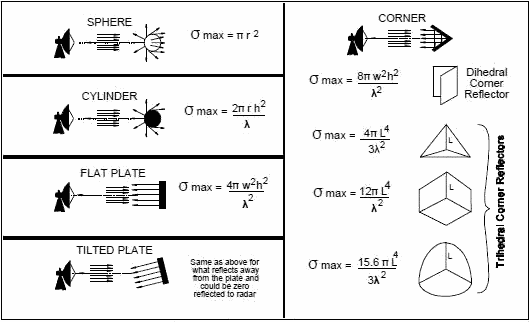
stealth fighter have very weird shape because they was designed to reflect radar wave away from the source , especially frontal
I have been providing it since beginning, you only refuse to look.
Do all the quotes I post earlier not gain your attention?
you have provide no evident to prove that F-35 , F-22 will only have RCS of -30/-40 dBsm in narrow cone and not achieve able in real life situation
Shaping allow for reduction of RCS three times more in magnitude than radar absorbent materials.
the phrase “The four rules of stealth, shaping, shaping, shaping, and radar absorbing materials ” are meant as an analogy to say Shaping are more important than RAM ( because it work at wider range of frequency ) but it not to be taken literally as shaping allow for reduction of RCS three times more in magnitude than radar absorbent materials. Because there are many different kind of RAM and their absorption capability at different frequency are also different .
Yes, LRSO being designed to finally provide B-2 with stand-off nuclear cruise missile capability.
and it have nothing to do with your assessment that B-2 cant carry cruise missiles or JASSM isn’t a cruise missiles
Stopping nuclear cruise missiles is never useless, why do you think USSR made them?
in a full scale nuclear war between US and Russia , cruise missiles and bomber mean very little , the most important asset would be nuclear submarine and ICBM
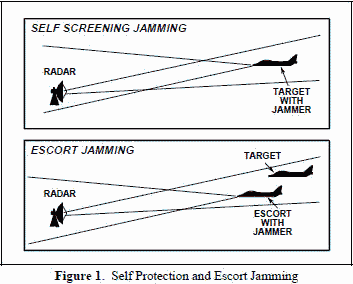
What part of increasing the range of jamming by a factor of two require the square of the radiated power to maintain jamming density do you not understand?
They dont need to maintain the same jamming density to jam when they stay further ! , why ? because the density of the reflected signal reduce as the aircraft is further from the radar
imagine this : if S-400 radar have maximum detection range of 100km again F-35 , and it’s burn through range again F-35 using jammer is 25 km
what exactly do you think happened at distance X
with 25 km < X < 100 km ? think about it !
But why the addition of LRSO then?
a longer range weapon allow you to attack enemy from longer distance thus increase the area that you can strike enemy significantly , for example : with a weapon that have 1000 km range , the B-2 can attack ground target inside the circle with radius of 1000 km ,with weapon that have 2000 km range , B-2 can attack ground target in circle with radius of 2000 km , do you see the significant increase in area now ?;)
Average RCS more so
unless you can produced an aircraft with spherical shape average RCS doesn’t really mean anything if you dont know where the spike located
Not just Sukhoi, but A. Davidenko. He work at the institution where Ufimtsev created stealth, and so allowed US to realize F-117, B-2, etc
1 ) Ufimtsev didn’t created Stealth , he invent the equation to measure RCS of 2D shape but he wasn’t able to find application for it’s so the USSR public the invention ,however the first aircraft with reduce RCS intention was the ho-229 that fly long ago before Ufimtsev public his study
2 ) and what exactly A. Davidenko. say about Irbis-e again ?
Cruise missile have the lowest average rcs in existence. Especially AGM-129 and Kh-101/102.
no one say stealth cruise missiles doesn’t have lowest RCS , but their RCS isn’t 0.01 m2
and cruise missiles with lowest RCS isn’t AGM-129 or KH-101 , it likely something like JSM , JASSM ( simply due to their much smaller size )
mig-31bmThankyou for your answer Mig-31.
1. When I am instructing technicians I ask a few basic theory questions to gauge their technical grounding. I am looking for their understanding of the physics.
in my opinion, if what i said is wrong, it would be wrong regradless of who iam or what background i have, thus your questions to find out my background have no purpose
anyway, what make you think iam a technician? have i ever claimed as such? , if you look at the previous thread ( f-35 cant dogfight) you will see i actually asked Andraxxus many questions regarding aerodynamic, if i wanted to pretend to be an aerodynamic engineer do you think i would have asked these questions ?
2. SFC is always a ratio, in this case as you say lb/lb, you were vague and I wished clarification. Throwing terms around are all very well but maybe not everyone understands it. Take afterburning for instance, I call it reheat just like RR but you can also call it thrust augmentation, that as a term is also used to describe means other than reheat to increase thrust.
so you agree that my answer about TSFC is correct ? or not?
3. You are correct, if the air enters the engine at supersonic speed it doesn’t work too well, but why?
supersonic air will cause shock waves on the compressor blades will make the engine unusable because of large pressure fluctuations that would cause fatigue and failure of blades, and supersonic flows will also cause high drag that slow the compressor blades down as they rotated.
4. . The answers I have seen here are obviously Wiki readings where it is stated that the pressure increases when reheat is engaged. That is incorrect. The pressure does not, cannot increase significantly otherwise the engine would stall/surge.
I would still like to see an answer over point 3 from you. After all you do know an awful lot don’t you?
i think you are confused, i didn’t answer your questions about reheat, you can come back to old topic and check for yourself
mig-31bmSimulations say otherwise,
:highly_amused: funny how you bash anything related to simulation a moment ago saying it isn’t reality , now that a simulation sound like it support your point , it suddenly become acceptable as a source and even more credible than the actual exercise :rolleyes::highly_amused:
but alright , no problem for me at all , but remember next time , if you quote something , read it carefully first , and dont cherry pick the part you want and hope that no one will come check the original source
here is the source : http://www.flightglobal.com/news/articles/eurofighter-boasts-typhoon-reign-over-f-35-345265/
In an internal simulation series, Eurofighter found that
four Typhoons supported by an airborne warning and control system (AWACS) defeated 85% of attacks by eight F-35s carrying an internal load of two joint direct attack munitions (JDAM) and two air-to-air missiles, Penrice says.
According to Laurie Hilditch, Eurofighter’s head of future requirements capture, the F-35′s frontal-aspect stealth can be defeated
by stationing interceptors and AWACS at a 25º to 30º angle to the F-35′s most likely approach path to a target.
Firstly : the red line : is what you happened to “forget” to quote :rolleyes: , these F-35 are in air to ground configuration
Secondly : look at the blue line : have you stopped for a moment and think for yourself , why do BAE need to station their AWACs at 25º to 30º angle to the F-35′s most likely approach path to a target ?:rolleyes: , funny how AWACs with their super powerful radar ,using S/L band frequency still have to be position at 25º to 30º angle relative to the F-35′s path to be able to detect and send Typhoon to intercept it :highly_amused: that mean BAE know that even with AWACs using S/L band frequency they still have no chance of detecting F-35 at 50-60 degree frontal arc ( 25-30 degree each side equal 50-60 degree total )
p/s : just so you know, the simulation is from Typhoon producer, so it is likely that they pump up their fighter as much as they can while at the same time put down F-35 as much as they can, and even then they know it is nonsense to show AWACS to be able to detect F-35 at military useful distance in 60 degree frontal arc, thus they have specific say they position AWACS in 30 degree angle relative to F-35 fly path
You understand how Average RCS is calculated?
Do you understand why stealth fighter look the way they do ? :highly_amused:
Only in yours dreams.
it seem like my dream came true 😉
F-22 and F-35 will achieve -30/-40 dBsm, in very very narrow cone, few degrees off the nose.
You have absolutely no data your support that theory mate :highly_amused:
USAF,LM, General Hostage?
All you have done is cite their brochure, and a statement that F-35 can kill S-400.
Neither of which provide confidence.
Third Party simulation? Give me a rest, an aircraft that does not actually exist somehow proves F-22/35 low wide angle front RCS?
Stealth aircraft always have lower average RCS than the non-stealth.
Stealth aircraft in respective aspects, always have lower RCS than non-stealth, all that is computed in average RCS.
and what have you provided to shown F-35 , F-22 will only have RCS of -30/-40 dBsm in narrow cone that not achieve able in real life situation ? :highly_amused:
The four rules of stealth, shaping, shaping, shaping, and radar absorbing materials.
Denys Overholser.
No one say shaping isn’t more important than RAM , but that doesn’t mean RAM isn’t important
Reality is you cited a nonexistent aircraft RCS.
the hypothetical model have similar shape to a normal stealth fighter , thus the way radar wave interact with them will be similar , and in reality you cited nothing to prove your opinion about frontal RCS
Everything to do with wording.
B-2 does not carry 2000km ranged, nuclearstand-off cruise missile.
:rolleyes: if they really want to , it isn’t hard t put a nuclear warhead on normal cruise missiles like JASSM
and again stop bending your own word , you said nothing about 2000 km cruise missiles at first , you even go as far as claim B-2 cant carry any cruise missiles and that JASSM isn’t a cruise missiles , it basically like saying F-35 cant carry AAM , and then later claim that you actually mean F-35 cant carry 200 km AAM like F-14 :highly_amused:
It will play the same role as yours namesake, just less efficiently.
in a full scale nuclear war they will use ICBM , both Mig-31 and F-22 will be useless in that case
I have not changed once in mine wording.
I have tried multiple times to explain to you.
What part of the above is beyond comprehension
:sleeping: what part of self screen jamming is easier at long distance is so hard for you to understand ? :p how do you think burn through distance work ?
What will attack a B-52H delivering nuclear cruise missile from 2000km away?
nothing , but nothing can attack B-2 from 1000 km either
What part of relevant RCS do you not understand?
Frontal RCS is very relevant if you ask me
Yes, carefully collected brochures and basic statements by generals, and nonexistent aircraft RCS.
To the topic of Irbis-e, it was designed to detect the lowest rcs target in existence, the cruise missile from 90km.
.
:highly_amused::highly_amused::highly_amused: funny how you criticize me for quote brochures and USAF general’s statements but then yourself eat up every single word that Sukhoi spit out about Irbis-e range :highly_amused:
and no 0.01 m2 isn’t the lowest RCS target in existent, detection range isn’t same as tracking range, the range didn’t take into account clutter or jamming either
mig-31bmOh yes, yours sources being non-existent aircraft.
:sleeping: what part about interaction of radar wave vs shaping that you dont understand ? :sleeping:
it doesn’t matter if the aircraft existed or not , the simulation was to show the interact of radar wave at different frequency vs object of certain shape and size , it show where the RCS spike is highest and lowest , it show that with common stealth fighter shape it entirely possible to achieve ( -20/-30 dBsm frontal arc even without RAM )
Stealth offers nothing like the laughable assertions in creative concept of operations, and what will they mean by effectively, they won’t need a 2 billion dollar redesign?
:rolleyes: so your conclusion is that even though USAF know that Stealth wont work again modern SAM , AWACs , fighter but they still continues to make stealth aircraft ? :rolleyes: even the sixth gen ? , even LRS-B , UCAV all have VLO characteristic , all for fun ? :rolleyes: , China and Russian , Japan , Korea , Canada , India ….etc and many other countries are all bunch of idiot that even though they know stealth doesn’t work again modern AWACs and IADS they still continues to buy or make stealth aircraft ? :rolleyes:
It rather do, because we talk about the average RCS of existing aircraft.
Theoretical aircraft with theoretical RCS do not hold mass against real life findings.
once again , average all around RCS mean absolute nothing without knowing where the spike located :highly_amused:, and i just demonstrated to you in the previous post that the theoretical aircraft actually have average RCS of 10 dBsm while still have frontal RCS of -30 dBsm :highly_amused: all that matter is where it’s spike located
Just ordered a copy.
:highly_amused: so you admitted that you are one of these people that repost that piece of article that you saw on some forum without actually checking the original source ( magazine ) :highly_amused: , i knew it , once again history repeat 😉
You would be surprised on how not “rare” it is.
In Kosovo, B-2s flew with several jamming platforms and escort fighters.
jamming make hiding from radar easier , especially low frequency radar like VHF , UHF , and no B-2 do not fly with escort 😉 , and you haven’t provide any evidence that B-2 have to fly at similar altitude with tornado in any conflict up until now
F-22 has a larger airframe, allowing for growth past what F-35 offer
1 ) F-22 is alot more expensive
2 ) F-22 weapon bay doesn’t allow it to carry things like 2000 pounds JDAM , JSM …etc
3 ) F-22 cant take off and land on a carrier without major redesign , it can take off and land vertical either
Feeling insecure?
Not even a little bit :highly_amused:
mig-31bmLike military Intelligence, these are a contradiction in terms.
I asked you basic questions about propulsion. Your answers are significant. Poor, lacking in basic schooling and incorrect.
On the positive side, you are very adept at Googling, Wiki research and cut/paste. Understanding that information however, is very vague.
if you were confidence of your knowledge, you could have explained why iam wrong, at that topic, instead of asking people rhetorical questions with pretentious attitude and getting butt hurt when they are annoyed and stop answer after a while . Were it this topic?
http://forum.keypublishing.com/showthread.php?135460-test-pilot-quot-F-35-can-t-dogfight-quot/page29
anyway i didn’t even know what questions you were referred to, this question? :
TSFC 1.92? compared to what?
here was my answer
TSFC = thrust specific fuel consumption which can be expressed as lbs of fuel burned per hour for every lb of thrust., so i dont really understand what you mean by ” compare to what”
or this one?
Gasflow. Are you talking about sonic or supersonic gasflow through the engine?
here was my answer
if the air go to engine at supersonic speed the engine wont work, the reason for variable intake, Ram.. etc is to reduced speed of air to subsonic before it go to the engine
i dont see why you think iam wrong at all
mig-31bmrubbish, afterburner is being used to achieve best possible launch parameters,
but even that isnt good enuff to reach acceptable parameters vs higher performer.
Secondly, it isnt humans that are the limit at medium to high alt., its the machines,
certainly F-35 wing load is the limiting factor
andraxuss have debunked that graph many times over and over and over , i dont know why you keep trotted that graph out
5G = 5 times lift of aircraft weight.
Lift = 1/2 * air density(at 60k) * Wing Area * Lift Coefficent * airspeed^2
Empty weight of F-22A = 19700kg
5*19700*9,8184 = 1/2 * 0,08891 * 78,04m2 * Lift Coefficent * 294,9^2
Lift Coefficent required for EMPTY F-22 to PULL (not sustain) 5Gs = 3,2
Such lift coefficient is nonexistent. Even half of it (1,6) is nonexistent for M0,9. Highest nominal Clmax EVER achieved is 2,1 for lowspeed flight. Theoratical maximum for single element airfoil is 3,06, no such thing ever built.
So clearly, F-22 cannot even pull 5Gs; even at its empty weight at M0,9. There are a dozen stupidities I would show but I won’t even bother dismissing that laughable chart further.
No, but its below F-15, similar to F-4
The US Department of Defense’s decision to relax the sustained turn performance of all three variants of the F-35
was revealed earlier this month in the Pentagon’s Director of Operational Test and Evaluation 2012 report.
Turn performance for the US Air Force’s F-35A was reduced from 5.3 sustained g’s to 4.6 sustained g’s.
The F-35B had its sustained g’s cut from five to 4.5 g’s, while the US Navy variant had its turn performance truncated
from 5.1 to five sustained g’s.
Acceleration times from Mach 0.8 to Mach 1.2 were extended by
eight seconds, 16 seconds and 43 seconds for the A, B and C-models respectively.
The baseline standard used for the comparison was a clean Lockheed F-16 Block 50 with two wingtip Raytheon AIM-120 AMRAAMs.
“What an embarrassment, and there will be obvious tactical implications.
Having a maximum sustained turn performance of less than 5g is the equivalent of an [McDonnell Douglas] F-4 or an [Northrop] F-5,”
another highly experienced fighter pilot says. “[It’s] certainly not anywhere near the performance of
most fourth and fifth-generation aircraft.”
you forget this piece of information from andraxuss :
@M0,8 15000 feet
F-16C @22000lbs = 6,5G with 27% fuel
F-16C @24000lbs = 5,9G with ~50% fuel
F-16C @28000lbs = 5,1G with ~100% fuel
F-5E @13600lbs = 4,5G@ 15k feet with ~100% fuel
F-4E @40925lbs = 4,3G@ 15k feet with ~90% fuel
F-15C @35000lbs = @10k feet = 7,6G, @20k feet = 5,1G. On average: 6,4G @ 15k feet with ~50% fuel
F-15C @42000lbs = @10k feet = 6,2G, @20k feet = 4,4G. On average: 5,2G @ 15k feet with ~88% fuel + empty CFTs.
if they was all fueled to fly 500 nm distance and back
F-15E need 58% fuel, total weight = 18000kg
F-16C need 83% fuel. total weight = 11735kg
F-35A need 57% fuel. total weight = 18082kg
Su-27 need 40% fuel. total weight = 20060kg
in that condition , their max ITR are as follow :
F-15E = 17,17 deg/s at 292 m/s,
F-16C = 16,07 deg/s at 313 m/s,
F-35A = 17,6 deg/s at 285 m/s,
Su-27 = 20,96 deg/s at 240 m/s
Acceleration from Mach 0.8 to 1.2 is stated to be around 60 seconds for the F-35A
http://theaviationist.com/2013/02/11/typhoon-aerial-combat/comment-page-1/
just so you know Su-27 with 4 AAM take 54 second to accelerate from mach 0.8 to 1.2 :rolleyes: much different , so high , wow
mig-31bmglyph is new here, but why would haavarla & MSphere bother with mig-31 ?
cut the crap obligatory, everyone that have been here in a while know where you and MSphere position when it came to F-35 :sleeping: , and i have said nothing wrong in the discussion with glyph, if i made mistake i will admit it immediately rather than try to beat around the bush unlike someome else here
mig-31bmWTF man!!!
Are you Reading Your own post right??Everybody here knows by now the purpose of the L-band radar, its an IFF array, which happens to be slaved by the X-band radar.
But why do you post crap in Return?
If the Zalson-M radar on the Mig-31 has approx 1.4 square Meter area surface on its array, then how can the AGP-81 have 2 square Meter on its array..?http://toad-design.com/migalley/index.php/jet-aircraft/mig31/mig31-zaslon-radar/
lol my bad my bad 😀 i apologies
i wrote that too fast so i mistaken radius and diameter when tried to measure area :highly_amused:, surface area apg-81 should be only 0.5 m2, however since the main thing that make N036L-1-01have bad gain is it’s frequency ( i need much bigger size to have good gain at L band) , the conclusion didn’t change much
here is the fixed version
APG-81 have diameter of 80 cm, so it’s area is around 0.5 square meters
we dont know the exact size of N036L-1-01 ( L band thingy on T-50, Su-35)
but we can estimated it is around 2 meters long, the wing is about 6 cm thick
so it’s frontal area about 0.12 square meters, as a result APG-81 has about 4.16 times bigger aperture.APG-81 work in X band so the wavelength is about 3 cm, N036L-1-01 work in L band so the wavelength is about 30 cm.
3*3 = 9 ( X band)
30*30 = 900 ( L-band)If you put these 2 value on the equation
Gain = 4π ((AntennaArea * AntennaEfficiency) / Wavelength^2)
you will see that even if APG-81 and N036L-1-01 have equal out put and antenna efficiency, if both were to track the same target, APG-81’s energy will be 416 times more focused
And on that pic, that L-band array, T/R emitters seems very large in size(ten times larger vs any T/R antenna from an X-band array.). Which mean they should have a decent range to do the work, what they are intended to do. IMO focus on a tight beam towards its unknown contact on the X band radar.
The T/R modules have to be big because it is intended to transmitting in frequency 1 Ghz to 2 Ghz
just like you can see VHF AESA radar have very huge TRM
btw the L band TRM is only in hollow part not the whole slat
To transmit in a tight beam in L band, you need very massive array, much bigger than the one on PAK-FA, Su-35
mig-31bmThe reason why Su-35 and PAK-FA implement those l-band AESAs is not for manned stealth aircraft btw.
LOL no these L band on Su-35 and PAK-FA are not for detect VLO UAV, stop dreaming
If you know how an AESA steering it’s beam you will realised that N036L-1-01 cannot steer it’s beam vertically since it is only 1 slot array in vertical plane, that would mean it cant determine altitude , and even if they improved it’s performance in future and adding another line vertically it is still useless due to pathetic angular cell resolution in vertical and elevation plane
and that terrible resolution wasn’t due to processing power of the aircraft computer, but the physical size of the antenna since beamwidth varies directly withwavelength and inversely with antenna size.The narrower or tighter the beamwidth, the better the ability of the radar to discriminate multiple targets from each other. The trade off for this ability is time to cover a volume. So if the goal is to simply detect without consideration of the quantity of the bodies inside the beam, then a wider beam is desirable to speed up coverage of a volume of airspace. There is an inverse (opposite) relationship between the transmitting array and the frequency employed. Basically, for/at ANY operating frequency, the larger the array the narrower (or tighter) the beamwidth, and the smaller the array the wider the beamwidth.
btw if you didn’t know
Relating to beamwidth is the ability of the radar to distinguish or discriminate targets from each other in an environment where are there are many bodies that will be within the radar’s sweep coverage
The volume of space that is occupied by a radar pulse and that is determined by the pulse duration and the horizontal and vertical beamwidths of the transmitting radar. Note: The radar cannot distinguish between two separate objects that lie within the same resolution cell.
N036L-1-01 will also have very very short range, not only because it have limited T/R modules but also due to the fact that it will have really bad gain due to it’s size ( Antenna gain of the radar is a known value of the radar. This is a measure of the antenna’s ability to focus outgoing energy into the beam. The power received from a given target is directly related to the square of the antenna gain. , with same out put higher gain = better range )
here is how to calculate gain
Gain = 4π ((AntennaArea * AntennaEfficiency) / Wavelength^2)
Where:
Gain: Antenna gain at the center of the mainlobe.
Wavelength: The length of the radar’s wavelength.
AntennaArea= The area of the antenna’s aperture.
AntennaEfficiency = The efficiency factor of the antenna.
APG-81 have diameter of 80 cm, so it’s area is around 0.5 square meters
we dont know the exact size of N036L-1-01 ( L band thingy on T-50, Su-35)
but we can estimated it is around 2 meters long, the wing is about 6 cm thick
so it’s frontal area about 0.12 square meters, as a result APG-81 has about 4.16 times bigger aperture.
APG-81 work in X band so the wavelength is about 3 cm, N036L-1-01 work in L band so the wavelength is about 30 cm.
3*3 = 9 ( X band)
30*30 = 900 ( L-band)
If you put these 2 value on the equation
Gain = 4π ((AntennaArea * AntennaEfficiency) / Wavelength^2)
you will see that even if APG-81 and N036L-1-01 have equal out put and antenna efficiency, if both were to track the same target, APG-81’s energy will be 416 times more focused and that would translate to range.
Sorry but N036L-1-01 have both terrible accuracy and terrible range to be a radar
mig-31bmB-2 in theory would have been the undetectable, but in the reality, not so much…
Wrong stealth aircraft isnt invisible , they can still be detected if they get too close to the threat radar
RAM does not play a significant role compared to shaping, it is merely fine tuning.
shaping is imortant , but RAM is also very important , if RAM wasn’t important then they wouldnt bother with it , RAM are maintenance headache
Again, Theory vs Reality.
One is not like the other.
reality is VLO aircraft like F-35 , F-22 , F-117 can reach RCS of -30/-40 dBsm in relatively wide frontal arc , you just refuse to believe what doesnt fit your agenda
It not carry the same long ranged cruise missile as the B-52 does, not nuclear capable.
I admit, you got me here, I was not paying attention to mine wording.
it has nothing to do with wording Glyph
i bet you didnt even aware of JASSM on B-2 until i point it out since you have tendency to use very out date source .
In a nuclear war, the only aerial useful asset(excluding ICBM/SLBM, they obviously fly) in the USAF, become the B-52H, and the F-22A.
in an actual nuclear war , F-22 wont do **** :highly_amused:
Yes, the comedy require an audience, which are everyone , to see yours truly amazing performance.
:highly_amused: you mean when iam exposed your stupidity for people to see and making fun of you ? ;)? very glad you think iam amazing
No, I simply downgrade the complexity for you to understand.
lol , no , you realize you are wrong the whole time and attemp to try different wording , hoping that you can pretending like the whole thing is just due to language barrier rather than you being wrong :rolleyes:
Nothing I said was wrong, and yes, if your jamming output is stronger than yours return signal, it become rather hard to track you, rather correct.
The maximum detection range of a radar, can be defined at the highest range(for target with specified RCS) at which the re-radiated power density at the receiving antenna, allow the radar to extract from the noise, a stable, coherent, position of illuminated target at specified range.
This figure which is constant variable for particular radar, at specified parameter, already take into account the two-way degradation coefficient.
Every single jammer, no matter how advanced, AESA or not, must achieve a minimum threshold
of jamming density at the source antenna to degrade the detection range of said radar. This density is usually shown in w/MHz. Perhaps a real life figure will help you, the jamming threshold of a Pechora-2T is around 2.7kw/MHz. If you achieve this threshold, congrats, you jammed this radar.
Remember, this already take into account two-way travel of radiated power by the radar.
To achieve the same density to allow for non-extraction of positional data, at twice the propagation range, you require the square of the jamming radiated power.
Yours explanation had some ration basis to it in terms of basic understanding, however you made some mistakes when it came to density degradation and what is required to jam a radar.
Now let revisit your scenario earlier : (here are what given in your scenario )
Phase 1 :
1 ) a SAM battery with radar X can detect aircraft Y from 100 km
2) how ever that SAM site only have old missiles that have reach of 50 km.
3 ) aircraft Y can go within 50 km from that SAM site with immunity ( due to it’s jammer and the fact that missiles of that SAM site cant reach further than 50 km )
Phase 2 : ( SAM battery get new missiles that can reached range 100 km )
your opinion is that : “aircraft Y can no longer jam radar X , because it cant get into 50 km distance to jam , thus the jamming density is reduced and unable to reach the threshold you mentioned ? is that what you tried to say ? ,the threshold you talk about is signal to noise ratio ! , when radar signal density > noise density ( jamming signal ) then the radar can still function , when the radar signal < noise ( jamming signal ) then the radar cannot exact the position of enemy’s aircraft , end of story . The radar signal density we talking about here is the reflection density ( why ? because that how radar work , it send out a pulse and wait for that pulse to reflect back ) , you are right that the jamming density will reduced as aircraft stay further away , but you forget the main important part , that is the reflection also get weaker ( at even faster rate ) thus the out put the jammer actually have to send out to protect the aircraf is actually less
to protect it’s self from enemy’s radar, the jamming out put of APG-81 must be higher than F-35’s reflection. Let imagine a hypothetical scenarios :
F-35 stay at 50 km distance from a ground fire control radar, F-35 successfully jam that radar by using APG-81, or NGJ.. etc what ever.
Now you increased the distance to 100 km, sure as the distance get longer, the density of jamming signal at the enemy’s radar place will get lower ( because the jamming signal from F-35 will have to travel extra 50 km) . However, as the F-35 stay further aways, the radar signal from enemy’s radar will also have to travel further to reach that F-35, thus the density of reflected signal will also be reduced, and at much faster rate than F-35’s jamming signal ( F-35 jamming signal will have to travel extra 50 km but the ground radar’s signal will have to travel extra 100 km).
Yes it is very interesting, the same way rifle is designed to shoot bullets to kill people.
Of course it was designed to meet latest threat, did you really think they would not implement ways of countering S-400?
again you missed the point .
Gen Hostage said ” F-35 is the first aircraft that was designed to neutralize S-400 and their cousin effectively” .think about it ,why did he said that ? , here is an analogy : a rifle is designed to kill people by firing bullet at very high speed, because an objects moving at high speed and hitting your body will lead to wound, and that wound can results in death, so what make F-35 different from F-15 , F-16 , EF-2000 , Rafale , F-18 E/F that make general Hostage said it was designed to effectively neutralise S-400 ?
you think a pathetic RCS reduction from 1m2 to 0.4m2 will allow it do to that ? :rolleyes: , or do you think USAF is so retarded they dont realize modern IADS can detect target with RCS = 0.4 m2 few hundred km away ?
Of course, B-2 was meant to fly high, safe in its supposed invisibility. 2 billion dollars later, it now flies low, like a Su-24, or an A-10, or a Tornado.
:rolleyes: oh really ,in what mission and in what conflict that B-2 had fly low like A-10 , tornado ?
B-2 cannot carry nuclear cruise missile as of now, it cannot carry 2000km ranged cruise missile, as of now.
JASSM at best, can only reach 1000 km, with its JASSM-ER variant. I meant to put B-2, that was typo, I have edited it rather before you posted your reply, so do not try to portray me as scrambling to fix when you point it out.
:highly_amused: but is JASSM a cruise missiles ?
and what exactly will attack B-2 from 1000 km? :highly_amused:
I rather doubt that will necessary, radar like Irbis, mounted on Su-35 rather offset differences in RCS. Thanks to sheer power alone.
4++ generation aircraft that mount the wide-angle main array sensor, hugely close disadvantage of 4th generation aircraft.
:highly_amused: yep irbis-e , very powerful radar , too bad still few hundred times weaker than ground radar 😉
4++ generation aircraft like Typhoon, Rafale,Su-35, etc have relevant RCS of around 2-4m2, depending on weapons load, Su-35 have advantage in that it benefit from very high fuel capacity.
Perhaps numbers are in order, F-22 relevent RCS lie in the .2-.3 m2, while PAK-FA, more in the .4-.5m2 due to the rear hemisphere.
funny how you try to reduce the RCS value for Su-35 while at the same time pump up RCS value for F-22 :highly_amused:
here is equation to estimated radar detection range based on different in RCS (same radar obviously )
R1/R2 = (RCS1/RCS2)^(1/4) ( R= range )
now if Su-35 rcs =2m2 , PAK-FA rcs = 0.5 m2 like you said , if a radar can detect Su-35 from 500 km , what is the distance it can detect PAK-FA ? :rolleyes: do the match and you will see how ridiculous your statement that “stealth fighter frontal RCS is cap at 0.4-0.5 m2” is
Forget claims of -40dBsm. Such claims are only achievable somewhat in cruise missile, as we both know, best stealth surface is the non-existent surface.
again ,that is only your opinion that has no carefully collected data to back it up, let alone any rigorous hypothesis testing or experiments
mig-31bmMine agenda? Pray tell what it is?
your agenda is stealth fighter doesnt offer much advantage , thus you concluded everything based on that belief and refused to believe anything that said otherwise no matter how credible the source is
I have not ignored the statement made by General Hostage, he stated the F-35 was designed to destroy Russian IADS, particularly S-400.
The same way rifle designed to kill people. I could tell you that information myself. It was rather obvious.
It amusing how you cling to it.
:highly_amused: oh i thought you said stealth offer no advantage again modern SAM :rolleyes: and now you said F-35 was designed to neutralize S-400 the same way rifle was designed to kill people :rolleyes: i didn’t know S-400 fare that bad again F-35
oh btw the full statement of gen Hostage is :” F-35 is the first aircraft that was designed to neutralize S-400 and their cousin effectively ”
You missed mine point, like usual.
To proof that existing stealth aircraft have the wide angle -30/40 dBsm, you cite a non-existing theoretical aircraft
you missed the point again Glyph , it doesnt matter if the aircraft actually existed in real life or not , what the simulation show is how radar wave will interact with an object of a certain shape and size ( object here is a hypothetical aircraft with shape similar to an F-23 with tail fin, and much bigger size ),the simulation shown that even if an aircraft was made entirely from metal , the shaping can still reduced frontal RCS down to -20/-30 dBsm in a wide frontal cone .
Real life results obviously trump theoretical. Like say this.
International Air Power Review, year 2006, issue #20, page 45:
Far more credible than yours theoretical aircraft.
:highly_amused::highly_amused:very funny , i seen that article being a few times before , every time a poster post that , everyone asked where he got that from , and he said the source is from : international AIR POWER REVIEW” – year 2006, issue 20, page 45. – ISNB: 1-880588-91-9 (casebound) or ISBN: 1473-9917. But when we asked him to take photo of the actual page , he suddenly disappear , it also very funny that while many people repost that piece of article you posted above , no one actually able to post the picture of the original page in that magazine :highly_amused: when asked they always said they took that from some forum post :rolleyes:
anyway , if you know that RCS of an aircraft isnt the same from every direction, it have very different spike depending on aspect angle , you will realized that it really nothing special that in some very rare situation EF-2000 can lock F-22 from long distance .
Look at the picture bellow
while RCS of VLO platform frontal arc can get very low ( reached -20/-30 dBsm without RAM ) , their side RCS often be very high and can reach 20/30 dBsm , so it isnt really much of a accomplishment if your fighter can some how lock a stealth aircraft from the side
How strange this supposedly invisible and unbeatable aircraft, had been the discontinued only few years after it operative induction, and not even deployed in Libya operation, with other NATO aircraft.
Very strange.
1 ) F-22 is too expensive , especially for a pure air superiority aircraft
2) APG-77 lack GMTI ( fixed in recent pack ) ,F-22 also lack FLIR thus it isnt suited for strike mission (which is the most common mission for fighter in recent conflict )
3 ) F-22 are used in combat recently
Oh I understand perfectly theirs relation.
LOL no you dont :highly_amused: , as you have demonstrated to everyone here
I understand things like radiated power management and its importance of LPI realization, sidelobe reduction, ECCM techniques like frequency hopping and phase modulation, pulse compression and pulse modulation, I understand reciever variables like effective bandwidth, demodulation potentials, spacial arrangement of receivers, selective pulse, CW cancellation speed and other many long, complex, and utterly beyond yours comprehension.
But of course you will dismiss the above, screaming of how I am amateur etc.
:rolleyes: ” listing a bunch of technical terms will make people think iam an expert ” :rolleyes: , sorry mate , i said it before: once people see that you fail to understand even the basic , listing a bunch of technical words wont make them think you are an expert , it will only show them that you are an amateur that read a few books , few website and somehow deluded yourself into believe that you have good knowledge in the subject
:sleeping: most of what you listed isnt that complicated anyway
Cite such exercise
here you go 😉
In no-holds-barred mock battles with F-15s, F-16s and the Navy’s F/A-18 Hornets, he and other Raptor pilots generally “destroy” their adversaries before those foes even realize they’re around…”
That was proven in the June 2006 Northern Edge exercise, when even E-2C and E-3 AWACS aircraft reportedly weren’t much help against the F-22
http://www.defenseindustrydaily.com/f-22-raptor-capabilities-and-controversies-019069/
Right after how I tell them mine conversation with you. In a bar, celebrating mine promotion to cleaner of the decade
fixed for you 😉
oh , and iam sure they will laugh at your face :highly_amused:
The reason for the addition for low flight capability came from increased threat, like the S-300 appearing all over USSR.
Hurts does it not?LRSO was conceived to FINALLY provide the B-2A with a simple ability of critical strategic nuclear cruise missile capability, priceless capability when confronting an advanced IADS,
abruptly shifting the B-2 development from high altitude attack to a low attack to finally deliver its nuclear gravity bombs upon Warsaw Pact formations, after something like 8-10 hours journey is rather bad you know, especially when costs 2 billion USD, and already high unit price.
No it isnt hurt , since it is likely make up information , like the last time you said B-2 cant carry cruise missiles :highly_amused:, just give me the link or screenshot the document ( the whole page since you have tendency to cherry pic your information ) where you got this :
.
Then came the bad news. In early 1983, the data was in. The B-2 was going to need a major redesign
To meet the new Air Force requirements, the B-2 would have to be redesigned, moving control surfaces and compensating for the stresses of high-speed, low altitude flight.
It was no small matter. “The redesign would be the largest single internal event that occurred during development” of the B-2, Kinnu and Griffin concluded later.
Northrop’s technical fix was extensive but elegant. It was also expensive, with estimates for the redesign running close to $2 billion
and when did that happened
The four rules of rcs reduction, shaping, shaping, shaping, and RAM You must be professional comedian.
man your reading skill suck so so bad :p
re read what i wrote :
you are the one who said frontal RCS doesnt matter , only average RCS matter , if that was the case , there is no point for shaping on stealth fighter , they would only use RAM ,all around average RCS of stealth fighter is only lower due to RAM , shaping reduced RCS in one direction but increase RCS in the other
:sleeping: do you understand “ if that was the case “mean ? OMFG
of course in reality , shaping matter because it help reduced RCS in the direction of interest ( aka frontal arc )
The basic what?
If you want to go to where I don’t understand
there are a lot of thing that you dont understand, For example : jamming , radar , English , rhetorical question , simulation , sarcasm
Theory vs Reality, I wonder what win.
My statement is F-22 , F-35 can achieved very low RCS of around -30/-40 dBsm in frontal arc (my statement are supported by USAF , LM , gen Hostage claim and even the simulation of third party shown that it is entirely possible for stealth airframe to achieved that RCS in frontal )
Your statement is : F-22 ,F-35 cant achieved that RCS level in real war condition, their frontal RCS are about 0.3 – 0.4m2 , your statement has no carefully collected data to back it up, let alone any rigorous hypothesis testing or experiments . In fact , you may think that Russian weapon manufacture statement support your agenda , well that isnt necessary true, look at the scattering model below
it low in the frontal , but very high on the side , so what will happened if you the the average of all value from all direction in that picture ? one can easily claim that hypothetical aircraft have RCS of -30 dBsm frontal arc , while other can claim that aircraft have average all around RCS of 10 dBsm and both are right:applause:
does that mean another fighter which wasnt designed to have low RCS in frontal but have same average all around RCS ( 10 dBsm ) will have similar survivalbility ? No !
mig-31bm@mig-31bm
There are three glaring problems with that graphic that I see (yes, I know it’s not yours).
2. It assumes that the Red Air know from which direction the F-35s are inbound.
😀 i know, i only use that to make a point 😀 since people seem to think spread fighter only few km apart will help them look at stealth aircraft from high RCS spike 😀
3. It assumes that the Red Air can freely communicate (unidirectional datalinks) without giving their own position away.
probably doesn’t matter much with the elephant size RCS of su-35 though :highly_amused:
mig-31bmDo you even understand what I try to say?
The reason why stand-off jamming become the harder to achieve is the same reason why what you call stand-in jamming is easier than the stand-off jamming.
Stand-in jamming become the easier the closer you get, because of the density increase of yours signal, until you hit burn-through.
:highly_amused: funny how after you finally do research and realize you are wrong , now you quickly change your statement and pretend like you are right the whole time :highly_amused: what with all the BS that you spill out a moment ago like : ” jamming signal will degrade faster than radar signal “:rolleyes:, ” reflection density doesnt matter ” :rolleyes:
btw even if we did have misunderstanding about stand off and stand in jamming , then my picture and explanation in previous page should have explained it perfectly ,and if you actually understand jamming then you would have agree with me at that point , but no :highly_amused: lol you didnt , you out right say it was wrong , so dont pretend like you understand everything from start
😉 you know what , i will give you another chance to re read what i wrote , now tell me is it wrong ? :rolleyes:
here is how aircraft using a jammer can protect themselves
so basically to protect it’s self from enemy’s radar, the jamming out put of APG-81 must be higher than F-35’s reflection. Let imagine a hypothetical scenarios :
F-35 stay at 50 km distance from a ground fire control radar, F-35 successfully jam that radar by using APG-81, or NGJ.. etc what ever.
Now you increased the distance to 100 km, sure as the distance get longer, the density of jamming signal at the enemy’s radar place will get lower ( because the jamming signal from F-35 will have to travel extra 50 km) . However, as the F-35 stay further aways, the radar signal from enemy’s radar will also have to travel further to reach that F-35, thus the density of reflected signal will also be reduced, and at much faster rate than F-35’s jamming signal ( F-35 jamming signal will have to travel extra 50 km but the ground radar’s signal will have to travel extra 100 km).
Not cherry pick, just interesting information.
:rolleyes: the fact that he say F-35 is designed to effectively neutralize S-400 are also very interesting , funny how you only said ” i could have said it myself ” then choose to ignore it completely after that lol :highly_amused:
I cite the CIA, and FAS. Do not see where you are going
and you bend the statement to fit your agenda :rolleyes: , and chose to ignore any positive thing that they have to say about F-35
B-1 cannot carry nuclear cruise missile, simple.The only aerial asset, that can carry the nuclear cruise missile in USAF is the B-52H. Accept it.
oh so first you said B-2 cant carry cruise missiles :rolleyes: , now that i point out that it can carry JASSM , you suddenly change the name to B-1 and put the word nuclear in front of it hoping no one will notice :rolleyes:
mig-31bmI do not post only sources from Russia, from CIA and FAS as well.
Only when it fit your agenda :rolleyes: and most of your statement have been debunked to be false
also you completely ignored Gen Hostage comment about F-35 and S-400 :highly_amused:
Yours explanation is both wrong and pedestrian.
No it isnt
Average RCS of aircraft implementing low observable is far lower than average rcs on the no low observable aircraft.
No **** Sherlock , Stealth fighter have RAM on it ( something like F-35 are basically made from RAM ) , normal fighter like su-27 , mig-29 doesn’t
I am perfectly aware, I simply want to know from what document you cite the synergistic effect of the low rcs with the jamming.
:highly_amused: no you dont , stop kidding yourself , if you aware of radar equation , you should be able to understand the relation ship between radar , jamming and burnthough range perfectly
You seem to twist the message of mine statement in your head.
Let me clear things for you, you seem to have the trouble.
AWACS, with large detection range of the enemy fighter, allow friendly fighter to receive data and adjust course to completely circumvent the detection cone of the enemy fighter.
Stealth provide the same advantage, as the better sensor fit consistent with 5th generation aircraft provide the stand-off detection, the more advanced super cruise allowing propulsion, allow for the quick flanking,
and the stealth provide the room to maneuver by decreasing the sensor detection range of the enemy aircraft.
again, you misunderstand. Like the usual.
I meant that the stealth aircraft require the very powerful detection sensor, to allow for circumventing in time against the aircraft with wide angle main sensor array.
You missed the point , the point is , if stealth fighter can only achieved RCS around 0.4 , 0.5 m2 like you said , they would be detected very easy by AWACs , thus when an AWACs present , stealth aircraft will have no advantage in detection range again normal fighter ,However the fact of the matter is USAF did used E-2 and E-3 in exercise again F-22 , and they still unable to detect the stealth aircraft
Yes indeed, they would be lucky to have me.
sure , they would like to have a good laugh once in a while :highly_amused:
B-2 was not able to fly high like it was supposed to do so.
The B-2s radar including a terrain avoiding capability for low level flight illustrate my point, as well the CIA document I cited.
The CIA document tell you that, you seem the eager to ignore it, shielding yours person with ignorance.
You have no actual evidence that B-2 have to fly low , you are unable to state what altitude that it will have to fly at , the CIA document on predict that B-2 may have to fly at low altitude in next decade due to the advance that soviet air defense may have , you also missed very significant path of the document , the reason for low flying is that they concluded Soviet wont be able to defense again low altitude nuclear attack ( they may be able to shot down bomb or cruise missiles at high altitude but if bomb , cruise missiles come at low altitude they cant defense again them :highly_amused: )
[ATTACH=CONFIG]239509[/ATTACH]
What you say is true, in complete theoretical thinking, unfortunately for you, it have no basis in reality.
Average RCS of stealth aircraft far lower than the Average RCS of the previous generation.
again , you are the one who said frontal RCS doesnt matter , only average RCS matter , if that was the case , there is no point for shaping on stealth fighter , they would only use RAM
all around average RCS of stealth fighter is only lower due to RAM
, shaping reduced RCS in one direction but increase RCS in the other
My opinion is fact:D
no it isnt , far from that , especially when you dont even understand the basic
Seem the credible.
obviously more credible than amateur like you
Interesting report.
Very funny to me, this aircraft does not actually exist.
Yours attempt to prove to me that the frontal RCS of the existing stealth aircraft is the report by people on the RCS of a non-existent aircrafts.
You see the problem here?
I wonder why LM, Boeing, Northrop Grumman, etc never try to realize this aircraft.
It have the perfect name too, “Vendetta”.
1 ) you should look at the requirement of the AIAA design vs the requirement LM have when they make the F-35 😉
2 ) who said the Vendetta is the perfect stealth design ? :rolleyes: it isnt , it only to show you that it entirely possible for fighter stealth design ( i mean with aircraft stabilizer , tail fin..etc rather than a flying wing like B-2 ) to reached RCS level of -30 to -40 dBsm in a very wide frontal cone , if a group of aero space engineers can do that , then iam sure LM can do that too ( especially with billions dollars budget ) , so your assessment that F-35 , F-22 can only achieved RCS of -30 dBsm in very narrow angle that not achieve able in real life is wrong
Of course it would have such RCS, the least reradiating surface is the surface that don’t exist :highly_amused:
again ,you unable to understand the purpose of the simulation , it is to show where is the RCS spike located, how high, low they are for a given shape, size of an object b( here is a hypothetical aircraft with shape similar to an F-23 with tail fin, and much bigger size ) , it doesnt matter if the aircraft existed in real life or not because you can simulate how radar wave interact with a slope surface, shape by computer , it show you how proper shaping can shrink frontal RCS significantly even down to – 20,-30 dBsm without any RAM , so it entirely possible for stealth fighter to have RCS of around – 30/-40 dBsm frontal especially since they have RAM as well, and much proper shaping
Such deflection, it really does the hurt no?
Admit, the B-2 has none nuclear stand-off capability.
The missile capability does it have is twice less, at best.
:rolleyes: you tried to change your statement again , :rolleyes: i thought you said B-2 cant carry cruise missile ? , or JASSM isnt a cruise missiles ? :rolleyes:
Again, you miss my meaning.
I meant the only thing having weight in the aerial confrontation between world-level powers, is the large barrage of the nuclear-capable stand-off cruise missile
lol wrong again , the thing that have the most weight in confrontation are intercontinental ballistic missiles not standoff cruise missiles
I will be the honest as well, arguing with you is the best comedy I ever had pleasure of witnessing.
lol , and you are the reason why this discussion is a comedy


 Sign In