 mig-31bm
Also the affirmations about Russian (and European) having not advanced datalinks and sensor fusion on their own aircrafts seems me a far cry, doing just a quick tour in the forums about the models actually in production would convince one of the right contrary…
no one deny that Russian and European fighter can have sensor fusion or data link, however the moment , no information stated that production version of T-50 will have stealth datalink, or that it will have that in near future upgrade, it would be quite unreasonable to assumed it just suddenly have everything that other aircraft does
mig-31bmThese are with F110-GE engines which I have intentionally chosen to opt out as no such alternative engine by GE exists for the F-35.
It’s widely acknowledged that Pratts don’t push the jet as hard as GEs do.
still doesnt change the fact that pilot does think latter version of F-16 with heavier avionic and stronger engine is actually more agile than F-16A
as stated before ADVENT /AETP actually improve fuel consumption by 25% as well, so F-35 can counter the increase in avionic weight by carry less fuel
mig-31bmThe “outward” LERX moves the wing-body centre of pressure forward at high AoA, this reduces the amount of pitch needed from the elevators – don’t forget, this pitch will be a downforce.
Thus, by relieving the downforce from the tail, overall lift can be equal or better to an “inward” LERX.
Also, when the aircraft does eventually stall (vortex burst), the removal of this additional lift forward of the aircraft aero centre helps induce a natural tendency to recover with a downward pitch. Hence the Hornet’s high AoA controllability without TVC.
thanks for the answer, cheer
. But AFAIK, the F-16As are still considered to be the most agile of all F-16 variants, mkost likely the performance increase was still not enough to compensate for increased weight.
BTW, 2022 seems way too early to me, the priorities will most likely be elsewhere.
i heard pilot say the best F-16 for dogfight is F-16 block 40 or F-16 block 30
mig-31bmPerhaps most extreme engine improvement to same airframe came with F-15. From 107 kN to 129 kN is around 20% improvement (even Su-35’s 117S improves on AL-31F’s thrust by 16%).
Here is the maneuverability comparsion between PW-100 engined F-15A, PW-220 engined F-15C and PW-229 engined F-15E. All are clean, roughly at 50% fuel and no CFT attached:[ATTACH=CONFIG]239266[/ATTACH]
So you can see, higher thrust with added avoincs hardly make the aircraft more maneuverable. F-15E may shine when supersonic, but for dogfighting, I would take F-15A anyday.
I am utterly convinced that current engine of F-35 is more than enough, but if you aren’t, then don’t rely on an engine upgrade. When the time comes and F-35 recieves an uprated engine, it is likely to recieve additional features which adds to empty weight as well.
you are right that normally aircraft get more powerful engine in it’s life time, and that will be counter by the increase in weight
but ADVENT / AETD upgrade for F-135 doesnt just promise improve thrust, they also reduce fuel consumption by 25%, that mean F-35 can fly 25% longer, or it can fly the same distance carrying 25% less fuel. And i dont think the added avionics will be heavier than 25% fuel, so when fueled to fly same distance, the future F-35 with ADVENT /AETD engine will actually be lighter, while having engine with better thrust, that will benefit maneuver, does it not?
mig-31bmAn upgraded engine won’t help much…
i beg to differ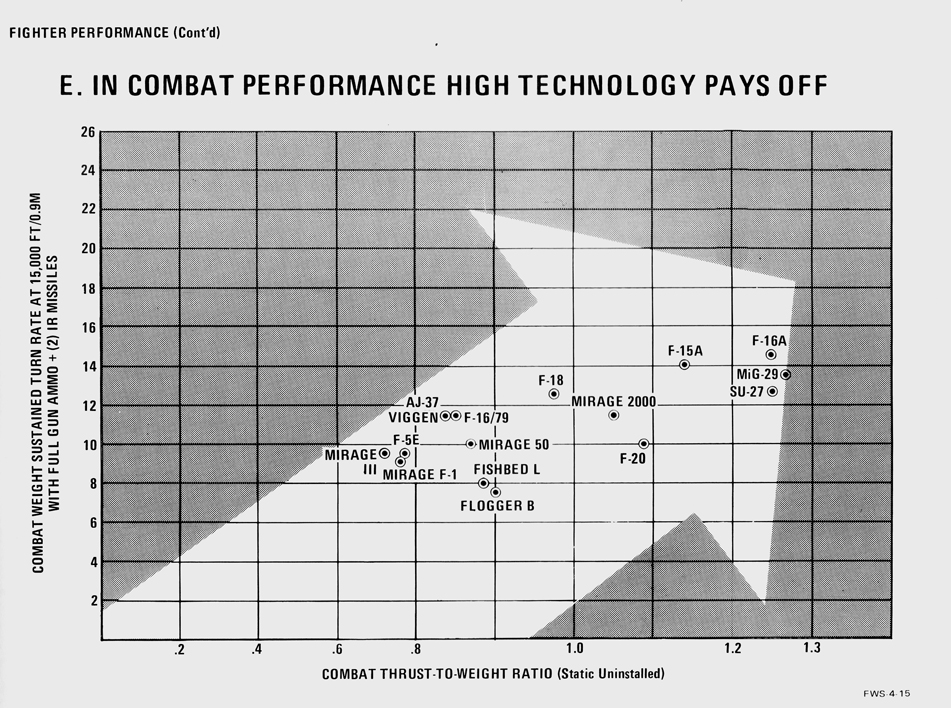
look at F-16/79 vs F-16, same airframe, different engine
or F-14A vs F-14D
mig-31bmIRSTs there won’t classify targets from 45,3 nm away and no funny things like “R-37M (tech late 1990s) ECM = always success” crap.
haha yes, IRST range in Command is ways too long, like literally longer than radar 😀
Well its not definitive X is better than Y. Inwards (then typically slightly outwards) curved design is more efficient, because it matches behaviour of vortex better. Such quick outward curve creates bigger vortex, but not “forces” the generation of the vortex in a controlled way, it merely creates bigger vortex at the cost of increased drag.
If you have enough room, F-16’s or Su-27s “pointed ogive” shape is always the best. Its not only for subsonics, it applies for supersonic as well (concorde’s wings for example). However there are several other design criteria to consider as well.
For example, F-18A/D has LERX designed for its wingspan. Enlarged wings on F-18E require larger LERX, but lengthening the LERX equally would mean either a) lengthening aircraft would result in extra weight or b) lengthening the lerx alone which would shift aerodynamic center to front (maybe even causing too much instability for elevators to handle, which in return requires bigger elevators which causes more drag than gains), and making pilot completely blind to his underside. So like everything else, F-18E’s design is a trade-off of multiple factors.
JF-17? If you don’t have the distance, you are stuck with quick outward ogive to genarate a vortex with sufficent meaning. TBH, JF-17 is one of the rare aircraft I would call copy (I dont even call Tu-160 or F-15 copy), which is an attempt to put some F-16’s aerodynamics on a F-20 clone. Within such constraints overly wide but short ogive design is way to go.
I see, very interesting, but isn’t JF-17 is same size with F-16? why didn’t they use same LERX with it?
the point about weight and center of gravity : isn’t LERX is very tiny and small? how could it weight enough to change center of gravity of aircraft ? ( i mean something like refueling probe would look like it would be alot heavier, or CFT look like they are alot heavier too, but they don’t seem to affect fighter alot)
BTW since canard alot bigger than normal LERX ( even the one F-16, Su-27) so they are better for maneuver ?
mig-31bmIf a relatively basic T-50 is able to hold its own against Block 4 pig even without datalink
no stealth datalink, not no datalink
and with the Pk dubiously shifted in favor of the AIM-120D,
how would you know AIM-120D isn’t better than RVV-SD?, what if they simulation based on physics and found that AIM-120D is a bit better
then it’s a good sign of the platform itself being superior..
you forget that
they didn’t simulate the jamming mode of APG-81
didn’t simulate ALE-70 FOTD that F-35 can carry, while they simulate T-50 jammer
you can shift the results in favor of the T-50 relatively easily by adding a better radar (GaN), stealthy datalinks, better passive sensors,
F-35 can get better radar too, and better jammer as well, assumed T-50 can also do the same, the end result would be both of them cant detect the other until the distance is too close and result based on lucky shot
new RWR etc..
in 1 vs 1, RWR cant really provide firing solutions
in many vs many, only one fighter will transmitting while other stay silent and received information from it, so RWR will be alot less useful than you preferred it to be
but you can never make the F-35 match the PAK-FA in terms of kinematics, …
but they can make missiles agile enough to shot down even the most agile fighter ( especially when launched more than one)
another possibility is that in future fighter will use DEW ( either laser or EMP) which mean kinematics will be much less important
mig-31bmNoone said so. And the original article is easy to find on Defesanet. V. Riller spent two full weeks testing Rafale.
read the old thread then
http://forum.keypublishing.com/showthread.php?134900-Rafale-news-amp-discussion-part-XVI/page19
Btw no use counting modules on a mock up presented for PAS…
that mock up is inside Rafale nose, whether you like it or not, there isn’t much space left, i know you hoped that the total TRM of F-35, F-18,, Gripen.. etc radar are less than mock up counting and the production radar of Rafale will have more TRM than mock up, but to be honest that quite delusional
mig-31bm@Mig-31
The inwards LERX gives the most efficient/ intense vortecs.
And like andraxx explained, the LERX that start way forward at the cockpit/nose section also gives the most efficient vortecs..
thanks for the answer
but if the inwards curve LERX is better then why J-17 and F-18 use their massive outward curve LERX? , i mean their flight is obviously after Su-27 and F-16, why they didn’t use the better solution?
Please excuse my ignorance, how is running a few head-to-head scenarios in Command: MANO in any way indicative of real-life performance? Even if we presume their simulation models are highly complex, the relevant platform data (e.g. F-35, T-50) is pretty much educated guesswork and that’s without even going into the AI models.
of course they wont know the exact performance of relevant platform , what they can do is
simulate battle based on value available to the public ( like kinematics, ew.. ect) , ( like if all these information available to public are true then what will happened, if formation of fighter A meet formation of fighter B)
mig-31bmEvery aircraft uses more fuel at SC than in subsonic. I have already provided the numbers for the Rafale, it’s four times as much.
I won’t be using any methods on the F-35, got no time for this.. If they can make more, then they would already have announced it. That program needs every bit of good news it can get. If they claim 150 miles, I am not quite sure they can reliably make even 130. My 0.02..
you have provided number, however that number isn’t from producer but from Picard estimation based on TSFC of M88 Specma and internal fuel load of rafale ( actually 35 min instead of 39 min but there are many bigger mistake )
his estimation would actually be alright if it isn’t based on many wrong assumptions from the start, such as ignoring fuel to take off, ignoring time to climb to optimum altitude , ignoring time to accelerate to mach 1.4, But the biggest mistake is assumed TSFC is a constant value, well it actually isnt, very depending on altitude and speed ( Andraxxus will explained this better than me, ) but any way, look at this :
https://books.google.com.vn/books?id=L9KYFB-wrbgC&pg=PA88&lpg=PA88&dq=TSfC+engine+jet+constant&source=bl&ots=DYGKlLdC0p&sig=FeQa67XJmAhpBD7KTSLJly4uH5E&hl=en&sa=X&redir_esc=y#v=onepage&q=TSfC%20engine%20jet%20constant&f=false
P/s : using your way of calculating, an F-35 can last around 19 min at low afterburner settings ( 30K thrust)
Only a matter of time.. Your F-35 can hardly fire an AMRAAM as we speak, wonder how much of that stealthy data link is actually working as we speak.
You cant install a bigger radar on Rafale, Typhoon, Gripen nose ( unless you redesign the whole aircraft for a bigger nose)
you cant install VLO characteristics on Gripen, Rafale, Typhoon either ( unless you remake the whole thing)
Also since lower RCS make jamming significantly more effective, so F-35 have advantage in that as well
I have already provided the figures.. 1,800kg/h @ cruise thrust, 8,000kg/h @ full dry thrust, 26,000kg/h @ max AB. The rest you can google up, it’s all there.
Rafale optimum cruise speed is not mach 0.9
and TSFC isn’t a constant value
You always ask up for evidence, now it’s time for you to back up your claims with something more than just bypass ratio. If you got numbers about the F-35 exhaust plume being significantly colder than one of a Gripen, then we’re talking. If you don’t, then it’s all garbage.
small mass of air move at high speed will have higher IR signature than big mass of air move at slow speed, simple physic.
the bigger bypass ratio is the more air will more through the fan instead of the engine core ( compressor) to produce thrust, the air move through the fan will move at slower speed and not combustion
engine optimum for supercruise would need to move small mass of air fast instead of big mass of air slow, ( same reason why F-135 isn’t optimum to supercruise despite having bigger thrust than F-119) , thus they will have lower bypass ratio, that lead to higher exhaust temperature
and reduce temperature by only 100 degree can reduce infrared radiation by half
You have counted 1,626 “valleys”.. The problem is that not every “valley” represents a TRM. The patent drawing you have posted shows the true arrangement. The real number should be around 1,480 TRMs. That affects even APG-80, BTW, which looks to be under 1,000 TRMs.
no, not every peak is a TRMs, but the valleys is
if you look carefully at the drawing, the number of “fake” T/R modules for each line is around 2-3 top , count the total number of line that shown the total reduction is around 40-50, top
As for the Rafale pic you have posted, I cannot recognize what exactly have you counted. But without the info regd. how the TRM arrangement looks like you’re basically pulling numbers out of thin air. Given the smaller dimensions of the Raffie’s nose I expect 900 +/- 10% GaAs type TRMs.
the picture showed the number of peak on Rafale, so it is basically the best case scenarios for rafale, so no Rafale wont get 900 +10% TRMs, sorry
mig-31bm.
, F-5E’s and MiG-31’s tiny root extensions all work in same very basic principle but size does matter here, and none of these can possibly approach 1/4 the intensity F-16/Su-27 achieve with their LERX (size relative to wing size of course.
why does F-5 and mig-31 lerx considered tiny but Su-27 and F-16 one are considered big? they look equal to me ( relative to the wing of course, in fact the one on f-5 look really big compare to the wing)
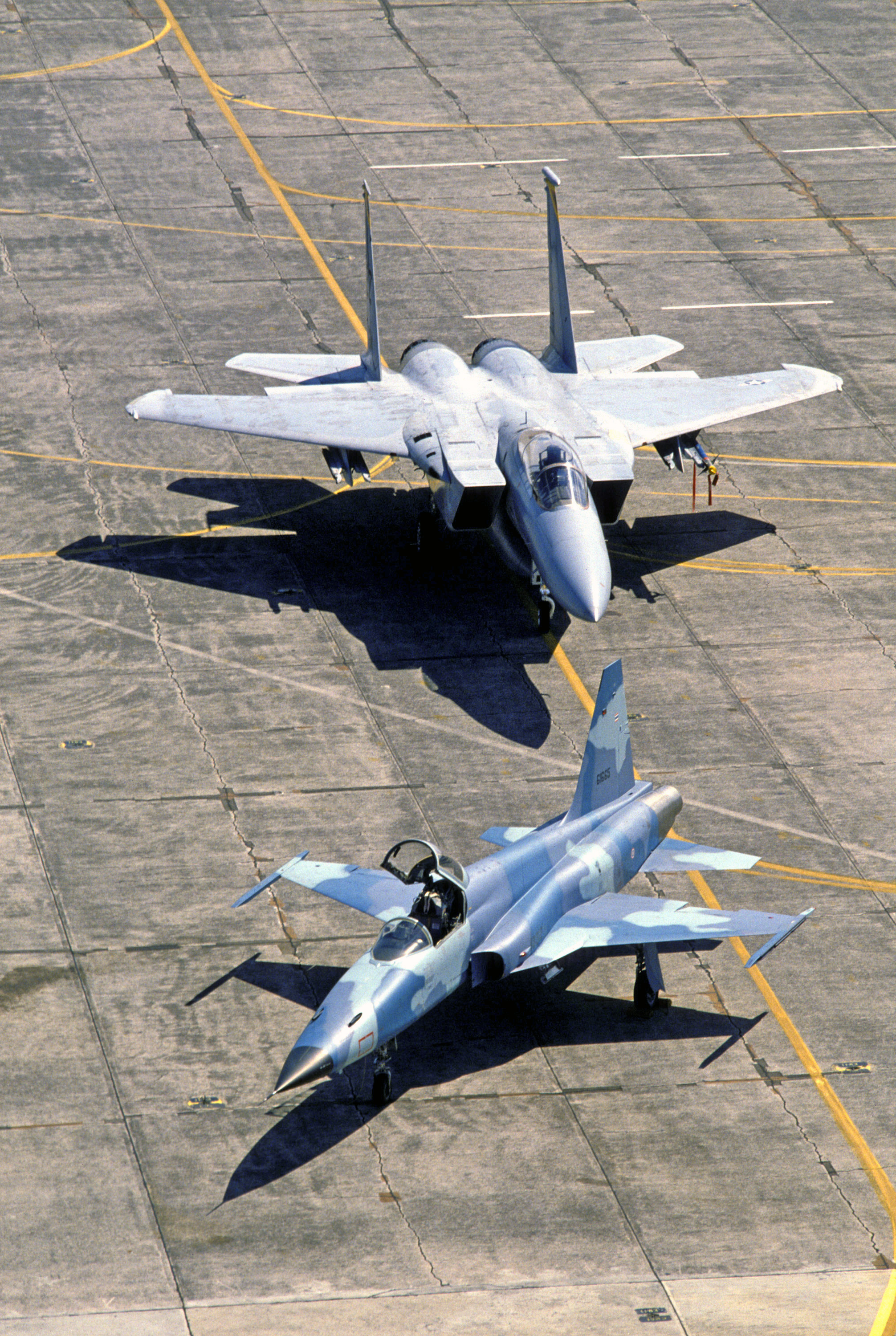
vs

also what kind of LERX is better? the one on F-18E or the one on F-16 , i know they are both LERX but they curve different way through , one is out ward one is inward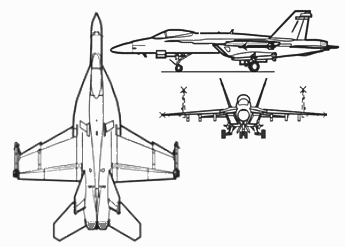

mig-31bmthe resolution is low, we can dismiss theories of pinpointing anything BVR when they dont provide resolution on par with eyes,
as has been said before: its first and foremost a missile launch detector, and useful detecting obstacles close up,
like your wingman during night flight
a radar wont provide same resolution with your eye ( in fact, alot worse due to their wavelength ) , and they still use it for BVR
mig-31bmthrust proportional to the amount of heat generated.
that not true :
a Mi-26 have max thrust > 123,450 lbs but it won’t create any where as much infrared radiation as an Mig-21 on full afterburner, even though , a mig-21 only have maximum thrust of 15,650 lbf
mig-31bmRafale can supercruise for 39 minutes.. Typhoon probably even longer…
You misunderstanding the 9-10 minutes figure for F-22 and F-35, that is not the total distance they can fly supersonic but rather, the supersonic part that included in the total combat radius ( already been explained in the analysis by aerodynamic engineer i posted several page ago) , because, even for F-22 flying at supersonic will use more alot more fuel than subsonic. I never heard about Rafale supercruise for 39 minutes but If you want to calculate the time Rafale can fly at supersonic by using TSFC, then we can use the same method for F-22, F-35, and the result will be alot bigger.
DDM-NG is by no means magic.. EODAS is not much more useful.
DDM-NG have only 2 sensors and have to use fish eye effect to see around ( and there still significant part blocked by the airframe ) , DAS have 6 sensors so each sensor have to cover alot less volume of sky) , i didnt see you disagree when people on Rafale thread say they heard some unnamed pilot say DDM-NG allow track, attack enemy’s fighter, or even estimated range to a missiles
Biased much? :rolleyes:
Still they got everything pretty comparable.. Makes one wonder how’s that possible..
i dont see they are compatible at all
Rafale, Typhoon lacks stealth data link
Gripen, Typhoon lack DAS like system
Rafale, Gripen, Typhoon all have smaller radar than F-35
Rafale, gripen, Typhoon all lack VLO characteristics
For M0.7-0.8 it surely doesn’t.
150 miles at mach 1.2 without afterburner
I did not say 1/4 thrust. I said 1/4 fuel consumption @M0.9 [1,800 kg/h] compared to max thrust @M1.4 [8,000 kg/h]
any evidence that Rafale use only 1/4 fuel at M0.9 compared to M1.4?
. The amount of IR energy is, of course, quite proportional to amount of fuel burned.
no, it have been explained to you before, a big mass of air move at slow speed will have less Infra-red signature than small mass of air moving at high speed
( helicopter rotor will have alot less IR signature than an jet engine )
The number is inaccurate.. It has been discussed before.. you need to count “valleys”, not “peaks”.
Same for APG-80 (obviously using the same modules)
yes we did, and even counting by that method APG-81 still have around 1626 TRMs so my point stand
You are counting the “peaks” as the T&R module but the “valley” is the actual T&R module antenna aperture.
You can tell this due to the “peaks” at either end of a strip are half the size of the rest of the “peaks”.
In this YouTube primer on AESA building blocks (the 1:55 mark), you can see the T&R modules and how they sit behind the apertures along with the aperture Peak and Valley layout.
https://www.youtube.com/watch?v=XRKqnYQl4mE#t=125
Wideband radiators, such as the Vivaldi flared notch emerged to address the needs of wide bandwidth systems. The flared notch provides broadband performance with nominally linear polarization. Because of its broad beamwidth, it is ideal for electronically scanning antenna arrays with scan volumes of at least 60 degrees. – See more at:
http://www.raytheon.com/news/technology_today/2014_i1/aesa.htmlThe -81 uses a printed circuit-board type of flared notch antenna while the -79 uses an injection molded radiator assembly and antenna assembly. This explains why the faces of the -81 and -79 look so different.
http://www.google.com/patents/US6127984
http://www.google.com/patents/WO2013180828A1
http://www.google.com/patents/US20050088353
I got 1626
original link here :
http://forum.keypublishing.com/showthread.php?133321-F-35-News-Multimedia-amp-Discussion-thread-(2015)/page3
Also FYI
using same original counting method :
APG-80 have 1020 TRMs
APG-79 have 1368 TRMs
your beloved Rafale have around 840-863 TRMs give or take
mig-31bm.
If you are referring to the canted area at wing roots, yeah it would produce a vortex which would actually be useful (and withness the benefits of CFD, no appearant body part, but airflow is still directed above wings with pressure differences). Still I would question the intensity of such vortex when compared to F-16/18.
here is scott reply Andraxxus :
I appreciate Andraxxus time in going through my data. I certainly have it out there to be reviewed and anyone who can aid in the accuracy only increases the overall knowledge base. I have no way of knowing which version (I have four so far) of my analysis he was judging. My responses to his points are as such, and please go back and share my responses.
Of course the F-15 doesn’t have a static MAC. 27% was not the best choice on my part and I have in my most recent version recanted the “Stable” part of that discussion as the Strike Eagle borders on neutral stability per other texts of the Manual.
For Strike Eagle max lift I used 40,000lb at sea level with power off for 125 kt, yielding which gives 1.24. With his 1.2028 I think we are splitting hairs. The reason it is much lower than the others is, in my opinion, due to the lack of full instability, LEF, and any LERX/chines.
For Viper lift, he goes on about how G, speed, and altitude matter. That was not the purpose of this section. I was trying to demonstrate the highest Clmax the F-16 could generate 9G with as that will give the “best” turn, even though the CAT-1 limited gives a best turn rate at ~8G and best radius at ~3G. You cannot use mil thrust as a stall indication as installed dynamic thrust does not equal (is less than at stall speeds) rated thrust.
As for the F-35, it has Chines which perform the same action as the LERX as evidenced by the vortexes they generate so I did not penalize it. The F-35 also has LEF, so again I am not penalizing it. What he is not bringing up is that both of these aircraft are fully unstable. This means the horizontal tails make lift. This added lift “adds” to the “reference” CLmax the same as a LERX does. Relatively speaking, the F-35 has a MUCH larger tail and it is deflected at least as much as the F-16 tail if not moreso when under similar circumstances. This means that that the tail of the F-35 has to make proportionally more lift than the tail of the F-16, so I gave it a higher Clmax. If he wants to disagree on this point he is certainly allowed to, the actual value will not be known to the public for decades to come.
For ITR he seems to take each of them to 9G and calculate ITR for the speed required by his ClMax analysis. I went a different route and showed what their ITR would be at the cruise speed for the mission based on the Manual (F-15E and F-16C) and my CLmax analysis (F-35A). So his is not wrong per say, just different.
STR is given in both Manuals for F-15E and F-16C so there is not a lot of guesswork involved.
For the F-35 I have to generate a model of dynamic thrust and work backwards through the induced drag equation to estimate the extra Cl available. This is, I admit wholly, the least accurate part of my analysis as it requires the most assumptions.
On to the payload. He is using an F-15A-1 not an F-15E-1. The F-15A-D are cleared to 700/2.0M with CFT/Fueselage mounted missiles. The SAME PAGE of the F-15E-1 lists 660/1.4.
Send him my regards, I appreciate the review.
F-15’s LERX-like structure is a different -symetrical- airfoil (64A006). Its by definition not an extension of the wing’s leading edge. It would of course produce a vortex, but again I would question the location and intensity of the vortex.
so basically to be consider lerx the thickness have to be the same as the wing?
BTW you are right though , i cant find pictures of F-15 with vortex on top


 Sign In








