 mig-31bm
Look it up.. Google is quite full of it..
here
Sukhoi has not touted loaded supercruise (Mach 1+, with weapons and without afterburners), which is likely to require improved engines.
http://www.defenseindustrydaily.com/russias-su-35-mystery-fighter-no-more-04969/
not much else
The F-35 cannot sustain that speed in dry thrust.. it has to engage burner every now or then or in few mins the speed falls down below supersonic
,
F-22 only have 100 nm of supercruise radius in it’s total combat radius, 100*2*1.852=370 km, at mach 1.7 that is just over 10 minutes
F-35 can maintain mach 1.2 in dry thrust for at least 150 miles
150* 1.610 = 241 km , at mach 1.2 that is over 9.89 minutes
No evidence that Rafale, Gripen, Typhoon, Su-35 can even supercruise that long
and F-35 have to use afterburner ever now and then is only your baseless assumption , an actual aerodynamic engineer already did analysis and calculations, his conclusion is completely different from your
DAS is a short-range fixed 1x mag system for ground targets. Not much use in A-A.
oh really? how? , DDM-NG with only 2 camera is such magic, but DAS with 6 different camera is suddenly only good for ground target
These are not $390bil programs, they need much less sales to hit a break even..
well, less budget = less money to develop modern radar, RWR, IR sensor.. etc
You got absolutely no data about that, whatsoever. All the buzzwords about reduced IR emissions mean nothing if you don’t know the comparison base..
already, posted the graph several page ago
LOL, no. First, the shorter reaction times more than balance out this “disadvantage”.
faster also mean more closure rate, with mean you also have shorter reaction time if enemy launch missiles at you
Second, these designs don’t have to kick the burners = less IR signature.
F-35 doesn’t need the burner either
A Rafale can fly M0.9 using 1/4th of nominal fuel consumption of full dry thrust..
find a source that say Rafale can fly at mach 0.9 on 1/4 dry thrust then
What did it jam?
F-22 radar
The Sh-121 radar is 1,526 TRMs.. Do your homework first.
APG-81 have 1676 TRM, you do your homework !
mig-31bm– RCS – same from front, could be even slightly less from side, 4x greater from behind
Quite bias
Russian themselves said PAK-FA sacrifice VLO characteristics for more kinematics characteristics, while USA said opposite about their F-35, and some obvious features such as the direct intake that show engine fan blade, i dont see T-50 habe equal RCS with F-35*from front
dont really see why PAK-FA would have better RCS from side either
– IR at equal speed – same from front and sides,
unlike F-35 vs rafale or Typhoon, the PAK-FA is actually significantly bigger than F-35, it more like su-27 size, it also lack IR suppressing paint, IR signature will be bigger from front and side ( may be not to much, but still bigger)
– RVV-BD as Meteor equivalent
they are not similar at all, very different kinematics characteristics
, iam not saying Meteor is necessary better but they are for very different purposes
, RVV-SD as equivalent for AMRAAM,
ok, this is acceptable
– IRST – hard to say, should be more advanced than that but make it equal to EOTS as a start
I dont see why PAK-FA should be more advanced than EOTS, while OLS-35 is quite inferior in term of detection range, LFR range isn’t good either
. Look up 101KS-O type, plus 101KS-N, 101KS-V and 101KS-U distributed system
both PAK-FA and F-35 will have DIRCM, however, PAK-FA doesnot have similar IIR tracking, warning system like DAS, what it have is a UV missiles warning receiver
– Sh-121 radar (1,526 TRMs) range +30% compared to AN/APG-81.
the radar is actually N036, and APG-81 have 1676 TRMs, i dont see why PAK-FA should have 30% more range than APG-81
– datalink signature – no data, make the same
F-35 have stealth directional datalink, never heard of similar thing on PAK-FA
– RWR – no data, make equal for both LPI and non-LPI
doing this would similar to say, we dont know the exact turn rate of PAK-FA and F-35 so let make them equal
mig-31bmExactly. Hence how answering OooShiny’s (valid enough) question is impossible.
Where did that come from? I have to confess, I find it very hard to believe the 2.3 GHz figures unless the measurement was taken dead square and centre ahead.
here
http://www.hitechweb.genezis.eu/stealth2.htm
I used to see a picture that they use software to measure the reflection spike of stealth aircraft at low frequency (1-2 Ghz) , it higher than at 10 Ghz, but wasn’t as high as we imagined though
mig-31bmNo, I can’t.
I don’t know the numbers for how the change in wavelength will affect the RAM’s effectiveness. Nor can I state how much resonance there will be off features on the F-35 that are approximately 8-15cm in length.
How long is the aileron chord?
How long is the rudder chord?
How long is the slat chord?
Or the EOTS pod?
Or the width of the intake?
I know once the radar wavelengths are of the order of the part feature, VLO is out the window.
..
actually it is quite abit more complicated than that

a subordinate mode of surface wave behaviors is the ‘creeping wave’ behavior and its attendant 10-lambda rule. Lambda (λ) is symbolic of wavelength. The 10-lambda rule states that if the diameter (sphere or cylinder) is 10 times the wavelength that is impacting the body, the creeping wave behavior will not occur. Creeping wave behavior contribute to RCS. So if the impacting wavelength is in the mhz range, as in meters length, then the object would have to literally be tens of meters across in order to prevent the creeping wave behavior contributing to RCS, but that is only a simple body, like the cylinder , a complicated body like an aircraft would be alot harder to predict the way that radar wave will interact with the body, the only way to know is if we have actual equipment to measure
Just because the frequency isn’t X band doesn’t mean the RCS of stealth aircraft will suddenly go up to thousands square meters, For example : here is F-117 prototype RCS measure in test again different frequency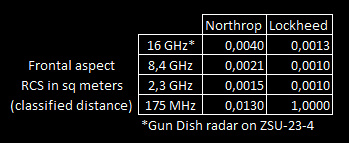
Well his work seems thorough and accurate in method, I don’t share his assumptions, and accuracy of calculations. Let me put a wall of text and some data to point out his mistakes or areas I don’t agree.
Firstly, thanks for great answer Andraxxus , very detailed , i will post your analysis over there and see what he say
F-15 Flight manual gives stall speed at 30000 lbs exactly at 110 knots. Calculating Clmax from these gives us Clmax=1,2028 .
Incedentally, F-15’s maneuvering Clmax is given by Soviet booklet is 1,0. My calculation gave (1-0,147)*1,2028 = 1,02; not too bad.
i dont quite get this part, what is that 0.147 value?
“. As for F-35, such lifting body design is not present on F-35 to any degree (its more like F-15’s body lift than Su-27 with lifting body), has no lerx to make airflow stick to wings, and my mk1 eyeball inspection tells it uses MUCH thinner wings than the profile above. (Abominal extensions below wing roots don’t count as wings)
.
iam bit curious about this, F-35 seem to have the vortex part on the top of its wing similar to fighter with LERX? does it not?

how exactly to distinguish LERX wing and normal wing based on look? , i asked this because the part on F-15 wing look alot like Lerx, but it actually isn’t so i was really surprised
mig-31bm– the F-35 would not be able to supercruise
mach 1.2 dry thrust though
– the F-35 would not meet the original KPPs in almost anything
here :
PARLIAMENTARY JOINT COMMITTEE ON FOREIGN AFFAIRS, DEFENCE AND TRADE 20 MARCH 2012 (Tom Burbage) Transcript:
For any performance-related requirements, we artificially penalise the engine by five per cent fuel flow and two per cent thrust. Those margins are given back as we mature the design and get more and more solid on exactly what it is going to do. They are there for conservative estimation up front. We have not taken back any of those margins yet so, when those margins are taken back, the airplane will continue to be well in excess of its basic requirement
– the F-35 would not become a good WVR performer
equalise range ( combat radius of 500 nm) , each aircraft would need :
F-15E = 58% fuel, = 18000kg
F-16C = 83% fuel. = 11735kg
F-35A = 57% fuel. = 18082kg
Su-27 = 40% fuel. = 20060kg (50% should easily reach
While carry these amount of fuel all can pull 9Gs, their ITR will differ by speed;
F-15E = 17,17 deg/s @ 292 m/s,
F-16C = 16,07 deg/s @ 313 m/s,
F-35A = 17,6 deg/s @ 285 m/s,
Su-27 = 20,96 deg/s @ 240 m/s
F-35 isn’t particularly bad here, not to mention DAS, DIRCM
– there will not ever be 200+ airframes produced annually
still more than Eurofighter, Rafale, GripenNG does it
– there won’t be hundreds of jets exported with all nations breaking their necks to get some
your prediction being wrong so far, F-35 export number and customer far surpassed Rafale, Eurofighter or Gripen NG
– there won’t be 2,443 jets procured for US forces, not even close to that
still more than Rafale, Typhoon, gripen , T-50 regardless
no IR suppression visible, the aircraft will be exactly as easy to lock on as anything else
Ah no,
Higher bypass ratio = less heat ( in that aspect, F-35 is better than Rafale, Typhoon, T-50, F-22, F-15.. etc)
LOAN also help created instable pume that mix with cool air faster
decrease 100 degree in temperature will significantly reduce IR signature
F-35 also have paint ( topcoat) that attenuate IR radiation emissivity at the surface
Also since T-50, Rafale, Typhoon, F-22 allegedly have faster cruise speed than F-35, the friction at the surface will be higher => more heat => they can be detected easier
– there won’t be electronic frying of opponents using APG-81
actually jamming by APG-81 have already been tested along time ago
– there won’t be 6x internal AMRAAMs or 4x Meteors before ~2025
at least you are not delusional enough to think MBDA will purposely miss out a big market
– there won’t be considerable advantage in situational awareness vs its peers
still bigger radar than Gripen NG, Rafale, Typhoon, F-16, F-18.. etc
nit much known about T-50, j-20 radar though ( but their radar actually have less T/R modules than F-35)
– there won’t be air superiority vs T-50 or J-20, quite on the contrary
let say if that true, then the same will applied to all these 4, 4.5 gen fighter,
mig-31bmNo, the F-35 Can’t Fight at Long Range, Either: Stealth fighter can’t see, shoot or survive
it would be great if you can read previous page before posting this garbage, now i have to repost
the original article here
https://medium.com/war-is-boring/no-the-f-35-can-t-fight-at-long-range-either-5508913252ddF-35 Joint Strike Fighter is dead meat in a close battle against even a dated two-seat F-16D fighter jet, according to a scathing test pilot report War Is Boring obtained.
=> author clearly didn’t know the objective and criteria of the test
, according to pilot, the F-35 was supposed to go full elevated AoA to test the software , F-16 was there for observations rather than to winThe stealth fighter lacks the sensors,
really? how? what magical sensors that others fighter have that F-35 doesn’t?
weapons
how is F-35 lacking BVR weapons? , does other competitors carrying DEW now?
and speed that allow a warplane to reliably detect and shoot down other planes in combat.
what speed you would need to shot down other planes? mach 2 like F-16? or mach 3 like mig-31?
To this end, the F-35 does have a high-tech radar, high-fidelity cameras and other advanced gear that can detect airplanes. But foremost, Lockheed optimized these sensors for spotting targets on the ground — and at relatively short distanc
please explained to me how F-35 radar have shorter range than Rafale, Typhoon, Gripen NG, F-16, F-18, AV-8B, Mig-35, .. etc?
and how is APG-81 is only optimized again ground target?
How is ASQ-239 short range? or only work again ground target?
How is EOTS short range?, what make it only optimise again ground target?
DAS may have short range but what make it only optimise again ground target?according to data compiled by Carlo Kopp at Air Power Australia.
enough said, garbage in, garbage out
Kopp estimates the APG-81 can detect an aircraft with a radar cross-section of three square meters—a MiG-29, for example—just over 100 miles away.
Nonsense, in testing APG-81 can track target with RCS = 1 m2 from 160 km, and tracking range is very different from detection range
it’s likely that none of the opposing pilots would even want to activate their radars at all. That’s because most fighters carry gear that can sense radar waves and pinpoint their origins.
author simply doesn’t understand how RWR work
Remember, the F-35 has one huge and very hot engine
repeat same BS argument from APA, pretty sure he doesn’t know about bypass ratio
those long-wavelength, low-band radars that Russia, China and Iran are building right next to potential hotspots in Europe, East Asia and the Middle East.
Author doesn’t know that low band radar doesn’t have enough azimuth angular accuracy or elevation angular accuracy to cued missiles
Pierre Sprey, an experienced engineer who worked on both the F-16 and the A-10 ground attack plane.
let me remind all of you this is the guy who think F-15 is useless with all it’s Radar and ECM, according to him fighter doesn’t need a radar or ECM or radar guide missiles
Tehran insists its Ghadir radar can spot jets more than 300 miles away
Teheran also claimed they made a stealth fighter
Russian arms-dealer Rosoboronexport claims the Rezonans-NE can detect stealth planes nearly 750 miles distant.
Firstly, they didn’t claim their radar can detect stealth fighter from 750 miles, they claim they detect normal fighter from 350 km
Secondly, according to producerThe Rezonans-N radar is a mobile highly automated coherent all-round surveillance phased-array radar employing the resonance wave reflection effect in the metric wavelength band.
which mean it use sky scattering effect to see over radar horizon, as a result it can detect low flying target even at long distance like 1000 km , but it also mean similar to all other sky scattering radar it have a huge blind area near the radar location ( like 400-500 km)
https://en.m.wikipedia.org/wiki/Over-the-horizon_radarThat means a “supercruising” fighter such as the Su-35 — that is, a fast-flying plane that exceeds the speed of sound without a fuel-guzzling afterburner
since when Su-35 can super-cruise? and at what speed?
Unable to supercruise like its rivals, the JSF can’t launch its own weapons with nearly as much extra power
F-35 can fly for 150 miles in dry thrust at mach 1.2, not supercruise but not too bad
before anyone say why it is only 150 miles, does F-35 run out of fuel or in a dive, i posted an analysis by an aerospace engineer degree earlier, you can read at the link, there is explanationF-35 can only carry four AIM-120
after block 4-5, it is 6 aim-120D
The more conventional Su-35 can carry a whopping 10 missiles under its wings and fuselage.
People like to bash, F-35 acceleration rate, but F-35 take 64 sec to accelerate from mach 0.8 to 1.2, Su-35 with 4 aam take 50 sec , let see how long Su-35 take to accelerate with 10 aam, and how fast it can cruise with 10 aam
In the Pacific Vision war game, which the California think-tank RAND conducted on behalf of the Air Force, F-22s and F-35s lost a simulated aerial battle over the Taiwan Strait
RAND, already said they didn’t conducted that simulation
mig-31bmback to the F-35, here’s a pilot talking about the new helmet
http://foxtrotalpha.jalopnik.com/f-35-pilot-seems-unimpressed-with-jets-x-ray-like-visio-1717500325
I’m quite disapointed, the DAS system for one sounds rather poor, at least for spotting a target
also it seems you can’t just project a rear-view of the F-35 while looking forward, like a digital rear view mirror. that sucks
and finally he compares cockpit visibility of the F-35 with the F-16 and F-22, saying that they are designed for air superiority, while the F-35 is not
He also said that
– some one can sneak on him if he was on an F-16, and no one can sneak on him if he is in an F-35
– No fighter can compete with F-16 and F-22 in cockpit visibility ( which likely including F-15, F-18, Su-27, MiG-29, probably even the Eurocanard)
– if you fly the plane right , opponents will be destroyed before they get into the merger
mig-31bmThe F-35 is a big, slow target.
if F-35 is big then F-15, Su-35, F-22, J-20.. etc would be massive
Typhoon and Rafale are not that much smaller than F-35 either
Slow you say? : F-35 can fly at mach 1.2 in dry thrust with internal load ( 6 aam or 2aam + 2JDAM) , Rafale can fly at mach 1.4 on dry thrust with 6 aam, Gripen can fly at mach 1.2 in dry thrust with 2 aam, … etc i dont see F-35 being slow at all, if you want to talk about top speed then all F-35, Typhoon, Gripen NG, Rafale are all slug compared to fighter like F-15, Mig-25, Mig-31
You think F-35 isnt agile enough? consider the fight is 500nm out from airbase, to reach that distance, each fighter will need :
F-15E = 58% fuel, = 18000kg
F-16C = 83% fuel. = 11735kg
F-35A = 57% fuel. = 18082kg
Su-27 = 40% fuel. = 20060kg (50% should easily reach
while carry that amount of fuel, all can pull 9Gs, their ITR will differ by speed;
F-15E = 17,17 deg/s @ 292 m/s,
F-16C = 16,07 deg/s @ 313 m/s,
F-35A = 17,6 deg/s @ 285 m/s,
Su-27 = 20,96 deg/s @ 240 m/s
I dont see F-35 as particularly bad here, what ITR fighter like Gripen NG, Rafale, Typhoon will achieved in same situation?
Pretty much shows how “realistic” this simulation is.
If we consider Meteor PK around 40% again agile target , 4 of them will ensure a kill most of the time
let say if each AIM-120D only have PK around 20% ( half of Meteor) , 4 of them will have total PK of around 80%, which mean if F-35 release all 4, it will be a kill most of the time
so obvious that the end result would be similar
10-15 T-50s? In total? 😉
yes, until 2025, not much will be bought
M1.2+ clean.. no further data has been revealed..
Source?, never heard about that anywhere , apart from APA crap
mig-31bmadding to the virtual air battle
No, the F-35 Can’t Fight at Long Range, Either
http://www.defense-aerospace.com/articles-view/release/3/165258/why-the-f_35-can%E2%80%99t-fight-at-long-range%2C-either.html
Full of garbage nonsense to stay polite
the original article here
https://medium.com/war-is-boring/no-the-f-35-can-t-fight-at-long-range-either-5508913252dd
F-35 Joint Strike Fighter is dead meat in a close battle against even a dated two-seat F-16D fighter jet, according to a scathing test pilot report War Is Boring obtained.
=> author clearly didn’t know the objective and criteria of the test
, according to pilot, the F-35 was supposed to go full elevated AoA to test the software , F-16 was there for observations rather than to win
The stealth fighter lacks the sensors,
really? how? what magical sensors that others fighter have that F-35 doesn’t?
weapons
how is F-35 lacking BVR weapons? , does other competitors carrying DEW now?
and speed that allow a warplane to reliably detect and shoot down other planes in combat.
what speed you would need to shot down other planes? mach 2 like F-16? or mach 3 like mig-31?
To this end, the F-35 does have a high-tech radar, high-fidelity cameras and other advanced gear that can detect airplanes. But foremost, Lockheed optimized these sensors for spotting targets on the ground — and at relatively short distanc
please explained to me how F-35 radar have shorter range than Rafale, Typhoon, Gripen NG, F-16, F-18, AV-8B, Mig-35, .. etc?
and how is APG-81 is only optimized again ground target?
How is ASQ-239 short range? or only work again ground target?
How is EOTS short range?, what make it only optimise again ground target?
DAS may have short range but what make it only optimise again ground target?
according to data compiled by Carlo Kopp at Air Power Australia.
enough said, garbage in, garbage out
Kopp estimates the APG-81 can detect an aircraft with a radar cross-section of three square meters—a MiG-29, for example—just over 100 miles away.
Nonsense, in testing APG-81 can track target with RCS = 1 m2 from 160 km, and tracking range is very different from detection range
it’s likely that none of the opposing pilots would even want to activate their radars at all. That’s because most fighters carry gear that can sense radar waves and pinpoint their origins.
author simply doesn’t understand how RWR work
Remember, the F-35 has one huge and very hot engine
repeat same BS argument from APA, pretty sure he doesn’t know about bypass ratio
those long-wavelength, low-band radars that Russia, China and Iran are building right next to potential hotspots in Europe, East Asia and the Middle East.
Author doesn’t know that low band radar doesn’t have enough azimuth angular accuracy or elevation angular accuracy to cued missiles
Pierre Sprey, an experienced engineer who worked on both the F-16 and the A-10 ground attack plane.
let me remind all of you this is the guy who think F-15 is useless with all it’s Radar and ECM, according to him fighter doesn’t need a radar or ECM or radar guide missiles
Tehran insists its Ghadir radar can spot jets more than 300 miles away
Teheran also claimed they made a stealth fighter
Russian arms-dealer Rosoboronexport claims the Rezonans-NE can detect stealth planes nearly 750 miles distant.
Firstly, they didn’t claim their radar can detect stealth fighter from 750 miles, they claim they detect normal fighter from 350 km
Secondly, according to producer
The Rezonans-N radar is a mobile highly automated coherent all-round surveillance phased-array radar employing the resonance wave reflection effect in the metric wavelength band.
which mean it use sky scattering effect to see over radar horizon, as a result it can detect low flying target even at long distance like 1000 km , but it also mean similar to all other sky scattering radar it have a huge blind area near the radar location ( like 400-500 km)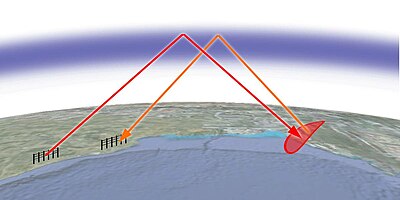
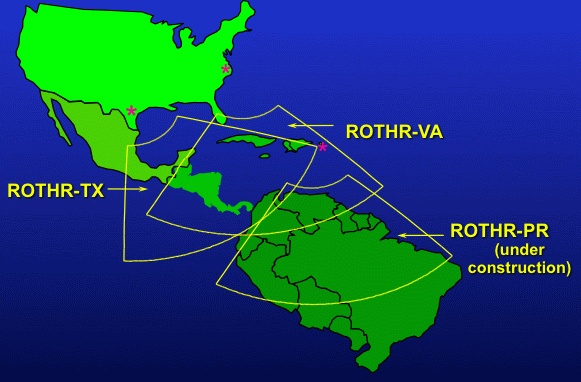
https://en.m.wikipedia.org/wiki/Over-the-horizon_radar
That means a “supercruising” fighter such as the Su-35 — that is, a fast-flying plane that exceeds the speed of sound without a fuel-guzzling afterburner
since when Su-35 can super-cruise? and at what speed?
Unable to supercruise like its rivals, the JSF can’t launch its own weapons with nearly as much extra power
F-35 can fly for 150 miles in dry thrust at mach 1.2, not supercruise but not too bad
before anyone say why it is only 150 miles, does F-35 run out of fuel or in a dive, i posted an analysis by an aerospace engineer degree earlier, you can read at the link, there is explanation
F-35 can only carry four AIM-120
after block 4-5, it is 6 aim-120D
The more conventional Su-35 can carry a whopping 10 missiles under its wings and fuselage.
People like to bash, F-35 acceleration rate, but F-35 take 64 sec to accelerate from mach 0.8 to 1.2, Su-35 with 4 aam take 50 sec , let see how long Su-35 take to accelerate with 10 aam, and how fast it can cruise with 10 aam
In the Pacific Vision war game, which the California think-tank RAND conducted on behalf of the Air Force, F-22s and F-35s lost a simulated aerial battle over the Taiwan Strait
RAND, already said they didn’t conducted that simulation
i do think that unless GB pushes hard, Meteor won’t be modified to fit into internal bays,
its the only customer that would contemplate paying i think,
hope some brit can suggest the odds in favor
MBDA say they will do it
UK bought F-35
Japan also cooperate with MBDA to make a version of Meteor with AESA seeker for their F-35
amd given the huge sale number of F-35 compared to most modern fighter, i dont see MBDA stupid enough to stay out of market
mig-31bma) The F-35s have AWACS and ELINT support, while the Su-35Ss have nothing of that. Where are Beryev A-50Us and Tu-214Rs?
actually if you read the whole link you will see that they added support for Flanker later, both AWACS and jamming support
Adding the A-50 as AEW support to Red proved pointless as the F-35s still were invisible to its radar
After about 15 runthroughs with the Su35s being shot out of the sky I decided to add more Red support assets. The first being a A-50 ‘Mainstay’ to provide AEW coverage and the second a Su-24MP Fencer F EW variant to provide jamming capability. – See more at: http://aerosociety.com/News/Insight-Blog/3272/Does-the-F35-really-suck-in-air-combat#gallery[m]/43/
few people having the game also tried themselves with different tactic such as adding ground radar support :
I used my own copy of C:MANO to add a quick twist. I dropped a slew of ground-based radars into Kaliningrad, and found that a new-build TALL RACK radar was able to give a moderate 3D picture of our plucky stealth fighters – enough to cue the Flankers in their general direction. This did not alter the end result, as the TALL RACK was unable to generate enough of a “basket” for the fighters to shoot into before the F-35s had gotten plenty of shots off – See more at: http://aerosociety.com/News/Insight-Blog/3272/Does-the-F35-really-suck-in-air-combat#gallery[m]/43/
b) if the author wanted to include weapons which the F-35 will field in the future (Meteor), then it would be intellectually honest to do the same for future Russian weapons (RVV-SD, RVV-MD…), as well.
doesn’t actually matter since Su-35 doesn’t get any shot off
RVV-BD is similar to R-33, Aim-54, more suited for big, slow target
, RVV-MD is short range missiles similar to R-73 and the F-35 didn’t even go there so i dont see why it matters
the author also did a test with F-35 carry Aim-120 and results turn out the same
c) by the time the Meteor gets integrated onto the F-35, the T-50 might already be in series.. If we’re talking post Block 4, then let’s take the future Russian designs into the account…
the main criticism at the moment is that many people think 4.5 gen design like Su-35, GripenNG, Typhoon, Rafale beat F-35, so that may be the intension of author why he would test F-35 again a 4.5 gen fighters
should also consider the fact that according to recent news Russian only gonna buy like 10-15 PAK-FA, number too low to be an actual threat
d) The F-35 cannot carry four Meteors internally. The missile is only compatible with the internal A-G stations.. The A-A stations cannot accept the missile without mods of the fin span and air intakes.
http://www.flightglobal.com/news/articles/picture-mbda-reveals-clipped-fin-meteor-for-f-35-347416/
Air intake doesn’t need modifications , MBDA said they will make folding fin Meteor so that it will fit F-35 AA station ( similar to the modifications between aim-120A/B and Aim-120C) , given the huge number of F-35 sales and the fact that UK themselves also bought F-35, there is no reasons for MBDA to miss out from such huge market
Japan also cooperate with MBDA to make a Meteor version with AESA seeker for their future F-35
mig-31bmThere are several claims floating around.
M1.4 SC with six missiles
https://defenseissues.wordpress.com/2014/07/05/supercruise/
[url]http://www.abovetopsecret.com/forum/thread188667/pg1%5B/url
Ok, one of them is blog written by Picard ( which is even more ridiculous than Carlo Kopp
the other is forum link
alright, i can accept this
Rafale can supercruise at mach 1.4 with 6 aam
and fly supersonic ( unknown speed) with 1 belly drop tank and 4aam ( small 1000L tank in belly)
M1.x SC with four missiles and a belly drop tank
https://en.wikipedia.org/wiki/Supercruise
normally, i wouldn’t accept Wikipedia, but this time ok
similar information with the link above
M1.4 SC with four missiles and two LGBs
http://sajeevpearlj.blogspot.de/2015/07/rafale-talks-once-again.html
..
1) it a blog not a website
2) your link have too many ridiculous claim by itself to consider its information valid
Super Cruise in Super sonic Speed
which means the engines can power the Aircraft without burning any flames
what.????
Rafale is invisible in Long ranges even with Air to air missiles and PGM
what????
The Rafale Performed the same in Libya by eliminate almost all of their early warning Radars by using the low flying technique
in Lybia tornado and F-16 were tasked for SEAD, not rafale
and your main criticism is F-35B/C doesn’t spend alot of time at mach 1.6 but you fail to proved that Rafale can spend alot of time at mach 1.6 on internal fuel
even the link state that Rafale can super-cruise at mach 1.4 with 6 AAM doesn’t say how long or how far it can do that
mig-31bmSomewhere between the author’s conception and his hitting the keyboard. The whole thing depends on one very obvious and dubious assumption, which is that you can determine stability/instability from H-stab incidence.
. i remember you said same thing last time and he already replied ?
Wow, my analysis jumped forums? I’m honored. Someone decides that my analysis provides enough science to question their viewpoint so they decide to attack my character? That’s their problem.
My credentials are getting an Aerospace Engineering degree from Embry-Riddle Aeronautical University (#1 school in the US for an AE degree) where my studies excelled in Aerodynamics and Stability. If whoever this person is doesn’t understand trim drag then that is their shortcoming. Oh, and I don’t work for any aircraft manufacturer. I work for an avionics company.
I did find a mistake in part of the stability analysis where it applied to the F-15 however. When I calculated the max lift coefficient for the F-15 is was based on stall speed at a given weight. This, in effect, is the modified CLmax. The true CLmax produced by the wing would then have to be INCREASED by the trim drag effects and would put it fairly close to 1.7. The “effective lifting area” for the F-15 was independent from the rest of the analysis and only served to explain why the relatively HUGE wing of the F-15 fails to allow it to generate the kind of turn that the F-16 can generate.
As for the nature of the analysis, the data I had specifically tells the stability margin (CG with respect to the AC of the main wing, which can be geometrically found) so it was not hard to find the geometric CG and estimate the AC of the tailplane to find the moment arm from the center of mass. Incidence, and alpha, angle of the tail is a result of what force is needed by the tailplane to balance the weight of the aircraft with the lift produced by the wing and body surfaces. So while there is a downwash, that only causes the tail to increase it’s incidence to reach the required alpha to get the needed lift.
A perfect example of the above was explained to me by either johnwill or Gums (they both taught me so much years ago) that at 25 degrees angle of attack the tailplanes of the F-16 are near max incidence to still provided the upward force needed to stop the plane from flipping up and going into a deep stall.
So, to anyone interested in science, take my analysis and ask doubters to use science to refute it. I have relevant education combined with real world experience of others to back up my assertions. That said, I am always willing to learn new things from people with the right credentials
http://www.f-16.net/forum/viewtopic.php?f=55&t=25735&start=90
mig-31bmSome very interesting analysis there, but I’ve never once heard that statement about the F-15E being limited to M1.4 with any load. That sounds a bit off to me. Anybody know if it is accurate? For some reason the turn rates for the F-16C at 20k feet are missing.
that bit confused me too, from what i heard F-15E with CFT and aim-120 on it limited to mach 1.7 ( airframe limit ), probably the author measures airframe limit when there are misslie under wing pylon
mig-31bmDuring the Indian evaluation, the Rafale has demonstrated SC M1.4 with four AAMs and two guided bombs, so it’s range at M1.4 which really has practical use for the Rafale.
Not heard of that, can you give the source that state Rafale can super-cruise at mach 1.4 with 4 AAM and 2 bomb? what is the exact range it achieved in such configuration ?
mig-31bm.
And sure, I have no doubt that the engine is colder than comparable engines since there are no other fighter jet engines in the same class! Are they comparing with AL41, F136 or the J58 on the SR-71? .
high mass of air moving at slow speed will have lower (infrared signature) temperature than little mass of air moving at high speed ( even if they provide same amount of thrust)
so a high bypass engine will have lower exhaust temperature than a low bypass engine, as a result it will have lower IR signature
Looking at bypass ratio, it is likely that F-135 have lower exhaust temperature than most engine apart from F100-PW-220 with bypass ratio of 0.63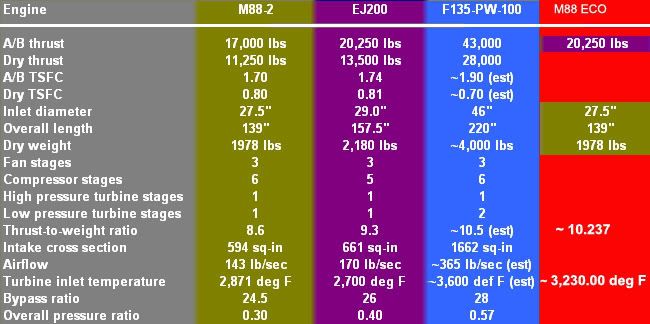
[ATTACH=CONFIG]239133[/ATTACH]


 Sign In







