 mig-31bm
Gain depend mostly of elements qualities before number. Focalizing on size or number to draw any conclusion on AESA gain assumes identical quality of T/R, which is not necessarily correct and affect result by a huge margin.
gain of a radar depending on beam width
and beam width varies directly with frequency and inversely with antenna size. For example : the leading edge Lband transmitter on PAK-FA working at 1 Ghz and have an antenna that is 1 meter in size, it will have beam width of 25 degree
=> cell resolution is terrible, energy not concentrated => terrible as a radar
higher quality T/R will result in higher transmitting power = send out stronger signal and more sensitive receiver = allowing it to detect weaker reflected signal, but that doesn’t affect beam width
The test carried out for passive shot was with a MICA EM ,going active 18 km from target. Not an IR whose seeker would be active at least from launch. Note also no radar tracking were involved , only ESM and IRST. So it is not the same as firing behind wing line a WVR IR weapon at a target 5+ km away and conveniently low ,using a radar track.
IRST does have LFR that allow measure range from short distance ( if the weather isn’t too bad and enemies doesn’t fly in cloud )
As for the journo tour witnessing spectra acquiring a firing solution in the 6 o’clock ,it did not ended up in live firing but a screenshot with a 7.8 nm. It shows system do acquire routinely at least at that range. IR seekers would be of little use in the 6 o’clock for acquiring ,but handy for lock after launch in a shot over the shoulder and MICA has some legs there that allow a 180 turn and still have some reach,as demonstrated in another test in June 2007.
DDM-NG will help tracking target at that distance
mig-31bmAnd thanks to every increasing processing power, RWR see their resolution improve by 2x every 18 months on average. The gain the radar has is slowly being reduced and it’ has been estimated that by 2020 it will be possible to build RWR that fully intercept the whole 0-20Ghz band. Such receivers will have 100% probability of intercept againt so-called LPI radars.
RWR will always, have to listen to wide band and have to cover a wide angle coverage, while radar know exactly signal that it transmitted is at what frequency and what direction so it will always have much better gain
If you can make RWR antenna more sensitive then you can make Radar T/R module more sensitive too
improve processing power will benefit both radar and RWR
Btw RWR sensitive enough to detect a signal is one thing, to recognise that signal is enemy rather than background noise is a different story ,
for example : AESA radar on fighter can scan both ground and air, very quickly, in random pattern, when a radar scan the ground, part of the radar energy will also reflect to enemy’s RWR, it would be very hard for the RWR to know that the signal coming to it
from ground is from an aircraft scanning the ground rather than a ground radar, or another aircraft fly at lower altitude ( especially if the transmitting aircraft doesn’t transmitt constantly )
BTW who ever said that radar were the only signals that can be detected? Coms, datalinks… every time a plane or a ground installation is emitting, it can be intercepted and fed to the avionics to build the tactical situation.
that true radar is not the only signal that can be intercepted,
But platform that pay attention to LO characteristics have stealth data-links too ( f-22, f-35, B-2, Gripen-NG)
You seem to be fixated in a head on engagement scenario between two planes trying to shoot each other. That’s only a very narrow set of circumstances, the actual added value of a system like SPECTRA is to detect the opposition from far away and avoid them.
Fair enough, i was trying to explained to people that if you want to engage enemy aircraft, ELINT system will not balance the disadvantage of having bigger RCS or weaker radar
( ELINT aircraft can turn away when they detect enemy’s radar signal .But it not possible for them to sneak behind enemy if the original position is head on, because side aspect RCS of all aircraft are very high, and they can easily be spotted from 300-400 km if they try to turn and showed the side aspect to enemies)
The resolution is deriven by the technology used, interferometer chains built 30 years ago were already capable of such resolution. On the other hand no amound of processing or other tricks will make the spiral antennas found on your typical RWR (on the Typhoon for example) achieve better than 1-10° resolution (again depending on the band listened to, the 1° is for X-band).
Even F-16 Block 60 use interferometer receiver for it’s EW systems ( Falcon Edge) so i dont think Typhoon still use Spiral antenna ( definitely not Typhoon Trance 3)
Sensor fusion is a direct result of the avionic architecture chosen. In the Rafale and the F-35, avionics are modular, any sensor can talk to another one, tracks are built by taking the best data from each sensor. F-22 is in-between, all sensors are fed to the CIP but the radar still rules as the supreme sensor.
really does not make sense, how do you know radar is the supreme sensor on F-22 but not F-35 or Rafales?
Typhoon or Gripen don’t really have sensor fusion. They have a centralized display and some disambiguation but the sensors don’t talk to each other. See the Swiss evaluation http://www.letemps.ch/r/Le_Temps/Quotidien/2012/02/13/Suisse/Textes/gripen.pdf
About the Eurofighter: “The sensors data fusion and the EW suite performances can be mentioned among the weak points”
About the Gripen: “There was no data sensor fusion between the radar and the EW suite”
Back in 2003 Saab was organizing their first ever workshops about sensor fusion, I wouldn’t hold my breath about Gripen NG capabilities in that area…
Typhoon Trance 1 and Gripen A may not have sensor fusion but i doubt that Typhoon trance 3 and Gripen NG doesn’t have them
, even F-18E/F and F-16 E/F have sensor fusion
It provides the Rafale pilot with a much better situational awareness. That’s a pretty big trump card.
situation awareness is always good to have, but knowing something is out there at what bearing is quite different from knowing direction, distance, altitude , speed, heading of them
mig-31bmRadar signals have to be reflected and travel back. That’s an instant 120 dB advantage…
radar signal have to be reflected and travel back will give RWR about 80 dB advantage
However
1. RWR antenna typically has a gain of about 0 dB due to wide angular coverage. Fighter AESA radar has a gain of roughly 40 dB. This means instant 40 dB advantage to the radar.
2. Radar can operate at much narrower bandwidth as it knows the frequencies it uses and RWR does not and has to operate at much wider bandwidth. RWR receivers have a sensitivity in the region of -40 to -60 dB while radar receivers have a sensitivity is roughly about -100 dB with digital receivers achieving even better sensitivity like -120 dB.
This can give additional 50 to 80 dB advantage to radar depending on exact design of the systems involved. As AESA has a very wide total bandwidth, RWR must cover that very wide bandwidth leading to much less sensitivity. As the radar signal has a quite narrow bandwidth and radar can process only very narrow bandwidth giving large advantage in sensitivity. For AESA the advantage can be for example in the 60 to 80 dB range.
3. Radar can code or modulate the signal so that it achieves significant processing gain over RWR. Either phase or frequency modulation/coding can be used. As radar knows the coding, it can filter out the signal from noise using matched filters. The RWR can’t know the coding and this gives the radar another big advantage in total gain. This is called Processing gain and it can be tens of decibels. The more complex the coding the larger the processing gain of radar is. Modern AESA radar using Digital Beamforming can use very complex coding schemes and basically only processing power and software is the limit here. A simple calculation about processing gain is dividing the spreading bandwidth (bandwidth where the signal is spread) with actual signal bandwidth.
mig-31bmSomething like NG’s MESA takes 10 seconds to do a full sweep…
See http://www.northropgrumman.com/Capabilities/MESA/Documents/mesa.pdfhttp://
Sorry, but fraction of seconds is really nonsense.
.
i think you should read it more careful
. Rotodome AEW systems have higher drag antenna configurations and are limited by mechanical scan rates of 10-12 seconds. In contrast, the MESA radar has variable scan rates and instantaneous target revisit rate to satisfy diverse mission priorities
or look at the APG-81 testing video
do you see the gray beam, these are target revisiting beam ( area that radar have scanned and detect target, can be instantaneous revisit for tracking) estimated the gray area accounted for 2/5 total FoV of APG-81, and it done that in 1.2 seconds, and not only detecting targets it kniw their heading as well, so it would take about 2-2.5 seconds for APG-81 to scan it’s whole FoV
mig-31bmRWR detect radar way before the radar detects their target, hence the planes are flying straight like they do 99% of the time.
RWR doesn’t always detect enemy’s radar before themselves get detected ( even though they have the advantage that the signal only have to travel one way)
Firstly, modern AESA implement several method to make their signal appear like background noise to enemy’s RWR ( due to the fact that they change frequently every second , have random scanning pattern,compress their pulse .. etc)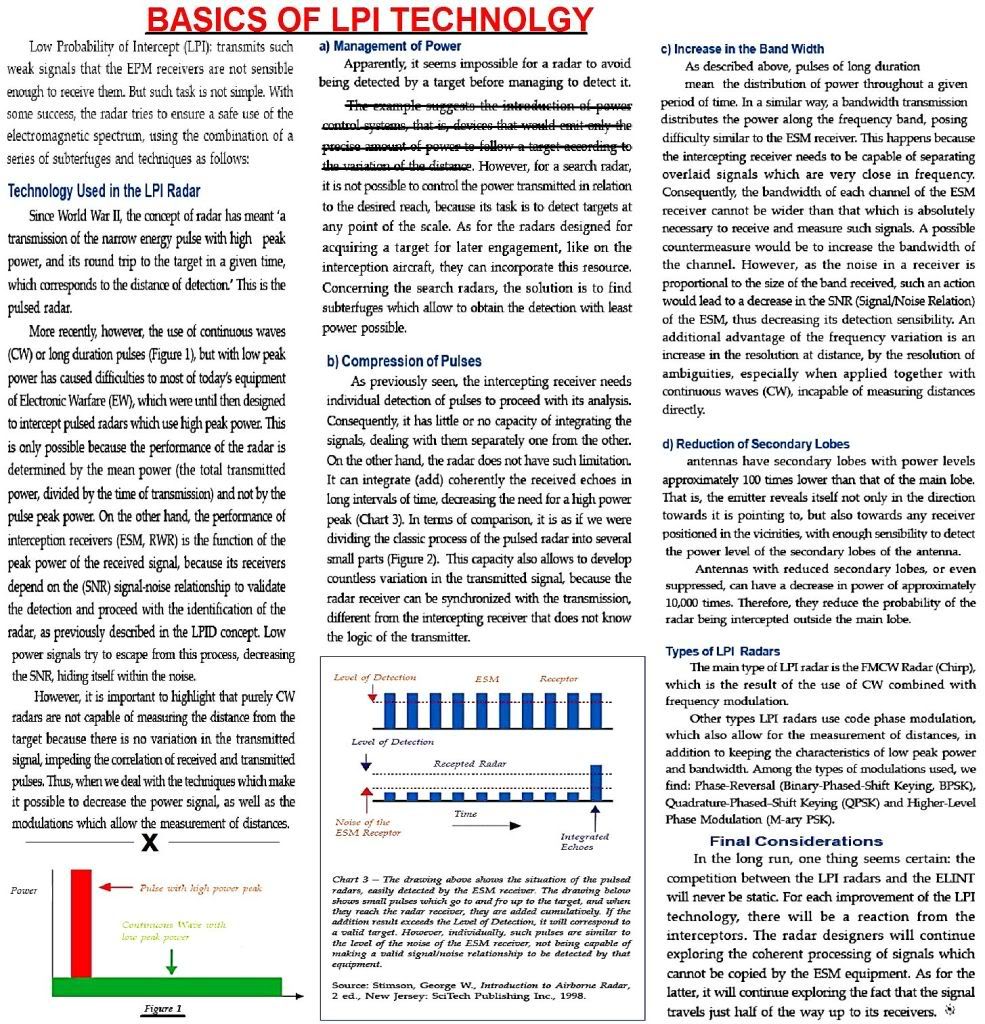
http://www.mar.mil.br/caaml/Revista/2007/Ingles/10-Pag40.pdf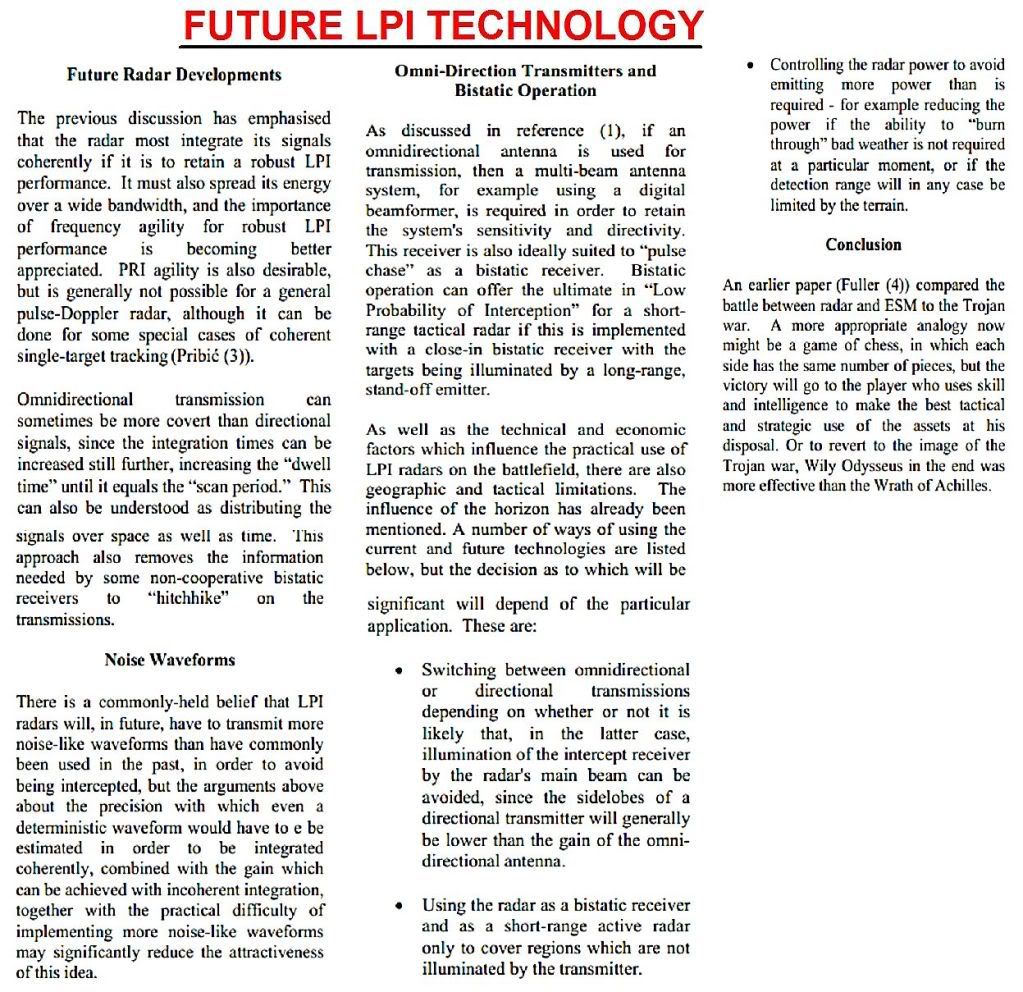
http://www.emrsdtc.com/conferences/2004/downloads/pdf/tech_conf_papers/A14.pdf
also radar receiver have much better gain than RWR receiver allowed them to detect weaker signal. Here are reason why radar antenna have better gain :
1. RWR antenna typically has a gain of about 0 dB due to wide angular coverage. Fighter AESA radar has a gain of roughly 40 dB. This means instant 40 dB advantage to the radar.
2. Radar can operate at much narrower bandwidth as it knows the frequencies it uses and RWR does not and has to operate at much wider bandwidth. RWR receivers have a sensitivity in the region of -40 to -60 dB while radar receivers have a sensitivity is roughly about -100 dB with digital receivers achieving even better sensitivity like -120 dB.
This can give additional 50 to 80 dB advantage to radar depending on exact design of the systems involved. As AESA has a very wide total bandwidth, RWR must cover that very wide bandwidth leading to much less sensitivity. As the radar signal has a quite narrow bandwidth and radar can process only very narrow bandwidth giving large advantage in sensitivity. For AESA the advantage can be for example in the 60 to 80 dB range.
3. Radar can code or modulate the signal so that it achieves significant processing gain over RWR. Either phase or frequency modulation/coding can be used. As radar knows the coding, it can filter out the signal from noise using matched filters. The RWR can’t know the coding and this gives the radar another big advantage in total gain. This is called Processing gain and it can be tens of decibels. The more complex the coding the larger the processing gain of radar is. Modern AESA radar using Digital Beamforming can use very complex coding schemes and basically only processing power and software is the limit here. A simple calculation about processing gain is dividing the spreading bandwidth (bandwidth where the signal is spread) with actual signal bandwidth.
4. When the radar main beam is not directly pointing towards the RWR, then it will only be seen through sidelobes. Given that sidelobe level can be lower than -50 dB in AESA radars (about -20 to -30 dB in fighter MSA/PESA radars), this gives the radar a healthy advantage against RWR/ESM systems which it’s not painting. This means RWR will only see very short flashes of main beam and makes it more difficult for the RWR to work effectively.
Calculated together, radar can suddenly have well over 100 dB advantage over RWR system through mainlobe and over 150 dB advantage otherwise. There are ways for RWR/ESM systems to get some of that back and of course the race is never ending. RWR/ESM system can use more directional antenna, more sensitive receivers and higher processing power.
also it worth noting that to measure range the ELINT aircraft will have to perform specific maneuver ( S shape maneuver, that will show it’s side aspect RCS to the enemy) , and as we know, all aircraft, even the Stealthy one have huge side aspect RCS ( around 20-30 dBsm or 100-1000 m2) . Modern AESA radar on fighter would have no trouble detect and track target with rcs = 30 to 40 dBsm from 300-400 km, so even though in theory, if both side receiver have equal gain, RWR can detect radar from longer distance than the radar can detect it ( since radar signal have to travel 2 ways) , in reality the ELINT aircraft will be detected as soon as it attempt to maneuver to collect data for passive ranging
————————————-
Only for head on closing (or the solution doesn’t converge for obvious mathematical reasons)
fighter have radar on their nose, and most BVR fight will happen with fighters of 2 side fly at opposite direction, into the merger
. Anyway it takes a single S-manoeuver to reach <10% accuracy according to http://subs.emis.de/LNI/Proceedings/Proceedings154/gi-proc-154-222.pdf
well in the table it specific say the range error is from 24-40 % for 15 seconds geolocation ( the longer they do it, the smaller the error is)
and the S maneuver will only work if the enemy fighter fly straight and doesn’t change their heading, fly at constant speed
remember that side aspect RCS of any aircraft is very high, the ELINT aircraft if wasn’t detected by enemy radar earlier will be detected the moment it perform the S maneuver
So after detecting the ELINT aircraft, all enemy pilot have to do is changing their heading according to the heading of ELINT aircraft ( if the ELINT aircraft turn left, you turn left, if the ELINT aircraft turn right, you turn right, accelerate or decelerate to make your speed not constant)
that will neutralise ELINT aircraft passive ranging ability
Hard to track a target if you don’t scan it regularly, isn’t it?
Thank god actual radar scan their targets every second or so
actually turn off radar most the time and only turn on radar for a few seconds is a common tactics among SAM crew to negate SEAD aircraft effectiveness
(and even AESA take tens of second to fully scan the battlefield. Fraction of seconds? Really? Can you be even more out of tune with actual radar performance?)
APG-81take about 2 sec to detect about 19 targets
https://youtu.be/CRkpFsXz9yk
something like SPY-1 with huge processing power will be alot better, fraction of a second doesn’t seem far from reality
0.1° is the typical performance of an intererometric receiver in the X-band. See http://www.phys.hawaii.edu/~anita/new/papers/militaryHandbook/sig-sort.pdf.
Even the Gripen NG RWR is quoted as better than 1° if fitted with interferometric antennas, see http://saab.com/globalassets/commercial/air/electronic-warfare/radar-warning-receivers/bow/bow-product-sheet.pdf.
Iam sorry, you probably misunderstanding my question, the question is : where does it state that Spectra have better than 0.1 degree accuracy
How suddenly Spectra have 10 times better accuracy than ELINT system on EA-18G, F-22, Gripen-NG?
and seriously, Gripen-NG still mostly in concept state, it use a lot of future technology for its radar and RWR, like the GaN modules, how can rafale that have been buit like 10-15 years before somehow have an ELINT sensor that is 10 times more accurate ?
That’s a sensor fusion issue, sensor fusion in the F-22 is actually quite limited (everything is slaved to the radar, it’s a hierarchical architecture like in the Typhoon and Gripen, unlike the cooperative architectures found in the Rafale or the F-35).
F-35 have better sensor fusion than F-22 because they was designed that way, and LM themselves claim it have better sensor fusion than F-22
but do you have any evidence to support the theory that Rafale have better sensor fusion than F-22, Typhoon, Gripen-NG?
( to be fair i don’t think F-35 have better sensor fuse than Gripen-NG either)
BTW, yet another paper discussing something that you claim is not possible (air-to-air passive ranging)…
Anyway, this entire discussion started because you made the claim that a bearing-only sensor cannot be use to estimate range. You were wrong and your entire posts are nothing but smokescreens to hide that very simple fact.
yes my original claim that air to air passive ranging is not possible is wrong , but the debate here have shown that single ship passive ranging by ELINT sensor doesn’t work at long range due to very inaccuracies, it also very easily negated by enemy’s tactics, Spectra isn’t a trump card conquer all like the Rafale fan prefer to believed
mig-31bmI wonder how many GaN modules are used in SPECTRA’s antennae? And would the be enough to send a pulse at some useful distance to range a target like a radar would? Would that require changes in the antenna?
Nic
in near future only Gripen NG is advertised to have GaN antenna
also it doesn’t make any sense to send pulse by Spectra antenna since ESM antenna are omi directional and have very small size, thus they would have much lower gain than a radar ( both for receive and transmit)
it much better to just use the radar to send the pulse
mig-31bmModern EW systems can determine the bearing of a signal with a very high degree of accuracy. This can certainly allow BVR shots under some circumstances, but not with the same precision afforded by a proper radar track. Such a shot would need to be shorter ranged, and would suffer from reduced probability of kill. (not to mention generally reduced situational awareness if the shooting aircraft were really operating entirely passively. )
Boeing has also discussed using multiple Growlers operating cooperatively to passively triangulate a target, determining its location, heading, and velocity in real-time. The limitation here is that it requires multiple Growlers.
http://aviationweek.com/awin/us-navy-aims-curb-enemy-jamming
So is it possible to employ the sorts of entirely passive tactics that people spend so much time here talking about? Yes… but we are talking about cutting edge stuff here that would almost certainly require multiple aircraft acting cooperatively using both very capable EW systems and very capable data-links and they would still probably want to supplement that information with an IRST or perhaps an active sensor.
Very cool stuff, but not a magic “win” button for air combat, especially if your adversary is using similarly advanced tactics where some elements in a flight are emitting, while others are operating passively.
i mentioned that method in my first post too 😎
but here we taking about single ship geolocation ability of Spectra again air target
mig-31bm1) Planes tend to flight at constant speed (unless you want to argue that 60 seconds of flying straight is unusual in a fighter plane)
fighter tend to accelerate when they detect enemy aircraft, and not all fighter have the same cruise speed and acceleration rate
2) Planes tend to flight straight (unless you want to argue that the typical fighter change headings several times per minute)
to perform the range measurement method we are talking about here
the ELINT aircraft have to perform maneuver that creates changing in bearing with enemy for calculation ( fly zick zag side to side) , side RCS of fighters are extremely high ( could be several hundred m2 even for small fighter ), thus the ELINT aircraft will appear very clear on enemy fighter’s radar screen when it try to maneuver to collect data for range measurement
Example : the ceasna have RCS about 0 dbsm head on but about 20 dBsm from the side
a steath fighter without RAM have about – 10 dBsm head on, but from the side that increased to around 30 dBsm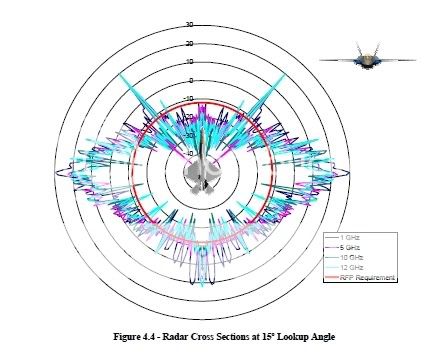
Su-27 with RAM have frontal RCS about 10 dBsm but side RCS over 40 dBsm
and since it not uncommon for fighter to point it nose and fly toward to enemy direction, the ELINT will have a really hard time collecting data because the enemy’s heading changing constantly
everytime the ELINT aircraft try to fly zigzag
3) It’s hardly unexpected that a plane will use its radar for at least a minute (hard to track a target or scan airspace without turning the radar on)
they can easily turn radar on for 1-2 seconds and turn off and wait 10-20 seconds before turning their radar on again ( iam not even talking about AESA radar here, these things have LPI and can scan the whole battle space for fraction of a second )
4) Nope, heading is not known at first
in the simulation example, it said that, heading is assumed to be known at all time
1) Depends on the relative positions, in most cases specific manoeuvers aren’t needed
it said in the paper that the ELINT aircraft must maneuver in a certain way to allow passive geolocated target
in head on situation the bearing will the the same regardless of range so if you dont perform specific maneuver it not possible to measure range
2) 1 mrad resolution = 0.06°, similar to the interferometric chain of the Rafale in the X-band (<0.1° accuracy)
can you posted a link to support this comment ? where does it say Spectra have 0.1 degree accuracy? even the ASQ-218 on EA-18G only have 1 degrer accuracy, ALR-94 have 2 degree accuracy
and 0.06° is like 10 times better than 0.1
3) 20% is after 15s, it converges to a couple % after a minute.
and enemy cooperative for the whole time?
As written in the article, RMSE = Root Mean Square Error.
I.e. the difference between estimated range and actual range squared (normalized of course). So the 0.2 reached after 20 seconds is the equivalent of 10% error on the estimated range. One can easily see how the error gets smaller the more bearings are measured.
ok so RMSE is the error? , so why the error get bigger in the graphics the longer you take to geolocated enemy? ( after 15 second point the error actually get higher)
This would be classified info. So either you’re committing treason or you’re talking about stuff you know nothing about…
according to LM advertising, their ALR-94 required APG-77 ranging capabilities to perform an Air to air Aim-120 shot
mig-31bmAN/ALR-94 has ranging capabilities. Just like SPECTRA, just like CARAPACE used on Belgian F-16AM, just like ICMS and IMEWS on Mirage 2000-5 Mk.2, just like a bunch of other systems.
These systems do not act like dumb RWR but true ESM system.Now, whether they are able to provide a precise enough objective designation in X situation or not.. I’m afraid you nor I cannot answer that.
ranging( measures distance) again ground stationary target is very different from ranging again moving airborne target as i have explained in previous page
even ALR-94 on F-22 still required APG-77 to measure range to perform Aim-120 shot
mig-31bmThat is your opinion. For once radar size matter less than number of T/R modules and the power applied
.
For a radar, bigger aperture = better gain = longer range, for same transmitting power
RBE2 cant match APG-81, Captor-E, APG-82, APG-71 in number of T/R module either, and bigger aperture mean more T/R can be putting on that
Range is good enough to exploit meteor
no article actually said that, and to be fair, Meteor, Aim-120, Mica can all be used at short range, just because they are medium range AAM doesn’t mean they cant be used at short range
. That Spectra enable passive shot do not imply it substitute to radar ,for BVR engagement as you imply.
A lot of Rafale fan seem to disagree with that, apparently they think with Spectra Rafale can challenge any fighters in BVR, whether the enemy have much more powerful radar or much lower RCS
Aside from you no one claim spectra can get a firing solution at radar max range. So do not read and interpret more than what is actually said.
what iam trying to say is Spectra passive shot is at really short range
in theory, several Rafale working together can use Spectra to triangulate to geolocated enemy fighters, however in many vs many situation enemy fighter can also work together with only 1 fighter transmitting while the rest stay silent
in 1 vs 1 situation, a single Rafale cant perform passive ranging at BVR by Spectra
For info cpt Romain is an active rafale pilot having been authorized by FAF, not dassault, but FAF, to express to the general public . So it is not some hear says.
well, i cant even find the original article with his interview, since the link is death
What Halloween shared with you, is not a test ,but a round trip on a rafale for a journo, so it is not likely to be the classified max range being exposed at that time
it said in the article that the shot was a simulated shot
it may not be the max range, but there is no indication that the maximum range is much better than that ( otherwise we already see tons of advertising)
.
Besides it is already way more than witnessed and reported on any other plateform and it was in the 6. It also shows this is indeed used routinely. Even at 7.8 MILES an offshoulder MICA at an incoming tail chasing plane left with no really good BVR missile will give him second thoughts.
JHMS system will allow fighter perform over shoulder shot as well, DAS on F-35 also allow perform over shoulder shot at short range, since at short range, only bearing is enough
mig-31bmAnd what’s the momentum of a shaped charge ?
shape charge like in HEAT warhead ?
mig-31bmGBU-24 is 1050 kg, BOACH is 450 kg
penetration is function of momentum
so i think GBU-24 probably penetrate better
(correct me if iam wrong)
mig-31bmThat’s what is called “desambiguïsation”, well… “make it not ambiguous anymore” 🙂
That’s the software hell of data fusion, especially with the fusion of L16 datas when you fuse every sensors datas of every aircraft of the patrol.
That apply for other simpliier tracks (radar) as well. Let’s note that IR tracks are the same as ESM tracks on this extent, i-e: no firing solution unless fused. We don’t know clearly if it’s actually operational or not but we can suppose it is.
i supposed that how Spectra alone could be used to geolocate enemy’s aircraft at BVR, by using several Rafale and triangulate
, in 1 vs 1 situation that wouldn’t be possible but in many vs many situation the effectiveness would depend on the level of data fusion of enemy, whether they can use 1 transmitting fighter and sharing information to every aircraft in patrol or not
mig-31bmThe original link does not work anymore but here is the original post.
http://forum.keypublishing.com/showthread.php?103455-Rafale-News-X/page13
You can however read another interesting interview of Captain romain posted here (he wrote a book on his deployment is Afghanistan) :
http://www.russiadefence.net/t930-dassault-rafale-thread
when i go to the link there is nothing there eagle, are you trying to say Dassault wouldn’t advertising such awesome feature of the Spectra in their Pdf ? ( could this be the same as Russian plasma stealth?)
there is nothing official about the claim that Spectra alone allow frequently BVR shot
Even ALR-94 on F-22 still required radar to measure the range and it can only give bearing information
Point is this feature is routinely used at BVR distance which I got the confirmation from the rafale pilots I discussed with
iam sorry but i cant take your word for it, as another person on another site claim exactly opposite thing with you, he also stated that he talked to pilot twice
so I think we should left pilot story out at the moment
. As you say it is a matter of range and at extreme ranges it could become an issue but its performance is sufficient to allow BVR shots (which exact distance is of course confidential). But it is wrong to say it would be effective at only short ranges as in fact it it used in BVR mode
BVR mean you attack enemy without seeing them
again small fighter the visual distance actually not very long, there a graphic around , i will try to find it, but if i remember correctly the visual range again f-16, F-5 is about 8-10 km
.
A single Spectra alone can provide a firing solution at BVR ranges (albeit probably not extreme range) but combined with other passive sensors and/or rafales exchanging info the location distance can become really huge allowing a silent shot from far away.
eagle, none of the link you posted actually said a single Rafale can use Spectra to geolocated enemy’s aircraft ( not even the interview with the captain) , it only said Spectra can locate target, which could mean using 2 rafale to triangulate target ( similar to F-18 case with ALR-67, it was also said to be able to geolocate target, but later reveal that it it only work if there are 2 F-18 triangulate )
To be fair Blue Apple posted very interesting article on how a single ELINT aircraft using only ESM could measures distance to enemy’s fighter by flying in a certain pattern , it could also possible that SPECTRA use that method, however that method still have many limitations and can be neutralise by enemy like i have explained
mig-31bmMig 31BM, pay attention to this and the previous report.
can you posted the link to the whole report?


 Sign In







