Dork Matter
racist now Garry?:rolleyes:
You know better than that–only white Americans are racist. :diablo:
Dork MatterYes indeedy!!
[attach]160641[/attach]
It kind of looks like the B-2 is flying on pixie dust like Tinker Bell. 🙂 There must be a load of at least 28 Ionic Breeze “air cleaners” installed, by my calculations. I knew all along that they weren’t really air cleaners, since they don’t clean much of anything, but secret military surplus being dumped on the market for a killer profit to fund more black projects! :dev2:
Its a facinating subject that of the B-2 and possible electrogravatics, i’ve read that there are two bays on the b-2, not the bomb bays but two other bays/areas where it has been speculated the electrogravatic systems were to be placed. i’m going on a memory from about 6 years or more ago but i think they were known as the LIB 28 bays or something,
Yep, “LIB 28” is the secret code for “Load of Ionic Breezes, 28 units.” The ions also promote good crew morale, just like a churning waterfall (59% more effective than Russian minty-green cockpit interior paint!), and the copious amounts of ozone these units emit leaves the air smelling fresh while mending holes in the atmosphere’s ozone layer. 😉
The whole idea of stealth is to eliminate any electronic emission, not to substitute one for another.
That would be the ideal achievement, but it’s not necessarily true for real stealth applications. Sure, you’d eliminate everything you could, but sometimes you have to trade one type of radiation for another. For example, RAM transforms radio-frequency EM waves into heat, which then ultimately gets reemitted as IR-frequency EM waves. Whatever has to be emitted during flight should be limited to IR bands that are absorbed by the atmosphere, and everything else either gets stored or dumped into the exhaust where other measures could be taken. The realistic goal of stealth is to dramatically limit the vulnerability of a system and its emissions to detection and exploitation by enemy sensors at meaningful ranges.
Then maybe they can’t install more thrust because more powerfull engines would require bigger airflow, which couldn’t be provided due to the intake shape or something?
While the engineers who worked on the B-2 aren’t perfect, they aren’t exactly dummies, to say the least ;), so they must have had their reasons. I suppose it’s possible that they wanted or needed to limit the size of the intakes for the sake of stealth, and this was considered an acceptable tradeoff, given the B-2’s aerodynamic qualities. Size isn’t always important with regard to RCS, but I’ve never understood how the B-2’s intakes worked anyway (e.g. if you look into them from slightly above, you can actually see the engines :confused: ), so it’s hard to say in this case.
Dork MatterHahahahaha… yeah, it was the AEGIS system that tracked the satellite around the planet…
It’s part of the system that was used for the intercept, which was a test of current US anti-satellite capability. And by the way, Aegis is not an acronym.
Wow claims for AEGIS just get better and better don’t they… I expect in 5 years they are going to be detecting comets entering the solar system and determining which are on a collision course with Earth… :rolleyes:
There are more strawmen in this forum than an Iowa cornfield. :rolleyes:
Dork MatterI suppose that if you get more thrust from your engines, you also get a much degraded IR signature.
This depends on how much thrust the engines are putting out at any given moment, which would be the same as it currently is, except during takeoffs and emergencies (when IR signature is of less importance).
The B2 is supposed to be stealth, so it shouldn’t have a big IR signature, and I also suspect its speed is limited by the materials (RAM and such?), so no need for bigger engines except for cases like emergency on take off.
Much greater thrust is what aircraft like the B-52 (hardly a draggy design), B-1, cargo planes, and airliners all have in reserve even though they don’t need it all the time, either. There is a safety factor to consider, and the B-2 is clearly deficient in this respect, standing alone by a wide margin.
I think it has very much to do with the aerodynamics, as a flying semi delta wing whithout tail it probably has low drag and especially an extremely strong ground effect.
Together with long runways and a good FCS it’s probably what makes it possible to get away with it.
This must have been what the designers believed, and it was what I had believed, too, except that I hadn’t realized just how underpowered it is until I actually looked up its specifications (the B-2 is much heavier than I thought!). Reducing drag is great, but sometimes you need that extra push to, for example, accelerate such a large inertial mass past the stall speed quickly enough, or make up for the loss of one or more engines. Obviously, you have to draw the line somewhere on how much thrust is necessary, and in every other case that line is drawn 50% or more above that of the B-2.
I’m not saying that this necessarily had anything to do with the crash, of course, but such questions are going to be raised regardless of the cause, and it could potentially become an issue.
Dork MatterHmm look at the weight of the aircraft and the thrust of the engines… it doesn’t match with any other bomber, it looks very underpowered. 😉
Yes, it is.
In order to have approximately the same thrust/weight at its maximum takeoff weight as other strategic bombers (or pretty much any large aircraft, for that matter), the B-2 would need to have about 50% more thrust. My initial thought was that the engineers figured that it could get by with less thrust during takeoffs and emergencies (generally the only times it would need maximum thrust) because of the aerodynamic efficiency of its design, but having only two-thirds the thrust/weight of every other large aircraft does seem like a major deficit…. :confused:
Kooky conspiracy theories aside, does anybody know the real reason for this? It seems as though incorporating two additional F118 engines into the design, assuming that no other suitable engines were readily available, would have been feasible.
That factor limits it’s operating altitude and would be my first suspicion about why a B-2 would crash during a heavy weight takeoff at a sea level base.
By the way, do B-2s carry extra fuel in their bomb bays for long trips?
Engine failure, auxiliary inlet failure, bird strike or anything that affects 2 engines (especially on the same side) would doom the jet.
In this case, however, it seems that they didn’t get very far or high before something catastrophic occurred, which probably means that the event was very catastrophic indeed.
Dork MatterWhat are the strange shades/markings? looks like it was once camo and they stripped it, leaving stains.
That is in fact the F-22’s camouflage scheme, and the topcoats on these planes are in good shape, save for a few carbon stains near the gun ports (can’t they put some protective goo there when training with guns?). If the pattern looks a bit washed out, that’s probably because of the lighting, as the topcoat has reflective properties (most likely related to IR emissivity).
Dork MatterI wonder perhaps – could it have eaten a seagull or a flock of ducks or geese or something?
That’s always a possibility, but when this happens, we usually know right away.
Anyways, I don’t know about anti-grav but I heard a rumour that the B-2 ionises the air passing over it’s full span leading edge, offering considerable aerodynamic advantages.
While I can’t say that I know for a fact that this is a myth, it seems pretty far-fetched for a non-research-oriented stealth aircraft to me.
At least the invisible switch was off on take-off or they wouldn’t have been able to locate the crash.:D
I’d say that the change in airframe geometry probably increased its RCS by quite a bit. 😉
Dork MatterNo but seriously, here’s my take on events: on the take-off run Pilot 1 called Pilot 2 a nickname that only P2’s wife calls him, realising his catastrophic mistake of blown infidelility, and using the ethos of the B-2 as a formidable first strike weapon, P1 lays into P2 with everything he’s got- to no avail. P2’s a former USAF kick-boxing champ & highly trained scientologist and pulverises P1.
P1 coughs up blood, spits out his teeth, and gurgles some nice (but rude) things about P2’s wife, jams the throttle setting, smiles (sort of) and ejects…P1 follows suite. The fight continues briefly on the ground (as correctly envisioned by DorkMatter) against a backdrop of flames & smoke, until the emergency services arrive.
This is reminiscent of Michael Bay’s take on the attack on Pearl Harbor–you should overnight a script to him, pronto. :p
Plausible right? I mean stranger things have happened- just look at that crazy female NASA astronaut who tried to murder everyone in sight. I thank you.
Good point–NASA’s psychologists must have completely overlooked her crazy-eyes when evaluating her suitability. 😀
I don’t know if loosing the FCS computers would be enough. The jet is remarkably aerodynamic to the point where the pilots had to inquire to the tower if they had touched down on the runway during the first flight.
That’s because of its FCS. While the B-2 has good aerodynamics, it probably has negative static stability in more than one axis (it doesn’t even have small vertical stabilizers like the YB-49), making it extremely difficult for human pilots to handle manually.
Something really serious has to have occurred.
Clearly, whatever it turns out to be, and it’ll be interesting to see whether the nature of the problem could have ramifications for the remaining B-2s. I tend to doubt the latter, as this type had always been a reliable flyer, but we’ll have to wait and see.
Now, were there to be any truth to those rumors, that might be serious enough. One of the reasons those rumors came about is the serious disparity between the weight of the jet and the thrust of the engines. The uninteresting solution is that the aerodynamics of the design greatly compensates for such a low thrust value,
The B-2 is practically all-wing and not designed to be fast, so it doesn’t need a huge amount of thrust. For comparison, while the B-1 needs more thrust to take off, for which it uses afterburner, it manages to get by most of the time on less dry thrust than the B-2 has, despite being larger and less aerodynamically efficient in lift. This may be “uninteresting” but nothing more is needed to explain the thrust issue.
but you still have to wonder what some of the unexplained compartments inside of the jet are really used for…
Well, if there is an “anti-grav” device in there, then it must not do a whole lot, all things considered.
Dork MatterToo early to tell. It must have been something serious to actually make one of those things crash though.
Or it could be something very “small” but vital and normally extremely reliable, such as the FCS computers. I imagine it’d be kind of difficult to dead-stick land a B-2 (in this case more literally than the usual meaning would imply).
…maybe a fight broke out on the flight deck…
What, were they still fighting on the ground after they ejected? 🙂 Perhaps they were members of the “Mile-High Fight Club” but were too eager to get started. 😉
still at $1.2 billion apiece- ouch!!
Oh, I know! According to this forum, you could almost buy an F-22 for that much! 😮
Dork MatterOhh, lets be honest… there are claims this satellite was 3 tons and the size of a bus and was a huge threat to people on the ground because of the fuel it had on board. Sounds tiny compared to a space shuttle reentering…
That’s very true, but if I remember correctly, NASA were planning on landing the Shuttle softly on an airstrip at the Kennedy Space Center instead of shooting it down, as crazy as this sounds now. :rolleyes:
The reality is that this was an NRO satellite and the US didn’t want it falling just anywhere where just anyone could pick up the pieces.
Nah, mostly they wanted to test the Aegis system and the SM-3 against a satellite, and were lucky enough to have a valid excuse to do so.
It certainly wouldn’t be reduced to powder and there would likely be relatively big chunks hitting the ground but the fuel would be very unlikely to make it to the ground.
The hydrazine tank was the most likely thing to make it to the ground intact, as Mercurius just pointed out. There’s no telling whether it would have survived impact, however, as it would very likely have hit the ground much faster than the Shuttle’s tanks due to lower drag. There was more than one reason for destroying the satellite, and this was a valid one.
Dork MatterWell, it looks like some Raptors have been working on their gunnery. 😎
Dork Matteri will go on record as saying i think one of these would pwn a gripen the majority of the time.
Why ? Because the AESA has most likely better range ?
It should have better range, which is a useful thing independently of one’s own RCS.
The Gripen still has the superior agility,
While it’s undoubtedly a more nimble fighter than the increasingly bloated F-16, the Gripen is still a bit underpowered, and in theory would suffer in the vertical energy fight, even when the F-16IN is carrying conformal tanks.
the less than 1/10th rcs,
I’ve seen this claim elsewhere as well, but to what are they comparing it? The original F-16A with no RCS reduction measures, perhaps?
and more or less the same weapons. The AESA advantage is seriously crippled by the short range of missiles
It’s still useful to know where the other guy is earlier, and set up accordingly.
and the large RCS of the F-16.
As long as it’s not actually larger than about three times that of the Gripen, it’s not an overall disadvantage, at least against the Gripen. There are too many ways to manipulate these comparisons between reduced-RCS fighters to put much stock in them, and whatever measures could be taken on one fighter could pretty much be taken on or retrofitted to other fighters.
But either way the Gripen to India would also use a AESA so eh. No, I don’t see the F-16 as “pwn”-ing the gripen a whole lot.
In my opinion, “pwning” is far too strong a term, but these two fighters are not that far apart, overall. The Gripen has amazing capability for a tiny fighter (how did they fit all of that in there?! 😮 ), which has its own advantages, but it’s still a tiny fighter in many ways.
gripen is seriously over rated, infact i’d go so far as to say the most overrated of all the latest fighters.
Maybe I’m just buying into the hype, but the Gripen does seem to do many things very well, as in actually being able to do what is claimed under realistic circumstances. While it has limitations for obvious reasons, it seems to be a fighter of exceptional quality–more overachieving than overrated, in my opinion.
Dork Matter
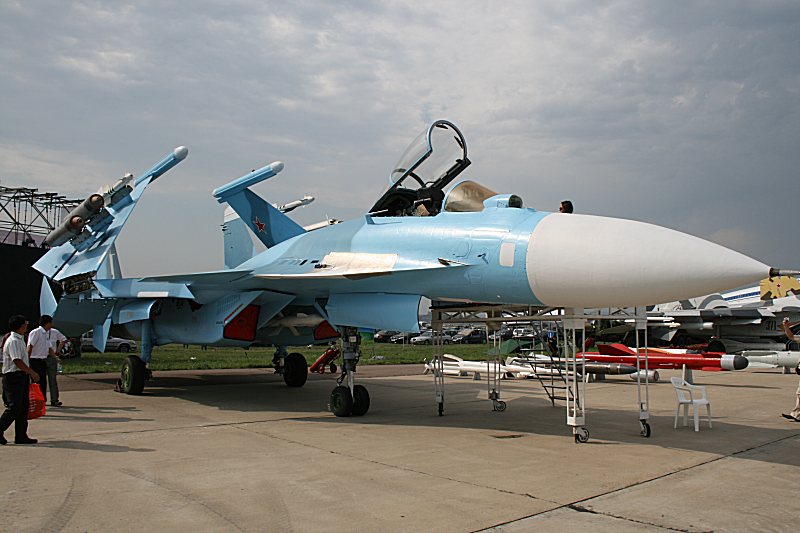
As you can see from the above photo of the Su-33 (taken at MAKS last year) – there were lots of Chinese gentlemen showing a lot of interest in it.
Make of that what you will…… :diablo:
I generously offered to help those guys with their aircraft carrier, but they won’t return my calls. 😉
Dork MatterHhhmm i’m personally sceptical it was a messege to the Chinese or an ABM trial, reason for it not being a game with the Chinese is they know as well as we do that America had an ASAT program back in the 80’s wasnt it with the Eagle firing the missile, point is they know as well as we do that America is technically capable of knocking out Sats.
The question is not whether we could but whether we can, as in right now or anytime we want to. Rivalry is mostly about what countries have done lately, otherwise there wouldn’t be a race to get (back) to the Moon.
Now as for the ABM trial bit, well i couldnt be sure on anything there and thats the reason i’m not gonna go say it was,
I don’t have insider information to truly judge intent, either, but I still completely believe that this was an excuse to test the capabilities of the Aegis system and the SM-3 under extreme conditions. How could they pass up such an opportunity? I would have made the same decision. The excuse is a pretty good one, too–nothing helps a big lie more than a little truth. 🙂
ok we know on the surface of things shooting down that Satillite and shooting down a ballistic missile are two very similer things, they both have extreme closure speeds, both take place high up in the sky/space, but but what about the actual deep in math of it all if you get me – just how similar to an actual real intercept was that sat kill?
They’re rather different in the most general sense, but in this case it was possible (just barely) to modify the geometry of the initial phases of guidance in order to simulate the expected terminal phase geometry (for which the missile was designed). Done correctly, it both tests the effectiveness of the missile and confirms a latent capability to intercept satellites using this method on existing hardware. Future upgrades of the SM-3–which include the rocket motors–would then implicitly improve and extend both its ABM and ASAT capabilities. While this ploy doesn’t truly fool anybody, it’s brilliant nonetheless. Russia and China can protest all they want, but they can’t prove anything, and if they try to contrive the same circumstances to perform similar tests, it’ll look suspicious. 🙂
Dork MatterThey mixed up meters and yards.
It’s a relief that they weren’t attempting orbital injection around Mars, then–WHEW! 😉


 Sign In