 Starfish Prime
This is not how it works in a 4.5/5 gen a/c like Rafale or F-35. Sensor fusion is handling this automatically, no need to “forget” about the RWR or anything.
http://www.dassault-aviation.com/en/defense/rafale/the-sheer-power-of-multisensor-data-fusion/
See above. In the Swiss eval the Rafale, for all its amazing sensor fusion, received a Situational Awarenes and Force Coordination score of just 0.25 ahead of the Typhoon. This hardly matches the marketing hype we’ve been drenched with over the past few years. Same with EW really. Good bit better than Typhoon (1.5) but only 0.5 ahead of the Gripen C. Certainly good, but this hardly seems like revolutionary technology.
Starfish PrimeCouldn’t the IRST take more time to scan the small area given by the RWR? Same thing as when a telescope or camera uses a longer pose.
It’s ultimately going to be limited by the maximum magnification available, which is fixed. I don’t believe scanning a +/-0.5deg square vs a +/-1deg square will yield any advantage. I think a 1 or even 2deg square will allow you to pick up to the maximum capability of the system.
Starfish Prime“Above” in what sense? In terms of survivability, definitely. Also in terms of completing most missions successfully, in particular when the Indian upgrades are implemented. The F15E can carry a bigger load a bit further but that’s about it in terms of advantages over the Rafale.
There is more to Rafale than just an “avionics upgrade”, I thought you knew that by now…
The IAF, and the Swiss Air Force both understand this.
How do you rate it above a fully upgraded F-15E in survivability without even knowing the details of EPAWSS or APG-82 current/future capabilities.
The F-15E can carry a bigger load further, and fly higher, and fly faster. It also has a bigger better radar and will be upgraded to RF attack/cyberwarfare along with the F-18SH.
No, the Rafale is literally a 4th gen aircraft with decent up-to-date avionics. Advertising it as anything else is dishonest, much like advertising the Gripen E as 6th gen.
Swiss eval wasn’t that outstanding. Yeah it had good EW (+1.5) and detection (+1.5), but what is that other than an AESA upgrade and EW upgrade away? SA/Force co-ordination – for all the hysteria over Rafale’s amazing sensor fusion, it was only +0.25 above the allegedly, “massively out-dated Typhoon, with no real sensor fusion, a hopeless federated avionics architecture and grossly inferior non-interferometric RWR.”:highly_amused: A similar story with identification, +0.25, whoopdeedoo. Engagement pretty poor (-0.75), arguably very important, especially when detection and identification is often palmed off to AWACS in a modern scenario. Performance was mediocre, well below (-2) the Typhoon. Workload was also inferior (-1). Endurance/loiter time, it won by 0.5, with those huge 2,200L drop tanks vs the 1,000L items on the Typhoon. Huh, not so amazing.
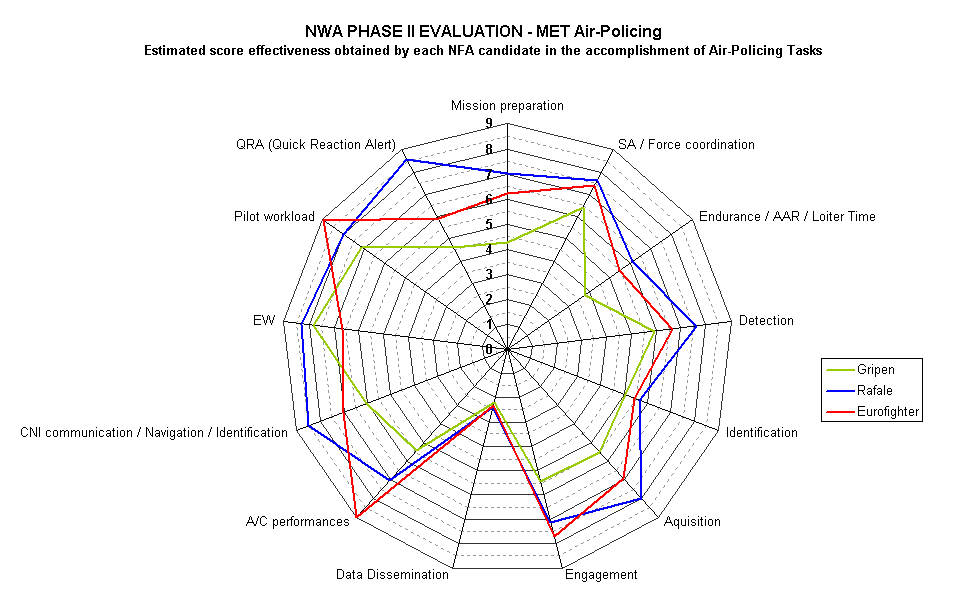
So no, it’s not really that amazing to be going around saying that it’s the only true 4.5th gen. Rafale largely won the Indian deal on price (the Typhoon was 11% more expensive IIRC) and better A2G support and, crucially, way way better marketing – that’s something it completely blitzes the competition on, oh those marketing goons. So no amazing reason there either. It’s a decent aircraft, currently slightly better than its nearest competitor, but it isn’t earth-shattering by any means.
Starfish PrimeIf the plane has both a RWR and an IRST, maybe the IRST can be used to get a more precise target location. The IRST could be cued to the RWR, I take it that would increase the range versus a standard scan, because the IRST can concentrate its search in a relatively precise direction.
It could if the target was within IRST range, but really the added accuracy going from the best non-interferometric to interferometric RWR isn’t big enough to make a significant difference in IRST detection range (because that depends on the IRST itself) and once the IRST has it, you’ve immediately got bearing accuracy in the microradians regardless of the RWR system. And if you are within IRST range, and you already got radar lock before firing the missile, why not cue the IRST then and forget the RWR? It still doesn’t give you very good range accuracy though, hence why you still need the radar. And it isn’t just about target lock either, there’s the RF attack and RF cyberwarfare function to consider. The swash-plate gives you more scope to maintain the desired course whilst still jamming.
Starfish PrimeNo, not worse everything… In some ways an F-35 deal would have been worse. Would the US allow an Indian F-35 carry Indian Nukes? Would the US agree to the same level of ToT as France? Etc.
Also to call Rafale a “legacy 4th gen aircraft” is not very accurate. It is far above and beyond the teens, which are very much the archetypal “legacy 4th gen aircraft”. That’s why I prefer to refer to Rafale as a 4.5 gen aircraft. It is not in the same league as the F-35 however the difference between Rafale and e.g. the F-16 is so significant that it fully deserves recognition for this. Rafale will also be above and beyond Typhoon and SH until those move closer to a proper “4.5” gen configuration with AESA, improved sensor fusion, improved EWS for Typhoon; and improved EWS, improved sensor fusion for the SH*.
IMHO currently there is only one 4.5 gen a/c, and that’s the Rafale! Gripen E/F seems to tick all the boxes and become a fully fledged 4.5 gen fighter, it will be interesting to see if also the TYphoon will meet Lokes strict requirements with future updates…
*OK the SH guys got the Growler, more than one way to skin a cat.
ToT no. Nukes? Well if you can design a nuke to mimic a conventional load, then yeah, there’s a get around. Frankly I don’t think they’d actually have sold an F-35 to India anyway. Sure they offered it after MMRCA and HAL FGFA were a done deal, but if it really came down to it, they wouldn’t sell it to India.
Is it above a fully updated F-15E with APG-82 AESA and EPAWSS? I wouldn’t have said so. And the F-15E comes with far more weapons support.
Sadly your opinion doesn’t count for much. An avionics upgrade can be applied to any 4th gen but it’s still 4th gen. You can call it 4.1, or 4.2 or 4.5, but it’s still 4th gen.
Starfish PrimeRafale is still cheaper than F-35.. Operating cost is what matters..
That’s unproven too. What about attrition costs?
I wouldn’t say so. Even in its IOC state, the F-35 is better in nearly every way.
Starfish PrimeAnd I don’t blame the people who fired the missile anyway. I blame:
a) The airline for flying over a country at war;
b) Ukrainian ATC for diverting it over an active air defence zone at the last minute;
c) The authorities for allowing flights over a war zone after a troop transport plane had already been shot down;
d) Ukrainian AF for flying military operations simultaneously; and finally
e) Idiots who mention flightradar24 as if it somehow should have prevented this bound-to-happen disaster.
If you leave a set of precarious circumstances, you can’t point the finger at the final person in the disaster chain, when something dangerous happens.
Starfish PrimeYou’re so far out of your depth that you can’t even tell when someone is correct or not.
What I’ve stated about the beamwidth of a radar like CAPTOR-M is correct, it’s the result of basic physics.
You don’t even understand your own links.
The first is talking about 0.1 millirad for the intercepting missile deviation when beam-riding, not the radar resolution itself.
The second is only claiming 0.2 millirad accuracy for the tracking, the initial error is +/- 2.5° (that’s the radar beamwidth) but of course it will be reduced by further scanning and filtering. But that’s true of the signals received by a RWR as well.
What I’ve seen is a discussion between several people who don’t know much and make errors at a basic level.
One such example is applying the logic from http://www.phys.hawaii.edu/~anita/new/papers/militaryHandbook/sig-sort.pdf which is a paper on RWR to the working of an AESA radar.
In an interferometric RWR, signals from two (or more) pair of dipoles are compared and the phase difference is translated in an angle of arrival. Such antenna has a gain of 3dB and an angular resolution that depends on the noise figure of the receiving chains and the accuracy of the reference clock.
In an AESA radar, signals from all the elements are summed and then processed. Because the signals emitted by all elements are coherent (all the same signal with the same phase shifts perofrmed in emission and reception), this summing results in a much bigger signal than what each individual element sees (e.g. for a linear array of N elements, you multiply the gain by N²).
If you start processing each element of an AESA array separately to compare the phase of the signals returned, you lose the coherence and your gain goes from 30-40dB to the 3dB of a RWR. I.e. you don’t have a radar anymore.
Only if you think Captor-M uses a parabolic antenna.
That aside, it’s not the point. Beamwidth != angular accuracy, as everyone else has been trying to tell you.
How does that make a difference. The beam has the same width regardless of whether it’s being ridden or not. And I’ll say again, a little louder so you can hear, THE BEAMWIDTH DOES NOT EQUAL THE ANGULAR ACCURACY!
WTF!? We know the milliradian accuracy is not the beamwidth, that’s what myself and garrya and mig-31bm have been trying to tell people for the last page or so. No RWR can’t do this, because it has no actual beam!
And if you apply that error to a smaller phase shift, the percentage error is larger, ergo, your accuracy is reduced.
Why would you have to stop the radar, just to process the incoming to the elements exactly? Layman’s analogy. I don’t need to stop airflow to measure mass flow rate, or stop an aircraft to take the air pressure. Nor do I need to stop an electrical circuit to measure current and voltage. Hence, I don’t need to stop a radar to measure phase difference at different elements.
Starfish PrimeConclude this, conclude that but why doesn’t Ukraine just release radar surveillance data from the day in question?
Starfish Primeand so the latest Rafale deal in India had a break down. just the fly away cost of the aircraft, sans training and other stuff
Rafale comes in $10 million USD more than the F-35A.
Brilliant. Pay $10million more, get a legacy 4th gen aircraft with worse….. everything really.
Starfish PrimeCrotale work at very high frequency though, I am under the impression that we are discussing X-band fighter radar.
Actually , I was talking strictly about angle tracking , about range tracking radar is simply much more superior both in speed and accuracy
I have linked some X-Band radars in the 2nd link. Yes they are for SAM engagement but these are discussing tenths of milliradian accuracy <0.1deg. This would be completely impossible using the calculation Blue Apple provided.
Thanks, I understood that. I was explaining in layman’s terms why it’s not simply a matter of taking beamwidth and saying, “that’s your accuracy.” There are all these methods available when dealing with a steerable beam, or multi-beam configuration that are simply not possible with with RWR. And of course, as you say, it’s a real world environment, not a lab test. There is noise and other sources out there making things difficult. But with radar, particularly with AESA, you know exactly what you sent and what you are looking for.
Starfish PrimeThis is what confuse me , if the varible inlet allow superior thrust performance on Mach 0.9 range , shouldnt the same thing happend supersonic ? .Since it is very unlikely that Typhoon intake would be optimized for supersonic rather than subsonic IMHO
It’s optimised for M0.9-M1.6.
http://www.ausairpower.net/Analysis-Typhoon.html
https://www.eurofighter.com/the-aircraft
https://www.eurofighter.com/advantages
Starfish PrimeSome facts:
Interferometric receivers (that are only fitted in US & French types although they’re an option on the Gripen NG) can determine angle of arrival with an accuracy of ~1° at 1GHz and ~0.1° at 10GHz.
Spiral antenna-based RWR have typically 5-10x less resolution than an interferometric one.
A parabolic antenna has a beamwidth (in degree) of 70*lambda/D where lambda is the wavelength and D the antenna diameter.
So taking as example the Typhoon radar which operates at 10GHz and has a diameter of 70cm, its resolution is at best… 3×3 degrees.
AESA are a tad better, with an extra 10dB of gain you can expect resolution of around 1×1° (useless for scanning but intersting if you already know where your prey is thanks to another source. It’s also nice for SAR modes to achieve sub-metric resolutions).
For “sub-milliradian” resolution, you’d need something like the SBX-1 (22000 modules, whole system weights 45000 tons…)
You seem to be quite confused, applying techniques used in interferometric receivers (phase difference measurement between pairs of dipoles) to the inner working of AESA, reaching the conclusion that the multiple elements in an AESA will allow more phase difference comparisons and improve accuracy.
But that’s not how an AESA works at all! In an AESA radar, the same signal is sent to all elements which are all shifted by a given phase delta to achieve the required emission pattern (e.g. if phase = 0 on all elements, you get a narrow 1×1° beam sent right in front of the plane). On each elements of the array, the receiver part shifts the received signals by exactly the same amount of phase and the signals of all elements are summed then processed. There is no comparison between the signals of individual elements like in a RWR, the radar works exactly like a classic mechanically scanned one except that it now has an antenna that can be steered/reconfigured on the fly.
Never read such nonsense. Nobody has claimed an accuracy of 0.1deg for an RWR. Spectra claimed 0.5deg.
https://www.forecastinternational.com/archive/disp_old_pdf.cfm?ARC_ID=662
DASS claims 1deg.
http://eurofighter.airpower.at/sensorik-dass.htm
That aside radars claim accuracy of tenths of millradians, i.e. tenth of 0.05deg, or 0.005deg. Some as low as 0.05 milliradians for SHORAD systems. Garrya has already demonstrated why it isn’t a simple matter of beamwidth. In a nutshell, as the radar is scanning, very rapidly in case of AESA, it will receive a reflection at several beam positions, as well as obtaining an accurate velocity, it can therefore calculate that the object lies in the centre of this range. RWR has no such ability.
Also, do you understand what a parabola is?
No you don’t need something like SBX-1 at all.
http://www.ausairpower.net/APA-HQ-7-Crotale.html
http://www.ausairpower.net/APA-Engagement-Fire-Control.html
You’ve been wrong on nearly everything so far, so I’d be careful about who you’re saying is confused. We’ve already linked several theses describing the benefits of increased modules and increased Rx SNR. Any measuring device has inaccuracy and not just due to SNR. There is inaccuracy in the way phase is measured because there is no such think as a phase-o-meter. You have to examine the amplitude at the two points and compare it to peak, if the difference is lambda or lambda/2 (for zeroes) then you have a null. By having more wavelength separations over a wider antenna, you apply the same absolute magnitude of inaccuracy to a larger number and the percentage inaccuracy reduces. You also get rid of nulls.
Does not bring any thing new to the table. Sub degree accuracy performance claim,in absolute, on an RWR dealing with larger range of frequencies than a radar,should invite to reflect on how it perform on frequencies similar to radar ones.
SNR requirements for Radar, to filter our in its purest form specific return signal , and enable TOA and Doppler shift measurements , is nowhere relevant or indicative for the need for direction finding an emission.
See above. There is no argument since empirical evidence on radar vs RWR accuracy proves you wrong. And yes SNR is important.
http://www.phys.hawaii.edu/~anita/new/papers/militaryHandbook/sig-sort.pdf
Starfish PrimeAndraxx stated from flight manual at M0.9, The RD-33 has higher dynamic thrust, Depending on altitude. Between M0.9 and M1.4 the drag on Mig-29 rise quite high. But the dynamic thrust should be pretty good. Perhaps still in the same ballpark as Ej-200
Now we all have been waiting for your EM charts on EF.
Learn to read other post, and perhaps respond with less smileys. But in your case, there is zippo credibility left anyway..I allmost feel sorry for you, coming in here with your high Bias and low knowledge.
He actually stated at M1.2 that it was higher (11500kgf, 113kN) than the bench rating (which is usually T-O thrust).
http://forum.keypublishing.com/showthread.php?140171-What-s-the-difference-between-energy%96maneuverability-theory-amp-Supermaneuverability&p=2342567#post2342567
http://forum.keypublishing.com/showthread.php?140171-What-s-the-difference-between-energy%96maneuverability-theory-amp-Supermaneuverability&p=2342685#post2342685
But this is likely similar for both aircraft as the ram effect increases at higher speeds. And we know for a fact that the Typhoon can supercruise at M1.5, with AAMs, whereas the MiG-29 cannot.
https://web.archive.org/web/20090815004539/http://www.eurofighter.at/austria/td_lu.asp
We also know that the Typhoon can supercruise at M1.21 even with drop tanks. So it’s clear that the T-D figure is superior for the Typhoon around the optimum climb rate speed. And we know that:
Rate Of Climb = [(T-D)/W]*V
W is equal for both aircraft (11,000kg empty, but also including wingtip jamming pods and TRDs for Typhoon). T-D is higher, we know this from the supercruise data. Therefore the velocity of the climb and/or the angle of ascent, given by:
Angle of ascent = arcsin [(T-D)/W]
must be higher. Hence the Typhoon must have a higher climb rate.
I rest my case.
Starfish PrimeRead it. Learn something. You must be wrong because the measured bearing accuracy of radars is >> the measured bearing accuracy of RWR systems. No RWR in existence is claiming sub-milliradian accuracy. So this isn’t really even a debate, it’s a known fact.


 Sign In







