Starfish Prime
M1.0 is about 1,062kph at troposphere.
Using standard atmosphere.:
Gamma = 1.4
R = 287J kg−1 K−1
T = 216.65K at 11km altitude
sqrt(Gamma*R*T) = 295m/s = 1,062kph.
2,495/1,062 = 2.35
Starfish PrimeNop, it measures the difference in Phase on the incident signal at an instant between 2 elements distant of a fraction of the wave lenght. AESA radar actually use that very technic to resovle the bearing. the phase difference is resulting from the signal delayed arrival between the 2 elements, hence having an instaneouss difference in phase measured between the 2 elements. this is 101 phase interferometry.
Phase interferometry makes, amongst other , the assumption that the signal wave are paralell and emitter at infinite .That assumption create calculation error that get worse as distance to emitter decrease, where signal waves get less and less paralell like. Anyhow the error in calculation from both assumption and other aspect has been demonstrated to be proportional to the inverse of range . so the longer the range the lesser it corrupt the result of calculated AOA.
Given AESA radar and RWR inferometer use the same technic , same magnitude in precision should be expected .Advantage to the radar though who controls the emission and thus the wave lenght and is specifically tunes to that on the receiveing side.
A2G does not change anything in term of bearing accuracy or not , it change all in term of range as the AOA intersected with a ground map will give you the coordinate and range. Fact the target is static or not does not change anything to the measured bearing, not even to its incertitude. The bearing still allows to cue a presision weapon ( metric ) at distance .
I’m aware of that but at the actual sensor level, how is phase measured? It’s measured based on signal amplitude difference between the two elements because there is no way to directly measure phase. A radar has way more elements and is larger, which greatly reduces error. See page 5-8.8, last few paragraphs.
http://www.phys.hawaii.edu/~anita/new/papers/militaryHandbook/sig-sort.pdf
Ah yes, it actually does, because you need a right angle to use the trig. My apologies. However, I would argue that at ranges of 20+km the error of that approximation is continually small, because the distances are huge compared to element separation. And hence, in absolute terms, whilst the % error may be marginally smaller at distance, the absolute error will be larger in terms of offset distance of actual target relative to that measured. Interestingly the Typhoon’s DAS claims 1deg accuracy at 100km.
Nope, see above. The radar has more elements a greater distance apart and has a measure bearing accuracy of circa 1 milliradian. The same thing that allows larger radars to make a narrower beam, also makes bearing detection more accurate.
Err no, but it does make the whole issue of range and velocity calculation way easier. It’s also a much easier target, especially if your missile has a passive radar seeker. So hitting a SAM radar is really nothing remotely like intercepting an aircraft doing 600mph.
Starfish PrimeI’m speaking to a wall here.. Who said it doesn’t? ME MYSELF said low wing loading DOES BENEFIT higher altitudes, but AT THE COST OF performance at lower altitudes. Its also crystal clear that Typhoon is optimized for high altitude high supersonic speeds, and Su-27 is optimized for Low/high altitude subsonic speeds. Then you go on by claiming, Typhoon is also better than Su-27 at subsonic speeds, which sounds like nothing but a blind and nationalistic bias to me.
Repeating myself for 2000th time, wing loading is a compromise. if low wing was a way-to-go for higher maneuverability, everyone would be building Gliders with afterburners,
On Typhoon, its STILL elevators that are balancing the moment about CG. IF canards produce a downforce or CG shifts or different AOA shifts CP, those area still corrected by elevators on both designs. Just because you don’t see a seperate tail on Typhoon or M2k, you really don’t think there is no elevator on those designs, do you?
Positioning of canards above or in level of the wing is another design choice. Above = you get canard’s lift improvements at very low AOA, like in level flight. Placing in level = you get improvement only at higher AOA, but you get less drag penalty at low AOA. Since Su-27 is designed to cruise without canards in the first place, it makes is no sense at all to put canards above main wings.
My original post.
and this was your response
I am not correcting anything because, clearly to everyone with a brain, my original post was intented to be anything but correct. If you didn’t get my point in that post enough to think that was even an estimate, then well.. I can’t find anything to say.
You are desperately trying to twist everything to suit your nonsense, but it simply isn’t working.
I’ve already said 14,7 seconds myself so what’s your point?. Your video is 16,1 second with an empty fuel tank. You know apart from a Mach limit, empty fuel tank has little drag index and negligable weight to make a difference in maneuverability, right?
I don’t understand how you can trash a wikipedia quote with a citation. You can trash the citated source as its probably an aviation magazine etc, but your logic in this, once again, is unclear to me.
But the situation at low altitudes and low speed is similar to that at high altitudes and slightly higher speed. The Cl is increased in both cases. The larger wing manages the same circumstances with lower Cl, which in turn reduces drag as the kCl^2 term becomes dominant under these circumstances. That’s advantage is compounded by having a higher TWR too. A larger wing area is as much a benefit at lower speed as higher speeds, more so in fact in turns, because higher speeds tend to make the kCl^2 term less dominant.
The dominant features correcting the moment are the canards not the elevators on the Typhoon. The M2K is another story though but I suspect the instability level is not as great.
Your original post did not look at the extremes of the envelope, as already mentioned.
Well how about you stop posting incorrect things then, there’s an idea. And your guesses are just that, guesses. The Typhoon is a more modern and more advanced design than the M2K as is the Rafale. Now the Typhoon beat the Rafale on performance 9 vs 7. So it’s been ranked significantly ahead a more far advanced design than the M2K, so your 10% figure is horse crap.
http://1.bp.blogspot.com/-u9A1B1CJxwY/TziFDQ6i_YI/AAAAAAAACYw/Zw1pk2MaDoQ/s1600/Swiss_eval_AP1.png
How do you know the tank was empty? And the fact it likely started with it full, means the aircraft may well have had much more fuel than the Su-27. There are weight (wing loading) and drag detriments to carrying a DT but there may even be g-limitations as a result too. The Typhoon also climbed during the turn and seemed to ease up after 4s before continuing the turn. So probably nowhere near maximum turn rate. I’ve seen other turns from the same aircraft clean take 18-20s, so you really can’t tell whether the aircraft is maxxed out or not in airshow turns. Now you’re guessing again as to what affect it has. I already outlined why the process of measuring from airshows is bad:
a) No measure of speed;
b) No measure of altitude;
c) No measure of fuel load;
d) No verification of to-spec weights;
e) No measure of ambient conditions (high density vs low density);
f) No guarantee it’s the maximum turn rate.
So you have 6 factors potentially compounding to thwart any decent assessment.
Show us this quote. I can’t find it.
Starfish PrimeNo-one signs to the Official Secrets Act. What you sign is an acknowledgement that you have been informed of the provisions of the Act.
And the provisions of the Act apply to everybody. That is why the journalists involved in the ‘ABC’ case found themselves in dock and facing the prospect of going to jail. They had gathered classified information with the intention of passing it on the persons not cleared to receive it, i.e. their readers.
In practice, modern juries are most reluctant to convict under the Official Secrets Act. In the last case that I can recall, the jury returned a Not Guilty verdict against an MoD employee who had leaked the deployment date of the GLCM system.
How’s that for a sweeping generalisation!
I would rephrase it thus:
The old ‘classified’ ruse is sometimes used by people who wish to claim capabilities that don’t to the best of their knowledge actually exist. That doesn’t mean the capabilities don’t exist, it only means that the poster doesn’t have any evidence one way or the other.
But I would also postulate:
A forum poster who is in possession of facts that are classified, rated ‘unclassified sensitive’, are covered by other restrictions such as the Chatham House Rule, or which the poster feels should not be in the public domain, can either not post on subjects on which this knowledge is relevant, or post only carefully-worded and limited information.
Of course, the problem for forum readers is having to work out into which category a specific forum member falls. Track record is the only answer, I think.
Given that I have never (to the best of my knowledge) posted such a claim, and having no opinion on the matter, I can only suggest that you pass that question to the Society for Psychical Research.
Semantics…
You can only be prosecuted if you’ve been made aware that the information you’ve received is classified, and then only way to prove that is with a signature.
Well that argument fails too, given the journalist who mentioned it.:highly_amused:
Well my premise is as follows: Using a fundamentally less accurate form of geolocation and velocity measurement for the sake of remaining passive, only to transmit said measurement non-passively seems somewhat futile.
Starfish PrimeWell it’s impossible to make a sphere stealthy. It’s a fundamentally unstealthy shape. So unless that B-DLC has 100% radar absorbance then the solution isn’t stealthy and if it was, then why the keen attention to stealth shaping elsewhere, when they could just use this material? Could it be they just reused an existing design with some tweaks.
And why have the IRIS-T face away when not being used, if this stuff is so great?
Starfish Primethe 11.5 tn might refer to the two seats configuration. Regarding speed I believe that 20 or 30 years ago they would state something like 2.2-2.4 maybe even 2.5, but nowadays it doesn´t make much sense. the RAF 1.8 figure probably refers to very specific RAF configuration for peace time to reduce airframe and engines fatigue. Most sources states 2+ which basically means it has power to fly at a speed in excess of mach 2 but its not recommended to surpass such speed as doing so would be very demanding for the airframe (composite materials and speed…), I think that mig25/31 was similarly limited to 2.8 and even F22 is probably limited to 2.2-2.4 to preserve its RAM coatings…
MiG-31 is limited to M1.5 right now.
Obviously speed depends on config. and there are recommended limits but also emergency limits (real limits), which are certainly over M2.0 and probably near the M2.35 figure given two AFs have stated that and the maths works out to that based on DA2 achieving >M2 with RB199s.
This suggests M2.35 at 36,000ft.
Starfish PrimeWell, that depends.. The shape can be largely irrelevant assuming you got the right material.. It’s called RAIT (radar absorbent, IR transparent), the prime example being conductive boron-doped hydrogenated amorphous carbon (B-DLC) applied in extremely thin coatings over the germanium glass.. Sick stuff.. In Russia, RPE Tekhnologiya is the main contractor.. They do the gold/indium/tin multilayer tinted canopies for the T-50.
That isn’t going to reduce radar reflectivity to zero though, otherwise you could shape the aircraft however you like and just stick that on it. Shaping is still the primary ingredient in stealth.
Starfish PrimeYes. Of course but he was mentioning relative precision.
If e is the precision over A then e will be also the precision over A/10 (sensor characteristic)
Let’s say that e/A=r then e/(A/10)=10*(e/A)=10r
Relatively,the precision affects 10 times more a measured distance at 1/10th the range.
Are we still talking about range or bearing measurement using phase interferometry?
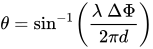
The basic calculation is:
Now as the point moves closer to the Rx, d becomes larger relative to the distance and the phase difference also becomes larger, hence the scope for inaccuracy given the same measurement errors is mathematically lower. This can easily be seen by taking a point on the rightmost line and moving it to and from the antenna and approximating it as a right angled triangle. If d = 1 (arbitrary units) and length along second line equals 5, then the hypotenuse is 5.1 (0.1 longer). If length is 10, then hypotenuse is 10.05 (0.05 longer), so phase difference is smaller and measurement accuracy is more crucial. The angle between the length and the hypotenuse is also getting smaller with distance, so range calculation becomes more difficult. As the length moves to infinity, the phase difference will indeed tend towards zero (as the lines will be parallel) and the calculation will become impossible.

This is also borne out to some degree because the AN/ALR-94, widely believed to be the best RWR (at least prior to the ASQ-239 maybe) is only accurate to 2deg at 450km.
https://en.wikipedia.org/wiki/Lockheed_Martin_F-22_Raptor#Avionics
Starfish PrimeLet’s approach your logic fail piece by piece:
1. That Sweetman would have gotten in trouble for disclosing AMRAAM mid course guidance vis AN/ALR-94- first off, who is saying that the briefing and simulation he viewed was classified? Is there anything to suggest that the information he wrote in his book or the article in JED was not cleared for release by DoD? Just because the specifics of a system such as the AN/ALR-94 are highly classified, does not mean that general capabilities are not cleared to defense journalists. Especially when a weapon system is controversial and new. The USAF probably saw Sweetman’s piece as good P.R. There were no specifics on accuracy released, no details on how accurate the ranging is, or what is collected by each sensor. You realize that the APG-77 acts as part of the EW system in “receive only” mode, also collecting emissions for the EW array, no?2. That because you “feel” that Sweetman was inventing this, you disregard it. Simply put, he could have included it in his book then not submitted a paper to JED. These are EW specialists, there was no retraction, or rebuttal. Again, he was reporting what he was shown, this is not op-ed.
3. Lack of press releases- There have been several missile tests for the F-22, -35. Have they ever specifically stated: range of target acquisition, specific parameters for test, what sensor was providing information via datalink? No. There is no reason to.
By the way, a system can be classified, but information can still be released on overall capabilities without disclosing the exact methods used, your argument is weak. Specific methods of NCTR beyond blade count is highly classified, yet it has be around since the early 1980’s, do you deny that this capability exists too despite extensive information that NCTR methods have evolved?
Again, this is not Journalistic license. This was written in a respected journal. There is no grey area here except the missing material between your ears. You are over on the “supermanuverability” tread arguing that the Typhoon is more maneuverable than the Su-35 with absolutely no hard information. You are using spec information released by Eurofighter on the 6g envelope of the Typhoon to prove points. Did the Eurofighter P.R. team go to jail for releasing information on the Typhoon’s performance specs? If they can release acceleration data and turn data at certain altitudes, why don’t they release the entire flight manual? (are you seeing the logic fail here?)
Better yet, I think the released Typhoon specs are bogus because I can’t view the flight manual. Since journalists have released some details in ride alongs and reports, why not release the whole flight envelope- details or it didn’t happen! AND since the Typhoon was reportedly beaten in BFM exercises vs. the MKI, then obviously it is not as maneuverable as the Su-35. ( I don’t believe this, but it is representative of your argument here)
– yes for the reasons that have been explained to you repeatedly. You want press releases and reports in glossy aviation magazines about capabilities that are not disclosed other than general statements. BTW, did you read the BAE release about their EW systems from Breaking Defense in July? This should give you a clue about the sensitivity of the topic:
http://breakingdefense.com/2016/07/bae-systems-inches-out-in-public-on-electronic-warfare/
1. Mercurius is. That’s why he claims an article stating a test demonstrating the same capability (and nothing more) can’t be published. My retort is that a capability is either classified or it ain’t. It might work in the very near BVR, but ultimately that doesn’t really add much over IRST.
2. He was, hence the comment ‘to some extent range’. The military does not rebut every false remark. We have seen countless conflicting reports emerge after training exercises for instance.
3. I disagree. If they released info. on a capability, the evidence they did a test to validate it would be available.
Yes, and an article simply stating that there had been a test to validate this capability would not disclose any exact specifics.
NTCR is well documented beyond Bill Sweetman. Passive BVR kills are not.
I’ve not sensed a massive level of respect for anything he has written lately.
Because it’s likely that it is more manoeuvrable especially considering it was purpose built to beat Flankers.
They didn’t release a specific, they said ‘over 6g’ and that doesn’t give information away that could help you beat a Typhoon, the same info. piece is available for the F-22. I could also argue as to why the Pentagon released F-22 supercruise speed but not the manual.
An article on the test wouldn’t provide any more information though. So one can’t be classified but not the other, because it’s the same information! That’s the bit you can’t get through your head.
Sorry that doesn’t say anything about a passive data link. You can’t send data without sending it.
Starfish PrimeAny methods include error . DF via phase interferometry AOA resolution is actually far more accurate than TDOA method and as mentioned said to give a bearing with less than 1 deg incertitude with the most basic setup. I guess the important thing here is in the less than 1 deg . As mentioned earlier the calculation error being inverse to the range the longer the range the less the error weigh on the results so 1 deg would be the maximum incertitude at useful range . Note that the method is used to extract target coordinates for A2G precision weapons, so the bearing is not too shabby. Here the range being easier to compute since target is static and on the ground.
I am not too sure why your are talking about amplitude and TDOA here along phase interferometry.
Anyway comparing on bearing measurement performance , one would have to know the incertitude associated with IRST bearing measurements according range too.
So I am not sure how you can conclude the IRST being much more effective in absolute ( no range notion) ,this not only on bearing , but on geolocation altogether .
Yes but phase interferometry is still attempting to measure the phas of a wave at two points. There is no way to do that directly, so it has to use the amplitude at those two points vs the pk-pk value. The latter can only be based on the last peaks and the signal strength is changing as the aircraft move. You also have the issue of pulse compression algorithms and AM thrown into the mix.
At long range the accuracy will be worse in absolute magnitude not better, because you have the same error applied to a smaller extended angle.
A2G is different, since the target is static and the ground is in a much more well defined position, therefore the angle pretty much gives the range away.
How do you measure the phase at two points? That’s why I mention it. No such thing as a phase-o-meter.
Well radar gives accuracy to a milliradian (0.057deg) and IRST is more accurate. So that makes it at least an entire order of magnitude better on bearing than RWR, even if range is slightly less accurate, which it may or may not be.
Starfish PrimeThe IRST housing is turned backwards when not in use, and its rear is treated with radar-absorbent material (RAM) to reduce its radar return.
That’s irrelevant, you still have a sphere on the front of the aircraft, regardless of whether the actual optics are facing forwards or backwards.
Starfish PrimeRemind me again who formed an alliance with Nazi Germany and launched an unprovoked invasion of Poland and the Baltic States. :confused:
Let me guess, another chapter that somehow got misplaced for your history books as a child?
[ATTACH=CONFIG]248505[/ATTACH]
Some of the 22,000 victims of the Katyn massacre, murdered by the “never brutal” Russians.https://en.wikipedia.org/wiki/Katyn_massacre
:rolleyes: This is obviously becoming pointless. Czechoslovakia, Hungary, Poland, the Baltics, the South Caucasus, how many states on Russia’s periphery have experienced the “not brutality” of a military invasion by Russia?
Let me know next time you see American tanks rolling down the street in Ottawa because we didn’t like their last election.
Let me know next time you see the US building walls to keep people from fleeing or murdering people trying to escape our “not brutality.”
Etc etc
It’s been argued that NKVD massacres actually started WWII.
Certainly the only person to have killed more than Stalin was Mao.
Starfish PrimeI think it could also be argued that increasing the launch energy of a Meteor is somewhat redundant and certainly not a good trade-off for increasing IR signature.
Starfish PrimeAs I explained in posting #98, to provide such a capability in a Standard-sized missile would require near-impossible levels of missile performance, a fact that at least one Russian high-level official has admitted “off the record” to his US counterpart. So it only becomes an issue if the Russians believe that the US defence industry is capable of producing near-magical increases in rocket-motor performance.
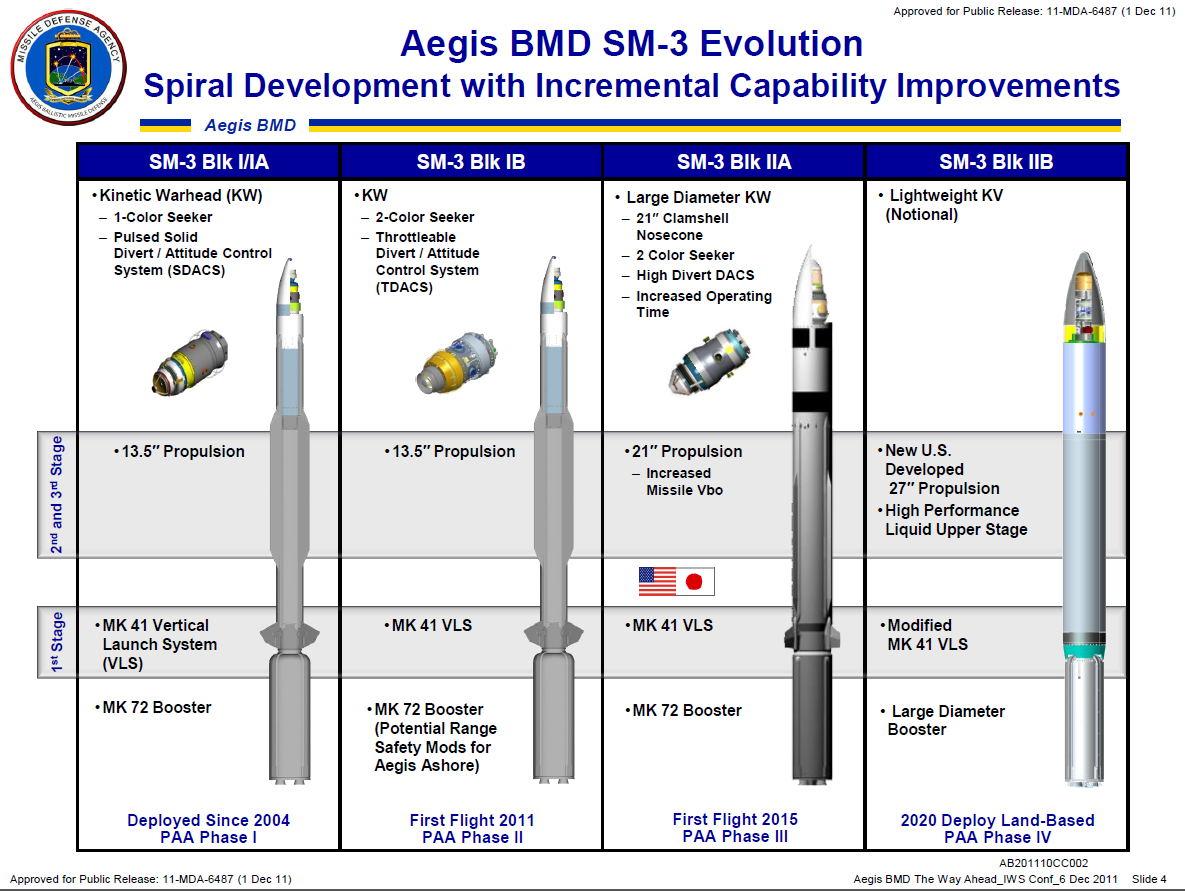
But would the SM-3-IIB fit the existing launcher? What was its diameter? Even if it was secretly revived, how many years would be needed to go from first flight (the first public acknowledgement of its existence) to deployment?
You could equally well argue that Russia might be developing a new mobile Pioner-class IRBM under a black programme.
The diameter was 27 inches, which doesn’t currently fit a Mk41 naval VLS, but I can’t speak for the land-based system, assuming it isn’t the same, which it may be.
The IIA is capable of 1500km altitude, so a 27 inch version with 65% more fuel probably could reach 2500km altitude.
Indeed you could, difficult to know. I personally think the Iskander-M offers more than the stated 500km range but that’s just a personal assessment and nothing more.
Starfish PrimeRCS will still be important, can’t shoot at something you can’t see
I think it would be difficult to design a laser that can beat IRST range, or even reach it. I doubt the current hundred kW class systems can even beat WVR.


 Sign In