Starfish Prime
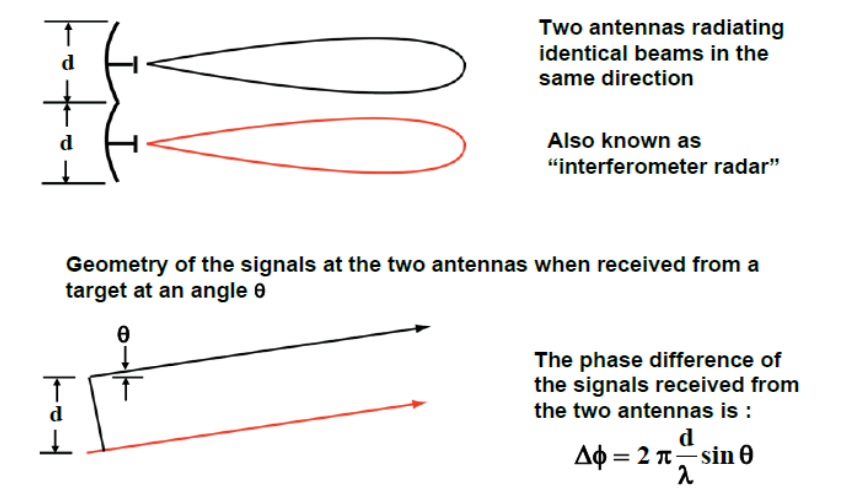
I know how an inferormetry work , finding direction with it should be simple , monopulse radar use the same principle to improve their angular accuracy
But i dont see how you can deduce range to target through doppler processing at difference receivers , given that all receivers are on the same platform , they would literally move at the same speed , hence create same Doppler shift. Unless you are talking about long baseline Interferormetry with receiver on different aircrafts several miles apart. In which case , shouldnt triangulation be a simpler solution ?. Moreover, if you dont know the transmitted frequency ( before Doppler shift ) then how can you deduce emitter speed ?Iam honest dont see how that possible that Doppler processing could be independence of speed or direction
Calculating phase difference isn’t as straightforward as people think either. The phase difference measurement is based on the amplitude of the signal at two points. Now unless you know the exact peak-to-peak value at that very moment, it’s an approximation. It’s also using a measured wavelength for the calculation, which may have inherent error and may also be time variant in the case of AESAs or FM.
Starfish PrimeWhether you see good reason or not, the results of all missile trials in the UK are classified, and I would assume the same for the trials conducted by other countries. In practice the situation can be even worse, as the following quote from Jane’s Air-Launched Weapons demonstrates:
“From 2008 onwards pressure from the customer nations (chiefly Italy) removed almost all discussion of the airborne firings from the public domain. It was not until the development launches were completed, in 2012, that MBDA was permitted to discuss what had been achieved. Details of the all the firings still remain incomplete. For example, the Meteor International Joint Project Office (IJPO) will still not allow the exact dates of all firings to be divulged. Indeed, following the announcement of the first Meteor firing by a Eurofighter Typhoon in December 2012 the IJPO forced BAE Systems and MBDA to redact and republish their press releases with the date and location of the firing now removed, even though this harmless information had already been published and reported worldwide.”
One of the charges made during the 1970s ‘ABC’ trial was that the accused went to air shows and defence exhibitions and asked questions on matters that they knew to be secret. In those days the D Notice system advised UK journalists to report only officially released facts on British defence equipment, and asked them not to speculate about the performance of British weapons.
You would have to talk to a working or retired journalist to learn what the current position is regarding the penalties for gathering or publishing classified information. The fact that investigative journalists such as Duncan Campbell and the late Chapman Pincher enjoyed long careers suggests that in practice there is considerable latitude.
You can’t have your cake and eat. It’s either classified or it isn’t. If if is, then the person who allegedly mentioned it to Bill would be in trouble. And if that wasn’t classified, then neither would mention of a trial that demonstrates the already stated capability.
Yes, complete details of Meteor firing ranges were not released but the fact they happened was. What you’re suggesting is the complete censorship of a trial, which demonstrates a capability that’s allegedly already been made public. It’s nonsense. Dates may be classified so an enemy power can’t re-examine surveillance from said day and work of the range.
Still doesn’t make sense. You’re arguing that someone released information to a journalist that was classified, hence why it’s valid, but details of the associated test can’t be released. The journalist might get off because they haven’t signed anything, but the person who released the information to them would not.
Starfish PrimeRWR measure received EM wave characteristics. This provide means for accurate direction finding , via phase interferometry notably, said to be less 1 deg even for most basic settings , but also range by measuring doppler change rate (precision unknown and depending on target change of attitude). Any how sets of measures will ultimately provide good localization over short time, especially since other more basic methods and measurements ,still based on Doppler, can confirm the measurements.
IR sensor on the other hand measure the received power of EM wave on matrix pixels. Direction finding rely on sensor position and pixel hit at the time, while range would require assessing the size of detected spot on matrix against a library, assuming a given object. Multiple sensors here would significantly improve accuracy in direction finding be it by basic triangulation or more advanced technics, but range will still be mostly assumed.
I think there are no question which one provide most accurate measurement. Draw back being RWR need the target to emit.
Which may be accurate enough at short ranges but not as competent as radar for longer ranges. Like I said, show me the trial. Rafale’s only such trial used a laser for range-finding, which seems odd if it wasn’t required, since the goal of the trial was to remain as passive as possible.
And the bearing accuracy of IRST detection is way more accurate than RWR, better even than radar and I haven’t seen any evidence to indicate that RWR range detection is much better. Triangulation between two aircraft a long way apart could possibly provide accurate range using sine rule if the datalinking and processing to back it up is there.
Debatable. 1 degree at 50km is still +/-900m, radar accuracy is about a milliradian, which gives +/-50m, IRST is more accurate still but less so on range. I wuld actually argue that if the missile is at least point in the right direction, it has a better chance of success than one that isn’t, irrespective of range.
Starfish PrimeMoving radar plate = increased RCS. Moving parts always increase RCS or have the laws of physics changed after the swash-plate was invented?
Now as for mid course guidance.
You’re going to have a 4 ship formation most of the time.
1 plane uses offboard & passive sensors to get tactical picture. Consolidated track may or may not be enough to have a firing solution, so he needs to use his AESA LPI radar only to gather missing data, which means he doesn’t need to scan the whole sky in front of him because he has a clear idea where to look, and only needs to illuminate the target long enough to get whatever data it needs to get lock, or to confirm firing solution of other sensors. Meteor fired.
Shooter receives by link 16 all consolidated tracks from all of the 3 other ships in the formation which are probably several dozen km apart, at least for two of them plus the eventual awacs & ground radars.
In these conditions I’m pretty sure you can fire & turn around while receiving updated data from other planes, including radar data from a plane a few dozen KM away out of reach of the target, which in any case will be busy trying to dodge a meteor coming from another direction entirely.
Advocating swash plate is like being stuck in 1 vs 1 air combat from the past.
Nic
Not from crucial frontal aspect and other aspects would depend on how it’s designed as well as the design of the randome. You simply can’t make such an assumption.
Oh true, but he still needs to use the radar.
Well if you have ground radar coverage fair enough but you can’t always rely on that. Whether the AWACS could provide it would depend on radar frequency being used. S-Band is a little lower than the usual fire control radar frequency, so won’t be as accurate at range.
You’re still relying on other assets with radar though, so the full picture is not a passive one. Third party guidance is well documented and not new.
The swash-plate and cheek arrays provide an independent capability to disengage, the other methods do not. But naturally sour grapes from those without it.
Starfish Primeimo; the F-22 is short legged enough as it is.
That would depend on whether the publicly released figures are accurate or conservative like the F-35’s initial figures. I personally suspect it can do more than 1,200nm on internal fuel.
Starfish PrimeFine i agree with that.
If the F-22/tiffy pilot choose to have 8 tons of fuel or wet bags, while they do their display so be it. It doesn’t take away anything for the Flanker.
When you do a 360 at 15 second, its not STR nor ITR, but somewhere in between. Personaly i do not see the need to focus on this.
Didn’t say it did. But the second Flanker video definitely shows a reduction in altitude.
Well the Typhoon gained altitude and had a 1 ton drop tank, so I would say that was at least STR and possibly +ve SEP.
Starfish PrimeI knew I’d seen that somewhere before. That’s from the video I posted but the actual visual content is gone from YT now.
Starfish PrimeThat with energy manuvereing is all very good. But its not what we are talking about is it.
At airshow, you have good pilots whom are doing a well pre-flight plan to its perfection. Hense his goal is to do a 360’ish in 13’ish sec, or there about then losing altitude and speed is mooooooot point!! This goes for all jets. If the F-22 and Tiffy pilots do not do it in their airshow display, i wonder why..?Anyway, the Flanker has proven its self, its crystal clear. I’m not about to search and post numerous vids just to make that point. Do it your self.
Yes but it has a fundamental bearing on analysis of airshow footage. If the Typhoon’s turn is +ve SEP, then likely that isn’t even STR, never mind ITR, so you’re looking at a different point on the graph. I.e. you’re looking at the 200 PS line instead of the 0 PS line.
The footage we reviewed here is by no means the entirety of airshow history, it’s simply what could be found after a quick search on YT and sadly the best example of a Typhoon 360 includes a climb and a 1 ton drop tank and a pause part way round, yet it still comfortably beats the 20s that Andraxxus claimed was the best the Typhoon could manage and offers an equivalent turn rate to that the Flanker demonstrated. Now the fact he even thought that clearly means other airshow 360s were nowhere near the limit. So, to close this off, airshow analysis is not scientific for a variety of reasons:
a) No measure of speed;
b) No measure of altitude;
c) No measure of fuel load;
d) No verification of to-spec weights;
e) No measure of ambient conditions (high density vs low density);
f) No guarantee it’s the maximum turn rate.
Starfish PrimeI know, but an F-15 has to use his energy(KIAS) cleverly if he is up against an F-16. Hens in this instance Speed is truly life.
Its just so funny, i remember the days the F-22 were out, there was no end to the god like speed and AoA rate if it. But now with the F-35, it is as those abilities has melted away by the very same crowd. 🙂
That’s the trend of air combat. That’s what studies have shown.
WWII to Korean War was about energy, Vietnam was about manoeuvrability (although energy definitely saved some F-4s), 1980 onwards was about detection and stealth.
Starfish PrimeI disagree, going superfast will indeed result in a very high IR signature, flying at about mach 1.4 would not, while providing a good speed above the TS regime and the ability to give more energy to the missiles.
The problem is not to have a performance disadvantage that is too high against the opponent. 20-25% less speed might be acceptable if the F-35 is more stealthy, but more than that, the disadvantage would be too great. For a multirole plane the tradeoff would be acceptable, for a pure fighter it would not.
Yeah, I don’t disagree but flying at M6.0 at 130,000+ft has very distinct advantages in terms of survivability vs normal fighters and SAMs. I’m not even sure the capability exists to kill such an object at present, the speed and altitude causes real problems, whereas flying at M2.0 at 60,000ft does not.
Well you’re going to have that problem against a MiG-25/31 anyway and F-14s have never struggled against them. Studies have shown that the speed doesn’t actually provide an advantage as already mentioned because it massively increases detectability. 10x for M1.8 vs M0.8.
Starfish PrimeI don’t see the point you’re trying to make with the F-117, the F-117 is not a fighter.
Why did the USAF want more than the 187 F-22 if that kind of performances is not needed? Clearly the ability to supercruise is an advantage for a pure fighter.
Also how does the friction increase the IR signature? I would argue that if the plane flies faster, it can fight higher where there is less friction, so that would partially reduce the problem. Also the enemy sensor will have a detection range proportional to the square root of IR signature.
I am not sure the level of speed of the F-22 would be needed ( around mach 1.75 supercruise), but enough supercruise capability to stay above the transsonic regime would be an advantage. Drag decreases at mach 1.1-1.25 or so, so if say the F-35 had 10% less drag, that could be enough to go beyond that transsonic range and get substantial supercruise capability.
No but it still needs to be dealt with by a fighter.
Because the original plan was to have more. Originally they planned on 750 F-22s and 140 B-2s during the Cold War.
If you can’t figure out how friction increases IR signature, you are beyond my help. At higher altitudes, the ambient is lower, so the aircraft becomes even more visible in IR.
Actually it won’t (read up on Lambert Law), but detection range is proportional to 4th root of RCS.
Why though? How often do planes go supersonic even in combat?
Starfish PrimeIf your goal is to make a 360 turn as fast as possible, the speed and altitude is kid of moot point. Eighter you do it in 12, 14 or you do it in 16 sec.
The Flanker has shown us many many times it can do it in 13 sec’ish. So what you would need to do now is show us a Tiffy that can do the same.And a 360 deg turn will show us the STR at a much clearer standpoint, than say a 180 deg turn.
And it’s difficult to find an airshow showing a full 360deg turn at maximum rate.
The only two videos show 15s for the Flanker, in the second of which it is losing altitude. The Typhoon is managing this with a climb and easing off part way. The climb indicated it’s +ve SEP vs -ve SEP, so not a fair comparison and it’s got a drop tank on. Unless you have the speed and altitude there’s no way to compare the kinematics because the SEP change is unknown.
No it doesn’t because you don’t know the speed or altitude change, so there’s no guarantee that it’s sustained. If one plane climbs during the turn and the other descends during the same turn, then the latter aircraft is at a weaker standpoint in a dogfight. One problem Eurofighter pilots actually commented on is the habbit of it always gaining speed during turns, which increases turn radius.
Starfish PrimeCan’t someone just Edit in a timer in those wids so we know when the turn start and ends.
Sometimes a jet only do 330 deg turn or it does 380 deg. Kinda hard to tell them apart.
Anyway, John Farley the British harrier test pilot said Victor Pugachev did a 360 in his Su-27PD in about 12 second. He did use a timer.. so I think Andraax is on to something.
Not that simple because we don’t have a measure of speed or altitude. The Eurofighter definitely climbs at the start of the turn and eases off after 4 seconds, which is plainly visible. It also has a drop tank, which adds weight and drag and reduces aero performance.
And a clean lightly fuelled Typhoon could also do that based on it’s 180 times. The problem is that aircraft rarely do a full 360deg in airshows. I would definitely argue that the Typhoon is getting through the first half turn faster, even with the climb.
Starfish PrimeWell, no. The demand for US made cars is traditionally concentrated on NAFTA countries (Canada, Mexico make up to 50%), the rest goes to the Middle East (Saudis, Kuwait, Qatar) and Asia (China, I’ll never understand the Chinese crush for Buick 🙂 ).. European imports are quite insignificant.. Overall, the US export about 2 million vehicles in a year (incl. foreign brands), while in Europe, the tiny Slovakia alone does half of that number..
A lot of US manufacturers build cars in Europe though. Ford, GM, Chrysler etc. Fords and Vauxhalls are very common in the UK.
Starfish PrimeWait, let’s back up on the conspiracy theories- answer the question:
You stated that the 1991 autonomy of Crimea was the basis for Russia to take over. I quote you
Now based on the actions that of Crimea that I posted, I’ll ask you again- is that accurate? Was anything I stated about the acts of the Crimean Parliament wrong? I don’t want to hear your justifications. I want you to answer the question. You stated there was a legal precedent based on the 1991 acts. Do you state that as accurate now?
Well it exercised its right to self-determination, opting to rejoin Russia.


 Sign In