 Starfish Prime
Everything else equal a small radar will have less performance than a big, there is no doubt about that, however things are more complicated than just looking at one single parameter for one single sensor.
Again, I don’t think the Rafale has lost any competition due to the small radar; please feel free to correct me if I am wrong.
It’s simply a dumb point, as I’ve already mentioned. It’s clear that evals are assessing detection and engagement, so it’s clear that it’s a factor regardless of the result. And if it’s losing to a mech scan radar with a 50% larger antenna on engagement then what will it be like against a GaN AESA the same size?
Also it will be interesting to see if Typhoon manages to succeed in score new sales after 2021 with their new super radar — I doubt it, because it will be very expensive, and overall still inferior to the F-35 (which will be fully operational by that time). Also the Rafale will probably struggle to score any sales after 2021, the window of opportunity is closing very rapidly for expensive Western 4.5 gen jets.
Sure, it won’t make much difference likely. Odd Middle East contract maybe. But sales haven’t been great for either aircraft relative to the F-35 and sometimes it’s about capability rather than just sales and the upgraded Typhoon will make a good partner for the F-35 in relevant air forces.
Starfish PrimeWell, its possible, but very debatable. I would be willing to accept a close couple canard would add to Clmax automatically, but on Typhoon, canards are just too far away to provide a meaningful vortex at high AOA.
In fact, Typhoon has two additional vortex generators to mitigate that.
Such canards would work better when aircraft is supersonic, making maneuvers that require little AOA, but I may be wrong, and there can be improvements on subsonic regime as well, I don’t know. In any case, airfoil itself is thin, you can improve it only to a degree, its not logical to expect Cl to go anywhere above ~1,2.
Agreed, then Su-27 has triple shock variable inlet ramps, so it can also give an edge when high and supersonic; nothing is exactly clear on this one.
Not all vortices are always visible and if you look carefully you can just see a feint vortex under the left canard in the bottom picture. Top picture, nothing too wrong with how it’s working. The other vortex generator you mention is more for body lift.
Starfish PrimeLOL Let me refer you to http://www.thefreedictionary.com/clueless
It just a non-engineer at a company struggling for superlatives. That aside since 2000 no Western fighter developer with HMCS+HOBS+LOAL has been much interested in enhancing dogfight manoeuvring in case you haven’t noticed. Therefore it’s likely to be for other reasons, like carriage of currently awkward loads.
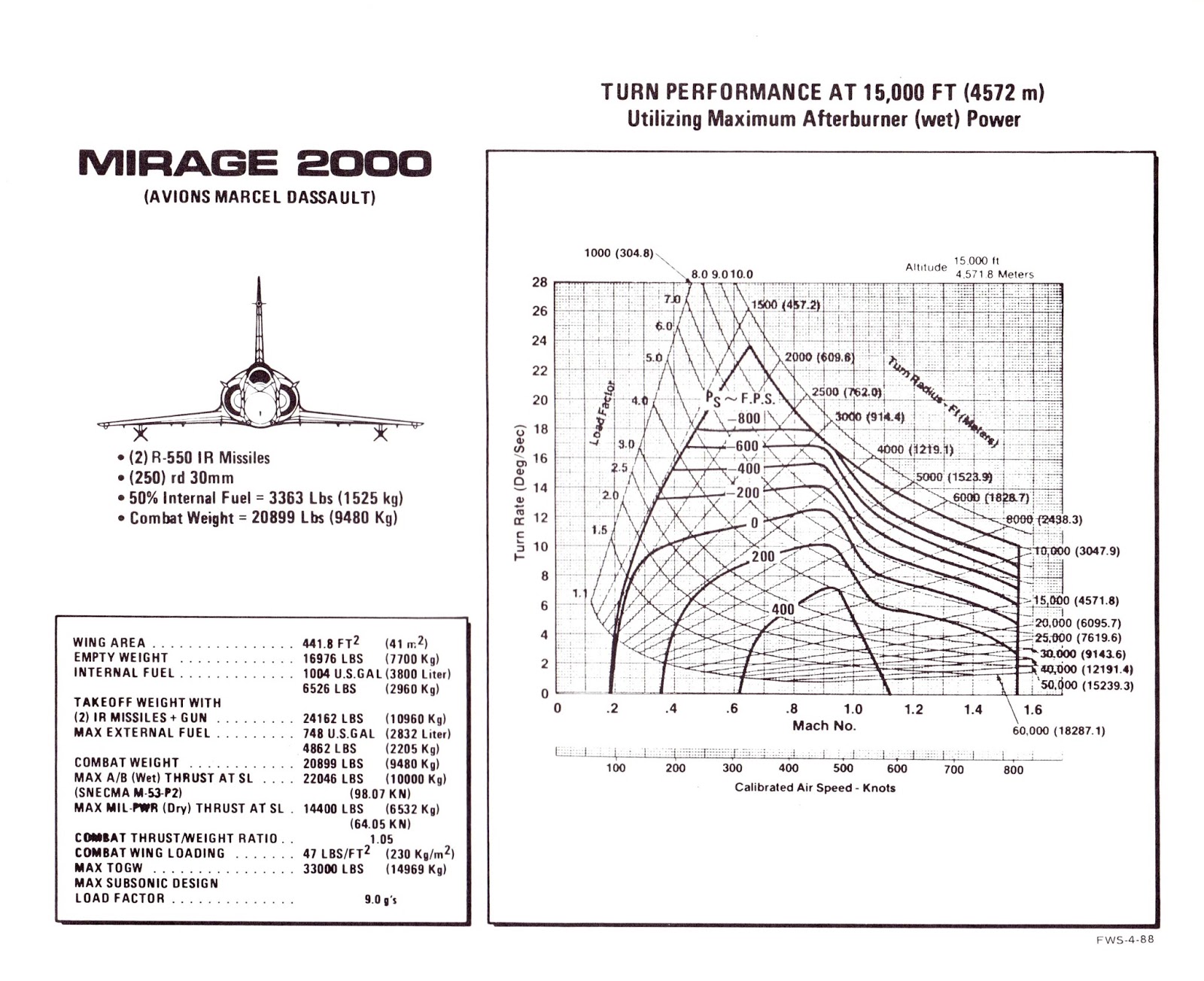
Starfish PrimeWhat are you on about? You’ve posted two pages from the F-16A and Mirage 2000. The F-16A with a F100-220 has 23,770 lbs of thrust. That is correct, no F-16A EVER had 28,000 lbs of thrust. ( if you want to compare the F-16C I can put up the numbers. However, the thrust to weight ratio does not change much at the -C is considerably heavier, depending on model, and again depending on the model, the sustained turn rate is less for some F-16C’s)
The thrust to weight ratio is listed at the two combat weights right on the side of both pages, those are the two you were using to make your comparison, so that is what I am using, and the difference is 8.5%.Second, at what speed are you comparing them? I told you at Mach .8 15,000 feet the sustained turn rate for the f-16 is 2.2-2.4 degrees better. That is directly from the pages of the manuals you posted. Hence there is no 25% greater thrust to weight ratio and the sustained turn performance for the F-16A is consistently 2+ degrees superior until they approach Mach 1. Lastly, the M2000 IS a relaxed stability design. You are fabricating or cherry picking, just stop.
Well the F-16C, page A8-57, manages an identical max STR at the same altitude anyway.
https://info.publicintelligence.net/HAF-F16-Supplement.pdf
The TWR of the C is 1.1 fully fuelled and 1.3 at 22,000lb, which is about 25% more than the M2000. The F-16C weighs more, so we see that a higher wing loading has been a detriment but compensated for by increased thrust. For max ITR the M2000 beats the F-16C by 5deg/s. It would be interesting to see what happens in lift-limited turns at lower altitude rather than drag limited turns at high altitude.
http://www.af.mil/AboutUs/FactSheets/Display/tabid/224/Article/104505/f-16-fighting-falcon.aspx
It’s about 2deg/s but I’m comparing peaks, which is 1.75deg/s. At M0.4 it’s even lower – 1deg/s.
What is the actual instability margin though. Looking at the M2000, it’s evident that there are no canards or tailplane to balance the moment about the CoG. Seems to be largely based on the Mirage III layout. The point is that the M2000 is losing out in STR because of lower TWR, the Typhoon doesn’t suffer that problem and has increased relaxed stability.
Starfish PrimeLOL Let me refer you to http://www.thefreedictionary.com/clueless
I see you found your way there first.:highly_amused:
Starfish PrimeWell, its possible, but very debatable. I would be willing to accept a close couple canard would add to Clmax automatically, but on Typhoon, canards are just too far away to provide a meaningful vortex at high AOA.
In fact, Typhoon has two additional vortex generators to mitigate that.
Such canards would work better when aircraft is supersonic, making maneuvers that require little AOA, but I may be wrong, and there can be improvements on subsonic regime as well, I don’t know. In any case, airfoil itself is thin, you can improve it only to a degree, its not logical to expect Cl to go anywhere above ~1,2.
Agreed, then Su-27 has triple shock variable inlet ramps, so it can also give an edge when high and supersonic; nothing is exactly clear on this one.
They examined canard position thoroughly and moving it forward would only have improved lift for a less unstable aircraft.
Starfish PrimeAgreed, then Su-27 has triple shock variable inlet ramps, so it can also give an edge when high and supersonic; nothing is exactly clear on this one.
A fixed ramp works fine until you exceed M2.0. Even pitot works fine up to M1.6 (-5% loss for F-16 intake vs F-15 intake at M1.6).
Starfish PrimeEurofighter were pushing this mod that might have brought it upto F-16 class :p
Adding leading edge root extensions and extended trailing edge flaps, and reshaping the side-of-cockpit ILS antennae covers as 70° delta strakes should improve the aircraft’s agility for close-quarters combat.Laurie Hilditch, head of future capabilities at Eurofighter, says the modification kit should give the aircraft the sort of “knife-fight in a phone box” turning capability enjoyed by rivals such as Boeing’s F/A-18E/F or the Lockheed Martin F-16, without sacrificing the transonic and supersonic high-energy agility inherent to its delta wing-canard configuration.
That’s probably more for Storm Shadow carriage than dog-fighting. AoA would benefit too though. Swiss thought the a/c performance was more than fine as is.
F-16? Okay now.
Starfish PrimeThe wikipedia numbers are wrong for the F414, I took the actual intermediate and wet thrust from: http://www.dtic.mil/dtic/tr/fulltext/u2/a493918.pdf
The F414 has a lower bypass ratio than the EJ2000 .314 to .4
How do you figure 25% advantage? The F-16 has 8.5% greater thrust to weight ratio, and a nearly 2.4 degree sustained turn rate advantage at mach .8 15,000 is a HUGE difference. They only approach parity around mach 1.
While that is true, that does not mean that two totally different planforms perform the same as bank angle and AoA increase (we are not talking high AoA , 20 degrees or less).
Ah okay, well most aircraft are above a 1.5:1 wet/dry ratio.
Says 0.25:1 here.
http://www.mtu.de/engines/military-aircraft-engines/fighter-aircraft/f414/
I would expect higher BPR engines to benefit from afterburning more, because the core gas is already very hot anyway.
Umm no, F-16C is 1.1, M2000 is 0.88, 1.14 is a mis-calc, it’s 1.37 at that weight – 28,600lbf. The thrust figure they state is not for a -200, it’s for a -100. That’s a 25% advantage. And bear in mind that the M2000 is canard-less and doesn’t run relaxed stability and despite that, only a 1.75deg/s advantage for the F-16 and a 4deg/s ITR advantage for the M2000.
https://en.wikipedia.org/wiki/General_Dynamics_F-16_Fighting_Falcon
Exactly, which is why the Typhoon is likely to win on turn rate.
Starfish PrimeIf SEP is -800 then that isnt a sustain turn , it is instantaneous turn.
True but it is taking a measurement at the same energy bleed rate, I mentioned the 0 PS figure too.
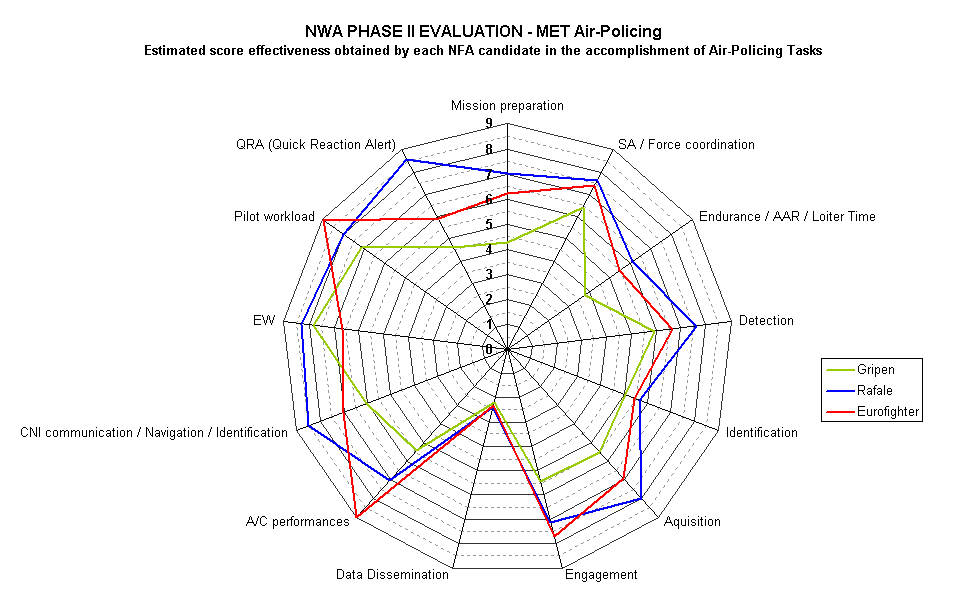
Starfish PrimeWell, Grippen C is not exactly known for its massive STR only half official statement is “30deg ITR 20 deg STR”, puts its sustained turn performance inferior to all 4 principle 4th gen aircraft I’ve mentioned. Rafale is a mistery in here as well, so I don’t see what that chart exactly proves? Indians liked Rafale over its competitors, Turkey preferred A-129 over AH-64D or Ka-50. This doesn’t prove anything.
Again you are missing the point. All, delta wings inherently have large wings. As a result, they are inefficient at sustained turns in general. You are taking a single multiplier in a formula (wing area), but ignoring the others.
In mathematical terms, you are saying x1*y1 = 30; and since x2 > x1, x2*y2 will always be greater than 30. This is clearly not the case.
According to your logic F-106, a delta with just 255 kg/m2 wing loading has higher maneuverability than its generational counterpart F-104, it even has greater maneuverability than Typhoon F-15 or Su-27?
Ok, for the record, I hate using empyrical formulae for proving anything, but lets have it your way.
We have two aircraft, both have equal weight at 10000kg, and airfoils correspond to Cd0 = 0,02 and k = 0,12 Only difference is, Aircraft #1 50m2 wing area, greater than the wing area of aircraft #2 which is 40. I want to pull 9Gs at M0,9@sea level.
Aircraft#1 -> 9*10000*9,8184 = 0,5 * 1,225 * 50 * Cl1 * 309^2 , Cl1 = 0,302; Cd1 = 0,02+0,12*0,302^2 = 0,0309. Cd1*Wing Area1 = 1,547.
Aircraft#2 -> 9*10000*9,8184 = 0,5 * 1,225 * 40 * Cl2 * 309^2 , Cl1 = 0,377; Cd2 = 0,02+0,12*0,377^2 = 0,0370. Cd2*Wing Area2 = 1,48.As you see, its quite easy to prove HOW an aircraft with higher wing loading does not necessarily translate to inferior STR. When maneuvering at 9Gs sea level, 25% reduction in wing area actually resulted in 4% decrease in drag, even if we ignore the fact that aircraft with smaller wings would be lighter in reality.
And before you start questioning it, none of my numbers are arbitrary; Cd0 = 0,02 is MiG-29s Cd0, k=0,12 corresponds to MiG-29’s airfoil at 0 LE flap deflection. Likewise, 10000kg and 40m2 wing area is ballpark similar to what MiG-29 has, and 50m2 and 10000kg is also the middle point of Eurocanards, namely Rafale and Typhoon.
So I ask two questions; #1, had MiG-29 had larger wings like Typhoon or Rafale, would it sustain turns better or not? #2, do you think MiG-29’s wing area is “just” 38m2 and not 50m2 just because inability of Mikoyan Gurevich engineers or is this a result of a thorough optimization that some performance points would degrade (as simple shown above) with increased wing area?
Ah, apples to oranges, you mention relatively insignificant differneces like relaxed stability or LERX in two conventional layouts, but you have no problem comparing wing areas of two entirely different aerodynamic layouts?
Same could be said for even 30 year old Su-27S with its R-73 and HMS combination.
If you have anything more solid and accurate, I am all ears.
A forum search will help you in this, one I am not inclined to re-do what I’ve already done by writing a wall of text and posting some 10 pages of the manual.
Only failure here is your inability to prove any word I’ve said wrong.
Look, I am not saying I am 100% correct, I openly say I am guesstimating the maneuverability of Typhoon, but some nonsense examples like F-104, or some charts provided by the buyers of the product who may twist the truth in both ways, or some pilot quotes contradicting a numeric comparison of what is published by Typhoon’s manufacturer and what is written on F-16 flight manual is just not enough.
By the same analogy, Su-35 came after Typhoon, and was purpose built to defeat it. Again, I don’t follow the logic here.
It is known for good ITR though. Rafale is known for good STR and ITR and we see the Swiss rank the Typhoon well ahead of both by some margin.
Oh really, care to prove the assertion that Canard-deltas are inefficient? Hmmm…. wonder why so many European manufactuers have specifically gone with them? Only those manufacturers aiming for stealth haven’t in the Western sphere.
It is if y1 ~ y2, which it likely will be to within less than 34% in this case.
Well do we know what the STR of an F-106 is? For a start you’re comparing older tech again though. No canard, stable configuration, CoP after of CoG.
Nope. All you’ve proved there is that with that specific Cd0 and k value, a plane with 25% higher wing loading has greater drag in the turn at that speed but they are both pulling 9g anyway. The plane with the larger wing area will continue to be able to pull 9g at lower speeds than the other, and hence higher turn rates. I could also use the Cd0 and k value in Jet Propulsion by Nicholas Cumpsty on Page 183, which are 0.01 and 0.2 respectively and get a different result. 0.0282 for Cd1 and 0.128 for Cd2, giving Cd1.A1 as 1.41 and Cd2.A2 as 5.12 and I have reason to believe they’re based on a Eurofighter’s Cd0 and k value. Cd0 is generally higher for aircraft with smaller wings too.
Probably
a) because Cd0 would likely reduce for larger wings.
b) the larger wing would be able to maintain 9g at lower speeds.
c) subsonic sea level turns where peak rates are achieved are not drag limited, making the entire premise of your argument invalid.
Repeat the calculation at higher altitude, e.g. half the air density, or at lower speed, e.g. 0.707 times and the value of Cl1 and Cl2 increases two-fold and Drag1.A1 becomes less than Drag2.A2 – 3.19 vs 3.53.
Everyone knows relaxed stability makes a huge difference and the Typhoon was designed for a relatively large margin of instability. That’s why comparing the F-16 to the F-15 is a bad comparison. The M2000 on the other hand doesn’t have relaxed stability and still beats the F-16 in ITR, proving that wing area is indeed important.
Yes it could against an early F-15 but the R-73 does not have LOAL yet and HOBS is still <90deg, so it still ain’t the same.
There’s nothing to say whether either aircraft is even maxing out a manoeuvre at an airshow, or whether SEP is maintained.
Well you started with the assumptions, at least appeared to.
http://forum.keypublishing.com/showthread.php?140171-What-s-the-difference-between-energy%96maneuverability-theory-amp-Supermaneuverability&p=2340023#post2340023
What pilot quotes are you referring too?
Actually it didn’t the Su-27M came out in 1988. The Su-35 is literally an overhauled Su-27, which came out in 1985. So what you’re actually arguing is that the Soviets designed a plane which could out-turn a Typhoon 20 years earlier. That’s quite a stretch considering it was never able to match the US year for year from 1955-1976, after which their focus moved to stealth.
Starfish PrimeI’ve read the report multiple times. There is NOTHING about specific performance numbers. The performance based on the OCA/DCA mission performance. It does not mean that the Typhoon has superior turn performance, nor does it mean inferior. Simply put, there is nothing to support either in the Swiss Eval, except that the overall aircraft performance on the missions was superior.
What numbers are you using? Wiki? The F414 produces 14,770 lbs in intermediate and 21,890 in wet thrust. The EJ2000 is very similar at 13,500 and 20,250. These are the manufacturers numbers. There is no credible report that he EJ2000 has a war emergency power setting the pilot can activate similar to some Migs. What the typhoon starstreak site stated was:
Like any engine, that means simply, that engine can produce more thrust at higher operating temps at the cost of engine life. There is nothing to suggest that the pilot can control this or that any air force would allow it.
Note also, add 5% to the stated 20,250 lbs of thrust. What do you get? Simply put, the Ej2000’s thrust is known.
BTW, I’m not arguing that the Su-35 has a higher sustained turn performance than the Typhoon. I’m saying your reasoning is flawed. Your trying to compare wing loading of canard/delta wing to that of cropped delta/tail planform. I shouldn’t have to explain why using simple wing loading numbers do not support that the Typhoon would have superior sustained turn performance
.
That is the point, they were both designed without high lift devices, and neither likely have significant body lift. So, obviously the Mig-21 with it’s larger wing will have superior turn performance as most speeds/alt.
What? what are you comparing? I was talking about to similar wings one with leading edge root extensions and one without. Which one is going to generate more lift as AoA increases?
Right, so how did the Typhoon get 30% ahead of the Rafale if it was just down to a slight speed or climb advantage say? Clearly it must have been better over a range of parameters.
Says 13,000lbf on wiki and 14,000lbf here. Either way, the wet/dry ratio is >1.5. As it is for most Flankers and the like too.
http://www.sps-aviation.com/story_issue.asp?Article=731
That seems to be exactly what it suggests.
https://web.archive.org/web/20081231141150/http://typhoon.starstreak.net/Eurofighter/engines.html
Overall the EJ200 employs a very low By-Pass Ratio (the ratio of air which bypasses the core engine or compressor stages) of 0.4:1 which gives it a near turbo-jet cycle. Such a low BPR has the benefit of producing a cycle where the maximum attainable non-afterburning thrust makes up a greater percentage of total achievable output. At its maximum dry thrust of 60kN (or 13,500lbf) the EJ200’s SFC is in the order of 23g/kN.s. With reheat the engine delivers around 90-100kN (or 20,250-22,500lbf) of thrust with an SFC of some 49g/kN.s.
Well that’s just as well, because you haven’t explained it. I was the original one who made the comparison either. Whilst wing loading and TWR isn’t everything, it certainly isn’t nothing either and when the differences are this huge, one really has to question exactly how they can be undone by other aspects.
Whilst the F-16 could achieve higher STR than a Mirage 2000 due to the M2000’s poor TWR, ITR was not higher. Even with the 25% advantage in TWR, the F-16 only manages marginally better STR of around 10% at 0 PS and 5% at -800PS. The lower wing loading did give an advantage of some 4deg/s peak. Now if the Mirage 2000 had 29,000lbf of thrust instead of 21,400lbf, no doubt it would have won on STR too. Now factor in inherent instability margin and canards on top of a 1.2:1 TWR and that kind of wing loading and you get the picture.
Wing area generally tends to include the part of the body that adds lift and we’re again comparing two planes built in the modern era, well actually the Typhoon is much newer in design to boot.
They will both generate more lift as AoA increases and canards area help keep airflow attached at high AoA. Can the Typhoon pull the same AoA as an Su-35? Nope, but that kind of AoA frankly isn’t useful for ITR and certainly not for STR. The Typhoon can easily make sufficient AoA that makes AoA a moot point in any turn rate comparison (see 1:30).
Starfish PrimeSo if B-21s are ‘Raiders’, where is the Lost Ark?
Starfish PrimeThe Rafale radar does not have a “sh!t” performance as you seem to imply… look at the chart you put up yourself. Other radars are better, but that does not make the Rafale radar a “poor” radar. There is more to this than radar size. The Swiss highlighted the performance of the (small) Rafale PESA radar. From the Executive Summary: “The strong points of the Rafale were the quality of its sensors such as the PESA radar,…”.
As stated earlier the AESA version has much longer range than the PESA (I believe range was increased by more than 50%).
Interestingly the French has now started to use the Rafales flying with the AESA as a “mini-awacs”, supplying info to the other Rafale flying without AESA radars.
Again, I think you are making a lot of fuzz about something that is not a major problem for the Rafale.
It was an analogy.
Yes PESA is good when up against mech scan radars and solid state is good against CRT but small size is a fundamental inherent weakness in the long run however you sugar coat it.
Which isn’t a new capability. Others just use an AWACS as an AWACS.
It’s a significant weakness relative to a key competitor, nothing more, nothing less. It has strengths too but that is a weakness.
Starfish PrimeThe evaluation was not a “turn contest”. The performance was based on DCA/OCA missions. For instance, the Gripen scored poorly on a interception mission profile. Climb rate, cruise speed/distance, acceleration at altitude, etc. All figured into scores.
That is because the EJ2000 is rated at 20,250 lbs of thrust, that is slightly greater than 90kN.
Effective wing area at increased g and angle of attack is not as simple as comparing nominal wing area. Lift coefficient at increased bank angle and aoa cannot be predicted by simply comparing wing area. Vortex generation, flow separation characteristics are not easy to predict.
Oversimplification, the F-104 was a tube with wings, again blended wing and body designs with significant (and increasing proportion of body lift as bank angle increases). As you point out LERX vs. non- LERX wings do not perform the same. The LERX will give high Cl and higher Cl max.
Up to what altitude? what model of F-16 were they comparing, MLU? That would not be surprising. You’re making a large number of generalizations that don’t even answer what andraxxus was pointing out.
A/C Performance covered everything, including those things and turn performance. And the Typhoon came out 30% ahead of a Rafale.
Nah, that’s just approximated based on dry thrust + 50%. If you look about most fighters on reheat increase by more than 50%. E.g. F414, lower dry thrust, higher wet thrust. And that’s before WEP.;)
And if the two figures were anything like close I would agree but they ain’t and the canards tend to help in that respect anyway. They’re not remotely close. 63 vs 85lb/ft^2 even with the Ef at 32% fuel fraction and the Su-35 at 25%. Put them on the same fuel fraction and it’s 63 vs 90lb/ft^2 and 1.2 vs 1.07 TWR.
So compare the F-104 to other fighters of that era like the MiG-21. That was also a tube with wings but massively superior in turn performance.
And high Cl will increase drag, so it’s damned on two fronts.
What he’s pointing out is a mile wide of the mark and rough calculations really are all that’s required here given the size of the differences AND crucially all we’re able to do with the figures available. There is simply no way an Su-35 can beat a Typhoon in STR unless it has about 1.5 times the Cl but somehow 20% less drag at that Cl even though the drag increases with the square of that Cl. And using a comparison of a 10 year newer design (1985) against an older design (1976) to prove something about a 18 year older design (1985) against a newer design (2003) is just silly.


 Sign In








