 Starfish Prime
Good to hear you acknowledge the primacy of the T-50, coming after the F-22 and having been designed to beat it. 😎
I’ll refer you to this.
Starfish PrimeThat was not the point I was making; I was making the point that the small radar of the Rafale is not a major problem; other factors are much more important than the Rafale radar size. I was also making the point that professionals tend to assess these things quite differently from fanboys on this forum. And this is demonstrated by the outcome of the evaluations they make, and the conclusions they draw which seem to be different from conclusions e.g. you would draw. You have already highlighted the much bigger radar of the Typhoon, and the higher A/C performance; the Swiss evaluators highlighted the Typhoons A/C performance but overall they ended with a very clear conclusion; Rafale was overall technically far above and beyond the Typhoon.
As for issues:
Lack of proper stealth for instance, is IMHO a much bigger problem for both the Rafale and the Typhoon.
Another big problem for Rafale is the high cost of the a/c, and the high cost of the weapons (compared to US weapons).
I would put the size of the radar much further down the list of issues for the Rafale. It seems the pros agree with me on that.
No they assess them the exactly the same as me but as you say, other factors have won things for the Rafale but that doesn’t make the small radar any less of a weakness. You can still win a decathlon with a sh!t performance in long jump, but that doesn’t make the long jump performance a non-factor, because next time the runner-up might have improved on their weaknesses. Why is this difficult so understand?
I never said the Typhoon should have won. JFC, have you even been following this thread. I admitted all the Typhoon weaknesses here. Hell, I wouldn’t have picked the Typhoon in present state but the 2021 Typhoon is another matter.
Of course stealth is but avoiding detection is simply the inverse of detecting, so why you would argue one is an issue and the other isn’t is beyond me.
Well yes, bulk manufacture reduces cost, agreed. Weapons cost I would put below radar performance and stealth, because you don’t use them all that regularly, except against ISIS and the Rafale is still compatible with the basic US Paveway series weapons which fill that role amply. If I knew my only military role would be bombing ISIS for the next 50 years, I would probably choose the Rafale but unfortunately you can’t militarily plan like that.
Starfish Prime..You didn’t even bother look at the youtube vid i posted, did you?
Well perhaps if it came with a SEP-o-meter it might be useful.
Starfish PrimeIf you^^ really read Andraxx posts, you would learn something.
The data he use is from flight manual of Su-27S, not Su-35S.So half your post does not make any sense in that regard.
The Flanker is a large heavy aircraft, with its role and mission right up in the same ball park as F-15C and EF.
Oh, btw, the Su-35S has even higher wingloading vs Vanila Su-27S. I’ve seen figure over 440kg/m2And as Andraxx wrote, the wingloading is not an all in figure where you can cherry pick the performance.
And certainly not if you start compare jets like F-104..? They are so different in design, class and role as it is completly moot point.
What we all know is that Deltas has some ups and downs when it comes to Energy manuvereing. Deltas tend to bleed energy as a faster rate vs non delta wings, under high alpha turns.
The game between F-16 and Mirage 2000 is well known.It sounds like you are suggesting having LERX on any jet is like cheating..? How rude of the Sukhoi putting LERX on their jet.. 🙂
LERX vs none LERX jets has absolutly no difference in Air arms. They are what they are, and they do what they do.If you say Andraxx twist everything, then for crying out load, prove him wrong and show us all where he did wrong.
And stop doing these general claims. That Swiss chart does not tell us much.. in fact it tell us Zippo in the BFM game.
And if they were anywhere near close I would likely accept that other features might sway things, but they aren’t. There is a gigantic difference in wing loading, even at equal fuel fraction, even when the Su-35 is running with a lower fuel fraction. That’s the side affect of designing an aircraft to carry a shed-load of fuel internally – it gets big and weighs a lot.
I think the F-104 still emphasises the point that small wings don’t help turn performance, even relative to other aircraft of that era, e.g. F-4s and MiG-21s.
Haha…. You’ll the discrepancy between the Mirage 2000 and F-16 is more due to the Mirage 2000s sh!tty thrust-to-weight ratio (0.88), which is not an affliction the EF suffers from (it’s nearly that good on dry thrust alone). That said, the only combat engagement between a Mirage 2000 and an F-16 resulted in a dead Turkish F-16.
No, I pointed out that there are fundamental massive differences in technology between the F-16 and F-15 which make the comparison null. That said, the difference in wing loading is also is somewhat smaller and the F-16 also has the benefit of slightly better TWR and even then the differences in turn performance aren’t great. The difference in wing loading is twice as high for a fully fuelled Typhoon vs a 50% loaded Su-35 and even more with an equal fuel fraction.
Well he didn’t really say anything of fact that could be disproved. I picked him up on the STR point however. kCl^2 is the dominant term in high-g loads and that reduces for a larger wing area, meaning that you can generate the same lift with a lower AoA and hence generate less drag. Aside from that, canards are known to accelerate the flow over the top of the wing and so provide an addition to lift even for similar wing loadings. If you want a drag analysis refer to the supercruise performance (M1.5 for Typhoon) and the fact that Air International states that the Typhoon is the only aircraft besides the F-22 can can pull over 6g in a M1.6 turn at 36,000ft. So the Typhoon has pretty much every known advantage in the book going for it wrt energy manoeuvrability and that’s verified nicely by a maximum a/c performance score in the Swiss eval. Then you have the final insult, which is the HMD+LOAL+HOBS, which adds an element of unfair to natural advantage in this match. And aside from that his comment about a Typhoon entering a spin after pulling too hard on the stick is comical. Obviously he’s not heard of fly-by-wire.
Starfish PrimeActually it’s the opposite.
ESA lets you tailor the radar beam, allowing for very narrow/high gain beams to lock at range beyond what is achievable for mechanical arrays. However it requires that one already knows where to look at because scanning with such narrow beams would take too much time (and would also generate a lot of false positives).
It’s for undirected scanning that ESA and MSA perform more or less the same*, they both use beams with the same width (that offers the best compromise in detection probability vs scan time).
*ok, you gain like 10% scan time by not having to re-position the array at the end of a scan.
Better? As in more expensive, weighting more, being less reliable… The US went for fixed arrays and they have the most experience on AESA radars.
Clearly it isn’t the opposite as the eval proved. The gain even in ESA radars is still a function of antenna size. That is inescapable regardless of the technology at play.
What!? The electronically scanned radars scan much faster than physically moving ones, everyone knows that.
https://en.wikipedia.org/wiki/Active_electronically_scanned_array#Basic_concept
Starting in the 1960s new solid-state devices capable of delaying the transmitter signal in a controlled way were introduced. That led to the first practical large-scale passive electronically scanned array (PESA), or simply phased array radar. PESAs took a signal from a single source, split it into hundreds of paths, selectively delayed some of them, and sent them to individual antennas. The radio signals from the separate antennas overlapped in space, and the interference patterns between the individual signals was controlled to reinforce the signal in certain directions, and mute it in all others. The delays could be easily controlled electronically, allowing the beam to be steered very quickly without moving the antenna. A PESA can scan a volume of space much quicker than a traditional mechanical system.
Reliability with PESAs and AESAs isn’t a big problem because they degrade gradually as individual modules fail.
Perhaps, but they didn’t mount it vertically like on Rafale, they’re at a slight angle. The Russians however went for the swash-plate design on the Flankers and side-arrays on the PAK-FA, which achieves a similar thing but has the ability to continuously cover the FoV without moving. The F-22 was also due side arrays, but not sure they got fitted even though Air International referred to them. Gripen NG will also use a swash-plate design.
Starfish PrimeIt seems you misunderstood what I was trying to say; what I meant was that it did not have an impact on the outcome. So far nobody has dropped the Rafale because of the small radar. The Swiss even ranked it higher than the Typhoon (in spite of the small radar) India chose it over the Typhoon (in spite of the small radar) etc.
That hardly proves the assertion wrong. An overall result, doesn’t change the individual impact of a given area. The Typhoon radar, horribly outdated as it is, still beat the Rafale radar on engagement range.
Starfish Primethanks for the links — the first one does not work for me but the second one does state that they plan to go for GaN later on. The article is somewhat old, so I guess we will have to wait and see what the cash-strapped Eurofighter partners decide to do in the future, especially given that some of them will operate the F-35 that will have a very good radar even if not GaN.
As for the radar size: theoretically you are right I just wanted to highlight that it seems not to have had an impact in real life evals of the Rafale, and you have not been able to counter that argument as far as I can see, just re-iterating your opinion that you believe radar size to be very important.
Yeah, I think the site is temporarily down for maintenance but it’s in there when it’s working again.
The cash strapped Eurofighter partners are not getting Radar 2, it’s UK only. I expect the F-35s to get GaN eventually, but it’s a fairly large powerful radar even without it.
Well it has an impact on detection, acquisition and engagement, which, as mentioned, are measured parameters in evals. So of course it has an impact. It’s also important for burn through and for RF attack, if the radar possesses that feature. It’s also a factor is bearing resolution. It affects pretty much every aspect of radar performance, I’m not sure you can write all that off just because it’s inconvenient. Maturity comes with the ability to recognise weaknesses.
Starfish PrimeDo you have any sources for the GaN AESA radar for Typhoon in 2021?
It’s the reason they’re waiting until 2021. Kuwait is getting the export variant in 2018 but the UK didn’t see the point in having AESA between 2018 and 2021 when they could wait and fit a better one in 2021. ‘Radar 2’ is the ultimate/final variant (known to be GaN) and will go on in 2021.
https://rusi.org/publication/rusi-journal/future-uk-air-power
http://www.ainonline.com/aviation-news/defense/2011-06-13/eurofighter-nations-inch-closer-new-radar-commitment
Starfish PrimeOf course for those who put the bar higher, neither Typhoon nor Rafale will do, then you need to wait for the F-35.
But for those who have done a proper and fair assessment of both Typhoon and Rafale it seems to me that they have either put Rafale above Typhoon, or at least put them at the same level in terms of technical eval. Thefore I think you exaggerate the issue of the small radar of the Rafale. For fanboys it seems to be a major issue, but not for the pros it seems…
Show me one eval where Rafale did not make it to the shortlist (or won) because of the small radar?
Same with radar size really though.
Well for the time-being yes, the Rafale’s radar is ahead on detection and acquisition, even if not engagement, because it’s using electronic scanning, which is a superior technology. But the technology will eventually equalise leaving the larger radar in the lead.
Well there’s a lot of evals it never entered. It wouldn’t necessarily stop you making the shortlist but it will change things from there forward.
Starfish PrimeIf it meets the requirements then it is big enough.
So far it has been deemed to meet the technical requirements in a large number of evals (although other factors has stopped several Rafale purhcases, but it has NOT been because of the “small” radar.)
So it seems that technical evaluators in a large number of countries disagrees with your emphasis on the Rafales radar size…
Well it depends on how far you lower the bar I guess. I mean we could say that the Rafale and Typhoon meet the requirements of stealth because they’re below 1m^2 but we both know it’s a lie.
Well it seems to me that evaluators, including the Swiss, have looked at detection, acquisition and engagement, all of which improve with a larger radar given the same technology.
Starfish PrimeSo “engagement” means “engagement range”? Are you sure about that?
The difference in “engagement” is in any case very small, both are between 7 and 8.
A/C performance is definitely where the Typhoon shines, no doubt. However as we all know, A/C performance is much less important these days, other parameters are much more important.
How these two fine a/c will compare after 2021 is impossible to predict — I get the impression that you believe the Typhoon will make huge improvements whereas the Rafale will not? I would not bet on that, at least not given the track records of both a/c so far…
Yep. The PESA wins on detection because of the faster scan rate but when it comes to putting power on a known target the larger radar does it better because the fact it’s mechanical is no longer much of a disadvantage.
Sure I agree but it’s nice to point it out given all the rumours we hear from the likes of Joe Bloggin’ Bloggs blogspot about the Rafale supposedly hammering the Typhoon in dogfight training. There are honestly a thousand complaints I have with the current Eurofighter. The fact it ever entered service with a mech scan radar, the landing gear and stores configuration – an almost comical mistake-, the slow rate of weapons qualification, a ‘could be better’ EW system etc. I accept all that and that’s why it irks me when blog people criticise the only aspect of it that there definitely isn’t a problem with – the performance.
The Rafale is due GaN by 2023/2024 from what I’m hearing but Radar 2 will introduce GaN AESA to the Typhoon in 2021. The DASS is also due a major update in 2021 and the IFF is being moved to the wing LE. The main problem though is that the Rafale is still limited on radar size and always will be and you have the issue of it being fixed and having a one-way data link, although I guess they could change the data link. I haven’t heard any plans to introduce RF attack and RF cyberwarfare to RBE2-AA either, which are a known capability of Radar 2. So I think the Typhoon has a legitimate chance of being ahead on many fronts in 2021.
Starfish PrimeFirstly, I didn’t make an assumption about anything. That sentence only meant a supermaneuverable aircraft like Su-35 will still need to outturn a non-supermaneuverable aircraft in energy maneuverability if its going to win a dogfight.
Secondly, it is YOU that is making assumptions about Typhoon, so let me trash them;
Wingloading: Wingloading is utterly useless without other aspects of aerodynamics. An F-15C has ~340 kg/m2 wing loading, and 1,2 Clmax. A Su-27S will have around 387 kg/m2 and it has 1,85 Clmax. Which one is better? From effective wing loading, you will see (340/1,2)/(387/1,85)= 1,354; Su-27 has 35,4% lower wing loading, and its equally better in instantenious turn rates. This is easily proven by picking a single point at same speeds from their ITR graph; at the point Su-27 achieves 9G @ 30,19 deg/s, F-15C achieves 22,1 deg/s; that is 36,6% difference; 1,2% error can explained by roundups, or me not reading the graph precisely enough.
Now, typhoon has 312 kg/m2, while it has unknown lift coefficent, Clmax has to be greater than 1,5 to match Su-27’s instantenious turn performance. You can bet your house and a million dollars no delta (with todays engine tech) can be made to even approach that number; for comparison similarly configured Mirage-2000’s Clmax value is ~0,9.
As for TWR; Yes, when both are @ 50% fuel + 2AAMs, Su-27’s T/W is inferior to Typhoon at by ~12%. But that is an unfair comparison, as Su-27 would reach nearly twice the range with that fuel. Su-27 @50% fuel has exact same T/W of Eurofigher @88% internal fuel, and probably will have similar range with that fuel as well. That being said, T/W alone is also irrelevant without L/D ratio. As a delta, again, you can bet a good money Typhoons maneuvering L/D at subsonic speeds will not even approach that of Su-27s; you are comparing a extremely thin airfoil on a delta with extremely thick airfoil on Su-27. You are comparing LERX and lifting body design with two puny vortex generators above main wings (we are talking about subsonic maneuverability, canards are too distant to come into play in Typhoon). There isn’t even a contest here.
As for Sustained turn performance its the most difficult aspect to guesstimate; Wing area linearly contributes to both lift and drag, Lift increases linearly with AOA, Drag increases exponentially. If all else is equal, at points where slightly increase in AOA would cause huge increases in lift, (like low altitude or high airspeed), small wing area and higher wing loading is actually desirable for better sustained turns. That is why huge wings on F-15 doesn’t really help much with its sustained turn rates at low altitude, and F-16 block 30, with higher wing loading and inferior T/W than all F-15, Su-27 and MiG-29, actually has highest sustained turn rates (@S/L) I’ve ever seen on a flight manual. Again L/D and dynamic T/W mentioned above will also come into play, I don’t think there is any quality that gives an edge to Typhoon in this area as well.
Typhoon’s delta, slightly better TWR and distantly positioned canard would come into play at supersonic, and would definately exceed Su-27 at between some supersonic speeds, but as Speed approaches M2,0 Su-27 will still gain an edge due to its variable inlets. This supersonic performance is highly irrelevant, as no one will dogfight at M1,5. This maneuverability will only help in BVR combat, missile evasion etc.
I don’t have a flight manual for Typhoon, I can only judge it from its airshows, and its public specifications by taking into consideration its still a canard-delta. I’ve proven in the past all its publicized “superb” climb and acceleration times are easily matched or exceeded by a Blk50 F-16; an aircraft which isn’t exactly renowned among 4th gen aircraft for its great climb or acceleration performances like F-15, MiG-29 or Su-27. So far everything about Typhoon is unimpressive enough for me to consider its not even on par with Su-27 in subsonic WVR combat, or with F-15 in high alttiude subsonic/supersonic or with F-16 in low altitude subsonic speeds.
Well let me reply to that with this assessment done by the Swiss. The Typhoon scored a maximum in A/C performance against a Rafale and a Gripen C which are very well known for their massive STR and ITR.
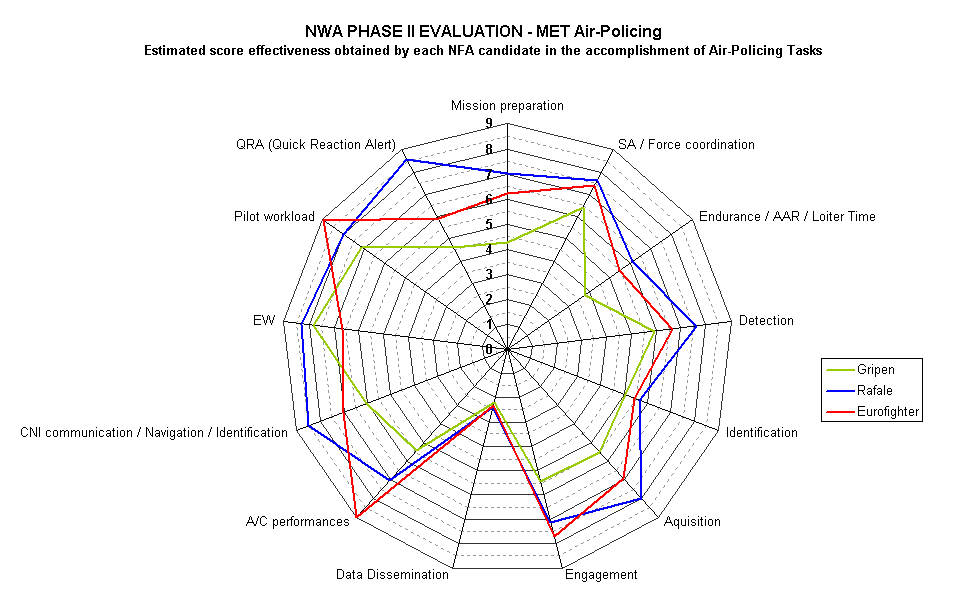
Well that’s just the point, even when you reduce fuel load to 50% (25% fuel fraction), the Su-35 is still 34% higher in wing loading than the Typhoon with full fuel (32% fuel fraction). The you have the TWR, where the Typhoon conservatively sits at 1.15 and I say conservatively because the engine rating is ‘>90kN’ and BAE rate the TWR at 1.2.
http://www.baesystems.com/en-uk/product/typhoon2
That’s again higher than the Su-35 on half fuel. So even at equal fuel fraction the Typhoon is still way ahead. I’m also pretty sure people haven’t moved to delta canards for a laugh. There are advantages there even if they’re not good for RCS reduction.
Cd = Cd0 + kCl^2
Now Cd0 dominates in cruise but at higher g loads the latter term dominates and Cl is inversely proportional to wing area for a given lift requirement.
Hell no, small wing area is not desirable for STR. See F-104 for details.
Apples to oranges. F-16 was designed with a CoP ahead of the CoG, F-15 was not. You’ve also got LERX vs non-LERX.
Aside from this, the Typhoon doesn’t have to out-manoeuvre an Su-35, the pilot just needs to look at it. This performance analysis is only even relevant in a fictitious training scenario.
Yeah, judging turn rates from air shows, extremely accurate.
Wow, love to see you prove an F-16 can out-climb a Typhoon, this will be funny. Flug-revue, 1999, Wolfgang Schirdewahn, the Germany test-pilot:”The climbing ability of EF-2000 with 4 BVRAAM and 2 WVRAAM is about 25% better than the F-16 with 2 WVRAAM.”
You’ve basically tried twist huge deficits in accepted performance determinants into positives. Result – fail. The Typhoon came after the Flanker and was purpose-built to beat it.
Starfish PrimeTrue, but nevertheless you may want to trade this extra size to improve something else. For instance, if maximum range was the only valuable parameter, which you appear to think it is, then all jet fighters would have the size of an airliner.
What you really need is a good enough minimum range.
Not really sure that’s a valid point. Of all fighter radars, Rafale is probably the smallest. I don’t think that can be twisted into a good thing no matter how hard one tries. Even the F-16’s is bigger and most would view that as an example of one of the smaller fighter radars.
Starfish PrimeHow many Rafale have been shot down so far? AFAIK the answer is zero. It performs quite well also in tests and trials. Used with the right tactics and doctrine it doing very well today, and I will continoue to do so for still many years to come.
Pffft….. How the hell were they going to get shot down? A guy standing on a camel hump with a well aimed RPG? No Typhoon or F-22 or F-35 has been shot down either. Hell, I don’t even think a GR4 has either… well not by enemy fire anyway.
If it can perform a given mission with a probability of success (PoS) of, say, 95%; how much can the F-35 improve on that, realistically?
Depends on the mission doesn’t it. I don’t think anyone is buying an F-35 for the sole purpose of bombing Islamists.
One of the countries in the world most serious about their defence, and investing heavily in defence (Singapore) decided recently they will NOT buy the F-35 right now… instead they will rely on their F-16 and F-15 only, for a few more years… And I don’t think it’s just because they wait for the bugs to be worked out, it takes best case 3-4 years from a decision is being made, and until the a/c start to arrive, so they are looking even further into the future.
And in other news, Ireland isn’t buying F-35s either. Exactly what do you expect people to infer from this?
Starfish PrimeWhere did you find this in the Swiss leaks? Or do you have another source?
The “old” Typhoon radar isn’t really that old I believe. At least not compared to the old Rafale PESA radar…
Type it into image search. The Rafale radar had better detection and the EW system was better but the Typhoon’s engagement was better, and aircraft performance (9 vs 7) and pilot workload (9 vs 8) were significantly better. So I suspect when the 2021 update to Radar 2 and DASS P4E occur the Typhoon will win on most fronts.


 Sign In







