A well reasoned response that! The 732 has always been popular within Africa becasue it is rugged and can operated into airports with limited ground handling equipment.
What makes the 732 so unique? How is its ground handling requirement any different than a 738 or 321? How is the 732 equiped for rugged field ops?
I think the reason aircraft like the 732 are so popular on the African continent doesn’t have to do with capability but cost. They can pick up a used 732 dirt cheap on the secondary market.
As for capability of the 738, check out the operations out of KMDW by ATA Airlines. Fully loaded 738’s routinely takeoff of 6500′ runways and land on 6000′ of available asphalt.
Here are 2 virtual tours of the C-17:
First is the cockpit:
http://www.boeing.com/companyoffices/gallery/video/md17wb1.htm
Second is the cargo area:
http://www.boeing.com/companyoffices/gallery/video/md17wb3.htm
Very cool looking.
You’re right. A fully loaded DC-3 could get off the shortest runways on even the hottest days!! Bring back the props!!!
There are many more factors in play that you can’t possibly know about by standing on the side of a runway and watching aircraft takeoff. You’re basing your entire argument on your experience that a 738 rotated at point A and a 732 rotated at point B. Not very scientific and quite ignorant of aviation operations.
We actually takeoff with reduced thrust about 99% of the time to save wear on the engines. It means we eat more runway but it saves us quite a bit of $$ in maintenance. It wouldn’t suprise me if there is a similar program for other engine types like those found in the 737NG’s.
My point being that such things as reduced thrust don’t reflect actual performance capability when you look at such factors as takeoff distance. And you do realise that every sequential version of the 737NG’s has more power right?
N87555 was the “Christine” of the fleet (in reference to the Steven King movie) and was always prone to electrical problems. The only time my mom has flown with me commerically was on that aircraft and resulted in her getting stuck at an airport and having to drive herself home. I figured it would be funny to see that 87555/”Triple Nickel” was still up to her old tricks. 😀
Outstanding pictures of both planes and scenery! The coastline sure is pretty.
I guess it wouldn’t be a flight on the 1900 without a failure or 2. 🙂 Great report though.
Would the N-number on that aircraft happen to N87555??
You had the “honor” of flying on Gulfstream International Airlines. The are a Pay-For-Training outfit that charges low time pilots about $20,000 for sit in the right seat of the 1900D for 250 hours. Basically it’s a training flight with paying passengers. Not the most respected outfit out there due to their hiring/training practices. They use to operated 1900C models they bought our 1900D’s when we were phasing out the turboprops.
Any pictures? I would love to see a picture of our old 1900’s. 🙂 I agree, the tinted windows aren’t very nice for taking pictures through.
I would recommend asking your question in the Commerical Forum rather than this Trip Report sub-forum. You’ll get more responses there. 🙂
When do you add the dirt? 😉
You sure don’t see very many scrapped 757’s.
It seems to be a rather normal decent. The airspeed is only a bit over 110 knots with less than 5 degrees nose down pitch. I would guess the VSI is somewhere in the vicinity of 1000 fpm.
It appears that it’s just the paintwork that is patchy rather than the aircaft itself. It does have non-matching cargo door and a nacelle piece. Cosmetic, no more.
What’s its max payload?
Yes, I’m looking forward to Part 3.
The C-160 Transall would be a good comparison as well.
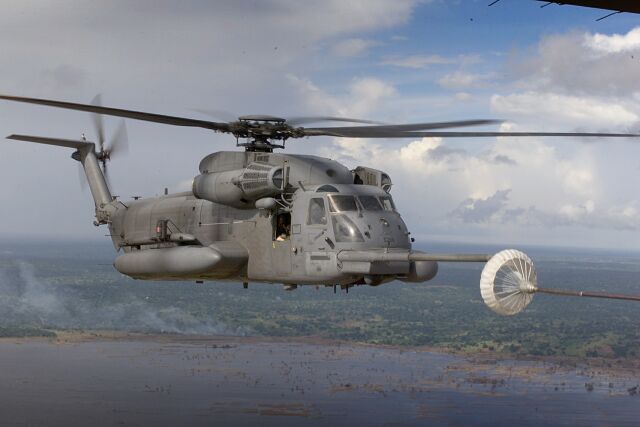
As for the Pave Low:
The MH-53M, weighing roughly 50,000 pounds, can carry up to 37 troops or hook load a charge of up to 20,000 pounds.
vs. CH-47 Chinook:
The Chinook can accommodate a wide variety of internal payloads, including vehicles, artillery pieces, 33 to 44 troops, or 24 litters plus two medical attendants. The “D” model can carry up to 26,000 pounds externally.
They’re fairly close actually with a slight advantage going to the Chinook. I’m sure there’s more to each helo that goes beyond the published numbers. One disadvantage of the CH-47 is the complexity of the dual rotor system.
I have to agree with Grey Area. If the mission was to move equipment up and down a river then you’ll have to compare boats, hovercraft, hydrofoils, etc. Each is quite different but they are all capable of completing the mission.

How about the MH-53M Pave Low? It’s a big helo and has air-2-air refueling capability.