Great pictures. It looks warm in Las Vegas. 😉
The 145 has to have two cabin crew. It can be reduced to one member of cabin crew, but only in very exceptional circumstances and is subject to various restrictions (pax load etc).
The number of cabin crew required is not only based on the number of seats but also the emergency evacuation procedures.
I thought the ICAO/FAA rule was that anything with 51 seats or more required 2 flight attendants and anything with 20 to 50 seats only needed 1 . Every North American operator of 50 seat jets has only 1 flight attendant.
Either way, if a company decided to offer service with 2 flight attendants I’m suprised that they decided to take a passenger seat out to accomodate them as there is a flight attendant jumpseat at the rear of the aircraft for a second flight attendant.
I love that you can see one of the ground crew standing in the jetway shielding his ears from the loud engines. 😀
Great pictures! I particularly like the picture of the arriving aircraft seen over the homes.
Great pictures! What airline operates the 737 with white over gray livery? With the gold line it looks like a Continental livery minus the globe on the tail.
What kind of camera did you get?
or gold screws.
Some arab is getting his bbj fitted with an interior that is held together by gold plated screws!
Years ago I took a tour of a company that does custom enteriors for biz jets. Among the stories that the guide shared was of a customer who wanted every bit of exposed metal to be 24 carat gold plated, even the seat rails. The salesmen had tried to explain that any gold put on the seat rails would wear off after using the chair. No matter, if need be more gold could be added later.
Ah, to be rich and stupid. 🙂
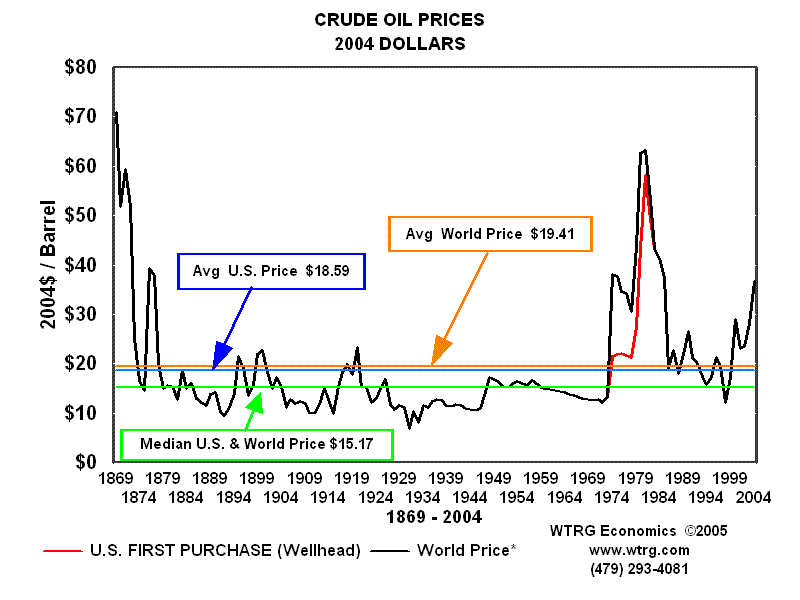
I’ll agree that the current oil crisis is a bit short of the 1973 energy crisis prices but there are quite a number of “new” issues. During the 1970’s in the US the airline industry was still regulated by the government so the swing in oil prices didn’t translate into lower profits for the airlines, at least not nearly on the scale that we are seeing now. Currently we have an outlandish excess of available seats in the industry which is the driving force of our low ticket prices (demand is up but supply is still greater = low prices). Low prices aren’t what you need when operating costs are rising. If an airline is able to squeeze out a profit now or in the future they are darn lucky. The problems of 2000’s are similar to those of the 1970’s only on the surface.
Here’s an interesting chart I found comparing the price of oil over the years adjusted for year 2000 dollars. In the US, the price of oil topped out at about $60 a barrel (adjusted) during the 1970 energy crisis.

So is that the usual first step for one of your drawings?
WD why are those things in yellow so big on the ERJ wing?
Your confusing 2 different aerodynamic features. The fins long the top of the wing are vortex generators where as the “teeth” along the leading edge of the wing are Vortilons. Similar in theory but different (if that makes any sense).
I explained this in another thread but I’ll give another brief rundown again.
Swept wing jets are great at highspeed but have poor lift capabilities at low speed. As a result designers use leading edge devices (slats and slots) to help with lift at slow speeds as well as mid-wing or slow speed ailierons. The one byproduct of such features is weight due to the requried mechanics and additional parts. On a 150,000 pound aircraft such weight penalties are a small fraction of the overall aircraft but are rather unbearable for small jet design. So the Embraer engineers decided to use a rarely used aerodynamic feature, the vortilon. At cruise attitudes and speeds they create little if no drag. But as you near approach speeds with your higher angle of attacks the vortilons shed vortices to help with airflow specificly that affecting the ailerons.
They were originally designed for the DC-9 which have one rather large vortilon. They can now be found on more recent aircraft like the a few biz jets and even the 767 albeit much smaller.
The benefit is about a 10 knot reduction in approach speeds. The CRJ that has no leading edge devices averages or aerodynamic features approach speeds in the 140’s where we see approach speeds in the low 130’s. At lighter weights we can push about 120 knots which feels like you’re hanging out there.
To compensate for the poor design of the ERJ Wing!
You can’t be serious.

But how many aviation museums are filled full of aircaft that killed or were shot down/crashed that resulted in killing the pilot/crew? It seems another relic is pulled from the back woods yearly to be restored or displayed in some manner.
It appears that it is part of a display on board the USS Intrepid museum in NYC. I never knew that they had a 9/11 display there. I wonder what artifacts they have.
It would appear that the webmaster has turned of that feature.
Yup, those are the vortex generators. The batch at the tip of the wing aides in aileron effectiveness and the other group helps with airflow over the flaps. Their placement either forward or aft along the wing chord gives the vortex generators effectiveness at different airspeeds. The more forward are usually associated with slow airspeed regimes due to higher angles of attack and the further aft they are installed gives them a better effectiveness at higher speeds.
If someone else has a better (or correct 😉 ) explaination please chime in.
Let’s see….planning a trip to Florida during a Hurricane season?……sure I can’t forsee any problems occuring. I also hear that SE Asia has a rainy season but don’t worry as it’s nothing more than a light drizzle.
I would go as far as saying it’s the picture of the week or month. That is one view few, if any, get to see. Outstanding!