steely dan
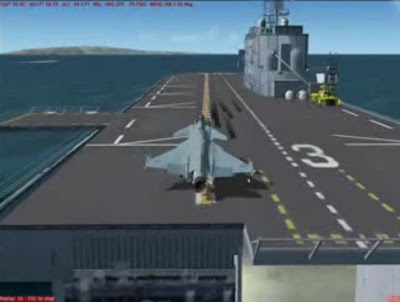
this is a curious image, as it appears to show a sea grippen landing on what looks like a wasp class LHD. i realize that these are only marketing images, but i find it unusual that they would depict this aircraft operating from a ship that it would clearly not be able to operate from in real life (USN LHDs have no STOBAR capability).
steely dansource:http://www.defencemanagement.com/news_story.asp?id=11101
Davies: both carriers will take JSF
Tuesday, November 03, 2009
Both the Queen Elizabeth and Prince of Wales aircraft carriers will be able to carry the joint strike fighter (JSF) according to defence equipment and support minister Quentin Davies. Speaking in the House of Commons he also rubbished the Gray Report’s claim that there was a £2bn annual overspend in the MoD’s equipment programme.
In October, it was reported that government would downgrade either the Queen Elizabeth or the Prince of Wales carrier, taking away their ability to carry the JSF. Reports stated the MoD was looking to save money on the 65,000 tonne carriers, which are already £1bn over budget.
Davies said reports the carrier plans were to be scaled down were “complete rubbish”.
“There is no suggestion at all, and there has never been in our minds at all, to re-specify the two aircraft carriers,” he said.
“There has been no change in that programme, and neither has there been any change in our JSF programme. We are already committed to purchasing the first three aircraft.”
He also said there was “no evidential basis” to the statement in the Gray report that between £1bn and £2.2bn was being lost each year as a result of failure to control equipment spending.
“The very fact that the range is between £1bn and two point something billion shows how imprecise that statement inevitably would be,” said Davies.
steely danThe thought of a ‘pop up ski jump’ had previously occured to me, but discounted it as all ski jumps i have seen are slightly curved, and it would not be possible to reproduce this in something that lays flat in the deck.
i’m not a mechanical or materials engineer, but if our species successfully devised a way to land men on the surface of the moon, i have to imagine that there’s a way to design a hinged and/or flexible deck structure that can modify itself via a series of hydraulic pistons to both lie flush with the rest of the flat deck in the down position and also take the shape of the necessary curve for a practical ski-jump in the up position. the big question would be cost, and the resulting cost/benefit analysis.
steely danFirst of all, the term “L-class boats” refers to WWI submarines, not modern LHD/LHA amphibious ships.
the term “L-class” has referred to a variety of different submarine and surface combatant classes over the years, but i’ll be sure to fully type out “LHA/LHD amphibious ships” in the future to avoid confusing you.
Second of all, there’s no merit to a “pop-up ski-jump,” as a useful ski-jump would be exceptionally large.
why? the ski-jumps on the invincible class carriers have proven themselves to be quite useful and are not exceptionally large.
steely danhere’s an idea from another thread: how about a pop-up ski-jump for the USN L-class boats? that way they’d get maximum fixed-wing performance & capability without necessarily sacrificing deck space for a landing spot.
would such a pop-up ramp be technically feasible? would it add enough benefit to offset cost? i know the political realities within the US navy would still likely kibosh any such plan, but i’m just thinking about different ways they could potentially maximize the capability and flexibility of these ships. these are 40,000 ton monsters. they’re the only flattops in any world navy that regularly operate fixed-wing STOVL aircraft without the aid of a ski-jump. it still seems odd to me.
steely danI’m saying that the technology incorporated in the M777/Excalibur 155mm howitzer and HIMARS/Guided MLRS are a better fire support solution (i.e. precise and timely) than waiting for the untimely arrival of fixed wing airplanes. The Marines are going to have those artillery assets anyway, so beef up that capability instead of squandering resources on a second-best fixed wing CAS solution. Its a matter of which system provides the best bang for the buck, especially when Marine lives are on the line.
but do you believe that operating fixed wing aircraft off of the gators offers any benefit or is it a vain waste by the marines merely to cling to some unnecessary prestige? i know that you think ground based artillery support is a better solution for the scenarios you’re describing, but what i’m interested in knowing is whether or not you think that deploying STOVL aircraft on the L class ships is something that should be done away with entirely or is there some benefit in maintaining that capability (and even increasing it in the case of the new america class) into the future?
steely danUSMC is trying to save a sacred rice bowl that has been in existence since WW2 — Marine fixed-wing aviation.
so are you saying that the marines are hanging on to their fixed wing aviation merely for the sake of hanging on to it and that it doesn’t provide any benefit to their ability to carry out amphibious assault operations?
steely danCAS during initial littoral operations will come from F/A-18s flying from CVNs (or USAF assets), not a pitiful handful of AV-8Bs or F-35Bs with no fuel supplies and even fewer munitions flying from L-class ships.
then why does the USMC even bother to operate AV-8Bs from the decks of those ships? and why is the new USS America (LHA-6) projected to regularly deploy with 10 F-35Bs (a 66% increase in combat aircraft)? if these STOVL aircraft are worthless to the mission of landing and supporting marines ashore, why bother with them? why design future ships to hold and operate even more of them?
my suspicion is that these STOVL aircraft do have some value to the marines operating off of the L-class ships, and that is the reason they continue to operate and train with STOVL aircraft off of such ships. it is also my suspicion that the marines would very much like to have ski-jumps on these ships (we already know from the article in the second post of this thread that the harrier pilots themselves would LOVE to see them), but it is the politics within the top brass of the navy that prevents the addition of ski-jumps because of a perceived threat to their precious super-carriers.
steely danIt’s worth noting that a LPH/LHA/LHD is primarily an amphibious warfare platform and not an aircraft carrier. This is why unobstructed deck space is more vital than a permanent ski jump. Harriers most likely would fly off to an austere shore base in the event of a real wartime scenario.
With the coming of the F-35B, and its far more adequate take off performance, a ski jump would be even less desirable aboard large American LHD/LHAs.
I’m well aware that the wasp class ships are LHDs and not CVs (I even directly pointed that out in my first post), however, the fact that the marines regularly operate 6 harriers off of these ships, and up to 20 of them in the small carrier role, means that these ships are seen as flexible platforms that can do more than just one thing. I strongly believe that sacrificing one of the deck landing spots for a ski-jump would be a very wise trade-off to increase the overall capability of these ships to properly operate STOVL aircraft. I think this would be especially true for the new America class LHA as they’re planning to deploy 10 F-35Bs on it, a 66% increase in the number of combat STOVL aircraft. And lookng to other nations, Spain’s Juan Carlos LHD still incorporates a ski-jump for STOVL aircraft, as will Australia’s two new Canberra class LHDs based on the same design, and austalia is not even planning on procuring any F-35Bs! And in a time of warfare there may be no austere on shore air base for the harriers/lightning IIs to fly off to and operate out of.
As for the increased take off performance of the F-35B, that’s news to me and it’s encouraging to hear, but the performance of the STOVL Lightning II still must be aided by a ski-jump otherwise the royal navy wouldn’t be planning to put them on the new queen Elizabeth carriers.
steely danAnother philosophical difference is that the British are open to ideas that to Americans seem goofy, but work, such as the 12-degree ramp at the bow of the ship that dramatically improves Harrier operations. Senior U.S. naval officers over the decades have vetoed the idea, saying they don’t like how it looks and that it takes up three helicopter landing spots. British and Marine officers say only one deck spot is lost to ten “ski jump.”
To a man, Marine pilots want the ramps installed on their ships to improve operational flexibility and safety.
Great article, thanks for posting it obi wan.
So American navy offcials won’t install ski-jumps because they don’t like the way they look? That seems like a load of BS to me. What designer of military hardware would ever sacrafice capability for aesthetics? These machines are designed to fight and win wars, not take the crown in a beauty pagent.
As for the discrepancy between a ski jump occupying 1 or 3 landing spots, I’d have to side with those who say 1. A ski jump would not need to occupy the entire bow ala the kuznetsov or other similar ships, it could just be a smaller ramp on one side of the vessel as seen on the Invincibles.


 Sign In