 thawes
Can anyone make a posi from this negative ?
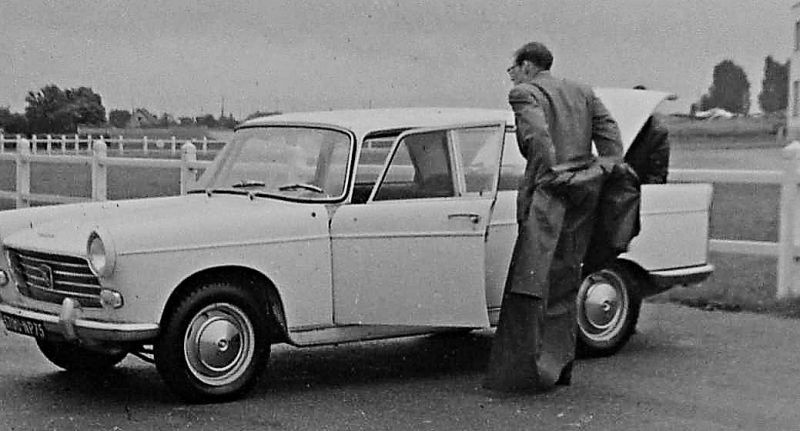
75 at the end of the numberplate indicates a Paris registration I think.
thawesBANUPA
I too visited LAP to see the competitors for the England to Australia air race. I remember seeing the Canberra, but always assumed it was an RAF one. There was a Viscount too and I think a Hastings?
I photographed the Viscount too – see below. All the competing aircraft were allocated race numbers as seen on the tail of this Viscount and my earlier photo of the Aussie Canberra.
ISTR there were about four or five Canberras, with an RAF Canberra winning the race. A KLM DC(6?) also took part with a full load of pax for New Zealand I think.
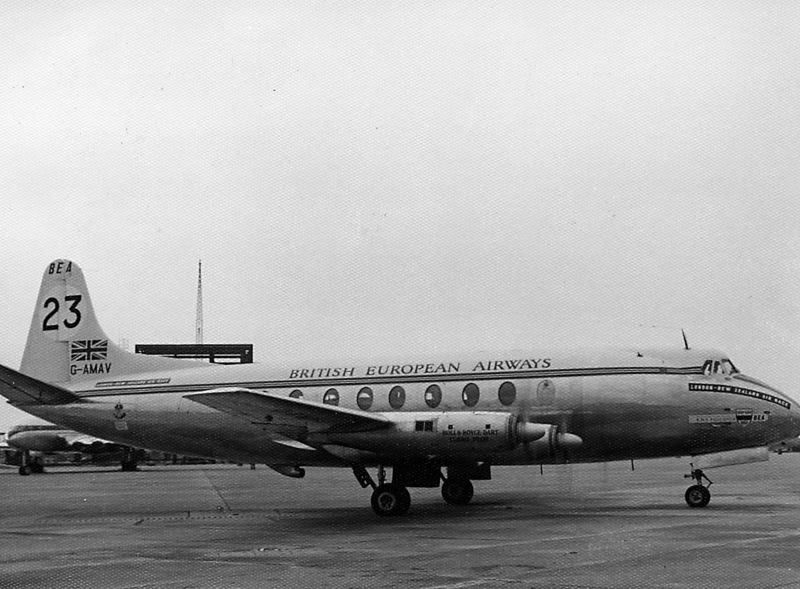
thawesLHR – 1953
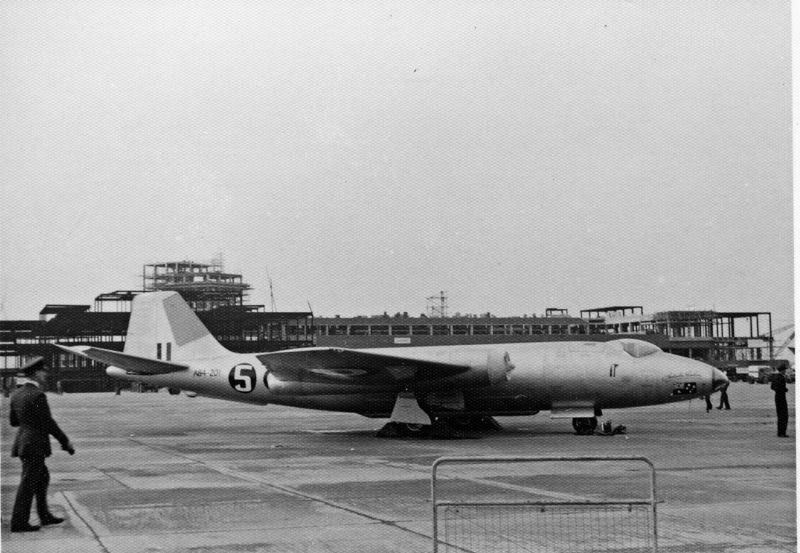
On 8th October 1953 I visited London Heathrow to watch the start of the London to Christchurch (New Zealand) air race and took the following photo which shows one of the competitors, the first licence-built Royal Australian Air Force Canberra serial number A84-201. Still in existence in Oz as a GateGuard I believe.
Interestingly the background shows the girders for the new ‘Europa Building’, which was actually the first true terminal building and was opened by the Queen two years later in 1955. The higher girders outline what I think is the ATC control tower under construction.
As a sideshow one could take a trip over the Thames and Hampton Court in a DH Rapide for 15/-, which I did. I still a have a photo of Hampton Court taken during this flight.
thawesPeterVerney
Re your post #7 above.
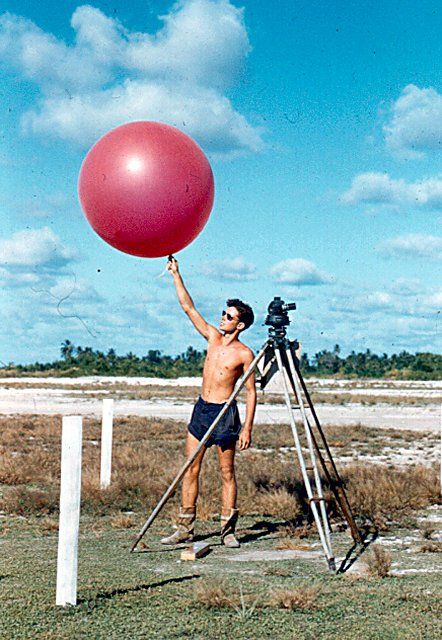
Incidentally at Lympne the met assisstant was on duty on the airfield alone at night. One of his duties was to fill a balloon with hydrogen in a little wooden shed, hang a chinese lantern with a birthday cake candle in it. This contraption was then released into the sky to be tracked with a fancy theodolite to obtain winds at height.
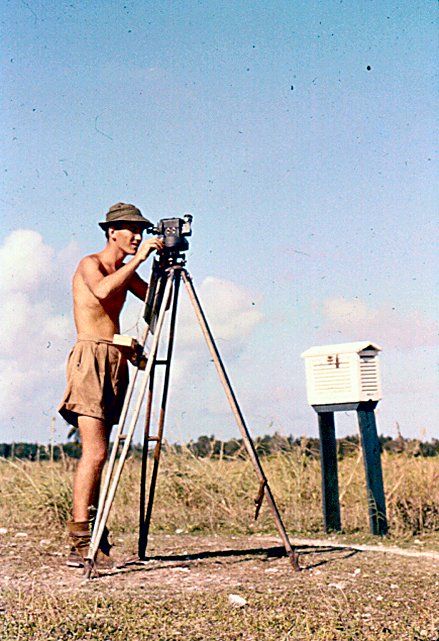
Below. As done at RAF Gan in 1958, but not at night. ISTR that on one observation the Met Assistant tracked his balloon to 25,000 ft or thereabouts where I suppose it popped with the reduced air pressure.
thawesPeterVerney
Re your post #7 above.
Incidentally at Lympne the met assisstant was on duty on the airfield alone at night. One of his duties was to fill a balloon with hydrogen in a little wooden shed, hang a chinese lantern with a birthday cake candle in it. This contraption was then released into the sky to be tracked with a fancy theodolite to obtain winds at height.
Below. As done at RAF Gan in 1958, but not at night. ISTR that on one observation the Met Assistant tracked his balloon to 25,000 ft or thereabouts where I suppose it popped with the reduced air pressure.
thawesI suggest “Over to You: Ten Stories of Flyers and Flying” by Roald Dahl
Which includes episodes from his own life whilst in the war-time RAF, from the time he learnt to fly in Kenya in 1939, to the time whilst flying with 80 Sqn he crashed his Gloster Gladiator in the Libyan desert almost almost killing himself in the process and to when he flew Hurricanes in Greece at the Battle for Athens in 1941.
Memorably in the story “Death of an Old Old Man” the first words are: “Oh God, how I am frightened” – something we can all relate to. An extract can be read here:
http://www.amazon.co.uk/Over-You-Stories-Flyers-Flying/dp/0140035745#reader_0140035745
I read “Over to You” after I noticed my grandson was reading it as part of his school course-work – it makes a change from Charlie and the Chocolate Factory, James and the Giant Peach, Matilda, and many others aimed at children.
A recommended read.
thawesPathe covered the return of the crew to the UK plus some footage of the USAF rescue aircraft here:
http://www.britishpathe.com/video/ice-cap-men-home-aka-ice-cap-men-return-from-green
Frankie Burke the signaller is shown in some of the film. He and I were in the same crew when we flew with 99 Sqn in the early 1960’s, sadly he died a couple of years ago.
thawesSpeaking of the Albatross and the USAF Air Rescue Service
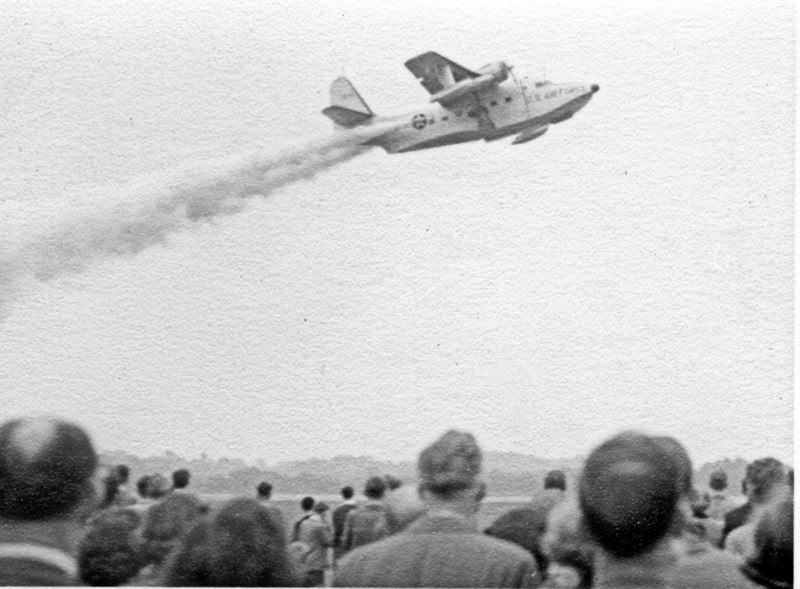
I took this picture at the September 1954 Biggin Hill Battle of Britain display. It shows a Manston based USAF SA-16 Grumman Albatross doing a Rocket Assisted Take-off in front of the crowd. Very noisy ISTR.
thawesRe the earlier comment about F86 Sabre canopies.
Sadly, the F86 Sabre also had a design flaw with the front edge of the canopy decapitating pilots as it slide back on its rails during the ejection sequence.
I photographed this rather battered (look at the wrinkling of the fuselage and the iffy paint job) USAF Manston-Based F86F of USAF 406th FIW at Biggin Hill during the 1955 Royal Observer Corps “Recognition Day”. The canopy looks fairly conventional and if opened at speed during the ejection sequence I would assume the slip-stream would lift it well clear of the pilot’s head.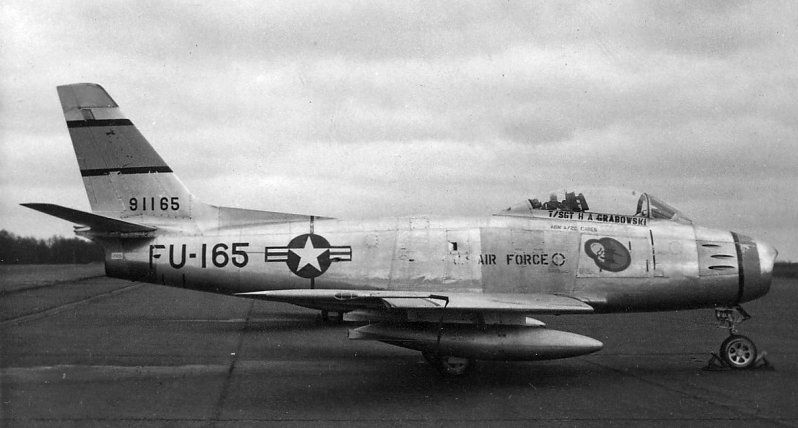
Rather puzzling is the absence of the red “Ejection Seat” triangle alongside the cockpit. Did perhaps the USAF adopt the red warning triangle later? R.A.F. Meteors I photographed at the same time (1955) quite clearly display the red triangle.
thawesTry here for old airline timetables:
http://www.timetableimages.com/ttimages/complete/complete.htm
As an addendum there’s a splendid account of a trip to the Far East by flyingboat on PPRuNe here.
http://www.pprune.org/aviation-history-nostalgia/48484-rma-caledonia.html
A lot earlier than 1968, but interesting nevertheless as it involved night-stops down the route.
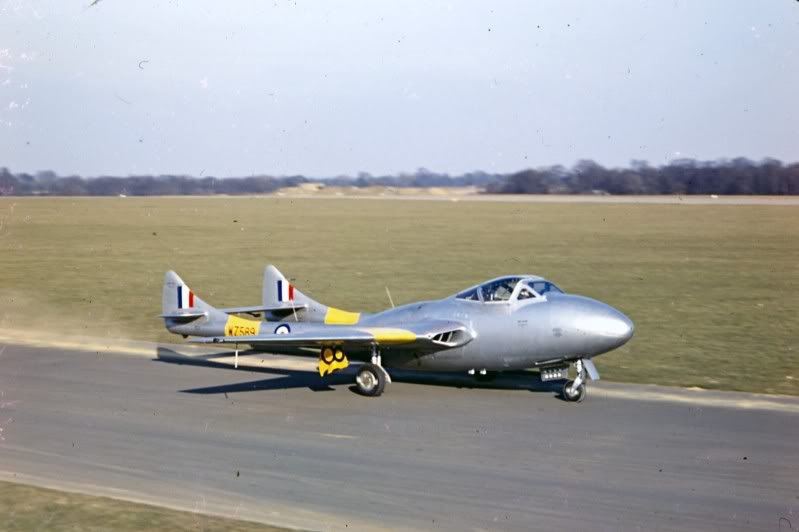
thawesPhoto of 41 Sqn’s T. 11 I shot at Biggin c.1954-55.
thawesNot sure if this helps, but attched photo shows RX 1155 as installed in navigator’s position in a Signals Command Varsity that calibrated the Chenies ROTOR station radar in June 1956. Cheines is near Bovindon and the calibration flight was flow from there.
On this occasion RX is located on a shelf above and alongside other nav kit.

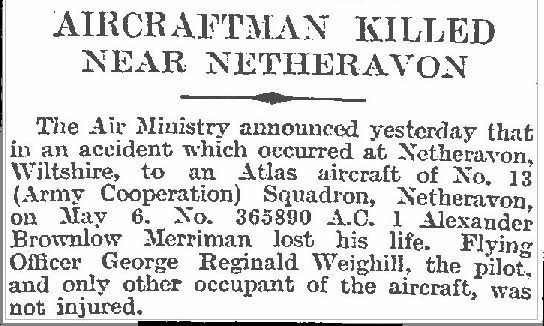
thawesPress cutting dated 8th May 1931. No further details of the incident I’m afraid.
thawesThe coronation fly-past on 2nd June 1953 (not 1954) consisted of 168 fighters (144 R.A.F. Meteors and 24 R.C.A.F. Sabres). In those days Buckingham Palace fly-pasts flew from south to north past the palace, rather than as they do now from east to west down the Mall towards the palace.
The route was over the Thames Estuary to Canterbury, the feeding-in point for the the various wings. From Canterbury, south to Dungeness, on to Hastings Pier continuing to Bexhill where the formations turned north towards Biggin Hill and then over south London to fly past the front of the palace.
The feed-in point for the 641 aircraft in the fly-past for the Queen’s Coronation Review at Odiham on 15th July 1953 fed in at Leavsden flying in a south-westerly direction to Odiham and presumably didn’t fly over Southend.
Details of the 15th September 1953 Battle of Britain fly-past can be found here:
http://www.flightglobal.com/pdfarchive/view/1953/1953%20-%201231.html
thawesThanks for this.
The only snag is that it costs money.
I did a test search for 99 Sqn from 1st – 30th November 1960. The November 1960 99 Sqn. ORB runs to five pages and to download just one month’s records will cost £3.50. Multiply it by 12 for a year’s records and it’s an expensive option.
For those who can’t visit Kew probably OK, but for those who can easily visit Kew a personal visit makes far better economic sense!


 Sign In







