 Liger30
Yeah, but if Leuchars is closed and its three (the 6° already there, two more squadrons to reform next year) squadrons of Typhoons and the QRA North are moved into Lossiemouth as it appears quite probable from the latest rumours, it is unlikely that the F35C can be based as planned in Lossiemouth as well.
Doubt the base could have at once three Squadrons of Typhoon and the F35C fleet as well…
The F35C might end up in, say, Marham, which would otherwise inevitably close down with the retirement of the Tornado GR4.
Liger30It has AT LEAST from 2009, if not from earlier… but the exchange program will have to be expanded noticeably to prepare for the resurrection of proper UK carrier ops.
Liger30The F35C virtual flight simulator will probably include the EMALs launch catapult training part. However, i expect most, if not all, of the catapult training for the crews to be done sending pilots in the US Navy schools in the US. It is the cheapest way to do it.
Of course, this will not be possible if the Converteam EMCAT is chosen instead: as similar as it will be in concept to the US EMALS, it won’t be the same system, and in that case the UK will definitely have to make up, between the other things, a land-based catapult training area, possibly adapting a part of Culdrose to build a CVF’s deck-structured runway.
Liger30HMS Ocean is not expected to bow out any earlier than 2022, actually. Her crew will aid the entrance in service of the CVFs most surely, but unless the RN is to remain for a few years without carriers and without LPHs both, HMS Ocean will stay busy enough on her own in those years.
The navy was also reported to be asking for 20 Harriers or so to be kept useable (probably using the others as source for spares, since selling them is a dream, not a realistic possibility…) and be flied by reservists picked up from the current crews. It was reported on the Telegraph as well… I don’t think they have any chance of success, but since i did not heard anything afterwards save for “we are still planning on what to do with the Harriers, i don’t know. Maybe a little something can be worked out on that front too…
Liger30Unless when the Charles De Gaulle is out in refit or plain broken.
Luckily (?) it happens with amazing frequency.
The US might be less willing to deploy planes on the QE in peacetime, even when a Carrier Wing from one of the Nimitz in port is theorically available. They will do it every now and then most likely, but with the cost of deploying planes on ships, you can’t expect them to always fill up the QE deck.
And anyway, it is an idea that does not shine. I want the UK carrier crowded with UK jets the Uk can use as the Uk pleases.
Cross-decking is good and awesome, but when the need arises no one will come crowding your deck unless they have real and immediate interests in doing so. It would be plain irresponsible to plan on it.
Liger30Same here, but with 90 airframes, if the Tornado GR4 fleet is to be taken as example, you can have 5 squadrons + OCU and spares at the very most.
Tornado fleet (after reductions envisaged in the SDSR): 96 airframes
5 in 41(R) Squadron – consider it a OEU
15° Squadron – OCU (Set to remain in Lossiemouth, along with 3 Typhoon Squadrons if Leuchars is closed and the QRA relocated as it appears more and more likely. The OCU would stay in Lossiemouth since the Tornado simulator and training is in there and it would make no sense to transfer them all)
617° Squadron
2° Squadron
13° Squadron
12° Squadron
31° Squadron
[for what i understood is the 9° and 14° Squadrons that will be closed down, either way for sure 2 Squadrons. The 617° will relocate to Marham.]
The F35C in the long term could have 14 airplanes in a large, common OCU/OEU managed by the RAF but used by the Navy as well. And ideally, in a smart, ideal world, there would be 4/5 Squadrons of 12 machines each.
If 4, two RAF (617° and 13° my suggestion, i want the Dambusters to live on!) and two Navy (800 and 801 NAS). If five, ideally i’d want a third RN unit (thus ensuring a full 36-strong airwing for QE), and it would be the 892 NAS that once flew Phantom from HMS Ark Royal IV. That would be an endless amount of awesome. 809 and 899 (ex-Sea Harrier units) could also be obvious candidate for resurrection. I’d love that.
As it stands, however, there’s the risk that the sole 800 NAS will survive, and providing only crews, besides. The F35C risks being a “RAF only” toy, with very awful risk of seeing them horribly rarely on the deck of the carriers they should equip.
Hope the Royal Navy fights hard and gets its own in the coming years. Hopefully, the SDSR 2015 will give us clue.
The admirals will better bash hard on the point that we are buying the things for the carriers, goddamnit.
Liger30EMALS Launch succesfull:
The U.S. Navy’s new electro-magnetic aircraft launch system (EMALS) – perhaps the most critical unproven element in the first new aircraft carrier design in four decades – launched its first aircraft Dec. 18, manufacturer General Atomics has confirmed.
The launch of an F/A-18E Super Hornet supersonic strike fighter took place at Naval Air System Command’s facility at the Naval Air Engineering Station Lakehurst, N. J., Navy officials confirmed. One launch was conducted on Dec. 18, while several more launches took place the following day.
A lot is riding on the successful development of the new launch system. EMALS is a critical piece of technology that will be installed in the new Gerald R. Ford-class aircraft carriers, the first of which is now under construction. If the system isn’t ready in time, the Navy would have to revert to older steam catapults to launch aircraft from the ships, a move which would mean costly delays and re-designs.
An official announcement by the Navy confirming the launches is expected to be released Dec. 20.
More than 722 launches of test loads have been made at the Lakehurst facility this year, at speeds up to 180 knots, the highest end-speed requirement for the system.
Other Navy carrier aircraft, including C-2 carrier-on-board-delivery (COD) and T-45 Goshawk jet trainers, will be part of the EMALS test program in 2011, said Rob Koon, a spokesman for NAVAIR.
http://www.defensenews.com/story.php?i=5278943&c=AME&s=AIR
A good news at least. Guess the MOD is following the test programme closely. Hard to say if they will place a Long-Lead item order in Planning Round 2011 or if they’ll wait until the programme advances more… guess they’ll decide also depending on the timing the industry can ensure for production of the needed system: absolutely no need to delay Queen Elizabeth further and have costs escalate any more, after all.
Hopefully, there will be no Converteam madness. Re-invent hot water would take time and money that simply are not there.
The Converteam EMKIT is awesome to launch drones of light/medium weight and sizes, but design an airplane-compatible one would take years and funds that can be best used on other requirements.
Liger30I’d love to see the FAA again indipendent. I trust them a lot more than the RAF.
And they are a lot more gucci too, operating from ships.
And if you look back in the years, they almost always had the fancier aircraft colors too.:D
Seriously, i’d like the Government recognizing that the F35C is here mainly for the aircraft carriers, and that thus it makes little sense to have them land based for the most part.
Years of sterling Harrier service in Afghanistan proved that the NAS is perfectly capable to work from land when needed.
A lot better than the RAF can work on carriers when the need arises.
The way the RAF is acting, DO NOT be surprised if they start pushing for a change to the “A” model with the argument that it will save money and get more capability.
Actually, not that much. It is possible, yes… but the RAF has an interest for the greater range and performance of the F35C. Years ago it even wanted 24 F35C for Tornado deep strike replacement ON TOP of the planned F35B buy.
Also, i think it’ll be a bit late to change mind again in 2015. The US have been pissed enough at this first change, to change yet another time would be more than simply embarassing. The Royal Navy would be furious. The UK public would be angry. The US would be pissed… No, i don’t think it would work that well.
Luckily. Arguably, the F35A is the thing the RAF needs less. Better to buy some Tranche 3B Typhoons and a new Marittime Patrol Aircraft with those funds, then, because the RAF could hardly justify buying american while turning down thousands of british jobs in aerospace by terminating early the Typhoon. For what? To buy a “5th generation fighter” ? For fighting who, they will be asked.
No, the F35C is what the UK needs. And arguably, it should be bought to give the FAA the capacity to put 36 F35C or more at sea in times of need. The RAF shouldn’t even have voice in the matter.
Liger30Changing the location of Australia on a map whilst underhand is not the main cause for CVA01, TSR2, F111 and the destruction of the British aircraft industry. To say so is frankly silly!
All of those things happened for a great many different political and historic reasons! CVA01 was probably overly ambitious. TSR2 was killed by a combination of politics, poor management and cost overruns. F111 was at the time it was cancelled for the RAF it was also a costly white elephant. You could write a whole book about the rundown and destruction of the British aircraft industry but lack of government support and starvation of funding as well as orders didn’t help.
To blame the RAF for the woes of British aviation shows poor research.
It was not the unique cause, but the RAF behaviour back then sure did help a damn lot. And to add insult to injury, it backfired against the RAF itself. THAT was a disaster on all the line.
Liger30History teaches us that the RAF has been the worse, ever since it cheated on Australia’s coordinates.
Killing the Queen Elizabeth, the TSR2, the british aerospace industry, the F111 and the power of the UK in one single go.
And that’s just an example. They tried to kill the Buccaneer too. They stole the Harrier from the navy and got the Sea Harrier killed.
It is a long list.
Save for Dannatt, that’s shown some very “Army Army Army” vision during the SDSR build-up, the Army and Navy are actually relatively responsible.
As to the navy especially, i struggle to find an example of childish reasoning on their part.
I don’t think you can find serious flaws in all the speeches the Sea Lord released even in the darkest hours of the SDSR built-up.
As to the RAF being dismembered between Army and Navy, well, that’s a bit extreme, but…
Arguably, the Nimrod should have ALWAYS been a Fleet Air Arm asset.
And Gods know why the hell the RAF should own the Chinook and Puma, that really should be an asset of the Army Aviation.
Hell, even in Italy the AVES owns the Chinook, what has the Air Force to spare in the Utility helicopter business…???
Liger30To answer the question:
http://www.defensenews.com/story.php?i=5211718
“We are heading for five Typhoon squadrons and one JSF [Joint Strike Fighter] squadron,” said Air Vice-Marshal Greg Bagwell, who commands the RAF’s air combat group. “It will be a six-squadron world; that’s what’s on the books.”
That could mean 107 Typhoons, plus about 40 F-35C JSFs that support a large operational squadron of 20 to 25 crews, Bagwell said. […]
“Six squadrons is the low point for the U.K.’s fast jet fleet,” one analyst said. “You can expect that to recover a little as the Ministry of Defence bolsters its force of Joint Strike Fighters beyond the current level mandated in the new strategic defense and security review.”
Bagwell was less sanguine. He called the first JSF squadron a “start point” and said more may come, but for the moment, “I expect a single squadron in 2020 and that’s it.”
Other senior RAF officers have said they aim eventually to operate around 100 F-35Cs, which will split their time operating from land bases and from the new Queen Elizabeth-class aircraft carriers being built for the Royal Navy.
In 2020, save plan changes still very possible, we will have a joint “super-squadron” RAF-RN with 40 planes that will act as frontline fighter unit (with possibly 20 jets, compatible with the 25 crews figure) plus OCU/OEU role and spare airframes.
Long term post-2020 objective is to buy further batches of F35C towards a total of “around” 100 airframes, compliant with possibly as many as 4/5 frontline squadrons of 12 fighters each plus OCU and spares.
By 2020, when the Carrier Strike capability comes back, only 40 fighters will be available, however.
Bagwell’s speech, however, sorta disgusted me. The RAF is, once more, planning to buy 40 airplanes to use operatively no more than 20.
Sincerely, this “50% of airframes are spares” policy horrifies me. I think only the RAF in the whole world is so spares-hungry. This concept does not exist anywhere else, at least not on this scale, and i’d like the RAF to avoid putting half of a shiny new fleet of fighters in storage for no reason.
Also, Bagwell has made his plan to kill off the fixed-wing naval aviation once and for all very clear.
The new JCA joint squadron will of course include the 800 NAS (probably with Squadron dignity) but it will most likely be CREWS ONLY, effectively commanded by the RAF that decides how the airframes are used.
Bagwell said he does not underestimate the challenges and risks involved in building the F-35C operation, but he thinks the RAF and the RN forces would have faced the issue regardless of whether the Harrier had stayed in service.
“The techniques and procedures to recover a conventional carrier aircraft using catapult launches and arrestor gear recoveries, or ‘cats and traps,’ are totally different from that of a STOVL aircraft,” he said.
“That is just as true for the aircrew as it is for the ships crew. Whilst the Harrier would have preserved the requisite skill sets for the F35B STOVL variant of the Joint Combat Aircraft” – the name the British called their JSF program – “they are largely irrelevant to that needed to operate the F35C.
“Effectively, we need to build the skill sets for the new aircraft and carrier configuration from scratch. We all ready have plans in place to begin that build up over the next 10 years with our allies and partners.”
He said it was a “tall order,” but regaining carrier skills is a problem Britain had previously faced and overcome.
One senior Royal Navy commander agreed with Bagwell’s assessment and said there was a much bigger question mark over regaining deck skills than the capabilities of pilots
Bagwell, who commands all of Britain’s fast jet operations, said the RAF and the RN “have 10 years to get our act in gear and understand what operating the F-35C variant means for training and other preparation. Some we will have to learn from the USA and France,” he said.
The British already have a pilot exchange program with the U.S. with officers flying carrier operations with the F-18.
Bagwell said he was confident British pilots would also be flying French Navy jets as well
“We will be flying Rafales from French carriers within a few years. I’m sure of it,” he said.
The British are targeting the availability of a single squadron of F-35Cs by 2020 to equip a joint RAF/RN operation. Briefing reporters last week, Bagwell said that would require an initial order for about 40 aircraft.
How the aircraft will be employed in the future has yet to be worked out, but said he thought the aircraft would not be tied to the aircraft carrier.
“They are there to project air power. It’s irrelevant where they are launched from. The Royal Navy will hate me for this, but sometimes they will be launched from the deck of an aircraft carrier for good reason. Other times it will be in-country closer to the problem,” he said.
Either way, he said the F-35C gave the British better deep penetration, ISTAR and other capabilities than the more limited STOVL F-35B.
http://www.defensenews.com/story.php?i=5259976&c=EUR&s=AIR
The phrase i highlighted makes perfect sense in the way it has been formuled. But, knowing the RAF, the Royal Navy’s admiral will better spend their 2015 SDR time being absolutely ferocious on underlining in every way the need for wasting less F35C as spares and have 12 assigned to the 800 NAS, to be the centre of carrier strike excellence.
The RAF can’t be trusted. We don’t want to see the F35C struck flying from Lossiemouth’s runways with Queen Elizabeth working as a base for Rafales coming from the “forever-refitting” Charles De Gaulle.
With a little effort, 40 airplanes could easily arm two 12 airplanes squadrons (800 NAS and 617 RAF) and a common OCU/OEU formation plus a SMALL number of spare airframes. The spares can come with later orders.
I swear, i’m starting to totally hate the RAF top brass. They make the RAF look like not just the Junior service, but the CHILDISH service.
Can you imagine the government telling the RAF: “We can’t afford to show to the public carriers without planes. The Fleet Air Arm gets the precedency on the F35C.” ? 😀
I can. And i like the idea immensely. I hope whoever runs the SDSR 2015 comes to this kind of smart conclusion.
I totally think it is only fair that the Joint JCA force is, if not 50/50 RN and RAF, then at least IN PART Royal Navy.
The RAF has to stop robbing the Fleet Air Arm of all its planes.
It already did with the Phantom, Buccaneer (that they had hated and then loved…) and Harrier. The Admirals now have to fight until the last breath to ensure at least 800 NAS survives in the right way.
The long term target for the F35C fleet should be something on the lines of:
800 NAS – 12 F35C
801 NAS – 12 F35C
617 RAF – 12 F35C
13 RAF – 12 F35C
1 RAF – common OCU/OEU
Then it would be fair.
Liger30Will the MOD/Treasury be willing to pay for the entire rear fuselage & tail structure to be replaced?
The “spares” are actually 12. 4 in storage, plus 8 non-updated HM1.
Will they like it more to buy new helicopters altogether?
Only other alternative is to convert some of the HC3 Merlins. Not that handy either. And leaving 12 “wasted” airframes while having even less troop transport helos, the most needed of all.
No good, i say.
I, for one, remain a great supporter of the “lease four Hawkeye from the US navy” idea. But since it is not too likely, despite how overall advantageous that could possibly be (France + US to collaborate with, too), i try covering the other most likely path.
Liger30Current Strategy regarding Sea King:
-SAR Sea King first to go, in 2014. Despite the latest stoppage to what was thought as imminent announcement (http://uk.reuters.com/article/idUKTRE6BF11R20101216) it is likely that the mostly civvy PFI initiative will be the winner, and 24 S92-A replace all the Sea King in SAR role.
Around 60 military crew would remain in the best hypothesis, but complete “civvy” service has been suggested, with responsibility going to the Transports ministry.
(Hopefully in that case the COST too would shift from MOD to transports, but i get the feeling the MOD would have to pay even in that scenario for some unknown astral reason… :mad:)
-ASaC Sea King goes around 2015/16, after Afghanistan withdrawal. MASC requirement more than likely delayed AT LEAST until 2020 (to have it in time for the F35C and Queen Elizabeth): possible solution for replacement, taking the 8 non-updated Merlin HM1 and have them fitted by Thales/Westland in their “pallet” design with the Cerberus radar suite ex-Sea King.
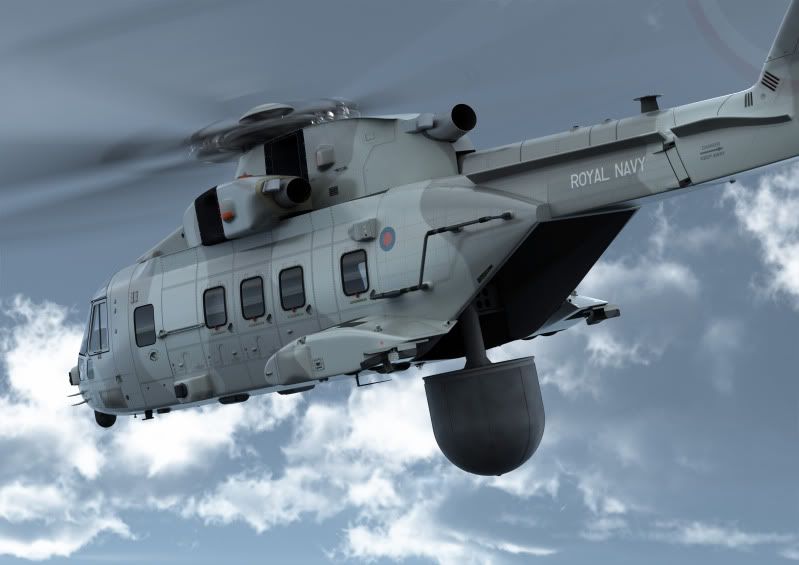
-Sea King HC4 goes after Afghanistan drawdown, and it will be the last to leave service most likely, but for sure within 2016, end of the line for ALL Sea Kings.
For its replacement, despite voices pre and post SDSR that said that the option was dead, the Merlin HC3 navalization remains the plan:
http://www.shephard.co.uk/news/rotorhub/heli-power-2010-chf-commander-reveals-challenges-ahead/7739/
The commander of the UK’s Commando Helicopter Force (CHF) says his organisation is facing a challenging time over the next decade.
With heavy commitments in Afghanistan and the need to provide a contingent amphibious assault capability ready to be deployed anywhere in the world, Capt Jon Pentreath told delegates at the Heli-Power 2010 conference in London that the force would soon have to start making plans to introduce two new aircraft models and have to prepare crews to operate those types.
‘We face huge uncertainties,’ explained Pentreath, ‘We are heavily committed to Afghanistan, and training for deployments there. Paving the way for new aircraft and training crews for those types will provide us with a real challenge.’
Based at RNAS Yeovilton in Somerset, the force is made up of three squadrons operating the Sea King Mk4 – 845 and 846 Naval Air Squadrons are front-line units while 848 NAS is the training squadron. A fourth unit, 847 NAS operates the Lynx Mk7 flown by Royal Marine aircrews.
However, under current plans in 2020 the look of the force will be very different. The current plan is for the unit to be equipped with 25 Merlin Mk4s – marinised Merlin Mk3s, which are currently used by the RAF’s 28 and 78 squadrons. The Merlins would replace the Sea King, and four Wildcats will replace the six Lynx currently in use.
The four Wildcats will come out of the Fleet Air Arm’s allocation of 28 aircraft and will be equipped like those to be operated by the British Army Air Corps.
‘In an ideal world we would retire the Sea Kings after the new fleet of Merlins is ready,’ Pentreath told Rotorhub.com.
So far no clear plans have been made about the Merlin Mk4 programme. Pentreath said the aircraft would ideally have a folding rotor head, but a folding tail rotor might not be necessary as the aircraft would probably fit onto the deck lifts being developed for the Queen Elizabeth-class aircraft carriers the CHF is likely to operate from.
Cost is another issue, however, and although it’s common for naval aircraft to be converted for operation on land – take the Royal Navy’s F-4 Phantom and Buccaneer strike aircraft which were handed down to the RAF during the 60s and 70s – it’s quite another to retrofit a land-based fleet for naval operation.
The entire UK Sea King fleet is due to exit service at the end of 2016, which means the first CHF Merlins would have to be ready to begin training in 2015.
Article dated 17 november 2010, at SDSR concluded.
Compliant with the two-platforms plan, the RAF (who is obviously bitchy like hell about giving the Merlins to the Navy, but which should really go to hell once and for all) would have the updated Puma and Chinook.
The Navy a fleet of Merlins and Wildcats.
The Royal Navy would aim to have 30 Merlin HM2, 4 Wildcat “Commando”, 5 Wildcat in OCU (700 NAS) and 19 Small Ships Flights each with a Wildcat in the 815 NAS squadron.
8 Merlin AEW would equip the radar sector, possibly in two squadrons of 4. It is also possible a single squadron of 4 is formed, but this would leave no space at all for losses, troubles, and such.
25 Merlin MK4 in two squadrons would re-equip the Junglies.
Total of 63 Merlin in service.
The Royal Navy had hoped to buy 66 in the early days of the programme, and have it replacing all Sea Kings.
Had the government listened, the problem would have long been solved.
HMS Ocean will last until 2020s (2022, it should be), and then the navy will have to do EVERYTHING with Queen Elizabeth and Prince of Wales, which more than carriers will be US Marines-style LHA most of the time, carrying (for example) 12 F35C, 4 Merlin AEW, 6 Merlin HM2, a few hundred Marines and their helicopters.
The navy is thus tempted to save money by not requiring folding tails on the Merlin navalization: the CVF has plenty of space (enough to move a Chinook on each lift easily despite its total “non-foldability”) and thus it is not seen as much of a capability driver.
Liger30Probably the Aircraft Carrier Alliance is starting to make new graphics. Nice find anyway. Pity for the awfully small sizes! Rolls could have gifted us a full size one at least.:D
Liger30The sites of the military are not exactly famous for fast updates… It is more than normal that the Royal Navy site still lists all sort of wrong things such as that.
As to the Aircraft Carrier Alliance site, they will update in time, i guess. Sure i’d like to get some detail, but it might be Planning Round 2011 before the Government makes clear such things such as:
-What catapults we expect to use (EMALS or scaled-up EMKIT, for example)
-If or not both carriers get the kit
It may take quite some time still before the significant updates come online.


 Sign In







