 Liger30
It depends. If you want a containerized launcher in which a standard container 20-feet is turned into a VLS system with… answer is that it would probably be quite a lot higher than an even an High-Cube container, since the missile is no less than 2.90 meters and within the canister it may give you a 3 meters thing.
Not impossible, but it would not be standard as of height, and mounted on a truck it would have an undesirable high centre of gravity.
If you want a “Container-Launched” CAMM variant like the russian Club-K, there’s no problem at all for it.
But simplest solution really remains using a flat-platform with the same size of the base of a TEU, put a crane and two 6-missile clusters that can be lowered down and erected for launch on it, and then use a ELPS truck to pick up the platform to have a fully functional Air Defence Missile Launcher.
I guess there would be a Battery Command Post in a standard TEU container mounted on another truck, and possibly other components, too.
A SAMP-T battery, for example, has got a Targeting post, a Command Post, an Electric Generator module mounted inside TEU containers, plus a workshop and spares carried in other containers mounted on trucks.
A CAMM battery will have less stuff, but it will be all definitely TEU compatible in this sense.
Liger30Moreover, it seems that the flapless systems fits another very important requirement:
COST.
It has been promised that a flapless drone will be easier and cheaper to build, support and maintain because of the lack of a lot of moving parts and related systems.
Which is very handy, and might really be what brings the concept to fruition.
After all, we’ve reached a point in which great improvements often don’t get fielded unless they generate consistent savings, more than increased capability.
See the Vector-Thrust EJ200 for the Typhoon: if we’ll ever see it on UK Typhoons it won’t be for the increased performances, but because Eurofighter manages to prove that it really lowers fuel consume and lenghtens the life of the airframe as they claim.
Which is by no mean a bad thing, of course.
It has also been said that the mod budget for research and technology will escape the worst of the cuts, so we can at least hope programmes like this one continue. They all have quite some potential.
Liger30This is what came out in 2009 about the Novel Air concept:
Three companies are vying to secure an unmanned air vehicle demonstrator contract at the heart of the British Defense Ministry’s so-called Novel Air Capability Vision, but details of their respective proposals for the program are being treated as classified.
BAE Systems, missile manufacturer MBDA and Cranfield Aerospace are understood to have submitted proposals at the end of October. The contract for the selected concept could be awarded early in 2010.
The overall program is intended to run for around three years with the aim of providing a flying vehicle, along with the possibility of an “experimental operational capability” by 2015.
Neither MBDA nor BAE Systems were in a position to discuss their respective submissions beyond confirming them.
The novel effort is being pursued alongside more “conventional” Defense Ministry UAV and unmanned combat aerial vehicle (UCAV) projects, its Mantis and Taranis technology demonstrator programs, respectively. BAE Systems is leading the Taranis UCAV and Mantis medium-altitude long-endurance programs, while its Herti tactical system is once again undergoing operational evaluation in Afghanistan.
One aim of the air capability vision is to drive innovation and technology exploration to meet what is a challenging set of “essential and highly desirable requirements.” These include system survivability, maneuverability, payload integration and transit speed.
In discussing the general aims of the capability vision initiative, the ministry describes the effort as intended to “tackle . . . high-risk, high-return” opportunities offering a “step change in planned or future capabilities.”
The program could be of particular significance to MBDA. Expanding into the UAV sector using its guided-weapons expertise is a clear growth path for the European company, though it could place it in direct competition with its parent companies, BAE Systems, EADS and Finmeccancia
MBDA is teamed with Selex Galileo and GKN, with its proposal dubbed Black Shadow.
The outline requirement for the Novel Air System program is to look at development of a reusable long-range strike platform capable of penetrating and operating in defended airspace. A target range of more than 600 mi. is called for; another design driver is that the air vehicle be capable of being launched and recovered from a frigate-size ship. The last requirement would suggest a vertical take-off and recovery design.
The design should also have a loiter capability in the target area to engage the target, carry out damage assessment, and to reengage if needed. The ability for the system to be operated in an urban environment is also required.
Novel Air Capability is one strand of the U.K.’s Defense Technology Plan that was unveiled last February. The driver behind the novel air capability element of the overall research effort was to examine a “more cost-effective means of achieving the effects currently provided by manned aircraft and cruise missiles by using new concepts in [UAVs and] unmanned combat air vehicles,” according to the technology plan.
Discussing the concept further its adds: “The specific effects under consideration are the delivery of novel payloads over remote hostile territory and, specifically, within the urban environment.”
The interest in “novel payloads” may be partly responsible for the sensitivity surrounding the effort. The use of this rubric likely indicates the air vehicle would be intended to deliver not only conventional weapons, but also radio-frequency and possibly laser packages.
The U.K. has been exploring high-power microwave (HPM) warheads for two decades, and technology and trial work are ongoing. The studies include design and development of an HPM payload suitable for delivery by a cruise missile, and whether such a package could also be applicable UAVs.
The air vehicle design will also have to be low-observable given the requirement that it be able to penetrate and loiter in defended air space.
While the British have enjoyed the ability to operate UAVs with near-impunity in Afghanistan, there is no expectation that this will always be the case. Air force officials have previously suggested that the generation of tactical platforms now being operated would fare far less well in an environment where the airspace was in any credible way contested.
http://www.military.com/features/0,15240,205560,00.html
The last news i can add i found on an italian defence magazine that i’m a subscriber of. The last number, just days ago, reported that french-originated rumours are that the UK MOD has financed MBDA’s “Black Shadow” project as part of the Novel Air Concept effort.
Translating from the article: “Clearly targeted for use on the Type 26, the Black Shadow is indicated in a Storm Shadow-derivative cruise missiles for naval surface-surface attack capability.”
Note: the idea sorta reminds me of the IKARA, but it is a lot more impressive: the missile-drone has a range of 1000 Km, and deploys a “warhead” (hopefully a range of different weapons for a range very ample of targets!) to the target, loitering in the area to asses the success of the attack, and then travels back to the frigate to be recovered, probably landing on the water i’m guessing, if we are looking at a “missile” derived from Storm Shadow more than the (astronomically expensive, undoubtedly) VTOL drone the above article and early 2009 art already shown in this forum suggested.
The concept is great, and depending on the “warhead(s)” designed for the system, it might give the Type 26 a formidable offensive power against a whole range of targets, from other ships (allowing for the retirement of Harpoon) to land targets.
If the warhead was powered itself, the range might equal or even overcome the TacTom’s reach.
I don’t know if the Black Shadow is exactly going to be something like this (it woud be awesome if it was, but…)
Honestly, this is quite amazing and promises to be ambitious like hell: the two larger missiles in the pic seem Harpoons, judging by the fins, suggesting a load capacity and sizes pretty damn impressive.
We might be looking at something a bit less amazing, more like a… long-range, come-back Storm Shadow missile that instead of crashing into the target fires a “warhead” (1000 lbs BROACH, for example, plus other warhead variants perhaps) into it, loitering around for some time to asses the damage caused, before getting back to the launcher to be recovered, refuelled and re-armed.
Even so, it would be some pretty great piece of kit.
Sure, if it is the drone above… well, it is nothing short of world beating.
But a “Sea Taranis” launched from Queen Elizabeth might be easier and cheaper an alternative to a “launch from everywhere” VTOL monster, at that point, especially now that Queenie gets catapults, which would make use of a large UCAV a more feasible platform to pursue… and easier than a VTOL super-machine.
Liger30Why play down the CAMM, i wonder…? For the MICA, of all things…!
The CAMM has a lot of potential. Only the very way it is launched is quite a massive advantage:
-The CAMM will require no Sylver, no MK41, no other expensive VLS silo, because differently from the missiles fired from those, it does not blast off with a huge hot flame that has to be contained, managed, and that requires the VLS cell to be able to handle the exhausts.
The CAMM launches from its container-canister, fired 100 feet in the air by cold compressed gas. Small thrusters aim the missile in the direction of the incoming threat even before the rocket engine ignites.
Better, faster reaction time.
Safer launch mode.
No need for expensive dedicate launcher systems. (CAMM will be fired, for example, by tubes erected vertically on the flatbed of normal utility trucks, which will be far less expensive than any other VL missile available.
The truck will carry at least 12 missiles, and in the MBDA images is shown with its own small crane to self-reload itself by picking up 6-missiles clusters from another flatbed truck.
Both the launcher and the reloads could be carried DROPS (or new ELPS) style.
(systems such as SAMP-T need a dedicated reloader unit)
CAMM could be fitted to practically every warship from HMS Queen Elizabeth to HMS Clyde, bolting the tubes where space is available and then connecting the missile software to the on-board radar.
The CAMM needs NO dedicated radar, and will use (on Type 23) the ARTISAN data to find its targets, while land-based variant might retain the current Rapier radar units, plus the handy Giraffe ABM radars the MOD’s bought.
It has been said range will be around 20 km, and there’s even the possibility to have CAMM capable to strike land targets as well.
I personally love the CAMM concept. It is innovative and with many good points.
I pick it up over MICA at any time, all things considered.
Liger30I will immediately, my friend.
The most badass it is, the happier i will be.:D You should know i only want the best for the Royal Navy.
… and for the RAF.
… and the Army too. 😀
Liger30For now, the RN has got some small budget for a test-phase work to study possible use on board of frigates and other ships of VTOL, helo-like drones “from 1500 to 3000 kg range” which means pretty much starting from something roughly the size of US Fire Scout (undoubtedly will be trialed, i’m guessing) to a larger platform.
For the carrier-borne UCAVs, we’ll see later.
Liger30The new (leased) vessel enters RN service in a couple of months, deploys in March next year. The SDSR made no mention of a change to that plan.
I read that… but i’ll believe it when i see it. Don’t really trust the press. It seemed far from a true certainty back then. Also because the SDSR did not talked about leasing anything, but merely promised the RN would “have an ice-patrol ship”.
And since Endurance has not been decommissioned… you see the trick…?
We’ll see. I certainly hope nothing goes wrong there.
I am a little puzzled by the worry over the MASC programme – the SDSR says that the RN will have “maritime intelligence, surveillance, target acquisition and reconnaissance (ISTAR) capabilities based on network enabled warships, submarines and aircraft;” – presuming they do not mean F-35C when referring to network enabled aircraft then the implication is that they will replace Sea King ASaC with a new platform.
MASC is not officially dead, in fact. The requirement exists… but i’m worried all the same because other programmes are not officially dead but nonetheless motionless for lack of budget: the Warrior WLIP is in a limbo, and we are not sure if and when it will really happen. Even worse is the Challenger 155/55 smoothbare gun change: a programme not dead but motionless from years.
Of course, since the ammo for the L30 was last produced in 2006, one day the line for the ammo will have to be re-opened, or the gun and ammo changed to NATO standard, otherwise the CR2 will have nothing to fire… But again, there’s only uncertainty. Uncertainty that bugs me.
Now it even seems that Leuchars is going to be closed to allow Lossiemouth to survive, after all… What a mess! What’s the idea? Close Leuchars, move the Typhoons to Lossie, so the Tornado can all go to Marham…?
What confidence does such a review deserve????
I stick to my personal idea. Keep only 4 + OCU Tornado squadrons, but at full organic (instead of 5 + 1 with only 10 planes each…) and base them all at Marham. Keep Leuchars unchanged. Close Lossiemouth and renounce to the demented idea of scrapping the Nimrod.
Moray retains Kinloss and it is happy. Leuchars remains, the UK has marittime patrol, the RAF keeps the Tornado, and bases them all together where it wants them, on Marham. Everyone wins.
Liger30Aster 30 has only very limited ABM defence use.
Aster 30 Block 2, also dubbed Aster 45, is a possible future joint development, but we’ll see if it’ll ever see the light. (doubt it, unfortunately…)
The SM3 was another option (perhaps the easier one), that could have been pursued with software updates to the radar and systems and the fitting of 8/16 cells of MK41 (good for the Navy that would have also obtained, finally, what it always said it wanted on the Type 45, to fire Tomahawk) and the use of SM3 interceptors.
It was on the press even in the recent weeks.
It would be cheaper and easier than collaborate with France and Italy on the Aster 45, most likely.
Liger30Awesome, didn’t know this little fact… The 1435 Flight is EXACTLY the unit that defended Malta.
But my “Budget” plane name still applies. It can be the name of the fifth Typhoon to send in the islands to “make them unassailable!” during the next 10 years.:D
Gods.
On a side it is an awesome tradition. On the other side… it gets you back to how freaking it is to see how defence in the Uk is being downplayed.
How was the line…?
“Lions lead by donkeys”, right…? Hell, there will never be a more appropriate line to describe it.
Liger30Ah, well, then everything is fine… A battery of Rapier of which perhaps one unit is still capable to fire missiles, probably with no reloads, and four Typhoons of which we ignore data such as:
Weapons available for use.
Amount of weapons available/operational tempo and sustainability.
Amount of fuel available.
Plus a VC10 and a C130 and two Sea King SAR that might soon be removed from Mount Pleasant and never replaced by anything.
Oh, and the HMS Clyde with its 30 mm gun (that in 2012 will come back home for refit, besides, and be unavailable for a year or so most likely) and the… what…? 90-to-220 volunteers of the Falklands Islands Defence Force with their Steyr AUG!
Formidable, truly…
Almost like Malta when it was defended by 3 Gloster Gladiators named Faith, Hope and Charity.
The fourth Typhoon we’ll call “Budget” so Osborne and the Guardian are happy as well.
I don’t undervalue the military presence in the Falklands, but please, let’s not be unrealistic in assessing what kind of attack they can repeal on their own either.
Besides, the navy does not exist just for the Falklands. Not the carriers, not the Naval Strike Wing, not the Sea King ASaC, which are assets for any kind of battle at sea, anywhere and whenever. All assets that are being thrown away with potential horrific future regret and cost.
Liger30It sure is. If you go back in the posts, you’ll see that i always suggested that an ASaC on a Type 45 was a smart thing. (indeed, had i designed the Type 45 myself, the hangar would have been double: one for ASaC-like helo/drone and one for a Merlin ASW…) BUT i’ve been forced to reconsider it on the basis of several factors:
1) Money
2) Again money
3) the fact that apparently there never was the appetite to try and put a Sea King ASaC on Type 45 anyway
4) the fact that there seems to be no second-chance: ALL Sea Kings gone by 2016. First to go will apparently be the SAR ones. The ASaC is likely going to be the second which goes as next year the Watchkeeper goes operative: in 2012, if all goes well, the first Watchkeeper will be deployed in Afghanistan and so there will be no more Afghan work for ASaC.
And no aircraft carriers either.
The evident consequence, since Sea King HC4 will instead keep on being busy, is that the ASaC will be the next casualty, with the Sea King HC4 being the last to bow out.
Understand me, i don’t like it. Also because it makes me fear for the MASC requirement as well.
But in order of magnitude, i’m more worried for the future loss of the Sea King HC4.
Seeing its bought, paid for, useful in a range of surveillance and ISTAR roles and doesnt need a carrier deck to work off discarding it is an absurdity.
That’s pretty much valid for Nimrod MRA4 too… And we sadly know how things went there.
My personal “Target 2020” has an 857° Fleet Air Arm Squadron equipped with 4 leased Hawkeye under the MASC programme, in fact.
(single squadron down from the current 857°, 849° and 854°)
And it also has a 846° “Junglies” Squadron with 12 Merlin [not new, but merely the Navy’s 8 + 4 HM1 non-upgraded airframes stripped of sonars and radars and fitted with seats for Marines and ex-Sea King H3M machine guns], down from the current 845°, 848° and 846° sqns with Sea King HC4.
In an ideal world, the Commando Helicopter Force would also obtain some of the storage Apache AH1 of the army (at least 8 airframes are used as spares, since there’s only 6 regular squadrons for total 48 machines, with another 8 used in a training squadron. The spares are possibly 11 since 67 Apache AH1 were procured) to reform the 847° that once flew TOW-armed Lynx.
Sounds bad, does it not…? A formidable shrinkage.
But the real bad thing is that we may well get none of these either.
By 2016 the Commando Helicopter Force might totally disappear (prelude to the loss of all LPHs as well – after the carriers without planes, the LPHs without helicopters!) and even the MASC might never come.
We also might see all F35C assigned to the RAF, so not even Naval Strike Wing anymore.
That’s what really horrifies me…
How soon the Falklands lessons are forgotten.
I totally agree with you!!! But they have been already entirely forgotten, if you think about it:
The nation is (once more…) throwing away its aircraft carriers for (at least) 10 years.
The HMS Endurance, now like in 1982, does not exist (it is parked, unrepaired and incapable to take to the sea, in Portsmouth, so it exists but it has the same value of a gigantic photo of herself… If Argies did not know she almost sunk and needs repair, she’d be like a rubber-Sherman of operation Fortitude, scaring the germans with a “Calais invasion!”. As it is, it doesn’t even do that) and the SDSR merely promised the Navy will keep having an ice patrol ship.
Yeah.
The Royal Navy has one. But see above for description of her current state and usefulness. Replacement programme, anyone…????
So, yeah. The nation is (Tomahawk aside) pretty much in the 1981 conditions.
Learn from history, they say…
Liger30Figures, i had never seen it either, and it was very interesting. It was a pleasure to share.
And thanks, i had a good weeked, hope you had it good too.
I’ve been haunted by the thought of what will happen to the Fleet Air Arm, however… The loss of the Sea King HC4 by 2016 without a replacement plan at all in the air horrifies me.
A little less worrysome is the loss of the ASaC Sea Kings… so long as the MASC is resurrected in time to equip the carrier in 2020, of course.
But the Commando Helicopter Force… to save at least the Junglies, the Navy will better look under the carpets and dig up for pennies to send its 12 unused Merlin HM1 not upgraded to Westland to remove radar and sonar and fit seats into them. It is the only viable option…
And i was also disappointed by the NATO missile shield agreement…
2010: Today’s Missile Defense
Current deployable missile defense system is geared against short and medium range ballistic missile threats, primarily those posed by Iran. The systems consist of AN/TPY-2 forward based radars and AEGIS BMD cruisers equipped with Standard Missile 3 Block IA, all linked to linked to the command, control and battle management center (C2BMC) operations center located at Ramstein Air Force base in Germany.
2012: ALTBMD Integrates NATO AssetsA new capability to be introduced by NATO in 2012 is the Active Layered Theatre Ballistic Missile Defence (ALTBMD), a distributed network linking various radars and sensors operated by different NATO countries, embarked by NATO in 2005. The new network building on the current capabilities, expected to launch in 2012, to enable each member nation to better employ its own missile defenses assets against incoming threats. Four European nations will contribute weapons systems and sensors for ALTBMD interim capability – Germany providing Patriot Advanced Capability (PAC 3) missiles, France offering SAMP/T missiles; Italy, contributing Horizon-class frigates and the Netherlands linking its PAC-3 missiles and Air Defense Command (ADCF) frigates. The United States will allocate Aegis cruisers, Patriot missiles, and space early warning to support the European missile shield.
2015: Initial DeploymentBy 2015 the current and ALTBMD capability will be enhanced with the introduction of the Next Generation Aegis 5.0 system, in land based units and naval platforms. The new Aegis version will employ SM-3 IB missiles, along with land based THAAD.
2017: Increased NATO ParticipationMore NATO members are expected to share their assets supporting ALTBMD in its full capability deployment, as NATO will plans to extend the system to cover ‘upper tier’ engagements, increasing detection range beyond 3,000 km. Hopefully, by that time, the new Medium Extended Air Defense System (MEADS) missile weapon systems are expected to be operational with the U.S., Germany and Italy; employing SAMP/T weapon systems and TPS 77 radars. Spain is expected to join, with Greece contributing Patriot systems, Patriot and F100 frigates, while Germany bringing new assets including the F124 frigates and Global Hawk unmanned systems online. Toward the end of the decade the U.S. will also dedicate more assets to ALTBMD, including new AN/TPY 2 radar sites in Eastern Europe and Land based Aegis and THAAD systems.
2018: Enabling Early InterceptBy 2018 the U.S. is planning to establish improved area coverage against medium and intermediate range ballistic missiles (MRBM/IRBM), with the introduction of two sites of Aegis Ashore 5.1 each equipped with SM-3 Block IB or IIA interceptors. With the Next Generation Aegis Missile (NGAM) fielded by 2020, the alliance will also have the interceptors capable of engaging targets at greater distances, extending the alliance defense against intercontinental ballistic missiles (ICBM). The distributed, deployment of defensive assets will not depend on a central operating center and rely on the distributed assets for engagement command and control.
It had been suggested that the UK would contribute with the Type 45 (SM3 missiles on Daring, yeah!), but the agreement has no sign at all of it. Even Greece and Spain step ahead of the Uk in that regard… Hell, it is starting to get really, really embarassing. The UK will contribute two locations, and nearly nothing else, since Flyingdales and Mewitt Hill will be updated and run mostly by the US, so even that is little collaboration at all…
But Greece wasn’t broke…???
What different policy priorities makes possible these days! The sixth global economy lagging behind a “broke” country like Greece…:(
Liger30There’s not so much info around, but this photo i don’t remember seeing before: It depicts one of the rudders undergoing construction.
 The aft sponson looks almost ready here.
A video of the work start at Birkeneid:
http://www.liverpoolecho.co.uk/liverpool-news/local-news/2010/07/27/birkenhead-s-cammell-laird-yard-start-work-on-queen-elizabeth-aircraft-carrier-100252-26936805/
This is a beautiful image of the Wartsila diesel generator being installed. You posted the video, but i don’t remind seeing this image before, so here it is too:
This video is not very good on texture, but it is interesting nonetheless:
(Sorry, i see it does not work. How do you embedd videos from youtube on here…?)
A final note of colour:
The bell from the original Dreadnought battleship, HMS Queen Elizabeth has been presented to the Navy by Chatham Dockyard Historical Society.
The bell will return to active duty on the aircraft carrier of the same name, currently being built at Rosyth. The return of trophies associated with ships of the same name is a long-established navy routine. The new HMS Queen Elizabeth will be the largest ship ever operated by the Royal Navy. The first warship to bear the name HMS Queen Elizabeth was launched on 16 October 1913, the lead ship of an important and innovative class of battleships which were powered entirely by oil.
HMS Queen Elizabeth served with distinction in both World Wars, receiving battle honours at Dardanelles in 1915, Crete in 1941, Burma in 1944-5, and Sabang and East Indies in 1945. Seriously damaged by an Italian underwater attack in 1941, her repairs in the USA were funded by a donation by the Baltic Exchange, which was presented with the ship’s bell on her de-commissioning in 1948. After many years in the Baltic Exchange, the bell was passed to the Chatham Dockyard Historical Society for safe keeping and display. There will be a further formal presentation of the bell in Rosyth on 18 November 2010. At 65,000 tons, the new HMS Queen Elizabeth will be the powerful surface warship ever constructed in the UK. With an expected service life of up to 50 year.
Hopefully, PoW’s bell will move to the new aircraft carrier too. In 2002 the bell of the old battleship HMS Prince of Wales was recovered and now is in the Merseyside Maritime Museum, i read.
http://blog.liverpoolmuseums.org.uk/graphics/prince_wales_bell.jpg
This is all i can dig up for now, but i hope we’ll get more news now that at least the construction phase, if not the future of the vessels, is safe.
Liger30It does not lists details of how the missiles are carried, but the configuration of the F35 weapon bay means that it is highly unlikely you could fit anything other than an AA missile on the AA pylon.

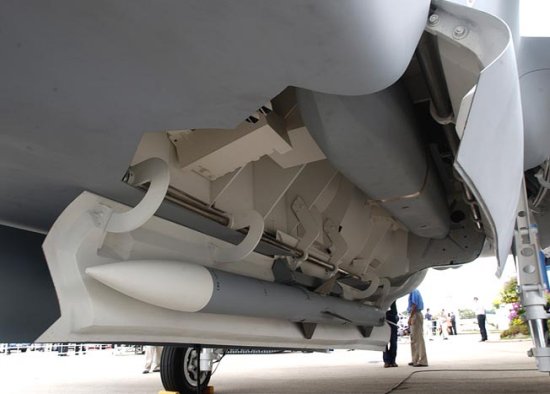
These invece are an AMRAAM and a SDB launcher in an F22 weapon bay: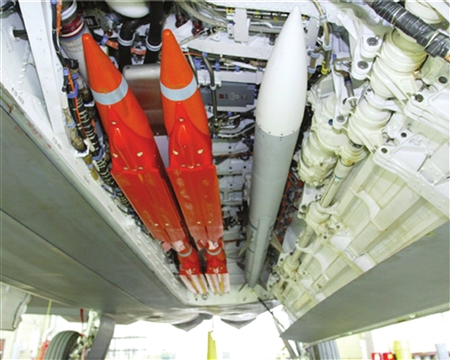
A BRU-61A launcher with 4 SDBs weights: 320 pounds (145 kg) empty, 1,460 pounds (664 kg) fully loaded.
Its dimensions (L x W x H) are 143″ x 16″ x 16″ (3.6 m x 40.6 cm x 40.6 cm).
The BRU-61A is to be integrated on the F35 for the US, and it is fully cleared for internal carriage.
The Model 100B launcher will most likely have very similar sizes, and the missile, prior to launch, will thus be around 1.8 meters long x 200 mm wide.
If you consider that the Storm Shadow at 1230 kg is 0,48 meters wide, a 100 Kg weapon could perfectly well be 0,20 meters wide or even less.
I don’t see any real reason to doubt of the 4-per-bay figure.
In fact, the F35C weapons bay can easily take on a 2000 lbs JDAM which is 3.89 meters long and with a wingspan of 630 mm, so there’s space available.
Liger304 in each bay, 8 is the total, not 8 plus 8.
And not necessarily. The square section of the Model 100B and the folding wings should make it easy to have a single launcher-rail (Brimstone like, or the BRU pylon of the US Small Diameter Bombs, even more similar) holding 4 weapons in two parallel rows of 2.
Each weapon bay would thus contain an ASRAAM/AMRAAM/METEOR on the AA pylon and a launcher platform with 4 Model 100B on the AG pylon.
No indications of sizes for now, but at 100 kg each, these missiles promise to be pretty small and the Magazine actually reports 4 in each of the F35B bays.
F35C has got longer ones, so it should be even easier.


 Sign In







