 Liger30
One can dream, i guess…
You know well that few would be happier than me if the sorts of the RN were to magically improve.
It’s just that i’m… a bit more cynical and pessimist, perhaps.
I just hope the SDSR does not make me say i was just “realistic”, later on.
Liger30A PARA battalion can be moved with 20 Chinook flights. 20!
Imagine moving any significant amount of soldiers at the rythm of 12 for each chopper involved.
It would be better service to have some more Merlins, of the HC3+ type, that can be used pretty much everywhere and carry quite a lot of people and/or stuff.
Sure, ideally your Bravo-Two-Zero SAS squad of 8 men shouldn’t go into Iraq with a 50+ seats Chinook, but while the Chinook can move both small and big teams, the small helicopter can’t do with big loads.
With a limited budget, you have to have assets as flexible as possible.
A chopper capable to move a lot of stuff is by any mean flexible and useful.
A small troop taxi is more for Special Forces than anything else…
And pretty often, the SAS deploy in numbers as well: there were 50 operatives in Barras, and they were Chinook inserted.
If anything, i’d keep an eye on the Future Heavy Load Helicopter that US, France and Germany are pursuing in a way or another.
Otherwise, the MIL26 will forever have no rivals.:D
Seriously, a bunch of very heavy lift choppers like the Mil26 would come a lot handy in many situations.
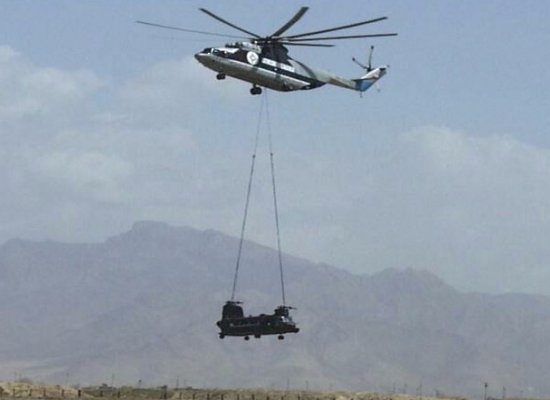
I believe this scene is from Afghanistan: NATO leased Mil26 choppers for very heavy duty job in the area.
This, if i recall correctly, was a damaged crashed US Chinook being recovered.
The RAF had to destroy two of its own Chinooks after crash landings in Afghanistan not to let the talibans get to them.
I hope they were so damaged to justify their destruction, because the RAF is not exactly in the position to happily waste Chinooks.
Mi-26 carries a considerable payload up to 44,000 lb (20,000 kg). The Mi-26 has proven much more powerful and efficient than its predecessors thanks in part to its eight-bladed main rotor. The rotor is 106 ft (32 m) in diameter. Over 200 examples of the Mi-26 were built and the type remains in use throughout Russia. Several have also been sold to civilian firms and foreign nations.
A civilian firm has been contracted to supply MIl 26 services to NATO in Afghanistan. Irony of life, i guess, since these machines were the enemy once… and now NATO has to so often lease MIl 8 Hip, Mil 26 and Antonov 124 to cover its needs…
Liger30I totally know the RN lacks frigate. Actually, the RN lacks submarines as well, because 10 were the call for them and MAYBE they’ll be 7.
The RN urgently lacks oil tankers.
A replacement for Endurance is also missing.
And plans for the future RFA vessels needed to ensure the fleet can work abroad are a total mess and desolation.
I call the frigate “legendary” because everyone talks of them, everyone wants them, the navy needs them, but no one truly believes they do exist. Again, hulls already available and with life left in them, like the Type 22 B3, are the most likely immediate candidate for the chop (rightfully so, in a cynic analysis. But does it make sense then to scrap them early and then build new ships that, cheap as they may be, inexorably will cost a lot more than keep the Type 22 to the end of their lives?)
And moreover, the money for them does not really exist, until there’ a change in policy and someone says, “Ok. It can’t be sorted out without losing this capability, that one and this one. For a few years, we are going to assign defence a billion more in the budget to cover the crisis.”
Which won’t happen, because until a war does not start, people can’t see the importance of defence not even if you bash their head hard against the side of a Challenger II. In this regard, the Guardian is the greatest example of myopia in this sense, with people always advocating to end defence spending to spend it all on hospitals and schools, and bragging about how the weapon systems are expensive! 5 billions! Oh, jesus! Like the MOD paid five billions all in one go for the carriers, 16 for FRES, and so along! No one that notices ON HOW MANY FRIGGING YEARS THE ACTUAL EXPENSE IS SPREAD and how most of the MOD budget actually goes in (in order of magnitude): Paying the personnel, running CASD, and running the kit in service.
Also, we are talking of frigates while suggesting the build of low low-cost hulls that are effectively OPVs, nearly disarmed, at the very best maybe “fitted for but not with”, which could be useful just out of Somalia but won’t have the range to get there with their own legs unless oil tankers the navy DOES NOT HAVE brings them there with RASs, while being good only as “radar targets” to send ahead of the carrier and valid ships (like it was done in the Falklands to protect Hermes and Invincible) in any scenario of actual conflict.
I think we should all get real, starting from the guys at the NSC who are going to make the decisions for real. I can’t see years passing between QE and PoW in any case: who the hell would fund the retention of the skilled workforce that will have direct experience of the built of QE, while a much reduced workforce starts assembling a new kind of frigate instead…?
BAe, BVT, Babcock… they are not charities. They pay their workers because their work generates money.
Also, if the MOD is struggling with an overspend that covers the next 10 years in the best case, how can it be feasible to build QE, then build frigates while also retaining workforce and external manufacture for PoW’s future building which would eventually follow in N years time…?
Week in and week out, there would be people advocating to scrap plans for the second carrier, for all the frigging time, and the whole mess would end up being a waste of money until thousands of workers are inexorably put off all the same and PoW dies.
I just can’t see it working.
Liger30It was different back then. The shipyard received orders to slow down the work to drag the construction phase one or two years longer. Saved perhaps 400 millions in the short term, but costing over 600 in the long term…
Now, for what i can understand, the idea was to have the shipyard build QE, then build some kind of legendary “frigate” everyone suddenly seems to want and later get back to carrier construction to build PoW.
Weird suggestion to say the least.
Liger30A bit different but also somewhat risky as Chancellors start looking at these things and and start asking if they really need it or if they can be deferred back a bit aka France with CdG and again with PA2.
That’s what scares me as well. But it is also hard to image shipyards completing a carrier, then changing radically to build frigates, then back to the carrier.
I have to say it looks unrealistic to say the least. To ensure economies of scale in efficiency, the hulls of a same class should always be built in sequence, so that the successive ships cost less than the first of class.
That is what regularly happens with shipbuilding.
As to keeping expertise for the Vanguard replacement, there’s the 7th Astute yet to order, arguably far more needed than a 5th Vanguard.
Better to get funding in time for the 7th SSN than for anything else.
Liger30Hopefully, no. 69 + 3 is my hope, so that the 3 help covering the needs of the OEU or something, since we need as many as possible of the airframes acquired to provide active frontline service.
Either way, the main target is a full airgroup (3×12) to embark when needed, plus OCU and spares of course.
Base will still be Lossiemouth as expected, i’m guessing. I don’t see a reason to change that…
The curiosity is to see how they will be given to FAA and RAF. Ideally, i’d like a couple of Squadrons being Navy, so that we are SURE they actually go at sea, not like Harriers Gr9 always fugitive from Lusty’s deck…
But one frontline squadron of F35 has ABSOLUTELY to be the 617°. I can’t think of a RAF without dambusters!
If we were so lucky to get 3 squadrons, they could be 800 and 801 NAS plus the 617° and an OCU, RAF owned as well.
Ideally, the best would have been 4 squadrons, to distribute half and half, but there will never be enough planes to do so…
Decisions are expected some time along this week, apparently.
The SDSR is expected to report on 18 October, 2 days before the Spending review, to give a mild illusion of a Strategic Review not dominated utterly by the Treasury’s bullying…
Pathetic attempt, but i don’t care so long as the armed forces are spared the disasters that were reported for them.
As to being able to postpone PoW and build frigates earlier, i have to express my greatest doubts for such a scenario. I don’t think it is really feasible, sincerely.
Liger30Actually, it is what many of us, and me in first place, have been advocating and hoping for from when it become utterly clear that the original plan wasn’t feasible at all.
To build both carriers, but have a single complete airgroup that can move from carrier to carrier while one of the two hulls is unavailable. With the second carrier eventually available as a mega-LPH for Commandos as well.
It is not optimal an arrangement, but it is by far the best one we can hope for, actually, and it would make me very happy, in particular because the cut envisaged by this article for the F35 is a cut of “just” half.
If around 70 F35 survive the review, enough to at least fill up ONE carrier at a time, we can consider it a formidable victory for how horrible things had started going.
It will all depend from how many F35 survive the review. It is vital to get at least enough to be able to put at sea a complete airgroup, which means having no less than 3 active squadrons of 12 planes each, and ideally four.
That will be the vital point Fox has to reach.
Liger30We can only hope it’s true, i guess.
And wait to see what “favourable budget” will actually mean in solid facts, and not easy words.
Things look at least a little less horrendous than a few days ago, and this is something, i guess. The leaked letter, either intentionally or not, must have helped a lot in this sense.
Along with US insistence to see the UK armed forces staying relevant. We can be pretty sure that the pressure we saw in terms on the press coming from Washington is nothing compared to the exchanges we don’t know about.
Whatever helps saving the Armed Forces, gets my blessing and gratitude anyway.
Liger30Yeah, it’s what i’m shouting by months getting “Drama!” comebacks all the time myself.
But you know, i’m resigning myself. If the F35B bought are only 40, there won’t be more than 12 of them operative, so even QE alone would be deprimently empty and incapable to be filled up even with a surge in case of war.
If an agreement can be found that saves QE and allows enough saving (even just long-term ones) that the NSC is moved to pity and avoids the absurd and foolish move of scrapping the Amphibs, i guess there’s all but to be “happy” with how things are going…
Meanwhile, latest news have hinted that Devonport is probably safe as a base. I always thought that the political cost of shutting the base was simply unaffordable, regardless of any other consideration.
Hope it means the amphibs are safe as well!
To brag about “retaining power projection” and losing the amphibs was ridiculous.
I will still come to Rosyth to shout aloud “Rule, Britannia, Britannia rules the waves!” when the QE will hit the water… But i’ll have to make an effort and forget that there won’t be planes for her to be really happy at least for that day…
70 F35 is the bare minimum to make sense. 40 is ridiculous.
Liger3012 additional Chinooks definitely can’t hurt. As to handing them from RAF to army, i guess it could (and under many points of view should) be done, but it is easier for the RAF to find and prepare pilots than it is for the army.
It is not an insurmountable problem, but it does exist, along with the obvious desire of the RAF to retain at least the Chinooks.
As to retain a single fleet and buy additional, navalized Merlin utility, that was ALWAYS my favorite option, and i already exposed it many times.
The long term advantages of a single fleet (covering SAR role as well) would balance the higher acquisition cost.
The SAS still has a number of smaller helos, included the captured A109 ex-Argentina, if i remember correctly, and in wider ops i’m sure it would be all too happy to be shipped by a Merlin.
The superior features of the Merlin HC3, included the 3 engines making it so survivable and the capability to mount plenty of guns, would make it fantastic for pure SF work as well, were the M60 and GPMGs changed with Miniguns.
I only disagree on the Lynx Wildcat. I think it will give sterling service, and definitely it is not useless. The army has done for years and years with the mk7 and mk9. The Wildcat and the mk9A will have a lot of work to cover.
As to the AW149 being able to carry weapons, i must notice that it is higly unlikely that that factor would ever matter at all.
Weaponry has to be INTEGRATED and integration costs. The Wildcat itself would be a far more suitable weapon platform, but how many weapons will be cleared for use is a mystery.
The thales LMM, probably, since it will be put on Navy Wildcats as “FASGM (Light)” will be cleared hopefully on the army version as well.
But Brimstone, Hellfires, even 70 mm rockets…? Unlikely to be funded unless a real need for additional attack helos comes out.
(remember that the Apache should have been 125…)
On the other hand, there was this interesting news of interest in the Army to make the Watchkeeper drones capable, at some point at least, to carry a number of LMMs for immediate intervention.
It would be a plus for a Watchkeeper to be able to kill the damn insurgent putting down an IED on the street, instead of “watching” it and waiting for a strike platform of some kind to come and intervene.
It is the same reasoning that gave us the Reaper from the initial Predator.
As to the MOD escaping most of the cuts, we’ll see.
A strike force dropping to 12 active airframes and a single, mostly-empty carrier is a damn horrible cut, actually.
I will sorta accept it if the navy gets the Amphibs and the RAF retains the Nimrods at least.
But sincerely, i hope the F35 that get bought are more towards the 70 than 40. 40 is truly a ridiculous number… It wouldn’t even give the UK the capability to fill up the single carrier it has got, and this would mean being in serious trouble when a real need for the carrier pops up.
Other than being a ridiculous sight XD. 12 planes… 6 on deck and the rest in the hangar, maybe.
The QE will look like a desert, with all that empty space.
Also, a replacement for Ocean becomes a desperate need if the second flat top is lost.
To get more F35, i’d accept a reduction from 16-planes-for-squadron of the Typhoon force to 12, even. But 40 is too damn few.
As to the latest reports talking of “doomed” CVFs incapable against missiles, that’s why we have Type 45. That’s why the Navy wants CIWSs on its ships (rarely gets them, but this is another story…) and that’s why the CVF needs a proper AEW system and F35 fitted with Meteor missiles.
Once you’ve got that, you can face a formidable enemy force containing the risks.
Of course, if you’ve got no CVF with embarked air group, there’s no way in hell you can send the fleet at reach of a capable air-and-missile force. It would get destroyed inexorably, even with the Type 45 around.
Sad but true. Air Defence destroyers have their limits… and even with the Sampson so high up compared to Aegis radars on US ships, the radar horizon is still a problem.
Nothing beats AEW plane flying above and directing the Meteors fired by the fighters on overwatch to take down an attacking force.
Liger30The Government of Sweden has requested a possible sale of 15 UH-60M BLACKHAWK Helicopters, 34 T700-GE-701D General Electric Engines (30 installed and 4 spares), 15 AN/AAR-57(V)3 Common Missile Warning Systems, AN/APR-39 Radar Signal Detecting Sets, AN/AVR-2B Laser Warning Sets, Aviation Mission Planning Station, transportable operations simulator, communications equipment, spare and repair parts, tools and support equipment, publications and technical documentation, personnel training and training equipment, U.S. Government and contractor engineering, logistics, and technical support services, and other related elements of logistics support. The estimated cost is $546M.
Unitary cost: 23 USD millions a piece.
And i remember the press using a “8 million Blackhawk” argument against the Future Lynx.
What kind of LIES the press can get away with!
NH90 may cost as much as 28 millions each, judging from what Italy plans to spend to buy 112 of them. However, 42 of those are going to be NNH version, and 12 are naval-transport (a NNH without radar and such but retaining foldable rotors and the like), both considerably more expensive than a standard transport version, pretty surely, so this has most likely pushed up the complessive price and a rough calculation of a-piece cost is tricking. Figures as low as 16 millions euro have also appeared, so it is hard to say what’s true.
Finding a reliable figure for the cost of this kind of platforms is never easy.
Press reports indicated that in November 2004 the FRC forum (as it was then called) had in a draft report recommended a mix of Chinook heavy lift helicopters and 50 NH90
Must be the order who made Gordon Brown famous as he cancelled it!
Agusta Westland hoped to sell this modified HC3 (dubbed HC3+, it is this way that the HC3 will look once they are (hopefully) navalized):

Smartest thing ever it would have been, to buy them navalized so that, just like the Apaches, they could operate without worries in every scenario, on every platform and circumstance.
The hope for a 2 billions, 70 medium-lift helos was once again destroyed in 2005 however, and by 2006 the labour-pet PFI idea had already surfaced:
On 8 August 2006 it was formally revealed that MoD was considering a turnkey lease of civil-owned, military-registered helicopters to replace its fleet of RN Sea Kings and RAF Pumas. The UK Defence Procurement Agency announced that it was seeking expressions of interest from industry for the potential provision, under operating lease terms, of a number of Civil Owned Military Registered (COMR) medium-sized helicopters for UK Forces together with associated training and support services. The proposed contract period is envisaged to be 10 years with an expected operational In-Service Date (ISD) of 2010/11. The solution should be capable of worldwide deployment for extended periods of operation. The contractor will be expected routinely to provide for approximately 23 concurrent helicopter tasks, available at any time of day and consuming up to 13,500 flying hours per annum. The DPA is also interested in exploring the possibility of extending this to include elements of our Littoral Manoeuvre capability which, if pursued, would seek to provide for an additional 18 concurrent helicopter tasks consuming up to an additional 16,000 flying hours per annum from 2011/12. Tenders must be submitted by April 2007, and the estimated value of the contract is in excess of £400 million. However the DPA said that it also plans to explore, in parallel, options to extend the in-service life of existing Puma and Sea King helicopters which, if adopted, will mitigate (and potentially remove) the need for the COMR services.
Then there is the AW149, of course, which wouldn’t be bad at all even if somehow “second league” with how most of NATO (notably France, Germany, Italy, Spain, Norwey, Portugal, Greece, Australia and many others) has been adopting the NH90.
The AW149 will be a smaller but cheaper alternative to the Merlin HC.3+, Sikorsky S-92, and even the NH90 – able to carry 12-15 soldiers or 3 tonnes of cargo. First flight is scheduled for 2009 and certification in 2011.
Then again, both Germany and Australia are not reportedly so happy with the NH90 TTH, and an order for AW149 would be certainly better than nothing.
The “weird” option is the coalition government going for a PFI with Agusta Westland providing regular service of a number of AW149 (ideally around 20).
Most likely option within the SDSR, is that the survival of the order for 12 Chinook will already be almost a miracle. If the MASC Merlins are finally funded and the Merlins HC3 navalization envisaged, it will be something worth shamelessly turning on candles in the churches to thank the Saints and Our Lady for their benevolence.
The rest is most likely daydreaming.
P.S
It just surfaced in my mind that the AW149 could be more than suitable for the SAR role. Maybe a super PFI sorta connecting SAR coverage + a bunch of battle taxi for the army would be feasible at some point…?
The SAR issue will have to be tackled at some point, and it may have more visibility and thus attention than the need of mobility of the soldiers. (sad but true) But if a “Utility Helo” provision could somehow be attached to it…
It may be a worth option to consider.
Also, it would allow for a degree of platform commonality. If we have to had another class of helos, be it ONE, not TWO. Spend money for training, support and spares only ONCE.
Liger30A realistic unitary cost for a medium lift helo (be it NH90 or Blackhawk) currently stands around 20-some million USD each, considering training and such.
228 millions for Puma upgrade would allow a buy of roughly 10 NH90 or Blackhawks. Not much…
Liger30As to the Carrier matter, i think it is no dead set. There’s a strong wish to somehow get rid of PoW, possibly to avoid having to cut the amphibs and so much frigates, but how/if this can be done is very murky to me. I still have massive doubts on the feasibility/utility of such plan.
As to industry, i guess they’ll have to accept building pretty much ANYTHING, because if they get to build NOTHING, they are dead as an industry.
As i said, anyway, there’s massive problems in this kind of approach. I see great risk and ridiculously tiny chances of a real success.
The only hope is that the long-term saving of losing PoW is enough to satisfy the NSC and save the amphibs, while funding some kind of different shipbuilding work for the industry, possibly finding an agreement to reduce penalty payments so the government can realize some sort of saving in the immediate as well. The carrier cut is, in fact, a long-term saving largelly generated by cutting running costs and planes, to bite into this legendary figure of the “38 billions overspend in ten years” (i’d totally LOVE to know what the hell makes this up, because pretty much it means the MOD has NO funding AT ALL for equipment FOR THE NEXT FRIGGING 10 YEARS: how can that be????) but won’t save a penny in the short term, unless industry is very very nice and sorta finds a way to content herself with alternative work while also getting less money that contracted for.
You see by yourself what kind of risky, murky mess it is, even without facing the fact of how strategically illiterate it is militarily speaking.
As to the F35 problem, it is very likely. But worse still, if the F35 bought are just 40, because then there would be only ONE squadron operative, with 12 planes, and that would be the end of it.
As to the RAF losing interest in paying for them, i guess it is true only in part: they must be pissed like hell (but then again, the Navy is crying, to say the very least…), but since they know all too well that they would not get anything else (FOAS dead, replacement for Tornado dead, Typhoon only partially alive) they will still take the little they can get, i’d bet, and hope to eventually keep Nimrod alive.
Also because they couldn’t do differently, could them…? They are being given no choice at all.
Isn’t it a disaster? I noticed there’s no “drama” accusations anymore against my warnings. Is it starting to get clear to everyone, i wonder, what the SDSR truly is…?
Liger30The OCU won’t retain a 24 planes consistence after the Active Squadron goes on-line, however, because that would mean NO storage airframes for attrition coverage.
What will happen…? OCU halved and 12 of its planes forming the storage reserve…?
40 is a ridiculous number. It just won’t work.:confused:
Liger30OCU’s size will be determined (i’m hoping) by the number of pilots and such that you need to form for the active squadrons.
24 machines in OCU to support 12 operative is wasteful to say the very very least.
Also, the first 3 F35B, the pre-production ones, won’t come before 2012.
Highly unlikely that any production aircraft will be ordered by the UK any earlier than 2012 or more likely 2013 or even past that.
Original plan 1 for the 150 F35 fleet were:
16 Machines for training
4 x Active Squadrons of 12 planes and 18 pilots each.
84 Attrition airplanes
Operative airframes would rotate to storage and storage ones be used, to ensure a fair and equal aging of the airframes and allow for an as long operational life as possible.
(still looks so bloody high to keep 84 airframes in storage, but this appears to have been the plan, i always thought that 6 squadrons were the target, even with 138 airframes. 14 Training (this was the latest OCU figure in documents at least) +4 OEU +72 Operative +48 storage airframes is what i would have expected. 48 operative planes and over 80 spares looks absurd to me, unless the RAF feared losing F35s quite damn frequently because they are single-engine [and this actually makes them a little less reliable indeed, but not like this! XD])
In 2007 a US GAO timeline showed the UK buying:
3 test planes in 2010 (ordered)
8 in 2011
3 in 2012
2 in 2013
9 in 2014
9 in 2015
12 in 2016
12 in 2017
12 in 2018
and so along. (thank you Richard Beedall! http://navy-matters.beedall.com/jca1-2.htm) An “unaffordable” expense of 1.2 billions a year in the 2016 year, in the worst case of paying every single plane 100 millions pounds. Hardly what i call unaffordable since at those dates it would the ONLY main equipment programme for the RAF.
How the revised timeline will be, is not yet known, obviously.


 Sign In







